Palliative care is specialized medical care for people living with a serious illness, directed at controlling symptoms rather than curing the disease. Compounding enters palliative care at a narrow point: when a medication the team wants to give does not exist in a form the patient can still take, or in a concentration that fits the way it has to be given. The hospice or palliative team directs therapy and writes the prescription, and the pharmacy prepares what that prescription specifies.
This page describes what palliative care involves, and the kinds of compounded preparations a palliative or hospice prescriber may order. It is written for patients and for the families and clinicians caring for them.
What is palliative care, and is it the same as hospice?
Palliative care and hospice care overlap but are not the same thing. Palliative care can begin at diagnosis and run alongside treatment intended to cure or slow the disease, including chemotherapy, radiation or surgery. Hospice is a narrower category: care for people whose illness is no longer being treated for cure.
A palliative team usually includes physicians, nurses, social workers and chaplains, and often a pharmacist. Care is delivered in hospitals, in nursing homes, in outpatient clinics and, most often in hospice, at home. The plan of care is built around what the patient and family say matters to them.

Where does compounding fit in palliative care?
Most medications used in palliative care are commercially manufactured, and where an approved product fits the prescription, that approved product is what should be dispensed. It is normally cheaper and it has been reviewed by the FDA. Compounding is for the gaps, and in this setting the gaps are practical ones. Prescribers can see what is prepared in this area on the pain and palliative care section of the catalog.
Four situations account for most palliative compounding requests:
- The patient can no longer swallow, and the drug is manufactured only as a tablet or capsule.
- The dose has risen to a point where a commercial concentration would mean an impractical volume, so a concentrated preparation delivers the same dose in a small amount.
- Several medications are given at the same times, and one combined preparation reduces the number of separate administrations for a caregiver to manage.
- The strength or the dose form the prescriber wants is not commercially available at all.
None of that is a claim about outcomes. A compounded preparation is not FDA-approved and is not reviewed by the FDA for safety or effectiveness. Whether any of the preparations described in hospice and palliative care compounding is appropriate for a particular person, and at what dose, is a decision for the prescriber who knows that person's history. Nothing here is a dose recommendation.
What happens when a patient can no longer swallow?
Losing the oral route is one of the most common reasons a palliative team calls a compounding pharmacy. When swallowing becomes unreliable, the same drug often has to be given by a different route, and that route may require a preparation nobody manufactures.
| Route | Used when | Example preparations | Status |
|---|---|---|---|
| Oral concentrate | Swallowing still possible | Small-volume liquid concentrates | Compounded, not FDA-approved |
| Sublingual | Swallowing unreliable | Drops, troches, rapid-dissolve tablets | Compounded, off-label |
| Rectal | Nausea, vomiting, unresponsive | Suppositories | Compounded, off-label |
| Topical or transdermal | Oral route lost | Gels and creams | Compounded, off-label |
| Subcutaneous infusion | Continuous dosing needed | Preservative-free cassettes | Compounded, not FDA-approved |
Giving a drug approved for oral use by the rectal or sublingual route is off-label, and the evidence behind each of these routes varies a great deal from drug to drug. Rectal administration is long established in palliative practice for some medications and poorly studied for others; the same post on compounded rectal suppositories covers how those preparations are put together.
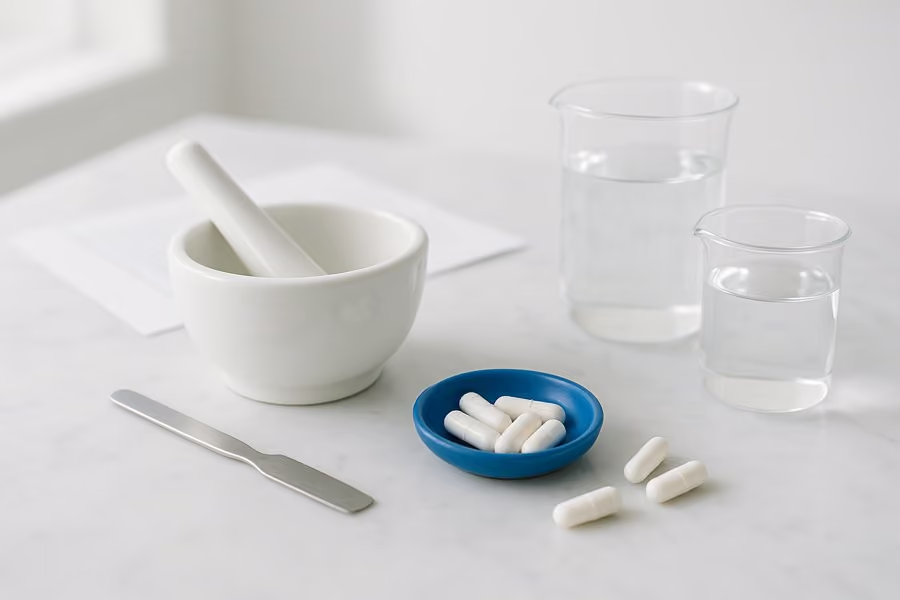
Where swallowing is still possible but tablets are not, a medication can often be prepared as a liquid instead. Custom oral suspensions are compounded for people who cannot take a solid dose form, including patients receiving medication through a feeding tube.
Why are concentrated, preservative-free preparations used?
When a patient needs medication continuously rather than at intervals, a palliative team may order a continuous subcutaneous or intravenous infusion, delivered from a cassette or a small pump. Doses in this setting can be high, particularly for someone who has been taking opioids for a long time, so the concentration matters: a concentrated preparation such as a preservative-free hydromorphone infusion puts the prescribed dose into a volume a subcutaneous site can accept.

Preparations meant to be infused are made without preservatives, because preservatives are not intended for the volumes and durations used in continuous infusion. Preservative-free work of this kind is compounded in our USP 797 sterile lab, against a prescription written for a named patient.
What symptoms besides pain are managed?
Pain is the symptom people expect palliative care to address, but it is not the only one, and several of the compounded preparations prescribers order are directed at other problems entirely. Nausea, excess respiratory secretions, agitation, mouth pain and muscle spasm all come up.
Excess secretions and nausea are two reasons a prescriber may order compounded scopolamine as a transdermal gel, an oral form or a nasal spray, which can be an option when the commercial patch is not usable.
Painful mouth sores and mucositis are the usual reason for magic mouthwash, a rinse mixed to the prescriber's own formula rather than to a standard recipe.
Not every compounded preparation in this area has evidence behind it, and it is worth being direct about that. Diazepam and baclofen suppositories are compounded on request, but randomized trials of that combination found no benefit over placebo, and the catalog page says so.

What should families know about opioids in palliative care?
Morphine and hydromorphone are Schedule II controlled substances. Diazepam and lorazepam are Schedule IV, and ketamine is Schedule III. All of them carry recognized risks, including sedation, constipation, respiratory depression and, for the benzodiazepines and ketamine, a potential for misuse and dependence. They are prescribed and monitored by the palliative or hospice team, and dose changes are that team's decision.
Controlled substances are dispensed only on a prescription written for a named patient, and controlled substances are not shipped to New York addresses. A hospice agency ordering a Schedule II preparation follows the same prescribing and record-keeping requirements as any other prescriber.
Families sometimes ask whether there is a way to manage pain without opioids, or with less of them. That question belongs to the prescriber, but the preparations that come up in those conversations are described in our post on compounded alternatives to opioids.
Ketamine is sometimes used off-label in palliative care for pain that has not responded to opioids. The published evidence in this setting is limited, and the FDA has issued a safety alert about compounded ketamine products; the routes and dose forms are covered in our post on ketamine nasal spray.
What does Bayview compound for hospice and palliative teams?
Bayview prepares concentrated preservative-free infusions for continuous subcutaneous or intravenous use, oral concentrates, sublingual drops and troches, suppositories, and topical gels, all to the order of the prescribing team. Preparations in the hospice and palliative care category start at $110, and preservative-free hydromorphone infusions start at $175, with the final price depending on the drug, the concentration and the quantity the prescription calls for.

Bayview is a 503A pharmacy, so every preparation is made against a prescription for a named patient rather than held as stock for an agency to draw from. What we work on for a palliative or hospice team is summarized on our hospice services page.
The full range of preparations we keep formulas for, in palliative care and every other area, is listed in the searchable catalog of compounded medications.
Compounded preparations are not billed through insurance, because a patient-specific preparation has no national drug code for a plan to adjudicate against, so payment is made directly to the pharmacy. Questions about cost, about ordering, and about the states where Bayview is licensed are answered on our frequently asked questions page.
Talk to your prescriber
If you or someone you are caring for is having trouble taking a medication, or a symptom is not under control, the first conversation is with the palliative or hospice team. They can tell you whether a different route or a different dose form is worth considering, and they are the ones who decide what to prescribe.
If they conclude that a compounded preparation is the right approach, they can send the prescription to us and we will prepare it as written.
Frequently asked questions
What does Bayview prepare for hospice patients?
The catalog covers concentrated preservative-free opioid infusions for continuous subcutaneous or IV administration, midazolam, ketamine, dexmedetomidine, and haloperidol infusions, oral and buccal concentrates, ABH-type syringes, and sublingual atropine. Bayview is a 503A pharmacy, so every item is compounded for an identified individual patient on a valid prescription.
We do not supply office-use stock, agency stock, or fillable hospice kits. An agency that needs non-patient-specific stock generally requires a 503B outsourcing facility.
Why are concentrated preservative-free preparations needed?
Subcutaneous tissue absorbs only roughly 3 mL per hour, so a patient whose ordered hourly dose is high cannot receive it subcutaneously at commercially available dilute concentrations. Concentrated preparations exist to keep the ordered dose within that volume. Preservative-free matters because benzyl alcohol irritates continuous subcutaneous infusion sites.
Turnaround depends on the preparation, the components on hand, and the sterile compounding required, so call the pharmacy with the specific order. Beyond-use dates are assigned per the applicable USP <797> category and the testing performed, and are printed on the label.
How does a hospice send a Schedule II order?
Under 21 CFR 1306.11 a Schedule II prescription must be written and signed, and EPCS electronic prescribing is accepted where your system supports it. E-prescribe to Bayview Pharmacy, 3844 Post Rd, Warwick, RI 02886, NCPDP 4106882, or fax 401-284-4506.
A facsimile serves as the original written prescription with no follow-up hard copy required in three situations: a Schedule II narcotic compounded for direct parenteral administration by IV, IM, subcutaneous, or intraspinal infusion; a resident of a long-term care facility; and a patient enrolled in a hospice program certified or paid for by Medicare or licensed by the state. Note hospice status on the prescription.
Are these compounded preparations FDA-approved?
No. Compounded preparations are not FDA-approved, and FDA does not verify the safety, effectiveness, or quality of compounded drugs before they are marketed. They are prepared under USP <797> sterile compounding standards and dispensed only on a valid prescription for an identified individual patient.
Where an FDA-approved commercial product exists, Section 503A restricts compounding a copy of it absent a documented shortage or a documented patient-specific need, such as a dye-free, alcohol-free, or different concentration. Note that need on the prescription.
Does lorazepam topical gel work?
We make no absorption or efficacy claim for it. A published pharmacokinetic study found lorazepam and haloperidol undetectable in plasma after topical application of an ABH-type gel, so the evidence does not support systemic delivery by that route.
Bayview prepares the gel when a prescriber specifically requests it, on a patient-specific prescription. Prescribers weighing it should be aware of that finding when considering it against an oral, buccal, or sublingual route.
Is dexmedetomidine established in palliative care?
No. Its use in palliative care is emerging and investigational. Reports in the literature describe subcutaneous and intravenous infusion for refractory agitation and as an opioid-sparing adjunct, but the evidence base is limited and it is not an established standard of care.
Bradycardia and hypotension are the dose-limiting effects reported. Bayview compounds it on a patient-specific prescription; whether it is appropriate for a given patient is the prescriber's judgment.
Why is hydromorphone compounded concentrated and preservative-free?
Subcutaneous tissue absorbs only roughly 3 mL per hour. A patient whose ordered hourly dose is high cannot receive that dose subcutaneously at commercially available dilute concentrations, which is why 20 mg/mL and 30 mg/mL preservative-free preparations exist.
Preservative-free matters separately: benzyl alcohol and similar preservatives irritate continuous subcutaneous infusion sites and accumulate at higher infusion volumes. The prescriber selects the concentration; the pharmacy prepares what is ordered.
What are the principal safety concerns?
Respiratory depression is the principal risk, and it concentrates in three situations: dose escalation that is not proportional to the symptom being treated, opioid-naive patients, and co-administration of a benzodiazepine with an opioid.
Equianalgesic conversion is the most common source of serious opioid error. Published conversion ratios are approximations, and the literature advises a 25 to 50 percent reduction from the calculated dose when rotating opioids to account for incomplete cross-tolerance. Nothing here is a dose recommendation; titration and monitoring remain the prescriber's responsibility.
How is the subcutaneous infusion site managed?
Continuous subcutaneous infusion is generally described in the literature using a 25 to 27 gauge butterfly or a small subcutaneous catheter placed in the abdomen, upper arm, anterior thigh, or upper back. Edematous, irradiated, infected, or broken tissue is avoided.
Sites are rotated when redness, induration, swelling, pain, or leakage appears; a site that stays quiet is often reported to remain usable for about a week. Site assessment and rotation follow the hospice's own policy and nursing judgment.
Is diazepam a controlled substance?
Yes. Diazepam is a Schedule IV controlled substance and the benzodiazepine boxed warnings apply. Taken with opioids it can cause profound sedation, life-threatening respiratory depression, coma, and death. Abuse, misuse, and addiction are risks, and continued use can cause physical dependence, so stopping abruptly can cause withdrawal including seizures. Do not stop on your own, ask your prescriber about tapering.
Do these suppositories work?
Benefit is not established. In the best-designed study, nightly 10 mg vaginal diazepam over four weeks produced no difference in resting pelvic floor EMG at any time point and no difference on any validated questionnaire compared with placebo, and a second double-blind, placebo-controlled trial also failed to show benefit.
Pelvic floor physical therapy is the intervention with actual evidence for hypertonic pelvic floor dysfunction. If you are considering these, ask your prescriber how they fit alongside physical therapy rather than in place of it.
What is in magic mouthwash?
The version most people mean combines three ingredients in equal parts (1:1:1): diphenhydramine, an antacid such as aluminum and magnesium hydroxide, and viscous lidocaine.
But magic mouthwash is a nickname, not a defined medicine. There is no standard recipe and no FDA-approved product, and formulas vary between hospitals, clinics, and individual prescribers. Some add a steroid, an antifungal, or an antibiotic. What is in your bottle is whatever your prescriber ordered, so read your label.
What do prescribers order it for?
Most often for motion sickness and for nausea, the uses the patch is approved for, when the patch does not fit. Some prescribers also order it, off-label, for persistent nausea in gastroparesis or during chemotherapy, for vertigo, and for the drooling that comes with Parkinson's disease and similar conditions, because scopolamine dries saliva. The evidence for those uses comes from the manufactured products and from practice, not from trials of compounded gel or capsules.
Why not just use the patch?
The patch delivers about 1 mg over three days and comes in one strength. A prescriber may want a smaller dose, a dose that can be adjusted, a single dose for one trip or procedure, or scopolamine for a patient whose skin reacts to the adhesive. The compounded gel gives the same route without adhesive, and the capsules, troche, suspension, and spray give routes the patch does not offer. Which one fits you is your prescriber's call.
Why is my medication being made as a liquid?
Because the dose has to get in. A liquid is compounded when swallowing a tablet is not possible or not safe, for a young child, for an adult with dysphagia, for someone fed through a tube, or for a pet. It is also made when the strength your prescriber wants does not exist as a tablet, or when a dye, sugar, or alcohol has to be left out.
This is about access and administration. A liquid is not stronger or more effective than the same medication in a pill.
What Bayview compounds for this
Important: Compounded medications are prepared to a prescriber's order for an individual patient. They are not FDA-approved, and the FDA has not evaluated them for safety, effectiveness, or manufacturing quality. This article is educational and is not a substitute for advice from your prescriber or pharmacist.
This preparation contains a controlled substance. Controlled-substance prescriptions carry refill limits, must be e-prescribed, and can only be shipped to states where Bayview holds the required licensure.
Uses discussed here may be off-label, meaning they are not part of any FDA-approved labeling. Off-label use is a decision for you and your prescriber, based on the available evidence.
Veterinary preparations are compounded to a veterinarian's order for a specific animal and are not FDA-approved animal drugs. Never give a compounded human medication to an animal without veterinary direction.
Compounded prescriptions are paid for directly rather than billed through insurance. Most are HSA/FSA-eligible, and many patients submit the receipt to their plan for possible reimbursement. Pricing depends on the strength, dose form and quantity your prescriber orders. Read more about cost and insurance.
Preparations in the hospice and palliative care category start at $110, and preservative-free hydromorphone infusions start at $175, with the final price set by the drug, the concentration and the quantity the prescription calls for. Compounded preparations are not billed through insurance, because a patient-specific preparation has no national drug code for a plan to adjudicate against, so payment is made directly to the pharmacy.
Bayview Pharmacy is an NABP-accredited compounding pharmacy in Warwick, Rhode Island, licensed to fill and ship compounded prescriptions for patients in Rhode Island, Massachusetts, Connecticut, New Jersey, New Hampshire, Florida, New York, Maine and Pennsylvania. Controlled substances are not shipped to New York addresses. See where we ship and how to get started.
Related reading