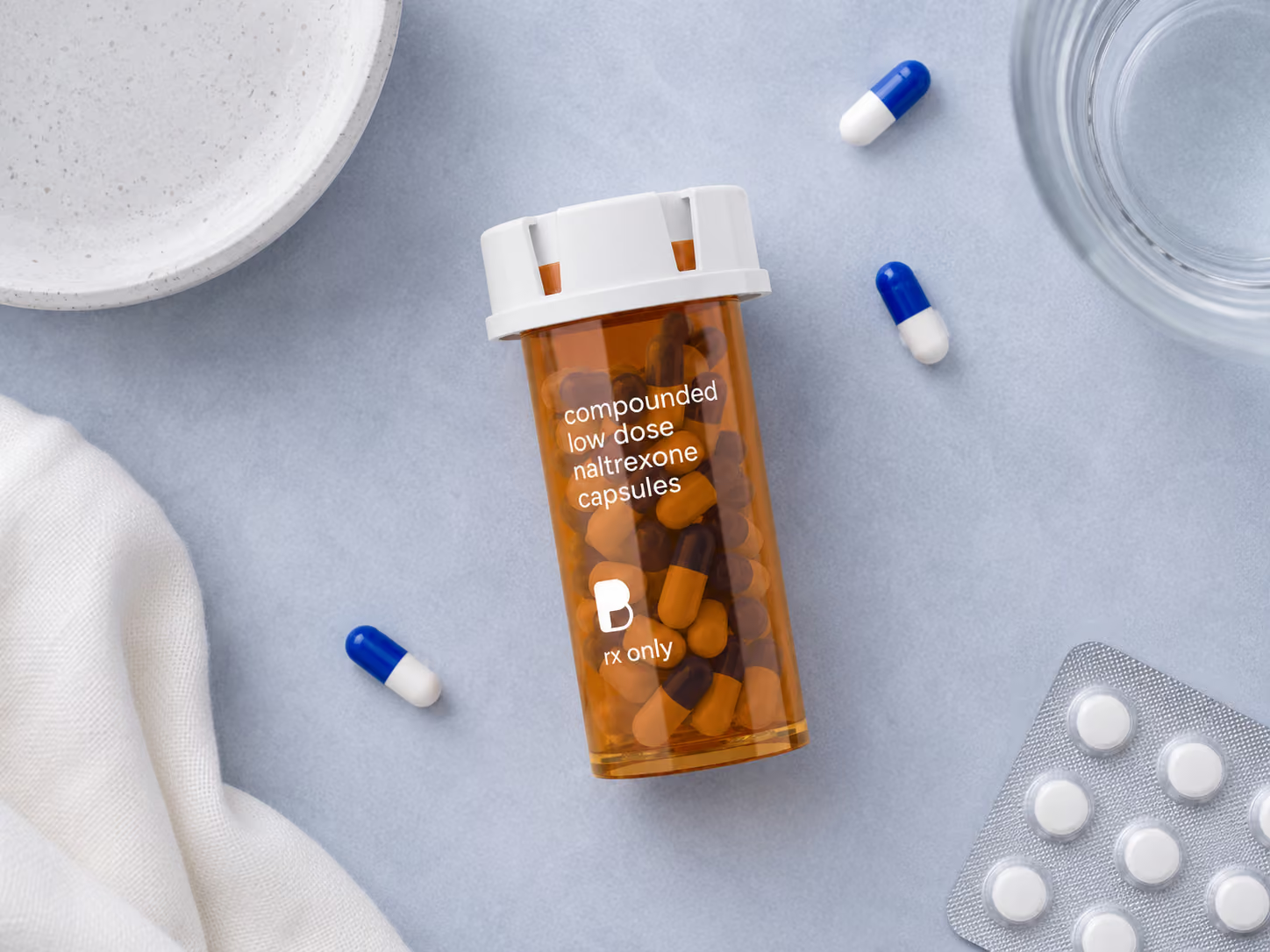
Compounded minoxidil is minoxidil prepared by a pharmacy at a strength, in a vehicle, or in a combination that no manufacturer sells. Topical minoxidil 2% and 5% are already sold over the counter as FDA-approved products, so compounding is generally reserved for the situations outside that range: a higher strength, a vehicle without propylene glycol, or a combination your prescriber wants in one bottle. Anything a pharmacy compounds is not FDA-approved, and both the dose and whether the preparation suits you are your prescriber's decisions.

Why compound minoxidil when 2% and 5% are sold over the counter?
Topical minoxidil is one of the few hair loss options with an FDA approval behind it. The 2% and 5% topical products are approved over the counter for androgenetic alopecia, which is the pattern thinning most men and many women experience. If a standard 5% product suits you and your scalp tolerates it, there is no compounding question to answer.
Compounding enters the picture at the edges of that approval. A prescriber may want a strength above 5%, a base that leaves out an ingredient your scalp reacted to, or minoxidil combined with a second agent so that one application replaces two. Those are the reasons behind the compounded minoxidil and finasteride formulas a pharmacy prepares on a prescription.

It is worth being precise about what changes and what does not. A custom strength or vehicle is not an upgrade over a manufactured product. It is a way for your prescriber to match the preparation to your scalp, your tolerance, and the regimen you will actually keep up with. That distinction is part of how a compounding pharmacy differs from a retail pharmacy.
How do the common hair loss preparations compare?
The column that matters most here is regulatory status. Off-label prescribing is legal and routine, but it means the FDA has not reviewed that drug for that use, and a compounded preparation has not been reviewed at all.
| Preparation | Route | Status | Evidence |
|---|---|---|---|
| Minoxidil 2%, 5% | Scalp | FDA-approved OTC | RCT |
| Minoxidil above 5% | Scalp | Compounded, not FDA-approved | Limited data |
| Low-dose oral minoxidil | Oral | Off-label | Case series |
| Finasteride 1 mg | Oral | FDA-approved (men) | RCT |
| Topical finasteride | Scalp | Not FDA-approved | Small trials |
| Spironolactone | Oral, topical | Off-label | Case series |
| Dutasteride | Oral | Off-label | Small trials |
Oral minoxidil is approved only as a blood pressure medicine. Its use at low dose for hair loss is off-label, and because the drug is systemic it carries cardiovascular and fluid retention considerations that a scalp application does not. Unwanted hair growth on the face and body is also a reported effect of the oral route.

Is topical finasteride FDA-approved?
No. In the United States, finasteride is approved as an oral tablet: 1 mg for androgenetic alopecia in men, and 5 mg for benign prostatic hyperplasia. There is no FDA-approved topical finasteride product here, so every topical finasteride preparation is compounded and has not been evaluated by the FDA.
Applying finasteride to the scalp does not confine it to the scalp. Finasteride is absorbed through the skin into the bloodstream, and published studies of topical dosing report measurable serum drug levels and a fall in serum dihydrotestosterone. Reported systemic exposure has been lower than with oral tablets in those studies, but it is not absent, so the systemic considerations that apply to oral finasteride apply here too.
That includes pregnancy, and this is the part to read twice. Finasteride blocks the conversion of testosterone to dihydrotestosterone, which a male fetus requires for normal development of the external genitalia. Finasteride is contraindicated in pregnancy and in women who are or may become pregnant. It should not be used by anyone who is pregnant, and it should not be started by anyone planning a pregnancy without discussing it with their prescriber.
The handling precautions extend to everyone in the household, not just the person being treated. Finasteride can transfer from a treated scalp, from hands, and from the container itself.
- A person who is pregnant or may become pregnant should not handle the bottle, applicator, or a treated scalp.
- Wash your hands after every application, and let the scalp dry fully before contact with a partner, a child, or bedding.
- Store the preparation out of reach of children, in the container it was dispensed in.
- Crushed or broken finasteride tablets should not be handled by anyone who is pregnant or may become pregnant.
Two other agents that turn up in hair loss regimens carry related cautions. Spironolactone and dutasteride are both antiandrogens used off-label for hair loss, and both raise the same category of concern in pregnancy. Compounded topical spironolactone is prescribed in dermatology for other indications as well, and the pregnancy question should be raised with your prescriber whichever antiandrogen is being considered.
Why does hair shed more in the first weeks of treatment?
An increase in shedding early in minoxidil treatment is a described and expected pattern rather than a sign that something has gone wrong. Minoxidil shifts follicles out of the resting phase and into the growing phase, and the resting hairs that were sitting in those follicles are released as the new ones come through. The shedding typically appears in the first weeks and then settles.
Knowing that in advance matters, because this is the point at which many people stop. Give any hair loss preparation several months before you and your prescriber judge it, and report shedding that keeps increasing, or that comes with scalp pain or visible inflammation, rather than waiting it out.
What happens if you stop?
Neither minoxidil nor finasteride resets the underlying process. They suppress it for as long as they are used. Hair that was maintained or regrown is generally lost over the following months once treatment stops, and the scalp tends to return to roughly where it would have been without treatment.
That makes this a long-term commitment rather than a course of treatment, and it is worth deciding on that basis before the first bottle. Cost over years, not cost per bottle, is the number to think about, and our FAQ covers pricing, shipping, and how ordering works.
Why does the scalp get itchy, red, or flaky?
Standard topical minoxidil solution contains propylene glycol as a solvent, and propylene glycol is a well documented cause of irritant and allergic contact dermatitis on the scalp. Itching, redness, scaling, and burning after application are frequently traced back to the vehicle rather than to the minoxidil itself. Foam formulations were developed in part to leave it out.

This is one of the clearest reasons a prescriber sends a minoxidil prescription to a compounding pharmacy. The strength stays the same and the vehicle changes, which is something no manufactured product lets you do.
Not every irritated scalp is the vehicle, though. Seborrheic dermatitis, psoriasis, and fungal scalp involvement all produce flaking and redness that can be mistaken for a reaction, and they call for different prescriptions. Compounded ciclopirox for the scalp is one route a dermatologist may take instead.
Inflammatory scalp conditions are another branch of the same question, and compounded tacrolimus scalp preparations are prescribed there as a steroid-sparing option. Which of these applies to you is a question for the person examining your scalp.
What Bayview compounds for this

On a prescriber's order, Bayview prepares the minoxidil and finasteride preparations in our USP 795 non-sterile compounding lab: topical scalp solutions and shampoos at strengths above the over-the-counter range, topical finasteride, oral and sublingual dose forms, and combination capsules pairing minoxidil with an antiandrogen such as spironolactone. Pricing starts at $140.
The broader set of compounded hair loss formulas covers the same actives arranged for different levels of thinning, and for men and women separately.
A scalp regimen often sits alongside other dermatology prescriptions. Compounded tretinoin gel is one of them, made at the retinoid strength a dermatologist orders.
The full dermatology and skin category lists what else is prepared here for the skin, scalp, and nails.
Everything Bayview compounds, across every therapy area, is listed in the searchable catalog of compounded medications.
How prescriptions in this area are handled is set out on our dermatology compounding services page.
Compounding is used across dermatology for the same reason it is used here, which our overview of dermatology compounding covers in more depth.
The tradeoffs are similar wherever a manufactured product stops short, including the compounded options for nail fungus.
Talk to your prescriber
Bring the specifics to the appointment. Tell your prescriber how long the thinning has been going on, what you have already tried at over-the-counter strength, whether your scalp reacted to it, and what other medications you take.
Raise pregnancy directly if you are pregnant, may become pregnant, or share a household with someone who is, because that single answer changes which agents belong in the conversation. Ask what the plan looks like at six months and at two years, and ask what stopping would mean. Bayview prepares what your prescriber writes, and your prescriber decides what is appropriate for you.
Frequently asked questions
What is minoxidil, and why is it in every formula?
Minoxidil is the shared base. It helps prolong the hair's active growth phase and support blood flow to the scalp, which can slow loss and support regrowth for some people. Other actives are added based on patient and severity.
How do I choose between a solution, foam, gel, or capsule?
It comes down to preference and your provider's judgment. Solutions, foams, and gels go on the scalp, and capsules are taken by mouth. Your provider sets the form and dose.
Does this work for both men and women?
Yes. Pattern hair loss affects both, but the formulas differ: men's versions often include finasteride or dutasteride, while women's lean on combinations like minoxidil with spironolactone. A provider selects the formula that is appropriate and safe for you, which matters because some ingredients must be avoided in pregnancy.
Why can't women use the men's formulas?
Men's formulas contain finasteride or dutasteride, which women who are or may become pregnant should not use or even handle, because they can harm a developing baby. Women have their own formulas.
How long until I see results?
Hair grows in slow cycles, so give any treatment three to six months of consistent use before judging it. Some shedding in the first weeks can actually be a sign follicles are cycling into a new growth phase. Monthly photos taken in the same light are the most reliable way to track progress. Results vary from person to person.
What happens if I stop using it?
Benefits last only while you continue treatment. If you stop, hair that regrew is usually lost again over the following months as follicles return to their previous pattern. If cost, side effects, or the routine is the issue, talk to your provider; a different strength, form, or combination often solves it without giving up progress.
Are there side effects?
Topical minoxidil can cause scalp dryness, itching, or irritation, and some people notice temporary shedding when starting. Report anything that concerns you to your provider, and see the safety information for details.
Can I use this during pregnancy or breastfeeding?
Several ingredients are not appropriate during pregnancy or breastfeeding. Tell your provider if you are pregnant, could become pregnant, or are nursing so they can advise you.
Will I need any lab tests or monitoring?
Some ingredients call for monitoring. Spironolactone can affect potassium, so your provider may check labs periodically, and oral minoxidil may prompt blood pressure checks. Topical-only formulas typically need less monitoring. Follow the plan your provider sets, and keep them updated on any new medications you start.
Are compounded medications FDA-approved?
Compounded medications are not FDA-approved. They're prepared by a licensed pharmacy pursuant to a valid prescription for an individual patient, under USP standards. The FDA does not review compounded medications for safety or effectiveness.
Do I need a prescription?
Yes. All of our medications require a valid prescription from a licensed provider. We're a dispensing and compounding pharmacy, so we don't provide consultations or write prescriptions. If you don't have one yet, you'll need to find and see a provider first.
Can I use a compounded medication while pregnant or breastfeeding?
That decision belongs to you and your prescriber, and it has to be made for your specific medication and situation rather than from a general rule.
Some compounded preparations are used routinely during pregnancy and lactation. Others contain ingredients that are avoided. And a few carry handling precautions that matter even when you are not the person taking the medication — certain hormone creams, for instance, can transfer through skin contact.
Tell your prescriber and our pharmacists if you are pregnant, trying to become pregnant, or breastfeeding before you start a new compounded medication. Our pharmacists are glad to review your formulation and talk it through with your prescriber. Call us at 401-284-4505.
How much do compounded medications cost?
Pricing varies depending on ingredients and formulation complexity.
Do you accept insurance?
Most compounded medications are not covered by insurance. We can always try and run your insurance prior to compounding your prescription if you wish.
What Bayview compounds for this
Important: Compounded medications are prepared to a prescriber's order for an individual patient. They are not FDA-approved, and the FDA has not evaluated them for safety, effectiveness, or manufacturing quality. This article is educational and is not a substitute for advice from your prescriber or pharmacist.
This preparation contains a controlled substance. Controlled-substance prescriptions carry refill limits, must be e-prescribed, and can only be shipped to states where Bayview holds the required licensure.
Uses discussed here may be off-label, meaning they are not part of any FDA-approved labeling. Off-label use is a decision for you and your prescriber, based on the available evidence.
Veterinary preparations are compounded to a veterinarian's order for a specific animal and are not FDA-approved animal drugs. Never give a compounded human medication to an animal without veterinary direction.
Compounded prescriptions are paid for directly rather than billed through insurance. Most are HSA/FSA-eligible, and many patients submit the receipt to their plan for possible reimbursement. Pricing depends on the strength, dose form and quantity your prescriber orders. Read more about cost and insurance.
Compounded hair loss preparations start at $140 at Bayview and are paid directly by the patient rather than billed through a pharmacy benefit. Compounded preparations are commonly excluded from insurance formularies, and off-label use is a second common reason a claim is denied. Ask for the cash price before you assume a copay.
Bayview Pharmacy is an NABP-accredited compounding pharmacy in Warwick, Rhode Island, licensed to fill and ship compounded prescriptions for patients in Rhode Island, Massachusetts, Connecticut, New Jersey, New Hampshire, Florida, New York and Maine. Controlled substances are not shipped to New York addresses. See where we ship and how to get started.
Related reading