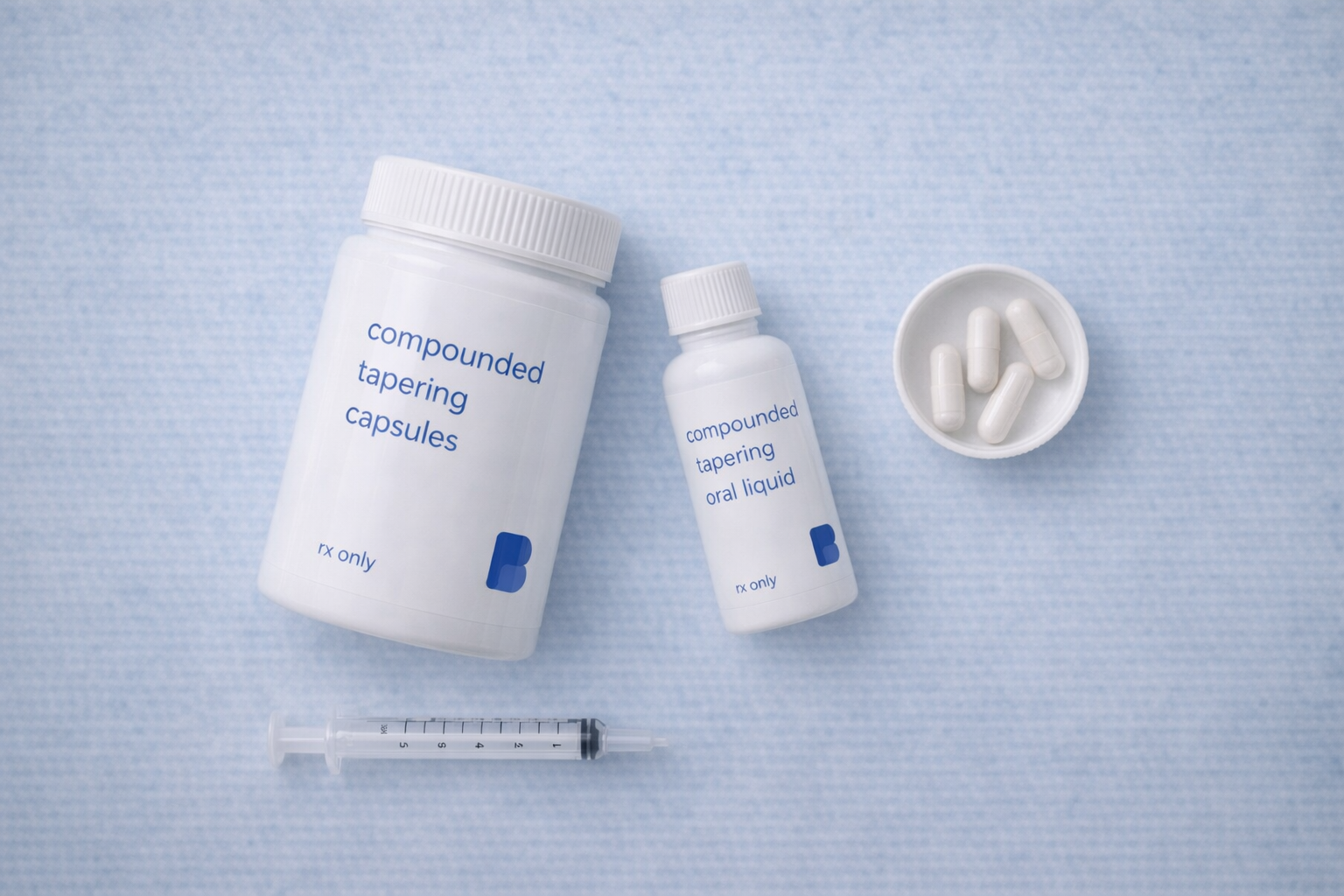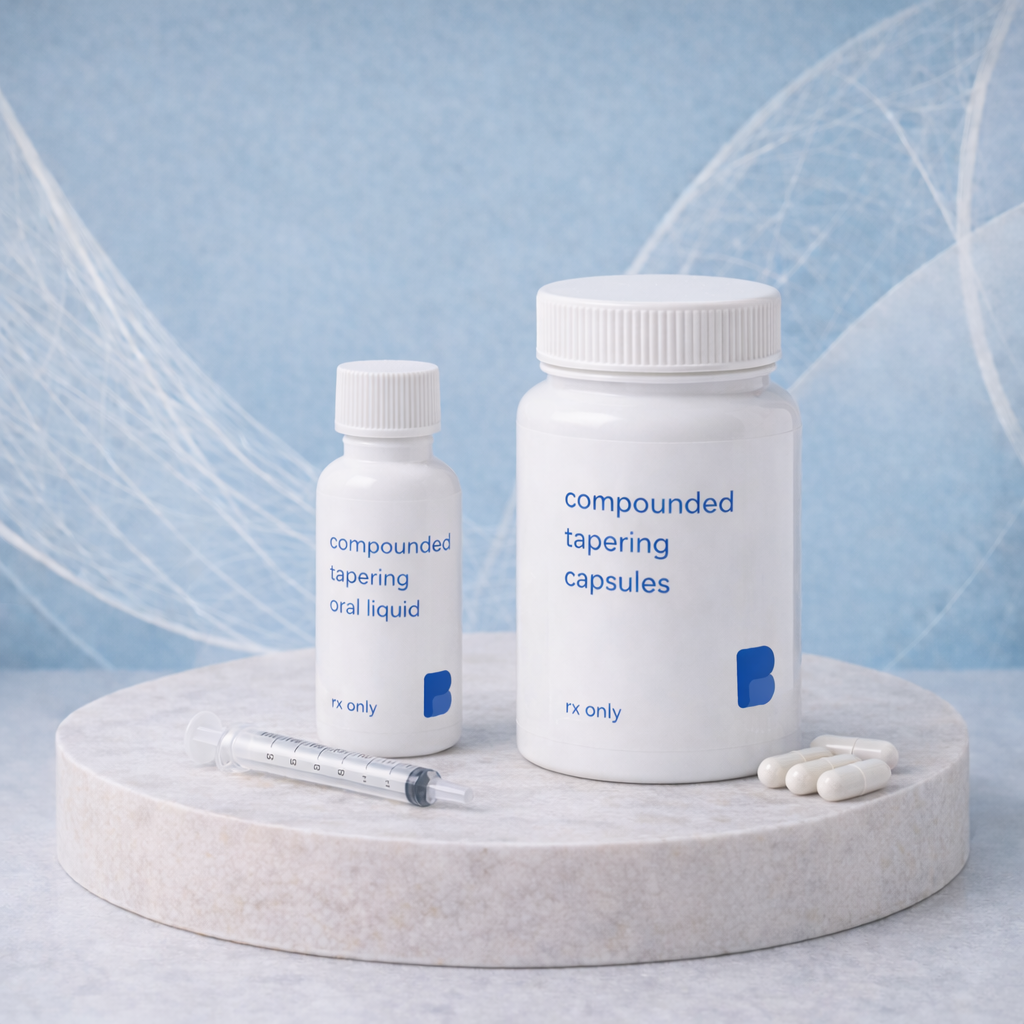






Tapering means lowering the dose of a medication in planned steps over weeks or months instead of stopping it all at once. Prescribers often taper antidepressants, benzodiazepines, and sleep medicines because stopping them suddenly, or lowering the dose too fast, can cause withdrawal symptoms. Manufactured tablets and capsules come in only a few fixed strengths, so the small steps a taper calls for are not always available. Bayview Pharmacy compounds capsules in in-between strengths and measured oral liquids, so each step can be filled as your prescriber writes it. Your prescriber decides whether and how to taper, and a valid prescription is required.
Why taper instead of stopping?
For benzodiazepines, FDA warns that stopping abruptly or reducing the dose too quickly can cause withdrawal reactions, including seizures, which can be life-threatening. FDA tells prescribers to use a gradual taper and notes that no single tapering schedule suits every patient (FDA). Antidepressant labels describe discontinuation symptoms after abrupt stopping or dose reduction and recommend a gradual reduction rather than abrupt stopping whenever possible (venlafaxine label; duloxetine label).
The UK's National Institute for Health and Care Excellence (NICE) advises not stopping these medicines abruptly except in exceptional medical circumstances, and its quality standard for depression says people stopping an antidepressant should have the dose reduced in stages (NICE NG215; NICE QS8).
How is a taper planned?
Your prescriber sets the schedule with you. Published guidance describes some common features:
- Steps sized to the current dose. NICE suggests a slow, stepwise rate of reduction proportionate to the existing dose, with the steps getting smaller as the dose gets lower, for antidepressants, benzodiazepines, Z-drugs such as zolpidem, and opioids (NICE NG215).
- Time between steps. A 2025 US guideline on benzodiazepine tapering suggests starting with dose reductions of 5% to 10% every 2 to 4 weeks, usually no more than 25% every 2 weeks, and notes that a taper may take months to years, especially after taking higher doses for a long time (ASAM).
- Room to adjust. NICE notes that the schedule can be changed so that withdrawal symptoms settle before the next reduction, and suggests giving people their dose in a form that lets them reduce it in small amounts (NICE NG215).
These are general descriptions, not a schedule for you. Every taper is different.
Why are compounded strengths used for tapers?
Small, gradual steps often fall between the strengths that manufacturers make. For example, the smallest venlafaxine tablet is 25 mg (venlafaxine label), and duloxetine's standard delayed-release capsules come in 20 to 60 mg and must be swallowed whole, not opened (duloxetine label), so a dose below 20 mg cannot be measured from them. The clonazepam label describes stopping in steps of 0.125 mg twice daily every 3 days for panic disorder (clonazepam label).
Bayview compounds two kinds of preparations for this:
| Custom-strength capsules | Measured oral liquids | |
|---|---|---|
| How the dose changes | A new strength of capsule for each step, for example 0.4 mg, then 0.3 mg, then 0.2 mg | The same liquid, measured in a smaller volume with an oral syringe at each step |
| Examples Bayview prepares | Clonazepam 0.1 to 0.9 mg; duloxetine 2 to 10 mg acid-resistant capsules; venlafaxine 18.75 mg; mirtazapine 2.5 mg | Clonazepam 0.05 to 1 mg/mL; mirtazapine 1 or 2 mg/mL; duloxetine 5 or 20 mg/mL; zolpidem 5 mg/mL |
| How each step is supplied | Usually one small fill per step, such as 14 capsules for a two-week step | One bottle can cover several steps, within its beyond-use date |
This comparison is for education only and is not a statement that either form is better or more effective. Your prescriber chooses the form, strengths, and schedule.
Does Bayview make tapering strips?
No. Tapering strips are a 28-day roll of daily pouches, developed in the Netherlands, in which each pouch holds the same or a slightly lower dose than the day before (UMC Utrecht). Bayview does not make tapering strips. Instead, it compounds custom-strength capsules or a measured liquid, and your prescriber can write each step of the taper as its own prescription.
When is a compounded liquid allowed?
Federal rules limit compounding a copy of a drug that is commercially available, unless the prescriber documents a change that makes a real difference for the patient (FDA guidance). A capsule strength that is not manufactured is generally not considered a copy. Some antidepressants, such as escitalopram, fluoxetine, and trazodone, are also sold as oral liquids, so Bayview compounds those liquids only when your prescriber documents what needs to change and why, for example an ingredient or flavoring you cannot take.
What to expect during a taper
Take each step exactly as prescribed and keep track of which strength or volume you are on. Withdrawal symptoms can appear when a dose is lowered. For antidepressants they can include dizziness, nausea, trouble sleeping, anxiety, agitation, flu-like feelings, and shock-like sensations (venlafaxine label). Tell your prescriber about any symptoms. The venlafaxine label says that if symptoms are hard to tolerate, returning to the previous dose may be considered, then lowering the dose more gradually (venlafaxine label). Do not speed up a taper, skip steps, or stop on your own.
Side effects & safety
A compounded capsule or liquid has the same active ingredient, and the same possible side effects, as the manufactured medicine. Benzodiazepines can cause drowsiness, and taking them with opioids, alcohol, or illicit drugs raises the risk of overdose, severe breathing problems, and death (FDA). Antidepressants carry a boxed warning about suicidal thoughts and behavior in children, adolescents, and young adults, and the labels advise watching closely for worsening mood or unusual behavior at times of dose changes, including decreases (venlafaxine label).
Who should not use these preparations?
Do not use a compounded preparation if you are allergic to its active ingredient or to an ingredient in your prescription. Tell your prescriber about every medication and supplement you take, any alcohol or opioid use, and whether you are pregnant or breastfeeding, before and during a taper. Do not drive or use machinery if a medication makes you drowsy.
How do I get started?
Talk with the prescriber who manages your medication. A licensed prescriber decides whether a taper is appropriate and chooses the medication form, the strengths, and the schedule. Bayview Pharmacy does not provide consultations or determine appropriateness. Already have a prescription at another pharmacy? You can transfer it to Bayview. Once you have a prescription, your prescriber can order through Bayview, and a pharmacist is available if you have questions. Bayview compounds tapering doses as part of our compounded medications catalog, alongside custom oral suspensions and gabapentin.
Clinical details for prescribers
Regulatory. FDA's 2020 class-wide benzodiazepine boxed warning covers abuse, misuse, addiction, physical dependence, and withdrawal reactions; FDA advises a gradual taper to discontinue or reduce the dose, notes that no standard schedule suits all patients, and advises particular caution with opioids (FDA DSC). Clonazepam, lorazepam, temazepam, and zolpidem are Schedule IV. Antidepressant labeling recommends gradual dose reduction rather than abrupt cessation; for venlafaxine, if intolerable symptoms follow a decrease, resuming the previous dose may be considered, then decreasing at a more gradual rate (venlafaxine labeling). Duloxetine delayed-release capsules (20, 30, 40, 60 mg) must be swallowed whole and not opened; a duloxetine sprinkle capsule (20 to 60 mg) may be opened onto applesauce, and no duloxetine product is made below 20 mg (duloxetine labeling). Under section 503A, a strength with no commercial equivalent is generally not an essential copy; for a commercially available product of the same strength and route (for example escitalopram, fluoxetine, or trazodone oral solution), note the patient-specific change and the significant difference it produces (FDA 503A guidance).
Guidance on tapering:
- NICE NG215 (2022): do not stop abruptly unless there are exceptional medical circumstances (1.5.6); for opioids, benzodiazepines, Z-drugs, and antidepressants, a slow, stepwise reduction proportionate to the existing dose, with decrements becoming smaller as the dose is lowered (1.5.11); agree review intervals, allow withdrawal symptoms to improve before the next reduction, and consider issuing the dose in a form that allows small decrements (1.5.10); gabapentinoids by a fixed amount per decrement (1.5.12) (NICE NG215).
- Joint Clinical Practice Guideline on Benzodiazepine Tapering (ASAM-led, FDA-funded; Brunner et al., J Gen Intern Med 2025;40:2814-2859): ongoing risk-benefit assessment; do not discontinue abruptly in patients likely to be physically dependent; tailor the taper and adjust to response; offer adjunctive psychosocial interventions; initial dose reductions of 5% to 10% every 2 to 4 weeks, typically not exceeding 25% every 2 weeks; tapering may take months to years, especially after extended use of higher doses (ASAM; guideline).
- Clonazepam labeling (panic disorder): discontinue gradually, decreasing by 0.125 mg twice daily every 3 days until withdrawn (clonazepam labeling).
What Bayview compounds (2026 fills):
- Clonazepam capsules (microcrystalline cellulose filler) 0.1 to 0.9 mg, most often filled as 14-capsule steps; clonazepam oral suspension 0.05, 0.1, 0.5, and 1 mg/mL. Lorazepam 0.5 mg/mL oral suspension and custom-strength capsules; temazepam 3.75 mg capsules; zolpidem 5 mg/mL oral suspension and custom-strength capsules (all Schedule IV, EPCS).
- Duloxetine acid-resistant capsules 2 to 10 mg (2, 3.5, 4, 4.5, 5, 10 mg filled) and 5 or 20 mg/mL suspension; venlafaxine 18.75 mg capsules and 18.75 mg/mL suspension; mirtazapine 2.5 mg capsules and 1 or 2 mg/mL suspension; sertraline 1.25 or 2 mg/mL suspension; fluvoxamine 10 mg/mL suspension; bupropion 50 mg capsules and 30, 60, or 75 mg/mL suspension.
- Trazodone 25 mg capsules; quetiapine 12.5 mg capsules and 10 mg/mL suspension. Escitalopram 1 mg/mL, fluoxetine 4 mg/mL, and trazodone 10 mg/mL suspensions with a documented change. Gabapentin capsules and liquids are on the gabapentin page.
- Writing a taper: one prescription per capsule strength with the step length (for example clonazepam 0.4 mg capsules, 14, then 0.3 mg, 14), or one liquid with the mL schedule written out. Each liquid is labeled with its beyond-use date.
Licensed to dispense in RI, MA, CT, NJ, NH, FL, ME, and PA. Ordering and account setup are covered on our for providers page.
This information is about prescription medications and is not medical advice. Compounded medications are prescription-only and are not FDA-approved. Your prescriber determines whether a taper is appropriate and sets the medication, strengths, and schedule.
References
- FDA Drug Safety Communication: boxed warning updated for the benzodiazepine class (2020)
- ASAM: Joint Clinical Practice Guideline on Benzodiazepine Tapering (2025)
- Brunner et al. 2025: joint clinical practice guideline on benzodiazepine tapering (J Gen Intern Med)
- NICE NG215: medicines associated with dependence or withdrawal symptoms (2022)
- NICE quality standard QS8, statement 4: stopping antidepressants (2023)
- Venlafaxine tablets, prescribing information
- Duloxetine delayed-release capsules, prescribing information
- Clonazepam tablets, prescribing information
- FDA guidance: compounded drugs that are essentially copies (503A)
- UMC Utrecht: tapering strips for antidepressants (2021)