
In Stock
Mupirocin Nasal Ointment & Spray | Compounded Rx | Bayview

Mupirocin Nasal Ointment, Spray & Sinus Rinse

Smiling man in blue pharmacist scrubs with arms crossed and pen behind his ear.
Medically reviewed by Ryan Dyer, RPh
Last updated on
October 16, 2026
Starting at
$91.55
for
10 mL nasal spray
Checkmark icon followed by text 'HSA/FSA Eligible'.
Start with a prescriptionPrescribers: how to e-prescribe this →
Licensed to fill prescriptions for patients in RI, MA, CT, NJ, NH, FL, ME & PA
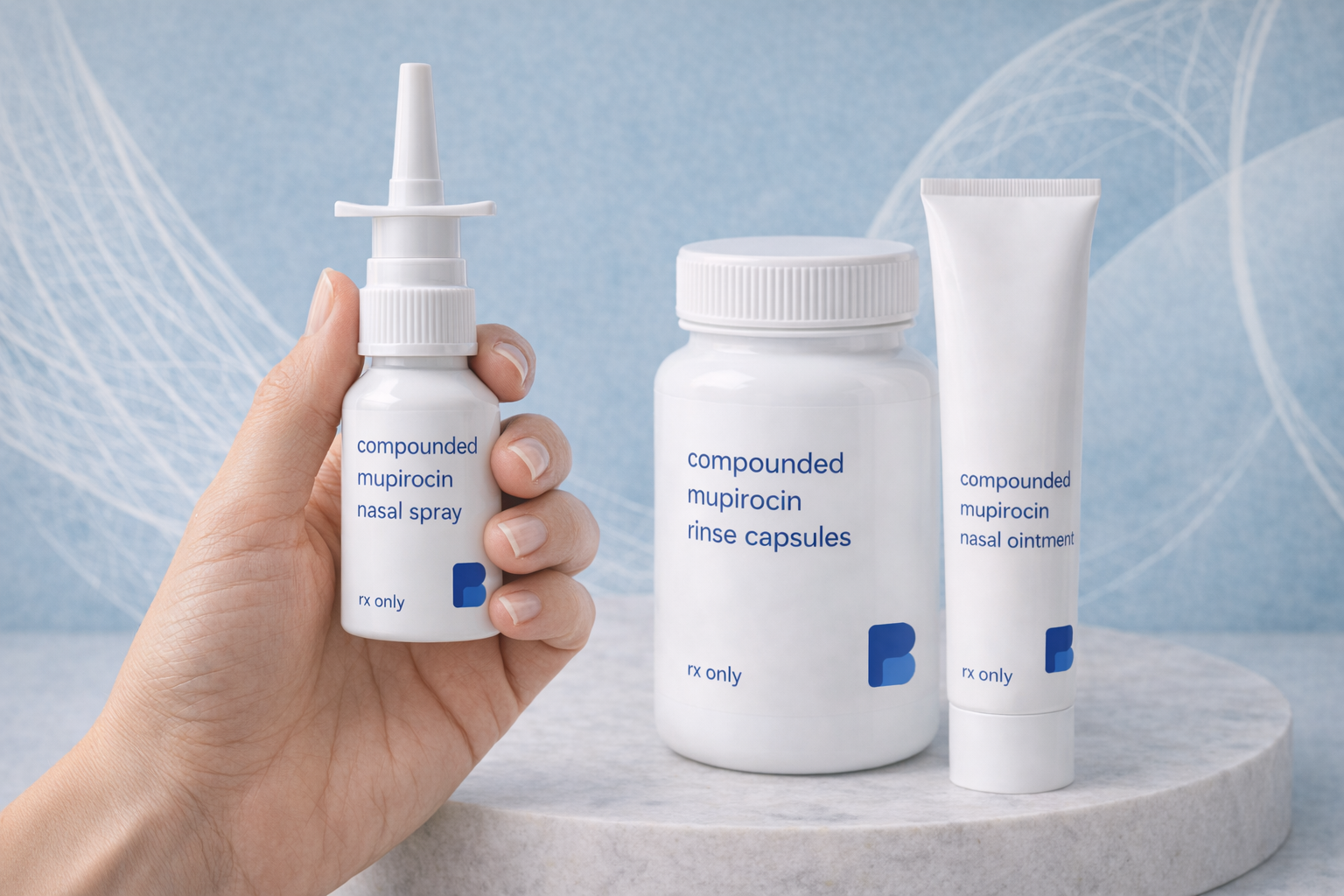
  • Made for the nose. Nasal ointment, nasal spray, or sinus rinse capsules.
  • A nasal ointment, compounded. The FDA-approved nasal version is discontinued.
  • Named in WHO surgical guidance. For known staph carriers before some surgeries.
  • Prescription only. Compounded to your provider's order.

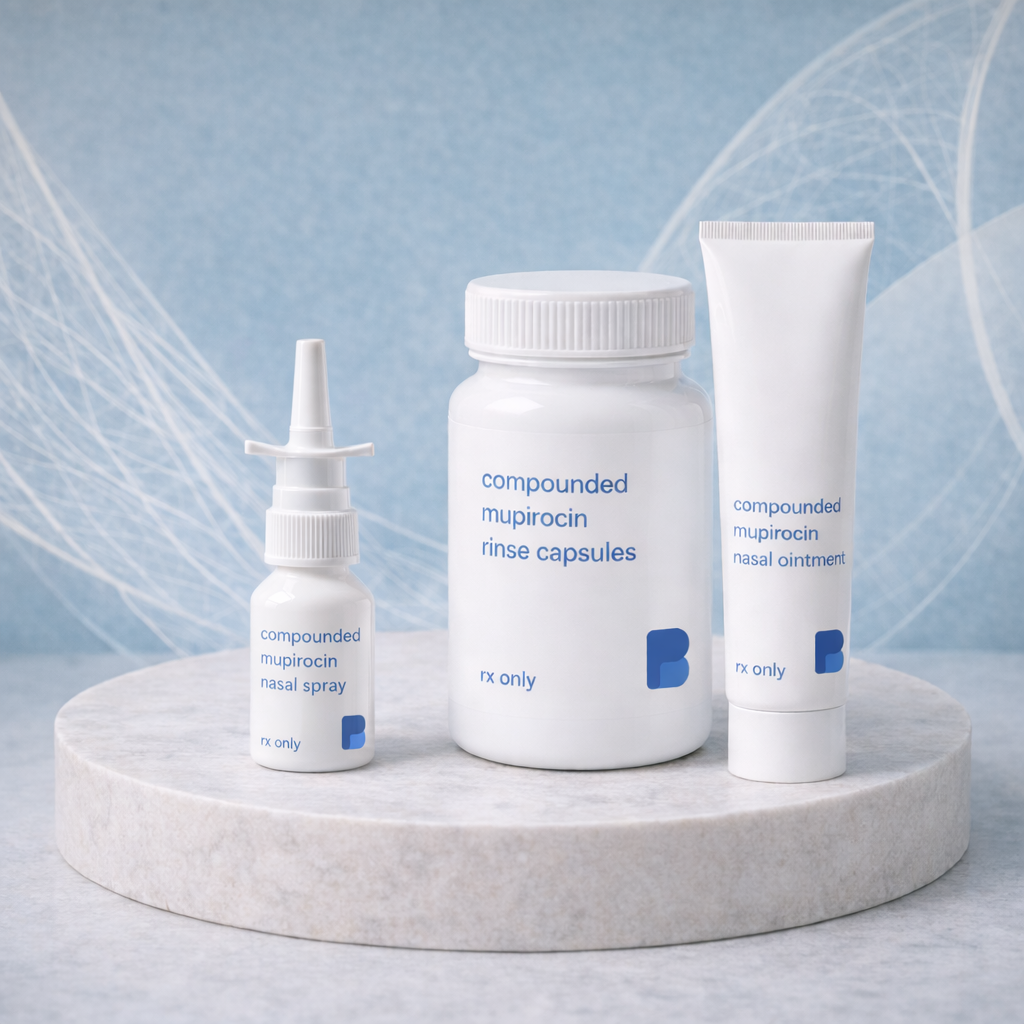
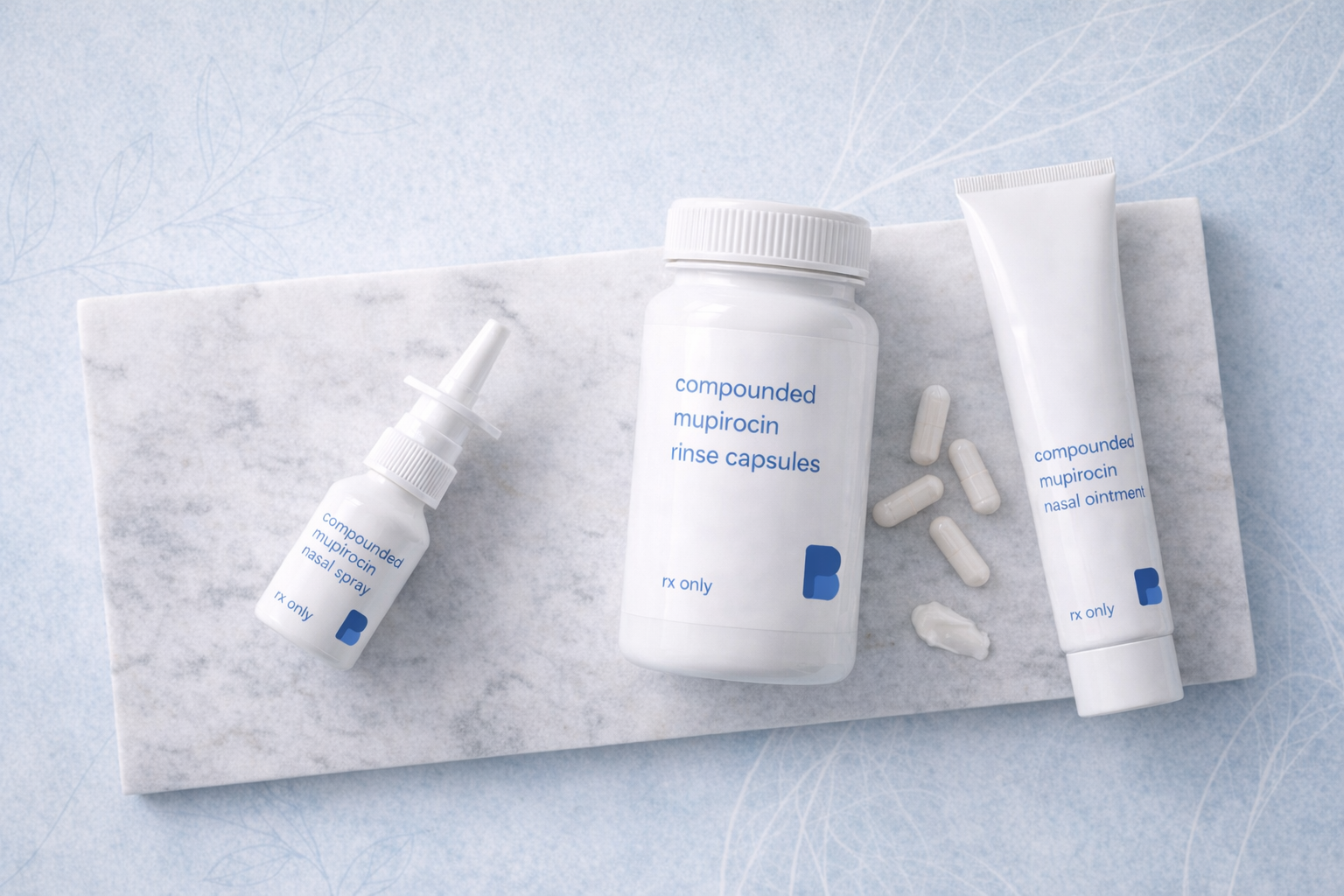
Mupirocin nasal preparations are compounded, prescription forms of mupirocin, an antibiotic, made to be used inside the nose. Bayview compounds mupirocin as a 2% nasal ointment, a 0.2% nasal spray, and capsules that are mixed into a saline sinus rinse, in the form your provider orders.

The FDA-approved mupirocin nasal ointment, Bactroban Nasal, is listed by the FDA as discontinued, and the mupirocin ointment sold for the skin is not meant to go in the nose. Compounded preparations are not FDA-approved, and a valid prescription is required.

Bayview also compounds povidone-iodine nasal spray, budesonide sinus rinse capsules, and amphotericin B preparations.

Related reading: what a compounded prescription costs.

Can I put regular mupirocin ointment in my nose?

Not unless your provider tells you to. The mupirocin ointment sold for skin infections is a different product, and MedlinePlus advises not letting it get into the nose. A nasal ointment is made for use inside the nostrils. The FDA-approved nasal version, Bactroban Nasal, is discontinued, so Bayview compounds mupirocin 2% nasal ointment when a provider prescribes it.

Is Bactroban Nasal still available?

The FDA lists Bactroban (mupirocin calcium) nasal ointment as discontinued, and Drugs@FDA lists no other approved mupirocin product for the nose. With a prescription, a compounding pharmacy such as Bayview can prepare mupirocin 2% nasal ointment, a nasal spray, or sinus rinse capsules.

Trusted by 105,826 patients to date.
A group of faces of our past satisfied patients.
Compounded medications are prepared pursuant to a valid prescription for an individual patient and are not FDA-approved. This page is for educational purposes and is not medical advice.
**The FDA does not review or approve compounded medications for safety or effectiveness. A valid prescription from a licensed practitioner is required.
Important safety information →
Service availability

Prescription delivery in your state

Bayview Pharmacy is licensed to serve patients in eight states and serves eligible New York patients on a limited basis while nonresident registration is pending. Check your state before getting started.

See every state we ship to, with shipping times and pickup details →

Where we currently serve

Select a highlighted state to check availability.

Currently licensed Limited basis, registration pending Not currently licensed Your selection

Select a state on the map or use the state checker.

Do we serve your state?

Choose your state to confirm current service availability.

Thank you! Your submission has been received!
Oops! Something went wrong while submitting the form.
Where we serve
Start with a prescription

Getting your prescription filled is simple

Send us your prescription

STEP
1
Have your provider e-prescribe to Bayview, fax it to us, or call it in directly to one of our pharmacists.
A thin blue light beam connecting two clear glass slabs on a white surface.

A pharmacist reviews it

STEP
2
We verify your prescription and prepare your medication to your provider's exact instructions.
Close-up of a white dial with blue measurement markings and a rotating knob.

We compound & ship

STEP
3
We prepare your medication and ship it discreetly to your door, with support when you need it.
Close-up of a gray box with a precise blue line running along its folded edges.

What is Mupirocin Nasal Ointment, Spray & Sinus Rinse?

Mupirocin nasal preparations are compounded, prescription forms of mupirocin, an antibiotic, made to be used inside the nose. Bayview compounds a 2% nasal ointment, a 0.2% nasal spray, and capsules whose powder is mixed into a saline sinus rinse, each to your provider's prescription.

The FDA-approved mupirocin nasal ointment, Bactroban Nasal, is listed by the FDA as discontinued, and Drugs@FDA lists no other approved mupirocin product for the nose (Drugs@FDA). The mupirocin ointment sold for skin infections is a different product, and MedlinePlus advises not letting it get into the nose (MedlinePlus). Bayview compounds this as part of our ear, nose, and throat line.

This is a compounded medication and is not FDA-approved. Bayview's mupirocin nasal ointment, nasal spray, and sinus rinse capsules are prepared for one patient on a prescriber's order. Only your provider can decide whether mupirocin in the nose is appropriate for you, and a valid prescription is required.

How does it work?

Mupirocin is an antibiotic that stops bacteria from making the proteins they need, by binding to an enzyme called isoleucyl-tRNA synthetase (FDA label). In the nose it acts on the surface it touches. Its main target there is Staphylococcus aureus (staph), including methicillin-resistant S. aureus (MRSA), which can live in the front of the nostrils without causing symptoms (FDA label).

What is it used for?

The FDA-approved nasal ointment was labeled to clear MRSA carried in the nose in adults, children 12 and older, and health care workers, as part of an infection control program during hospital outbreaks (FDA label). World Health Organization guidelines recommend mupirocin 2% nasal ointment around the time of heart and orthopedic surgery for people known to carry staph in the nose, and suggest considering it for carriers having other surgeries (WHO). Some ear, nose, and throat specialists also prescribe mupirocin in a saline sinus rinse for long-lasting sinus inflammation (chronic rhinosinusitis) when staph is found in the sinuses, an off-label use studied in small trials (Kim and Kwon). Only a licensed provider can decide whether any of these fits your situation; Bayview Pharmacy does not provide consultations, and a valid prescription is required.

Ointment, spray, or sinus rinse?

All three forms put mupirocin inside the nose. The ointment coats the front of the nostrils, the spray delivers a fine mist, and a sinus rinse carries the medication through the nasal passages and into the sinuses. The table below is for education only.

FormStrengthHow it's used
Nasal ointment2%Applied inside each nostril, then spread by pressing the nostrils together
Nasal spray0.2%Sprayed into each nostril from a pump bottle
Sinus rinse capsulesAs prescribed, most often 15 mgCapsule powder mixed into a saline rinse bottle, then rinsed through the nose

Forms are described for education only and are not a statement that any form is better or more effective. Your provider sets the form, strength, and length of treatment.

How is it used?

Use it exactly as your label directs. For the FDA-approved nasal ointment, the directions were about half of a single-use tube in each nostril twice a day, morning and evening, for 5 days, then pressing the nostrils together and releasing them for about a minute to spread the ointment (FDA label). For the spray, blow your nose gently, then spray the number of times your label says into each nostril. For a sinus rinse, open one capsule, empty the powder into your saline rinse bottle, mix, and rinse as directed. Mix a fresh rinse each time, use distilled, sterile, or previously boiled and cooled water (never untreated tap water), and lean over a sink and breathe through your mouth while you rinse. Keep mupirocin away from your eyes (FDA label). The FDA label advised against using other nose products at the same time, so ask your provider how to time any other nasal medicines (FDA label).

Side effects & safety

In clinical trials of the FDA-approved nasal ointment, the most common side effects were headache (9%), a runny or stuffy nose (6%), congestion (5%), sore throat (4%), a change in taste (3%), burning or stinging (2%), cough (2%), and itching (1%) (FDA label). Serious allergic reactions, including swelling and trouble breathing, have been reported. Diarrhea caused by Clostridioides difficile has been reported with nearly all antibiotics, and long use can let germs that mupirocin does not act on, such as fungi, overgrow (FDA label). Side effect data for compounded sprays and rinses are limited.

Stop and call your provider if you have severe irritation, a rash, or swelling, and get emergency care for trouble breathing. Tell your provider about diarrhea that is watery or bloody, during or after treatment (FDA label).

Who should not use it?

Do not use mupirocin if you are allergic to mupirocin or any ingredient in the preparation (FDA label). The safety of the FDA-approved nasal ointment was not established in children younger than 12, and there are not enough human data to know whether it carries a risk in pregnancy (FDA label). Tell your provider if you are pregnant or breastfeeding, and about all of your conditions and medicines, before starting.

How should it be stored?

Store as directed on your label. The FDA-approved nasal ointment was stored at room temperature and not refrigerated (FDA label). Keep rinse capsules in their closed container, dry and at room temperature. Keep all forms out of reach of children, and do not use them after the beyond-use date.

Why is this compounded?

The FDA-approved mupirocin nasal ointment is discontinued, and Drugs@FDA lists the remaining approved mupirocin products as ointments and creams for the skin (Drugs@FDA). There is no manufactured mupirocin nasal spray or sinus rinse. Compounding lets a licensed pharmacy prepare a 2% nasal ointment, a 0.2% nasal spray, or measured rinse capsules to an individual prescription. As a 503A compounding pharmacy, Bayview prepares each order under USP <795> standards. Compounded preparations are not FDA-approved. Related preparations include Povidone-Iodine Nasal Spray, Budesonide Sinus Rinse Capsules, and Amphotericin B. The full list is in our compounded medications catalog.

Clinical details for prescribers

Regulatory status. Mupirocin is not a controlled substance. Bactroban (mupirocin calcium) nasal ointment 2%, NDA 050703, is listed as discontinued, with a Federal Register determination that it was not withdrawn for safety or effectiveness reasons; Drugs@FDA lists no other nasal mupirocin product (Drugs@FDA). Bayview's nasal ointment, nasal spray, and irrigation capsules are 503A compounded preparations and are not FDA-approved.

Labeled regimen (discontinued product). Indicated for eradication of nasal colonization with MRSA in adults, pediatric patients 12 and older, and health care workers as part of an infection control program during institutional outbreaks; approximately one-half of a 1 g single-use tube into each nostril twice daily for 5 days. The label states there are insufficient data to establish use for preventing autoinfection or for general prophylaxis of infection (FDA label).

Perioperative decolonization. WHO: strong recommendation for perioperative intranasal mupirocin 2% ointment, with or without chlorhexidine body wash, in cardiothoracic and orthopaedic surgery patients with known S. aureus nasal carriage; conditional recommendation to consider it for carriers undergoing other surgery. Trial regimens ran twice daily for 5 to 7 days before surgery. WHO advises treating identified carriers only and monitoring mupirocin resistance (WHO).

Sinus irrigation (off-label). Studies in recalcitrant staphylococcal chronic rhinosinusitis used mupirocin 0.05% in saline (for example, 100 mg in 200 mL) twice daily for 3 to 4 weeks; a 2016 meta-analysis pooled six small studies (Kim and Kwon). Irrigation capsule strength and volume are set by the prescriber.

Counseling / clinical points:

  • Avoid the eyes; discontinue for sensitization or severe local irritation (FDA label)
  • High-level plasmid-mediated mupirocin resistance has been reported in S. aureus; prolonged use may cause overgrowth of nonsusceptible organisms (FDA label)
  • CDAD has been reported with nearly all antibacterial agents (FDA label)
  • Topical mupirocin ointment for skin is not intended for intranasal use (MedlinePlus)

Account setup, licensing, and ordering are covered on our for providers page.

Mupirocin nasal ointment, nasal spray, and sinus rinse capsules are compounded medications and are not FDA-approved. This information is educational and is not medical advice. Your provider determines whether it is appropriate and sets the dose and length of treatment.

References

  1. FDA label: Bactroban (mupirocin calcium) nasal ointment 2%
  2. Drugs@FDA: NDA 050703, Bactroban nasal ointment (marketing status)
  3. MedlinePlus: Mupirocin topical
  4. WHO Global Guidelines for the Prevention of Surgical Site Infection: decolonization with mupirocin
  5. Kim and Kwon, mupirocin saline irrigation in chronic rhinosinusitis: a meta-analysis
Reviewed by Ryan Dyer, RPh, pharmacist at Bayview Pharmacy. Last reviewed October 16, 2026. Bayview does not provide consultations and does not decide whether a medication is right for you. Your prescriber makes that call.

In Stock
Mupirocin Nasal Ointment, Spray & Sinus Rinse, a compounded medication prepared by Bayview Pharmacy

On this page

Made for the nose

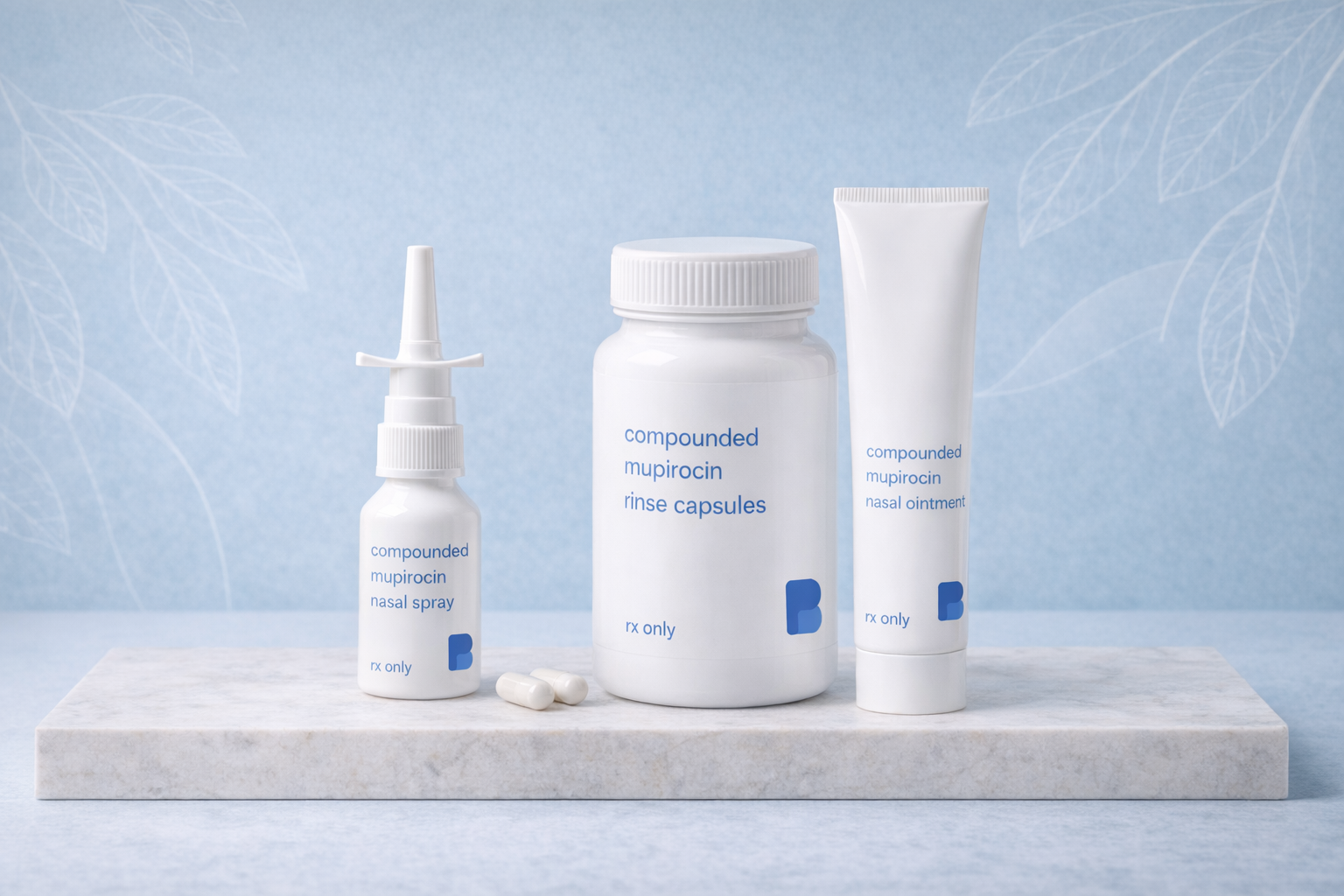
The mupirocin ointment sold for the skin is not meant for the nose. Bayview compounds mupirocin in forms made for nasal use, to your provider's prescription.

Start with a prescription
Made for the nose – Mupirocin Nasal Ointment, Spray & Sinus Rinse from Bayview Pharmacy

Ointment, spray, or sinus rinse

Bayview compounds mupirocin as a 2% nasal ointment, a 0.2% nasal spray, and capsules for a saline sinus rinse. Compare the forms below.

View our formulas
Ointment, spray, or sinus rinse – Mupirocin Nasal Ointment, Spray & Sinus Rinse from Bayview Pharmacy

Personalized compounding for patients who need more than a standard option.

"As a compounding pharmacy, we prepare each medication to a provider’s exact specifications. My focus, and my team’s focus, is quality, consistency, and close communication with prescribers so patients receive medication prepared for their individual needs."
Ryan Dyer, RPh
Owner and Chief Pharmacist, Bayview Pharmacy
Smiling man in blue scrubs with arms crossed and pen behind his ear
Three clear liquid vials, white powder on spoon, two capsules, and a cream jar on a metal surface.
QUALITY AND TESTING

Held to a higher standard

Every preparation is made under strict quality controls, and verified by a licensed pharmacist.
We use validated quality processes and third-party testing where appropriate
Sterile compounding in a dedicated USP <797> cleanroom
Non-sterile compounding under USP <795> and <800> standards
USP/NF-grade ingredients from reputable, vetted suppliers

Why patients choose Bayview

Made to your prescription
Made in our own pharmacy
Quality tested
Real pharmacist support
Discreet, secure shipping
Trusted since 2006

Our formulations

Bayview compounds mupirocin in three forms for the nose. Your provider selects the form, strength, and length of treatment; other strengths can be prepared to a provider's order.

Form Strength How it's used
Nasal ointment2%Applied inside each nostril
Nasal spray0.2%Sprayed into each nostril from a pump bottle
Sinus rinse capsules15 mg (others to order)Powder mixed into a saline sinus rinse

Forms and strengths are listed for education only and are not a statement that any option is better or more effective. A valid prescription is required. These are compounded medications and are not FDA-approved.

Start with a prescription
Nasal ointment | Mupirocin 2% nasal ointment | 10 g | Apply into each nostril, then press nostrils together | | Twice daily Nasal spray | Mupirocin 0.2% nasal spray | 10 mL | Spray 1 spray into each nostril | | Twice daily Irrigation capsule | Mupirocin 15 mg nasal irrigation capsule | 60 capsules | Empty contents of 1 capsule into saline rinse and irrigate | | Twice daily Irrigation capsule | Mupirocin ___ mg nasal irrigation capsule (custom strength) | | Empty contents of 1 capsule into saline rinse and irrigate | | Twice daily
Mupirocin Nasal

For prescribers

How to e-prescribe this formulation

Bayview accepts e-prescriptions from any Surescripts-connected EHR. Compounded preparations have no NDC, so they will not appear in your drug search. Choose the preparation below and copy the prescription into your EHR.

Patient? Send these instructions to your doctor's office.
  1. Find Bayview in your EHR's pharmacy directory

    Search by NCPDP 4106882, or by name and ZIP: Bayview Pharmacy, Warwick, RI 02886. Save it as a favorite so you never search again.

  2. Choose the preparation

    Name the preparation exactly as listed under Our formulations above: each active ingredient and strength, the dose form, the quantity, and the directions.

  3. Enter it as a compound

    Use your system's compound, non-formulary, or free-text prescription entry and paste the details. If your EHR forces you to pick a listed drug, pick the closest entry for the active ingredient and put the full formula in the prescription body (the Sig or directions field).

  4. Send it

    Transmit from your EHR. Prefer not to e-prescribe? For non-controlled preparations we also accept fax to (401) 284-4506 and phoned orders at (401) 284-4505. Order forms are in the Prescribers: download order form menu above.

Do not use Notes to Pharmacy for the formula. Some EHRs keep that field internal and never transmit it. A prescription that arrives without the formula is delayed while we call your office.

Compounded preparations are not FDA-approved. A valid prescription is required. Questions: call (401) 284-4505. Full e-prescribing guide

Frequently asked questions

Can I put regular mupirocin ointment in my nose?

Not unless your provider tells you to. The mupirocin ointment sold for skin infections is a different product, and MedlinePlus advises not letting it get into the nose. A nasal ointment is made for use inside the nostrils. The FDA-approved nasal version, Bactroban Nasal, is discontinued, so Bayview compounds mupirocin 2% nasal ointment when a provider prescribes it.

Is Bactroban Nasal still available?

The FDA lists Bactroban (mupirocin calcium) nasal ointment as discontinued, and Drugs@FDA lists no other approved mupirocin product for the nose. With a prescription, a compounding pharmacy such as Bayview can prepare mupirocin 2% nasal ointment, a nasal spray, or sinus rinse capsules.

How do you apply mupirocin nasal ointment?

Follow the directions on your label. For the FDA-approved nasal ointment, the directions were about half of a single-use tube in each nostril twice a day, morning and evening, for 5 days. After each use, press the sides of your nose together and release them for about a minute to spread the ointment. Wash your hands afterward and keep it away from your eyes.

What are the side effects of mupirocin in the nose?

In trials of the FDA-approved nasal ointment, the most common side effects were headache, a runny or stuffy nose, congestion, sore throat, a change in taste, and burning or stinging. Serious allergic reactions have been reported. Stop and call your provider if you have severe irritation, a rash, or swelling, and tell your provider about watery or bloody diarrhea.

How do I use a mupirocin sinus rinse?

Open one capsule and empty the powder into your saline sinus rinse bottle, mix it, and rinse through your nose as your label directs, usually once or twice a day. Mix a fresh rinse each time with distilled, sterile, or previously boiled and cooled water, never untreated tap water. Lean over a sink and breathe through your mouth while you rinse.

Do I need a prescription for mupirocin nasal ointment?

Yes. Mupirocin is a prescription antibiotic, and Bayview compounds the nasal ointment, nasal spray, and sinus rinse capsules only with a valid prescription from a licensed provider. Once we receive your prescription, we compound it in the form and strength your provider orders.

Do I need a prescription?

Yes. All of our medications require a valid prescription from a licensed provider. We're a dispensing and compounding pharmacy, so we don't provide consultations or write prescriptions. If you don't have one yet, you'll need to see a provider first.

What is compounding?

Compounding is the practice of preparing a medication tailored to an individual patient's prescription. Instead of a mass-produced product, a compounding pharmacy makes the medication to the specific strength, form, or combination your provider orders.

Examples on this site include medications compounded as liquids for people who cannot swallow pills, thyroid capsules made to a T3/T4 ratio no manufactured product offers, and all-purpose nipple ointment, which combines three actives that are not sold together commercially.

Are compounded medications FDA-approved?

Compounded medications are not FDA-approved. They're prepared by a licensed pharmacy pursuant to a valid prescription for an individual patient, under USP standards. The FDA does not review compounded medications for safety or effectiveness.

How do providers send a prescription to Bayview?

Providers can submit a prescription three ways:

  • E-prescribe: Search Bayview Pharmacy, Warwick, RI (NCPDP 4106882) in your EHR. For compounds, use the compound, custom, or free-text option and include the full formulation, strength, quantity, refills, and directions.
  • Fax: Send a signed order to 401-284-4506 (alt. 401-210-2757) with patient and prescriber details, medication, quantity, refills, directions, signature, and date.
  • Phone: Call 401-284-4505 to submit, clarify, or coordinate refills.

A valid prescription is required, and compounded medications are not FDA-approved.

‍

Can you fill a prescription from my own provider?

Yes. Your provider can send your prescription to Bayview Pharmacy by e-prescribe, fax, or phone, or you can transfer an existing prescription from another pharmacy.

How does shipping work?

Once your prescription is verified, we prepare your medication and ship it discreetly in plain packaging either via UPS or USPS. A pharmacy technician confirms the details with you before it goes out, and we're available if you have any questions.

How do refills and automatic refills work?

Refills are coordinated with your prescriber and your prescription. You can request a refill through our website or by calling us, and we'll handle the rest as long as you have refills remaining on a valid prescription. You can also opt into automatic refills on non-controlled substances, with no need to worry about running out of your medication. We can either ship it to you automatically, or ready for pickup.

Shipping & Delivery

Every prescription ships directly to your door in discreet packaging. Refrigerated medications travel in insulated coolers with ice packs to stay cold in transit.

Delivery AreaStandard ShippingRefrigerated Shipping
Rhode Island, Massachusetts & Connecticut$9 USPS$20 UPS
New Hampshire, New Jersey, Pennsylvania, Maine & New York (limited basis)$15 UPS$40 UPS Next Day Air
Florida$15 UPS$80 UPS Next Day Air

Need it faster? Expedited UPS is $15 for Rhode Island, Massachusetts and Connecticut. Your pharmacist will let you know if your medication needs refrigerated shipping. Questions? Call us at (401) 284-4505.

References

Sources reviewed

The medical information on this page draws on the following sources, which are also linked where cited.

  1. U.S. Food and Drug Administration. Bactroban (mupirocin calcium) nasal ointment, 2%: prescribing information (2020).
  2. U.S. Food and Drug Administration. Drugs@FDA: NDA 050703.
  3. MedlinePlus. Mupirocin Topical.
  4. World Health Organization. Global Guidelines for the Prevention of Surgical Site Infection: evidence-based recommendations (2016).
  5. Kim JS, Kwon SH. PLoS One (2016). Mupirocin in the treatment of staphylococcal infections in chronic rhinosinusitis: a meta-analysis.

Important safety information

Do not use if you are allergic to mupirocin or any ingredient in the preparation.

Warnings and precautions

  • For use in the nose only as directed. Keep it away from the eyes
  • Do not put mupirocin skin ointment in the nose unless your provider tells you to
  • Long use can let germs that mupirocin does not act on, such as fungi, overgrow. Use it only for the course your provider sets
  • Compounded mupirocin nasal preparations are not FDA-approved, and a valid prescription is required

Common side effects

  • Headache, runny or stuffy nose, sore throat, a change in taste, and burning or stinging in the nose

Get medical care right away if

  • You have signs of a serious allergic reaction, such as hives, swelling of the face or throat, or trouble breathing
  • You have watery or bloody diarrhea during or after treatment

Storage: Store as directed on the label at room temperature, away from heat and moisture, out of reach of children. Do not use after the beyond-use date.

This is a compounded prescription medication and is not approved by the FDA. Use it only under the supervision of a licensed provider, exactly as prescribed. Do not adjust your dose without talking to your prescriber. Seek emergency care for any severe or unexpected reaction. This information is not complete; talk to your provider about your full medical history and all medications you take.

Ready to get started?

Send us your prescription and a Bayview pharmacist will take it from there.