





Ciclopirox is a synthetic antifungal that has been used on the skin since the early 1980s. Unlike the azoles and terbinafine, which block a fungus from building its membrane, ciclopirox starves the fungus of iron and other metal ions, which is why it works against dermatophytes, yeasts, and some bacteria, and why resistance to it is rare.
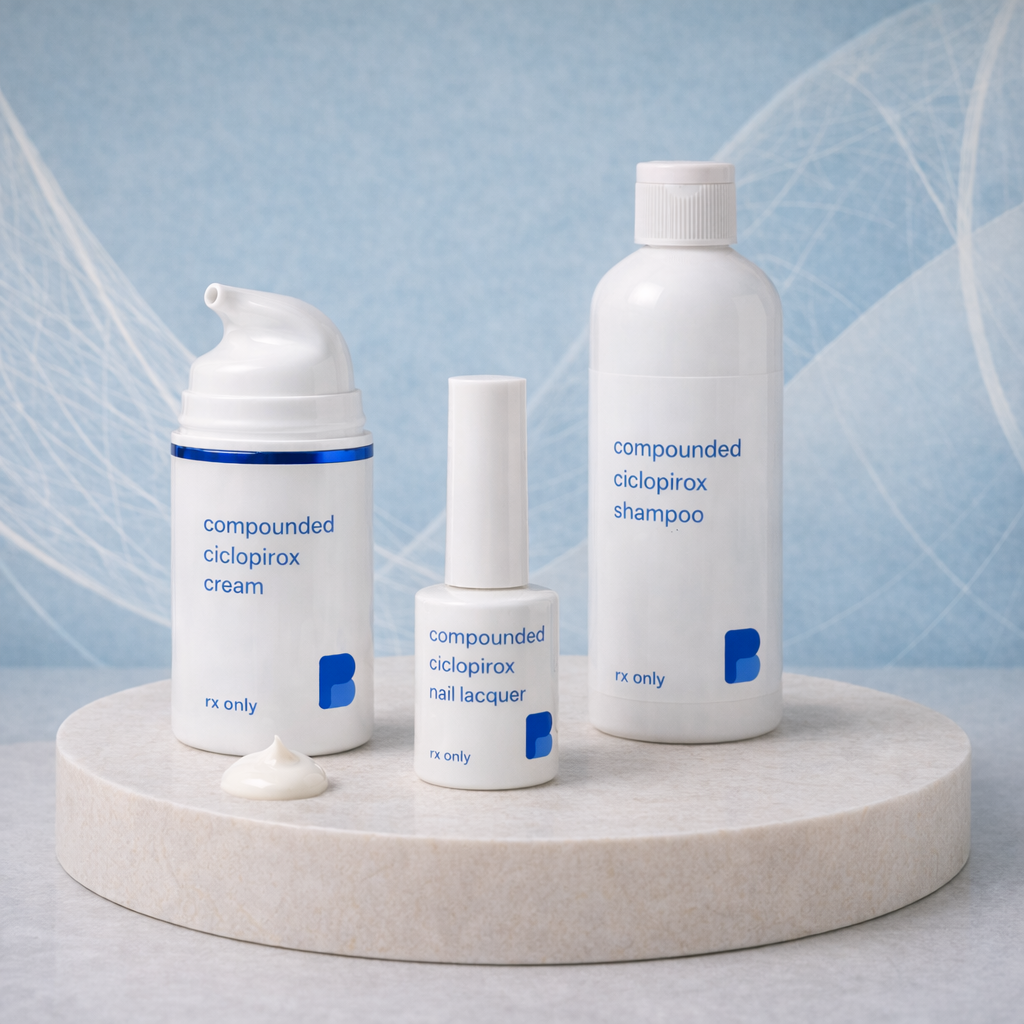
In the United States ciclopirox is FDA-approved as a 0.77% cream, gel, and lotion for fungal skin infections, as a 1% shampoo for seborrheic dermatitis of the scalp, and as an 8% nail lacquer for mild to moderate nail fungus. Bayview compounds ciclopirox olamine when a prescriber wants a strength or vehicle those products do not offer: a 6% cream or gel, a 1.5% shampoo or topical solution, or a nail lacquer in a different vehicle. These compounded preparations are not FDA-approved, and a valid prescription is required. When a manufactured product fits the order, that is what Bayview dispenses. Bayview compounds this as part of our dermatology compounding line.
How does it work?
Ciclopirox binds, or chelates, the polyvalent metal ions such as iron and aluminium that fungal enzymes depend on. Without them the fungus cannot run the enzymes that break down nutrients and detoxify its own waste, and it dies (DailyMed, ciclopirox nail lacquer label). Applied to the skin it concentrates in the outer layer and reaches down into hair follicles and oil glands; only about 1.3% of a dose is absorbed into the body (DailyMed, ciclopirox cream label). On the nail, the lacquer dries to a film that releases the drug into the nail plate day after day, which is why it is reapplied over the old coat and why the built-up coats are wiped off with alcohol once a week (DailyMed, ciclopirox nail lacquer label).
What is it used for?
The manufactured cream, gel, and lotion are FDA-approved for athlete's foot, jock itch, and ringworm caused by dermatophytes, for yeast infections of the skin caused by Candida, and for tinea versicolor (DailyMed, ciclopirox cream label). The shampoo is approved for seborrheic dermatitis of the scalp in adults (DailyMed, ciclopirox shampoo label).
The nail lacquer is approved for immunocompetent patients with mild to moderate fungal infection of the fingernails or toenails that does not involve the lunula, the pale half-moon at the base, as part of a program that includes monthly professional removal of loose infected nail (DailyMed, ciclopirox nail lacquer label). Prescribers order the compounded forms for the same conditions when they want a higher strength, a different vehicle, or a size the tubes do not come in. Your prescriber decides whether it fits your situation and how it should be used.
What to expect with nail fungus
This deserves plain numbers. In the two trials that approved the manufactured 8% lacquer, patients applied it every day for 48 weeks with monthly nail trimming; at the end, 5.5% to 8.5% had a completely clear nail with a negative fungal test, against 0% to 0.9% on the lacquer's vehicle alone, and 29% to 36% had a negative fungal test even if the nail still looked abnormal (DailyMed, ciclopirox nail lacquer label). By comparison, oral terbinafine clears the nail completely in about 38% of patients and clears the fungus in about 76%, and even after successful treatment nail fungus comes back in 5% to 50% of people (StatPearls, Onychomycosis).
A toenail grows about a millimetre a month, so a treated nail can take a year or more to grow out (StatPearls, Onychomycosis). Topical treatment is reasonable for mild, distal disease or for people who cannot take an oral antifungal, and the diagnosis should be confirmed with a KOH preparation, culture, or PAS stain before a 48-week course begins, since at least half of abnormal-looking toenails are not fungal at all (StatPearls, Onychomycosis). A compounded lacquer has not been tested in any trial, and no claim is made that it works better than the manufactured one.
Cream, gel, solution, shampoo, or lacquer?
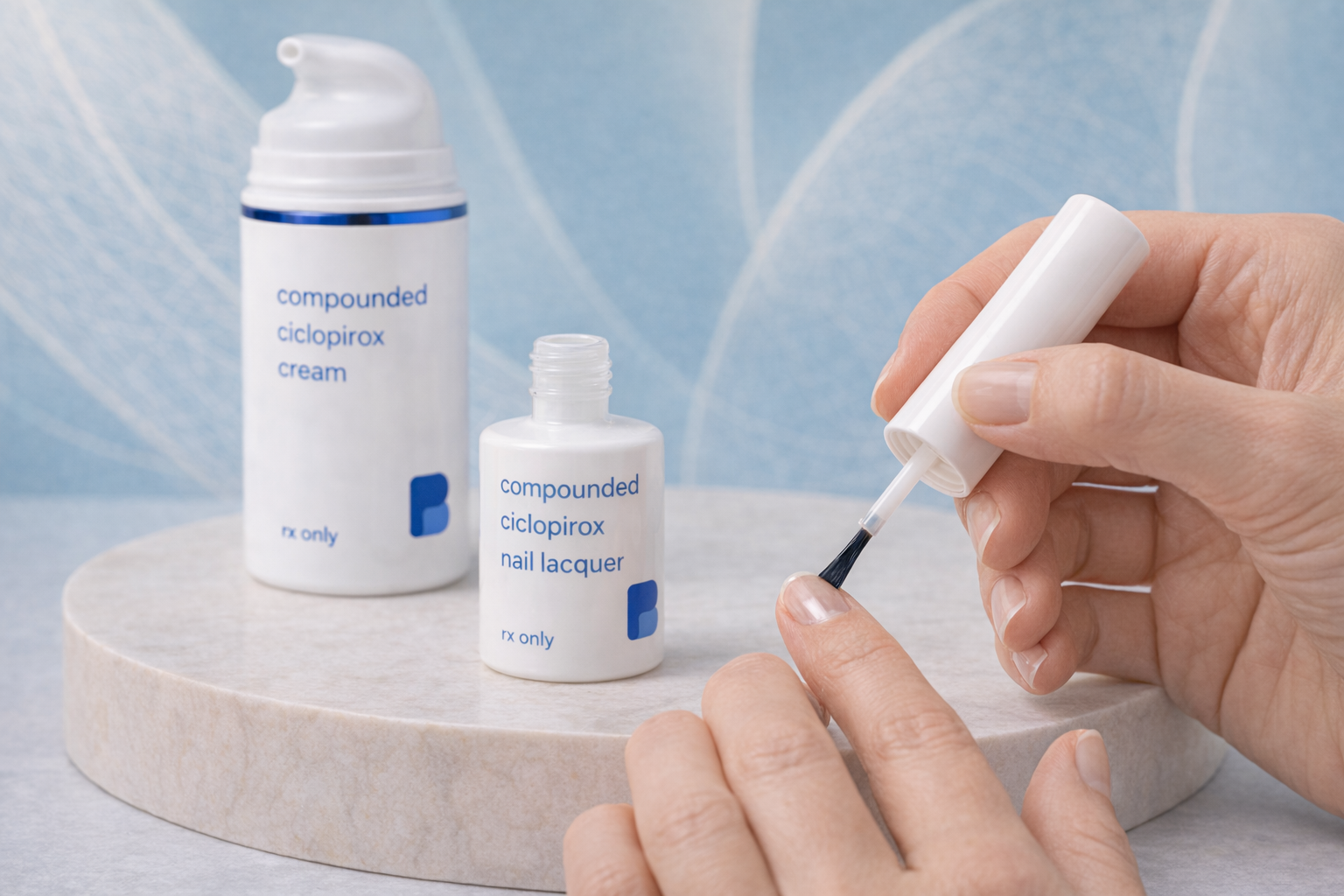
Cream suits dry, scaly patches on the body, groin, and feet; gel and solution spread through hair and between the toes and dry without residue; the shampoo treats the scalp in the shower and is left on for a few minutes before rinsing; the nail lacquer is brushed onto the nail plate and the skin at its edge and left to dry. Your prescriber selects the form and strength; see the strengths section for what Bayview compounds.
How is it used?
Follow the directions on your label exactly. For the cream, gel, or solution, massage a thin layer into the affected skin and the skin around it, usually twice a day, morning and evening; improvement is usually seen within the first week, and if there is none after 4 weeks the diagnosis should be reconsidered (DailyMed, ciclopirox cream label). Do not cover the area with plastic or a tight dressing unless told to. For the shampoo, wet the hair, apply about a teaspoon (two for long hair), work it into the scalp, leave it for 3 minutes, and rinse; the manufactured product is used twice a week for 4 weeks with at least 3 days between washes (DailyMed, ciclopirox shampoo label).
For the lacquer, apply it once a day, usually at bedtime, over the previous coat, to the whole nail and the skin at its edge and under the tip; let it dry, and do not bathe, shower, or swim for 8 hours; every 7 days wipe all the coats off with rubbing alcohol and start again; keep the lacquer away from heat and flame, and do not wear nail polish over it (MedlinePlus, Ciclopirox Topical). Have loose or thickened infected nail trimmed by your prescriber or a foot specialist about once a month; if you have diabetes or poor circulation, do not trim it yourself (DailyMed, ciclopirox nail lacquer label).
Side effects & safety
Ciclopirox is well tolerated. With the cream, itching and burning at the site were reported by about 1% of patients (DailyMed, ciclopirox cream label). With the lacquer, redness of the skin around the nail occurred in 5% against 1% on vehicle, and nail discoloration or a change in nail shape has been reported (DailyMed, ciclopirox nail lacquer label). With the shampoo, itching and application-site burning or redness were each reported by about 1%, and hair discoloration, mostly in lighter hair, and hair shedding have been reported after marketing (DailyMed, ciclopirox shampoo label).
Who should not use it?
Avoid ciclopirox if you are allergic to it or to any ingredient in the preparation. Tell your prescriber if you are pregnant; the manufactured products carry a pregnancy caution and are used only when clearly needed (DailyMed, ciclopirox cream label). If you are breastfeeding, so little ciclopirox is absorbed through the skin that it is unlikely to affect the infant, but do not apply it to the nipple or breast, and keep the infant's skin from contacting treated skin (LactMed, Ciclopirox). Also mention diabetes, poor circulation, or a weakened immune system before starting the lacquer. The manufactured cream is not established in children under 10, the lacquer under 12, and the shampoo under 16; use in children calls for a pediatric prescriber's direction (DailyMed, ciclopirox nail lacquer label).
How should it be stored?
Store as directed on your label, at room temperature away from heat, flame, and moisture, tightly closed, and keep it out of the reach of children and pets. Do not use it after the beyond-use date, and dispose of unused medication as directed.
Why is this compounded?
FDA-approved ciclopirox comes as a 0.77% cream, gel, and lotion, a 1% shampoo, and an 8% nail lacquer, and when one of those fits the order, that is what Bayview dispenses. Compounding is for the cases the manufactured line does not cover: a 6% cream or gel for a stubborn or extensive skin infection, a 1.5% shampoo or solution, a lacquer in a vehicle the manufactured product does not offer, or a size the tubes do not come in.
As a 503A compounding pharmacy, Bayview prepares each order in small batches under USP standards, pursuant to a prescription for an individual patient. We do not supply ciclopirox as clinic or office stock, that is the role of a 503B outsourcing facility, which Bayview is not. Compounded preparations are not FDA-approved. Related preparations include Topical Sodium Thiosulfate, Triamcinolone Cream, Ointment & Oral Rinse, and Cantharidin for Warts & Molluscum. The full list is in our compounded medications catalog.
Clinical details for prescribers
Regulatory status. Ciclopirox olamine is a hydroxypyridone antifungal that chelates polyvalent cations and inhibits metal-dependent fungal enzymes. FDA-approved presentations: 0.77% cream, gel, and topical suspension (tinea pedis, cruris, corporis; cutaneous candidiasis; tinea versicolor; the gel also seborrheic dermatitis of the scalp); 1% shampoo (seborrheic dermatitis of the scalp, adults); 8% topical solution (nail lacquer) for immunocompetent patients with mild to moderate onychomycosis without lunula involvement, as part of a comprehensive management program. Compounded 6% cream and gel, 1.5% solution and shampoo, and 7.77% or alternative-vehicle 8% lacquer are 503A preparations, not FDA-approved. Not a controlled substance.
Formulation & directions. Bayview compounds ciclopirox olamine as 6% cream and gel (30 to 60 g), 7.77% and 8% nail lacquer (6.6 and 15 mL; the 8% only when a vehicle the manufactured lacquer does not offer is needed), 1.5% topical solution (30 to 60 mL), and 1.5% shampoo (120 to 240 mL). Typical directions: cream or gel, twice daily for 4 weeks, re-evaluate if no improvement; lacquer, once daily at bedtime over the previous coat for up to 48 weeks, remove with alcohol every 7 days, professional debridement of unattached nail monthly; shampoo, 5 to 10 mL to wet scalp, 3 minutes, rinse, twice weekly for 4 weeks. Specify site, frequency, and duration on every prescription. Combinations (terbinafine, azoles, urea, ibuprofen, DMSO, salicylic acid, corticosteroids) are separate preparations.
Safety & counseling:
- Lacquer efficacy (manufactured product, 48 weeks, two vehicle-controlled trials): complete cure 5.5% and 8.5% vs 0% and 0.9%; almost clear 6.5% and 12% vs 0.9%; mycologic cure 29% and 36% vs 9% and 11%. Periungual erythema 5% vs 1%. Not studied in diabetic or immunosuppressed patients; weigh the risk of nail removal in diabetes. Pediatric under 12 not established (DailyMed, ciclopirox nail lacquer label).
- Onychomycosis context: T. rubrum accounts for about 90% of toenail cases; oral terbinafine complete cure about 38%, mycologic cure 76%; efinaconazole complete cure 18%; recurrence 5% to 50%; confirm mycology (KOH sensitivity about 60%, PAS about 95%) before treating; debridement improves satisfaction and may aid drug delivery but does not clear infection alone (StatPearls, Onychomycosis).
- Cream, gel, suspension: contraindicated in hypersensitivity; not ophthalmic; avoid occlusion; discontinue on sensitivity or chemical irritation; pruritus and burning about 1%; about 1.3% systemic absorption; pediatric under 10 not established (DailyMed, ciclopirox cream label).
- Shampoo: not ophthalmic, oral, or intravaginal; hair discoloration in lighter hair; itching and application-site reactions about 1%; postmarketing alopecia and abnormal hair texture; effective in 58% vs 31% and 26% vs 13% in the two pivotal trials; pediatric under 16 not established (DailyMed, ciclopirox shampoo label).
- Pregnancy: category B on all manufactured labels; use when clearly needed. Lactation: minimal absorption, unlikely to affect the infant; avoid the nipple and breast; water-miscible cream or gel only if applied near the breast (LactMed, Ciclopirox).
Non-controlled; ship to patient or office per the order form. Licensed to dispense in RI, MA, CT, NJ, NH, FL, ME, and PA. Background: DailyMed, ciclopirox nail lacquer label; DailyMed, ciclopirox cream label; DailyMed, ciclopirox shampoo label; StatPearls, Onychomycosis; LactMed, Ciclopirox. Account setup, licensing, and ordering are covered on our for providers page.
This is a prescription compounded medication and is not FDA-approved. This information is educational and is not medical advice. Your prescriber determines whether it is appropriate and sets the formulation and directions.