


Cholestyramine is a bile acid sequestrant: a resin that is not absorbed into the bloodstream and instead binds bile acids inside the intestine so they leave the body in the stool. Taken by mouth, it is used to lower LDL cholesterol and to relieve itching caused by a partial blockage of the bile ducts, and prescribers also use it off-label for diarrhea caused by bile acids. Manufactured cholestyramine is sold only as a powder for oral suspension, 4 g of resin per dose, that is stirred into a drink; capsules and skin preparations are prepared by compounding.
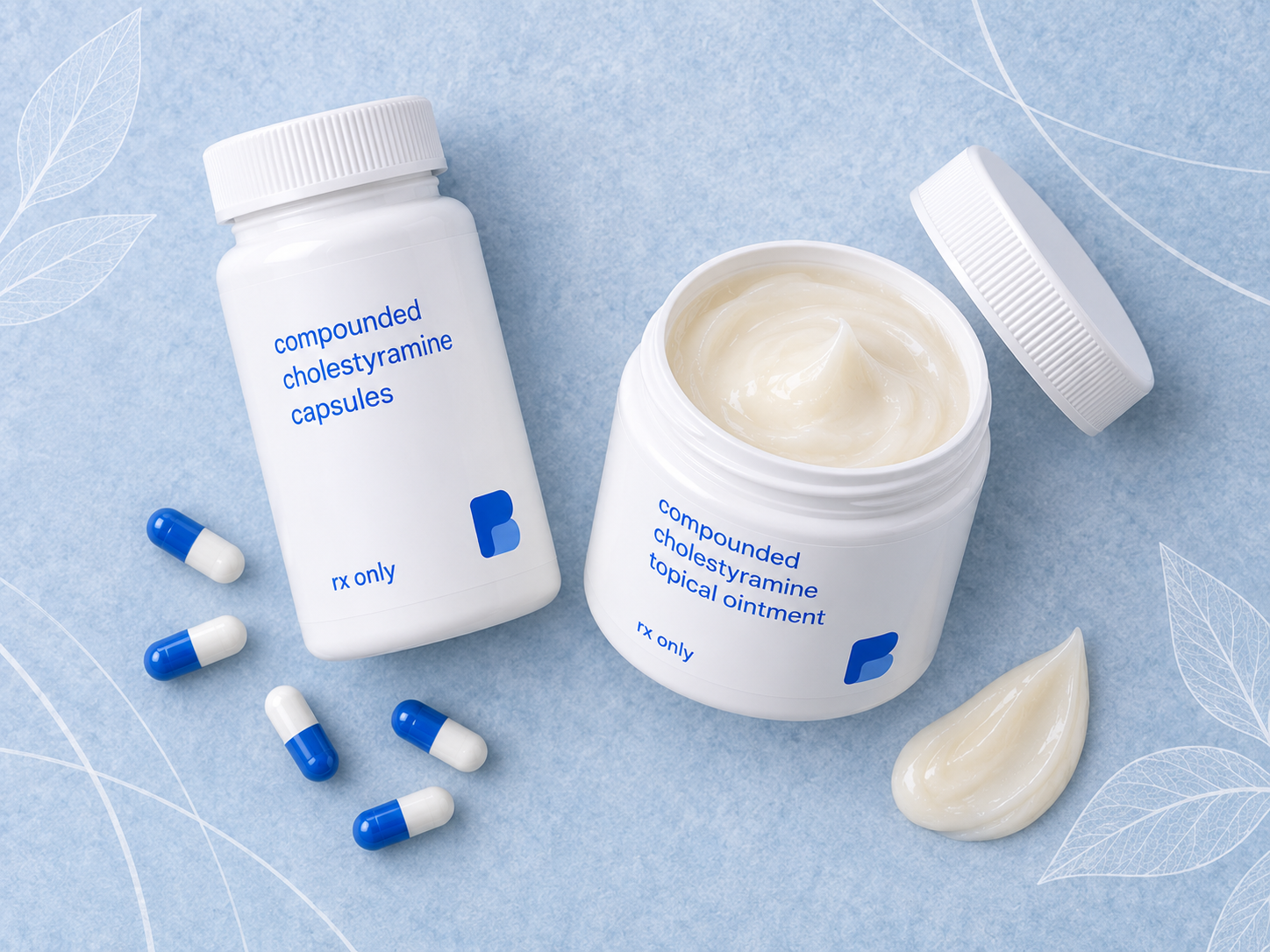
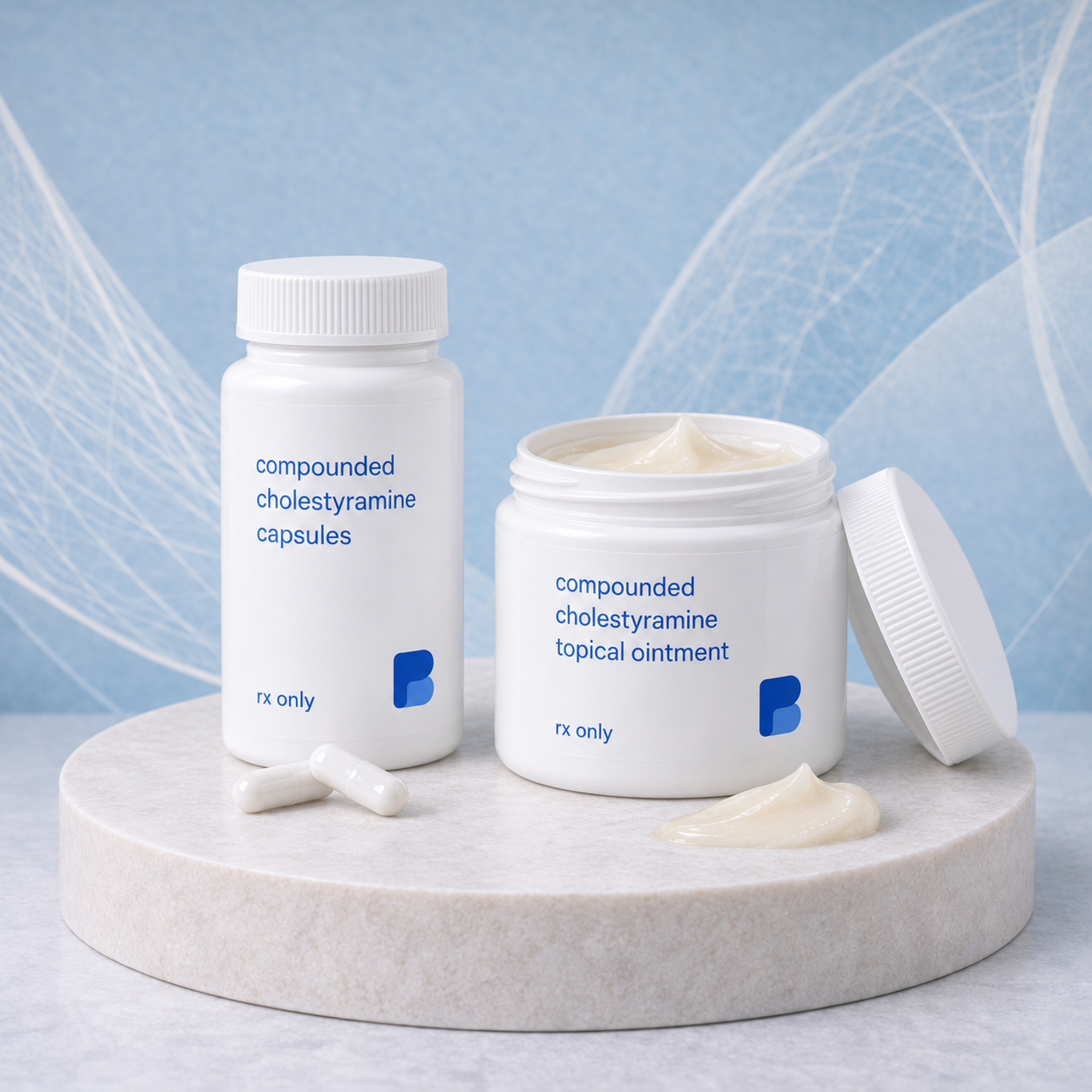
Bayview compounds cholestyramine 400 mg capsules and cholestyramine topical ointments at 5%, 6.5%, and 10%, alone or combined with zinc oxide or with zinc oxide and nystatin, to the strength and form your prescriber orders. Cholestyramine resin itself is an FDA-approved drug, but these compounded capsules and topical preparations are not FDA-approved, and applying cholestyramine to the skin is an off-label use. A valid prescription is required, and only your prescriber can decide whether it is appropriate for you.
How does it work?
Cholestyramine is a large anion exchange resin that does not dissolve in water and is not absorbed. In the intestine it binds bile acids and carries them out in the stool, so the liver converts more cholesterol into new bile acids and takes more LDL cholesterol out of the blood (StatPearls, Cholestyramine Resin). The same binding lowers the bile acid load that reaches the colon and the skin, which is the reason it is used for bile acid diarrhea and for itching linked to bile acids (StatPearls, Cholestyramine Resin). Because the resin binds other substances too, it can reduce the absorption of other oral medicines and of the fat-soluble vitamins A, D, E, and K (DailyMed, Cholestyramine for Oral Suspension).
What is it used for?
Oral cholestyramine is FDA-approved as an addition to diet to lower elevated cholesterol in primary hypercholesterolemia, and to relieve itching associated with partial biliary obstruction (DailyMed, Cholestyramine for Oral Suspension). Prescribers also use it off-label for bile acid diarrhea, for example after ileal disease or resection, and as an add-on in some other conditions such as refractory thyrotoxicosis (StatPearls, Cholestyramine Resin). These off-label uses rest on smaller studies and clinical experience rather than an FDA review.
Applied to the skin, cholestyramine is an off-label use with no FDA-approved product. It has been compounded into ointments for perianal, diaper-area, and peristomal skin irritation where stool rich in bile acids is thought to be the irritant. The published evidence is limited to case reports and small uncontrolled series: 8 patients with skin irritation around enterostomies treated with a 20% ointment (Rodriguez et al., J Pediatr 1976), 6 patients with perianal irritation after ileoanal anastomosis (Møller et al., Dis Colon Rectum 1987), and two single-infant case reports (White et al., Ann Pharmacother 1996), the later one using 5% cholestyramine in a petrolatum-based ointment (White et al., J Pharm Technol 2003). No controlled trials were found. Your prescriber decides whether it fits your situation and how it should be used.
Powder, capsule, or ointment?
The manufactured powder is mixed into 2 to 6 ounces of water or another drink and is never taken dry (DailyMed, Cholestyramine for Oral Suspension). Each dose of the manufactured powder supplies 4 g of cholestyramine resin, and the usual adult range is 1 to 6 doses a day (DailyMed, Cholestyramine for Oral Suspension). A compounded 400 mg capsule holds a much smaller amount of resin, so a capsule order is written as a number of capsules per dose; ten 400 mg capsules equal the 4 g in one packet or scoop of powder. The ointments are applied to the skin and are not swallowed. Your prescriber selects the form and strength; see the strengths section for what Bayview compounds.
How is it used?
By mouth, take cholestyramine as your prescriber directs, usually at mealtime, and take any other medicines at least 1 hour before or 4 to 6 hours after it (DailyMed, Cholestyramine for Oral Suspension). The powder is stirred into liquid and drunk; never swallow the powder dry (DailyMed, Cholestyramine for Oral Suspension). Drink plenty of fluids, and follow the low-fat, low-cholesterol diet your prescriber recommends if it is prescribed for cholesterol (MedlinePlus, Cholestyramine Resin). Your prescriber may start with a lower dose and increase it gradually.
On the skin, apply the ointment as your prescriber directs, typically as a layer over the irritated area after cleansing; in one published case report it was applied after each bowel movement (White et al., J Pharm Technol 2003). Wash your hands afterward, and do not use it on broken skin that shows signs of infection unless your prescriber is treating the infection.
Side effects & safety
Taken by mouth, the most common problem is constipation, which is usually mild but can be severe; bloating, gas, stomach pain, heartburn, nausea, and diarrhea also occur (DailyMed, Cholestyramine for Oral Suspension) (MedlinePlus, Cholestyramine Resin). Increasing fluids and fiber helps, and a stool softener may be needed (DailyMed, Cholestyramine for Oral Suspension). On the skin, the ointments can cause local irritation; report any rash that spreads or worsens.
Who should not use it?
Oral cholestyramine should not be used if the bile ducts are completely blocked, or if you are allergic to any of its ingredients (DailyMed, Cholestyramine for Oral Suspension). It is also avoided in severe hypertriglyceridemia (StatPearls, Cholestyramine Resin). Tell your prescriber about constipation, hemorrhoids, heart disease, gallbladder disease, kidney problems, bleeding problems, phenylketonuria, and every medicine and vitamin you take (MedlinePlus, Cholestyramine Resin). The phenylalanine warning on the label applies to the aspartame-sweetened light powder (DailyMed, Cholestyramine for Oral Suspension); ask the pharmacist about the ingredients of a compounded capsule. Tell your prescriber if you are pregnant or breastfeeding; the resin is not absorbed, but it can reduce the vitamins available to you (DailyMed, Cholestyramine for Oral Suspension) (StatPearls, Cholestyramine Resin). Use in children calls for a pediatric prescriber's direction.
How should it be stored?
Store as directed on your label, at room temperature away from heat and moisture, in a tightly closed container, and keep it out of the reach of children and pets (MedlinePlus, Cholestyramine Resin). Do not use it after the beyond-use date, and dispose of unused medication as directed.
Why is this compounded?
FDA-approved cholestyramine comes as a powder for oral suspension, in regular and light versions, and when the powder fits the order, that is what Bayview dispenses. Compounding is for the cases the manufactured product does not cover: a capsule for a patient whose prescriber wants the resin in a swallowed dose form rather than a drink, or a topical ointment for skin irritated by bile-acid-rich stool, which no manufacturer makes.
As a 503A compounding pharmacy, Bayview prepares each order in small batches under USP standards, pursuant to a prescription for an individual patient. We do not supply cholestyramine as clinic or office stock, that is the role of a 503B outsourcing facility, which Bayview is not. Compounded preparations are not FDA-approved. For diaper-area yeast, prescribers sometimes order compounded nystatin separately or combined with cholestyramine and zinc oxide. The full list is in our compounded medications catalog.
Clinical details for prescribers
Regulatory status. Cholestyramine resin is a nonabsorbed bile acid sequestrant. FDA-approved presentation: powder for oral suspension (regular and light), 4 g anhydrous cholestyramine resin per packet or level scoop. Approved indications: adjunct to diet for primary hypercholesterolemia, and pruritus associated with partial biliary obstruction. Bile acid diarrhea is off-label. Oral capsules and all topical preparations are compounded and not FDA-approved; topical use is off-label with case-report and small-series evidence only. Not a controlled substance. Prepared via 503A compounding.
Formulation & directions. Bayview compounds cholestyramine 400 mg capsules; cholestyramine 5%, 6.5%, and 10% topical ointment; zinc oxide 20%/cholestyramine 5% topical ointment; cholestyramine 5%/zinc oxide 5% topical gel; and cholestyramine 10%/nystatin 10%/zinc oxide 10% topical ointment. Label adult dosing for the powder: start 4 g once or twice daily, maintenance 8 to 16 g daily in divided doses, maximum 24 g daily; pediatric 240 mg/kg/day of anhydrous resin in two to three divided doses, generally not above 8 g/day. Ten 400 mg capsules equal 4 g of resin, so write capsule orders as capsules per dose and confirm the daily capsule count is practical for the patient. Topical: apply to affected perianal, diaper-area, or peristomal skin after cleansing, typically after each stool or diaper change and as directed.
Safety & counseling:
- Separate other oral drugs: at least 1 hour before or 4 to 6 hours after each cholestyramine dose. Watch narrow-therapeutic-index drugs (warfarin, digitalis glycosides, thyroid and thyroxine preparations) and re-titrate if cholestyramine is started or stopped.
- Fat-soluble vitamin malabsorption with chronic use; consider A, D, E, K supplementation and PT/INR monitoring, particularly with warfarin.
- Constipation is the most common adverse effect, with high dose and age over 60 as predisposing factors; start low, titrate, and counsel on fluids and fiber. Use caution with pre-existing constipation or hemorrhoids.
- Hyperchloremic acidosis possible with prolonged use (chloride-form resin), especially in younger and smaller patients, renal insufficiency, volume depletion, and with spironolactone. Contraindicated in complete biliary obstruction; avoid in severe hypertriglyceridemia and monitor triglycerides.
- Topical: evidence is limited to case reports and small uncontrolled series. Address yeast or bacterial infection separately, and reassess if the rash has not improved.
Non-controlled; ship to patient or office per the order form. Licensed to dispense in RI, MA, CT, NJ, NH, FL, ME, and PA. Background: DailyMed, Cholestyramine for Oral Suspension; StatPearls, Cholestyramine Resin; White et al., J Pharm Technol 2003. Account setup, licensing, and ordering are covered on our for providers page.
This is a prescription compounded medication and is not FDA-approved. This information is educational and is not medical advice. Your prescriber determines whether it is appropriate and sets the formulation and directions.
References
- DailyMed: Cholestyramine for Oral Suspension USP prescribing information
- MedlinePlus: Cholestyramine Resin
- NCBI Bookshelf: StatPearls, Cholestyramine Resin
- Rodriguez JT, et al. Treatment of skin irritation around enterostomies with cholestyramine ointment. J Pediatr. 1976;88(4):659-661
- Møller P, Lohmann M, Brynitz S. Cholestyramine ointment in the treatment of perianal skin irritation following ileoanal anastomosis. Dis Colon Rectum. 1987;30(2):106-107
- White CM, Gailey RA, Lippe S. Cholestyramine ointment to treat buttocks rash and anal excoriation in an infant. Ann Pharmacother. 1996;30(9):954-956
- White CM, et al. Cholestyramine ointment used on an infant for severe buttocks rash resistant to standard therapeutic modalities. J Pharm Technol. 2003;19(1):11-13