



Meloxicam is a nonsteroidal anti-inflammatory drug (NSAID), sold in the United States under the brand name Mobic and as a generic. It is taken once a day, and it belongs to the same class as ibuprofen, naproxen and diclofenac.
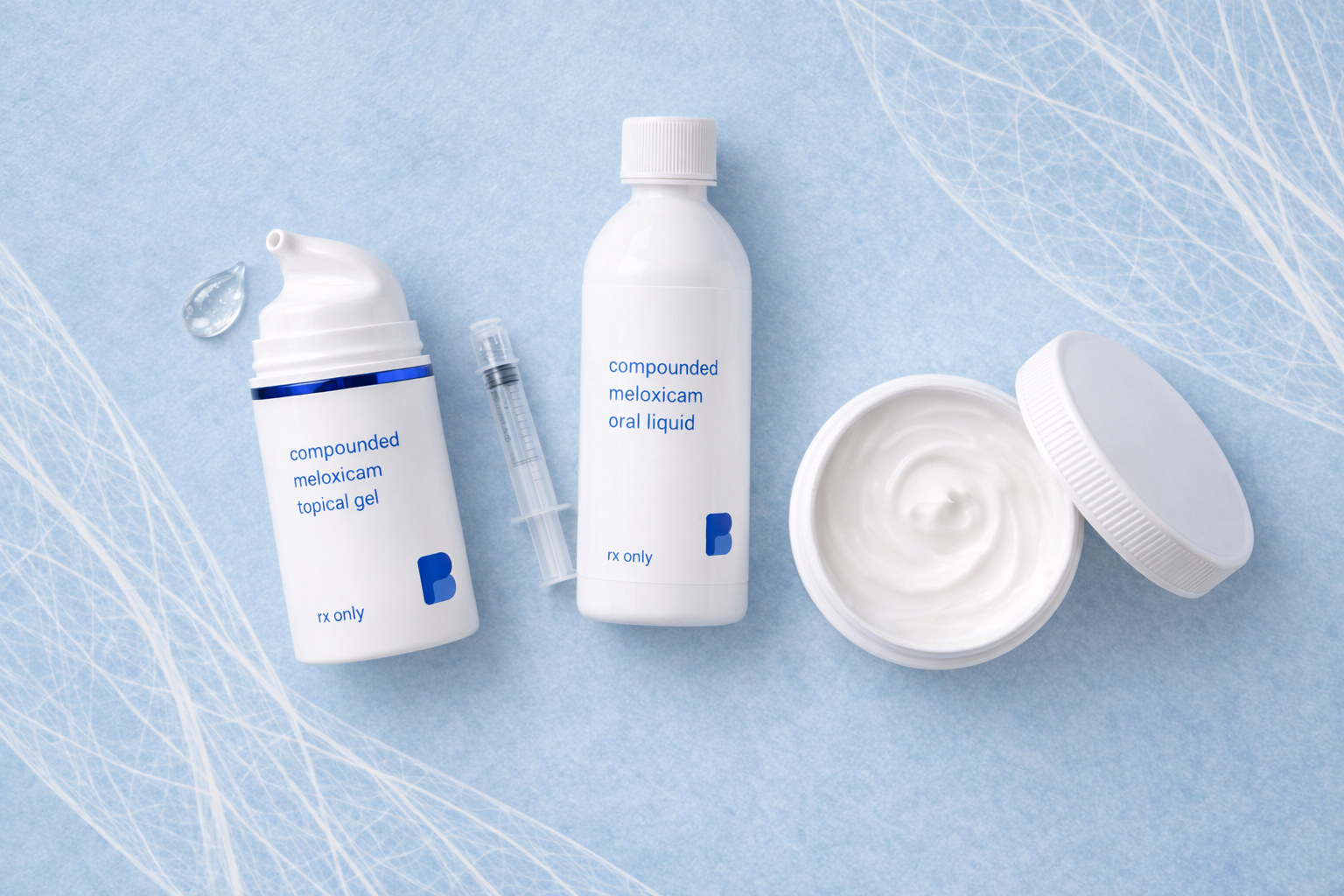
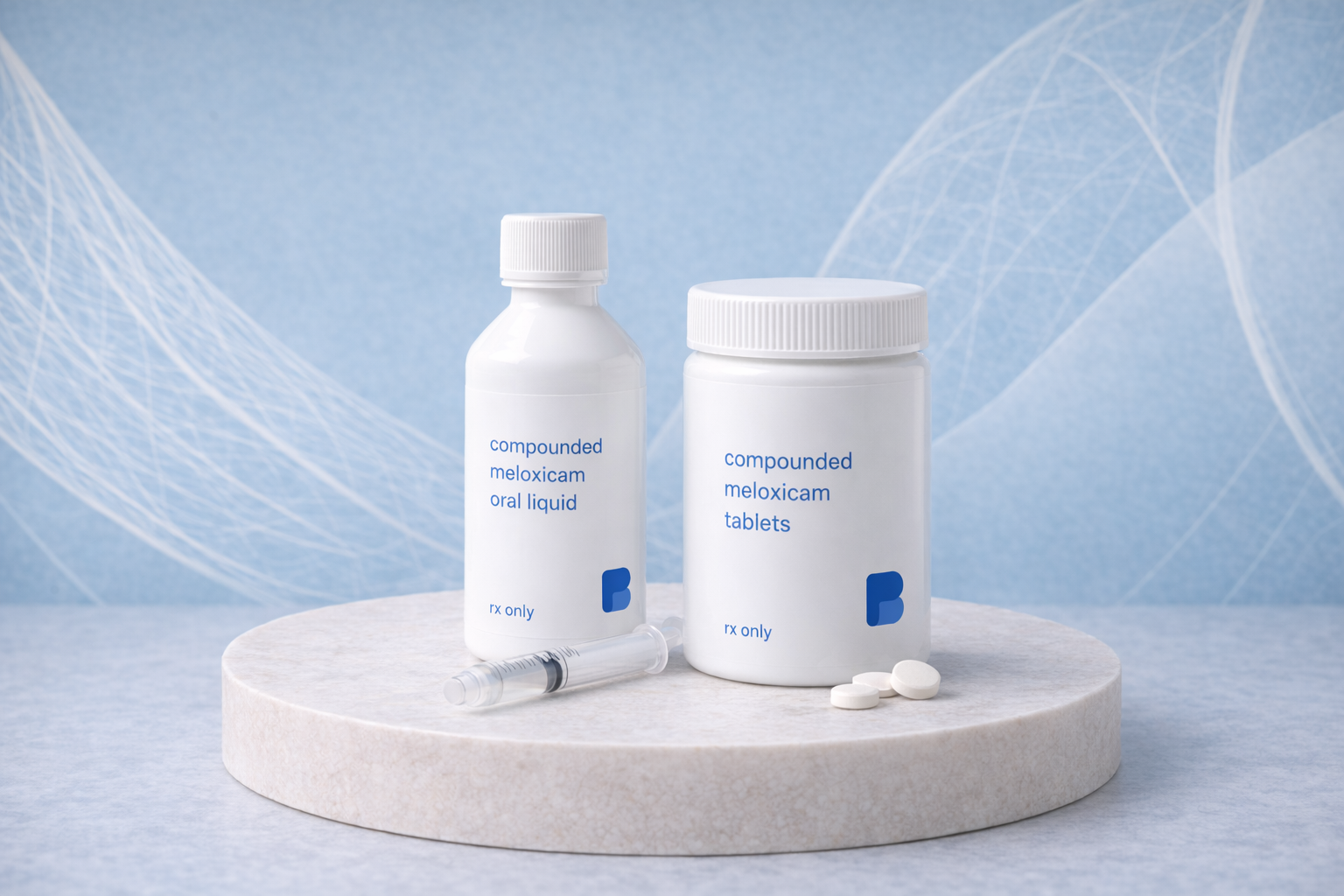
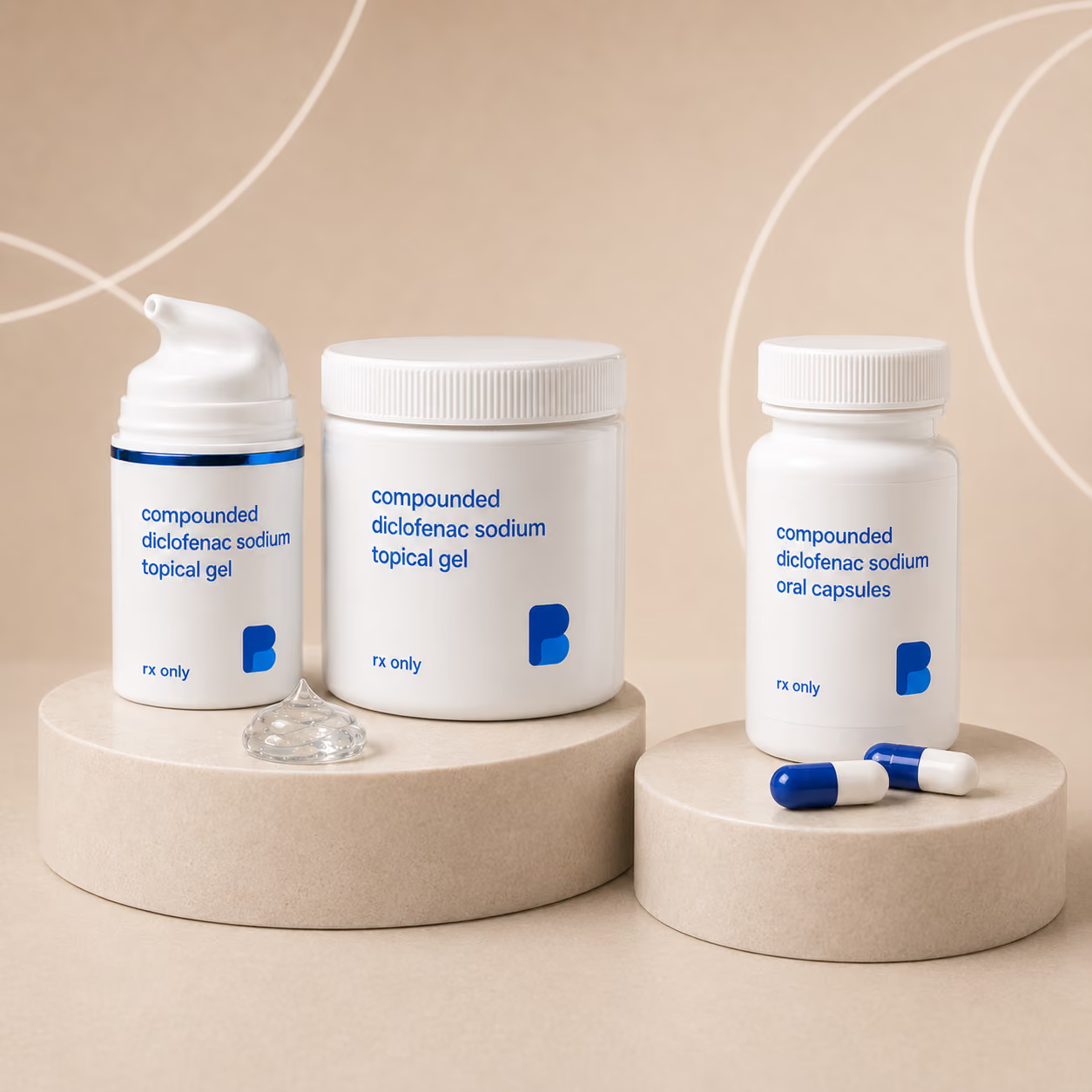
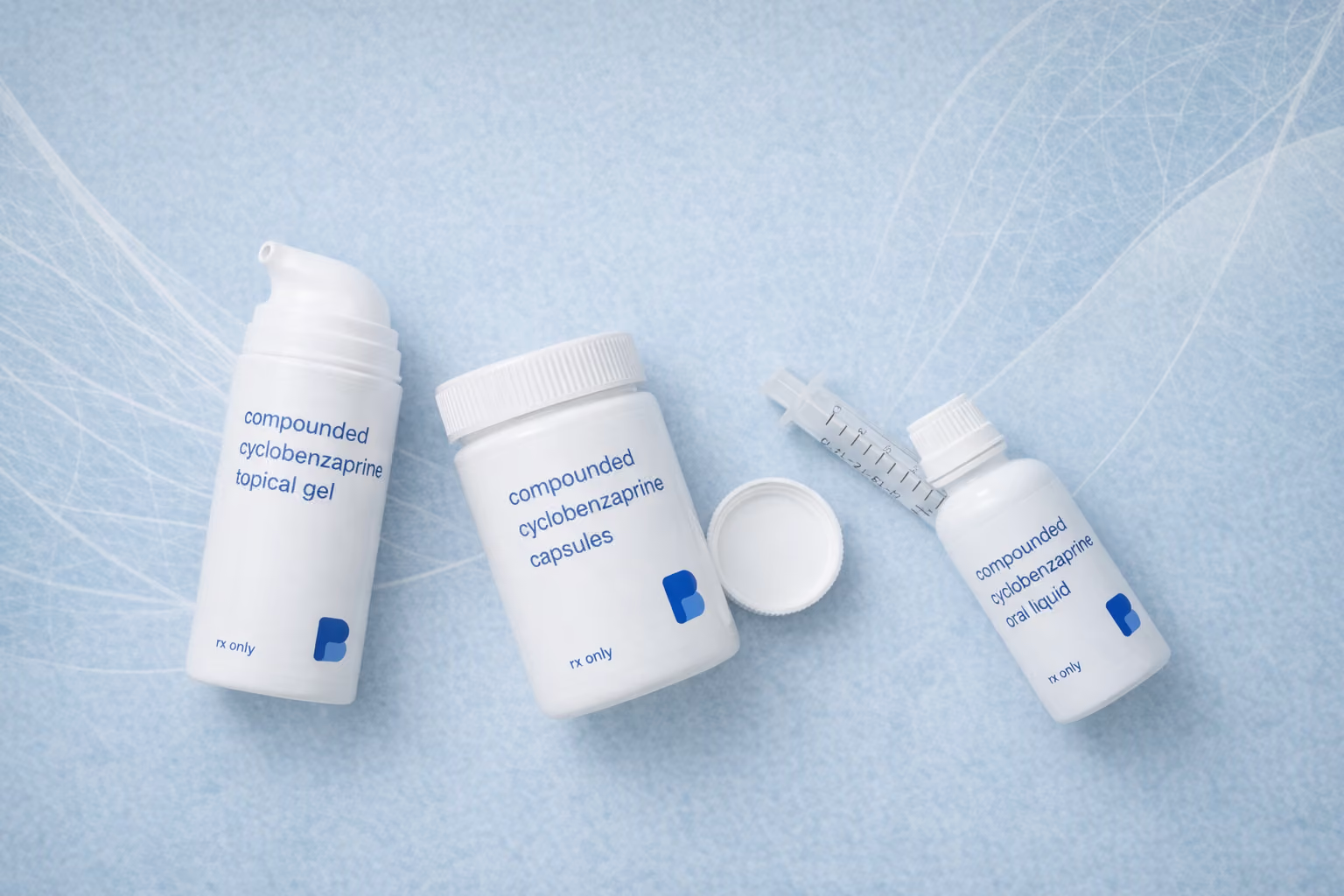
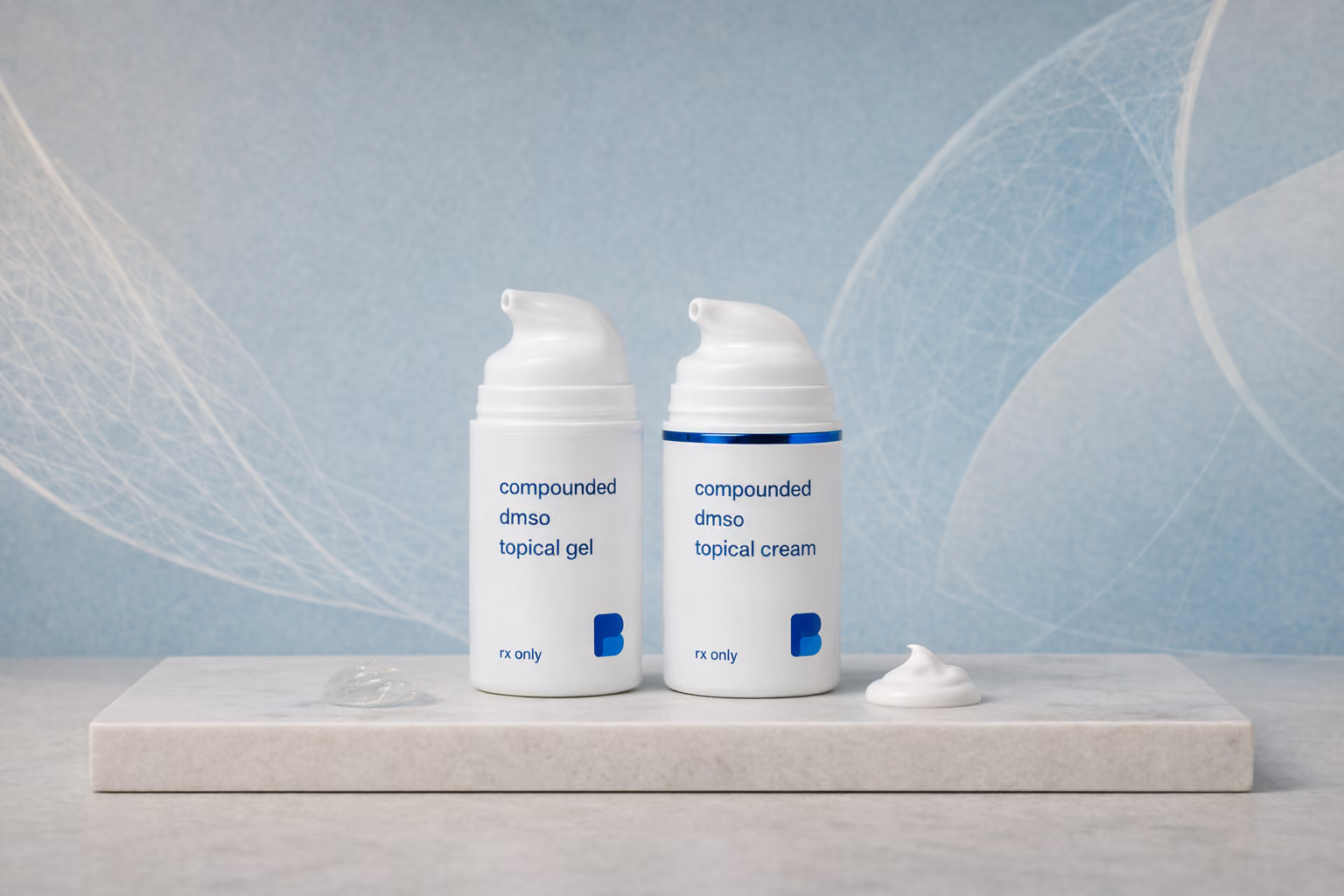
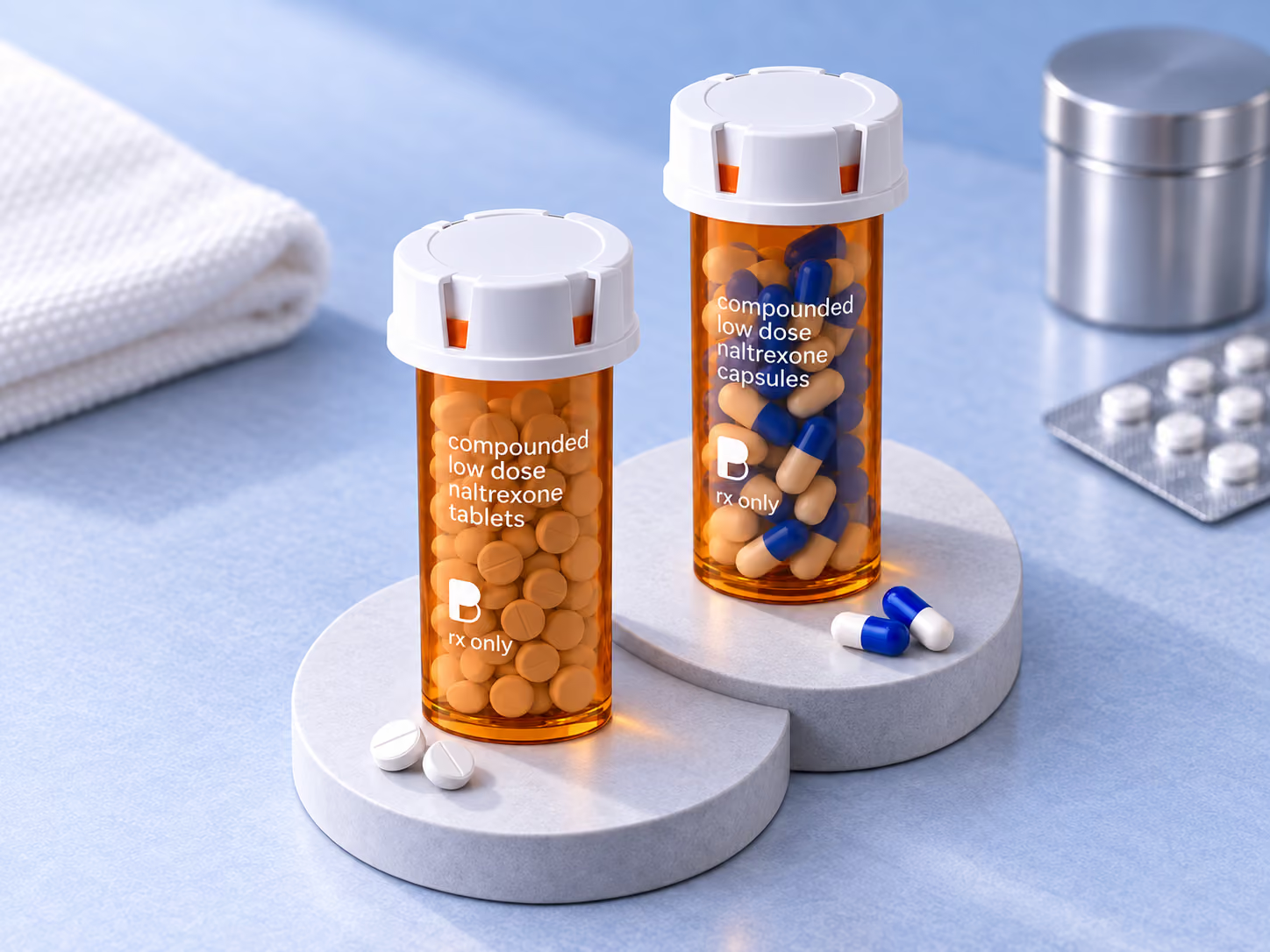
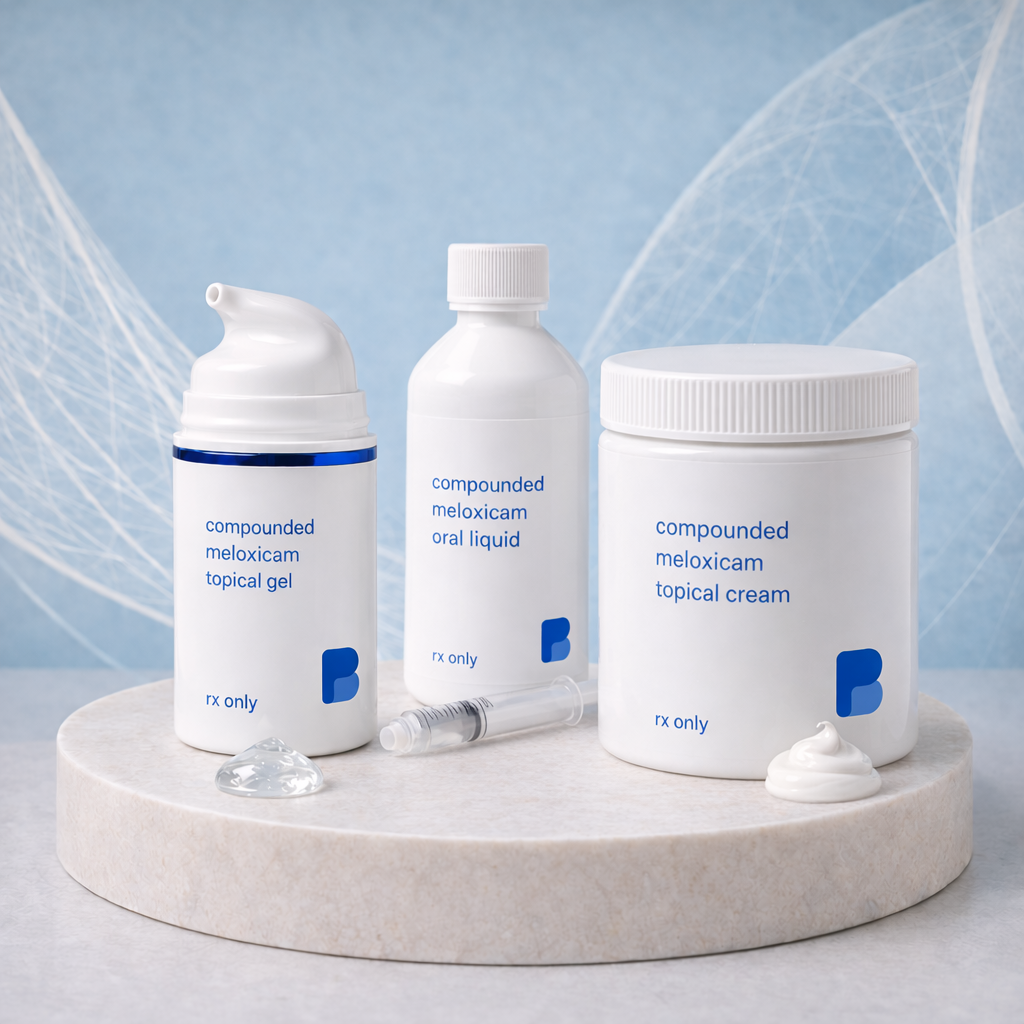
Most people know meloxicam as a 7.5 mg or 15 mg tablet. Bayview compounds it in forms the pharmacy shelf does not carry: gels and creams applied to the skin, combination topicals, a lower-strength 3 mg tablet and oral liquids in several concentrations. See the meloxicam ingredient page for a plain-language overview of the drug itself.
How does it work?
Injured or inflamed tissue produces prostaglandins, chemical signals that drive swelling and pain. Meloxicam blocks the cyclooxygenase (COX) enzymes that make them. At the labeled doses it acts somewhat more on COX-2 than COX-1, but it is still a full NSAID and carries every NSAID warning.
Taken by mouth, meloxicam has a long half-life, which is why the FDA labeling for the tablets calls for a single daily dose. How much meloxicam reaches the tissue from a compounded topical depends on the base, the concentration and the skin it is applied to, and it has not been measured in the kind of trials behind the oral products.
What is it used for?
According to MedlinePlus, manufactured meloxicam is used for:
- Osteoarthritis and rheumatoid arthritis. The FDA-approved uses of the tablets and oral suspension in adults.
- Juvenile rheumatoid arthritis. Approved in children 2 years and older.
- Ankylosing spondylitis. MedlinePlus notes that meloxicam is sometimes used for this.
Compounded topical meloxicam is prescribed off-label for localized joint and soft-tissue pain, often when a prescriber wants to avoid or reduce oral NSAID exposure. The published evidence for topical meloxicam is limited to formulation research and small studies, with no large controlled trials. Bayview prepares it to a prescriber's order and makes no claim that it works for any condition.
How do the forms compare?
The practical question is which form fits the patient. The oral products are the ones with trial evidence behind them; the topical and combination preparations are compounded and off-label.
| Form | Regulatory status | Evidence |
|---|---|---|
| 7.5 mg and 15 mg tablets | FDA-approved, prescription | Established for osteoarthritis and rheumatoid arthritis |
| Oral suspension | FDA-approved, prescription | Same labeled uses as the tablets |
| Compounded oral strengths (3 mg tablets, liquids) | Compounded, not FDA-approved | Relies on the oral meloxicam literature |
| Topical gels and creams | No FDA-approved product; compounded and off-label | Limited; formulation work and small studies |
| Combination topicals | No FDA-approved product; compounded and off-label | Varies by ingredient; combinations not well studied |
A prescriber may choose a compounded form for someone who cannot swallow tablets, needs a dose below 7.5 mg, or wants a topical preparation applied to one area. Those are the prescriber's decisions.
What about combination creams and gels?
Many meloxicam preparations in our formulary pair it with other ingredients in one base: lidocaine and prilocaine (local anesthetics), gabapentin, tizanidine (a muscle relaxant), topiramate, amitriptyline or tramadol. A prescriber orders the combination and concentrations for the individual patient.
Combination topicals are not FDA-approved as products and have not been studied as combinations the way single drugs have. Preparations that contain tramadol include a Schedule IV controlled substance and follow controlled-substance rules.
How is it used?
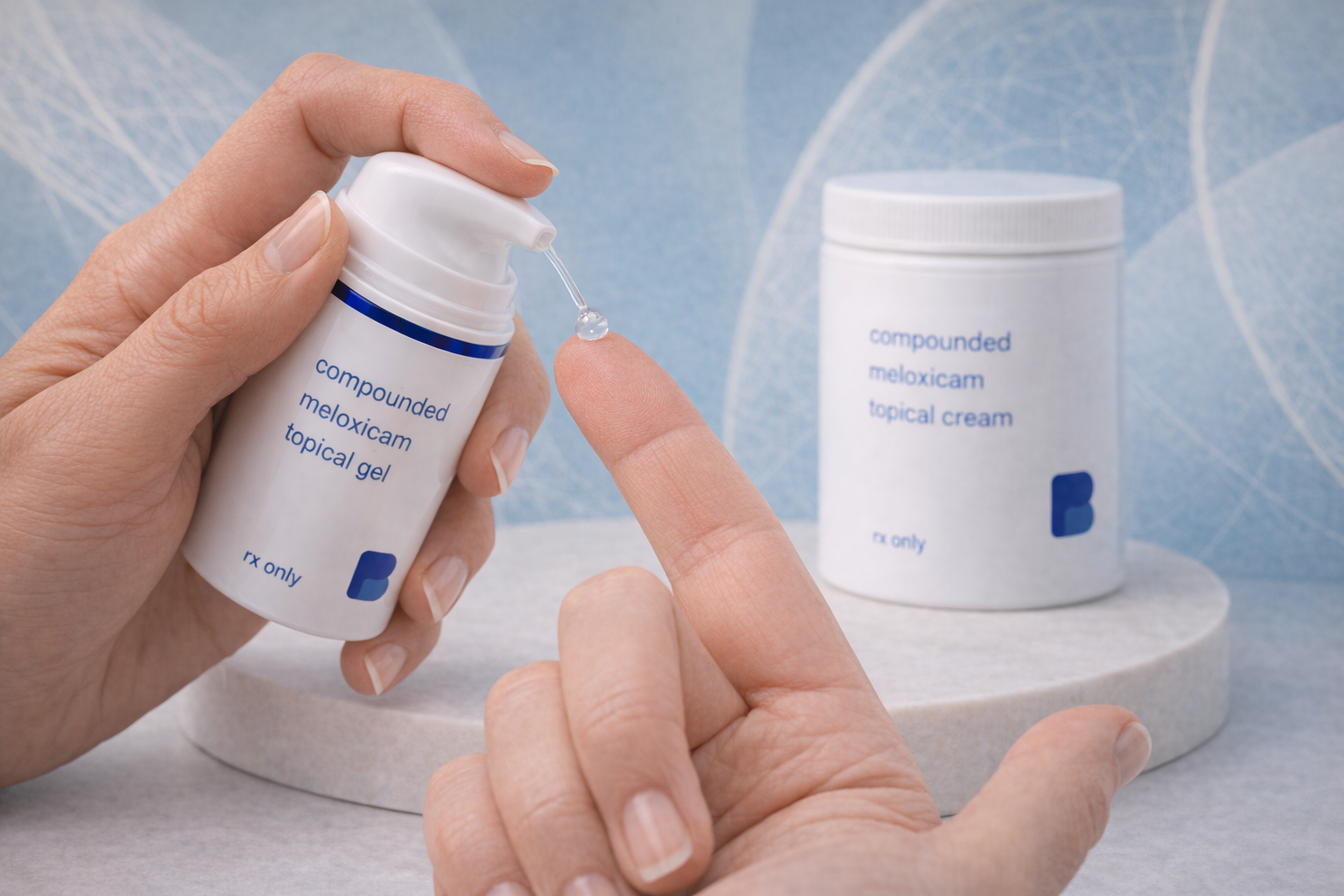
Follow the directions on your label; they come from your prescriber. For topicals, apply only to clean, intact skin over the area your prescriber names, wash your hands afterward unless the hands are the treated area, and do not cover the area with a tight bandage or heating pad unless told to. For oral liquids, measure each dose with the syringe or cup provided, not a kitchen spoon.
Side effects & safety
MedlinePlus lists diarrhea, constipation, gas and sore throat among the side effects of oral meloxicam to report if they are severe or do not go away. Topical preparations can cause skin reactions where they are applied, such as redness, dryness or itching.
The NSAID boxed warning applies to meloxicam: NSAIDs can raise the risk of heart attack and stroke, and can cause serious stomach and intestinal bleeding, ulcers and perforation (FDA Drug Safety Communication). Systemic exposure from a topical is expected to be lower than from a tablet but is not zero.
Get medical help right away for chest pain, shortness of breath, weakness on one side of the body, slurred speech, black or bloody stools, vomiting blood, swelling of the face or throat, or a blistering rash.
Who should not use it?
- Anyone who has had an allergic reaction, asthma attack or hives after meloxicam, aspirin or another NSAID.
- Anyone in the period immediately before or after coronary artery bypass (CABG) surgery.
- Anyone pregnant at 20 weeks or later, unless a prescriber directs it (FDA).
- Anyone applying a topical to broken skin, an open wound or an infected area.
- Anyone already taking another NSAID, including over-the-counter ibuprofen or naproxen, unless the prescriber intends it.
Human meloxicam preparations are not for pets. Veterinary meloxicam is prescribed by a veterinarian for a specific animal.
How should it be stored?
Store it exactly as your label directs and use it before the beyond-use date printed on it. Keep it out of reach of children and pets.
Why is this compounded?
Commercially, meloxicam comes as 7.5 mg and 15 mg tablets and an oral suspension. There is no manufactured topical, no strength below 7.5 mg in tablet form, and no combination product. Compounding fills those gaps on a prescriber's order.
Bayview prepares each order to the prescription under USP 795 non-sterile compounding standards, in the strength, base and container your prescriber specifies.
Clinical details for prescribers
Regulatory status. Single-agent meloxicam preparations are noncontrolled, so eRx, fax and phone orders are accepted. Combinations containing tramadol are Schedule IV: prescription for a named patient only, and not shipped to New York addresses. All compounded meloxicam is 503A, patient-specific and not FDA-approved.
Formulation & dosing. Formulary preparations include meloxicam 15 mg/mL topical gel; meloxicam 0.3%/tizanidine 0.2% cream; combination creams and gels with lidocaine, prilocaine, gabapentin, topiramate, amitriptyline or tramadol; 3 mg tablets; and oral liquids at 1, 1.5, 3, 5 and 30 mg/mL. For reference, the FDA labeling for oral meloxicam in osteoarthritis and rheumatoid arthritis starts at 7.5 mg once daily with a 15 mg daily maximum. Dose selection for any compounded preparation is the prescriber's decision.
Counseling / clinical points:
- Screen for cardiovascular and GI risk, renal impairment, heart failure and hypertension
- Avoid concurrent NSAIDs unless intended, since exposure is additive
- Topicals: clean, intact skin only; no occlusion or heat unless directed
- Avoid from 20 weeks of pregnancy per FDA guidance
- Trial evidence sits with oral meloxicam; topical and combination use is off-label
Send orders by eRx to Bayview Pharmacy (NCPDP 4106882) or fax 401-284-4506. See how to e-prescribe and the for providers page.
Compounded meloxicam is a compounded medication and is not FDA-approved. The FDA has not evaluated compounded preparations for safety, effectiveness or quality.