





4-Aminopyridine (4-AP), also called fampridine, is a medicine that blocks potassium channels on nerve fibers. Its FDA-approved form is dalfampridine extended-release 10 mg tablets, sold as Ampyra and as generics. FDA approved the tablet in 2010 to improve walking in adults with multiple sclerosis (MS), as shown by an increase in walking speed (FDA; prescribing information).
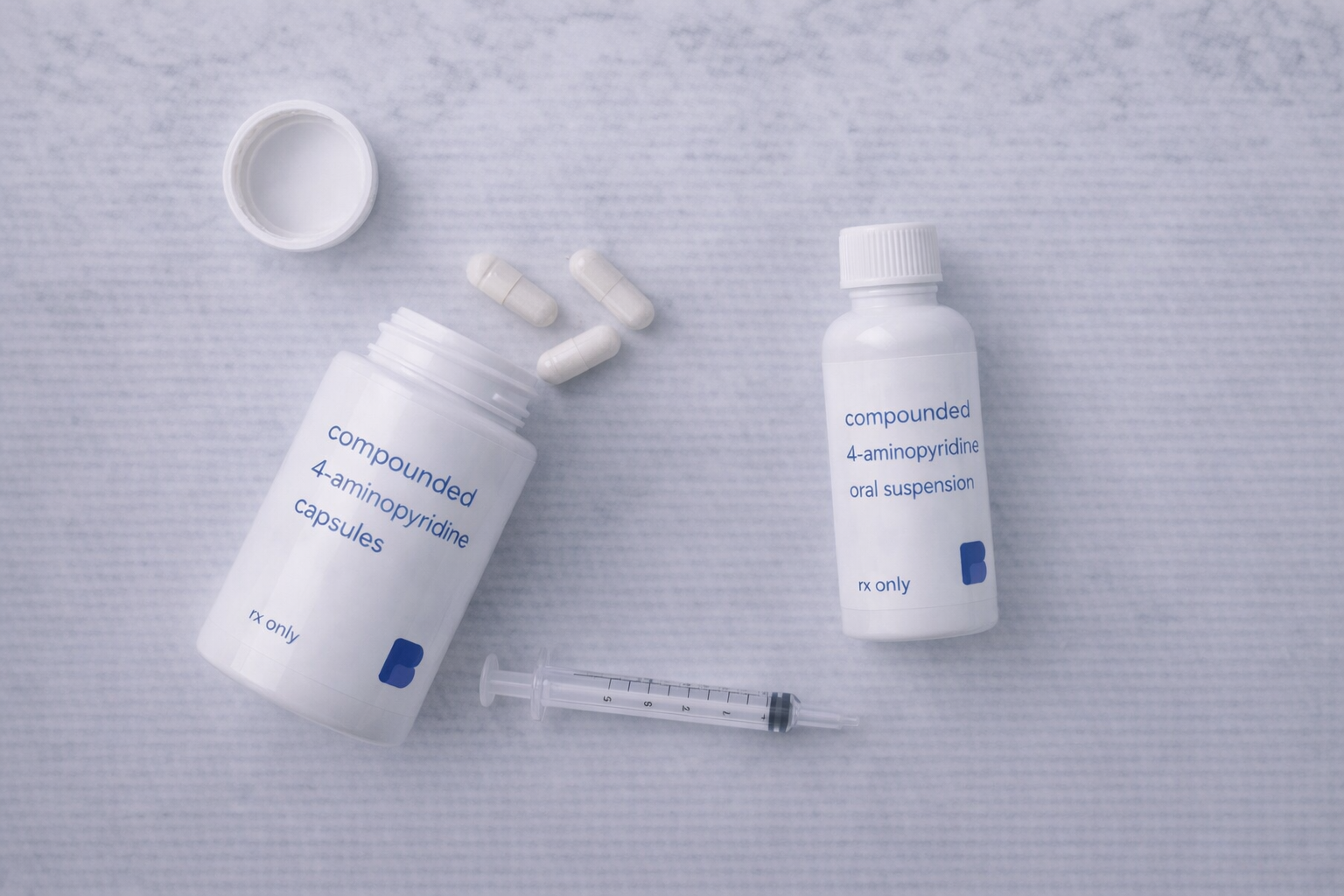
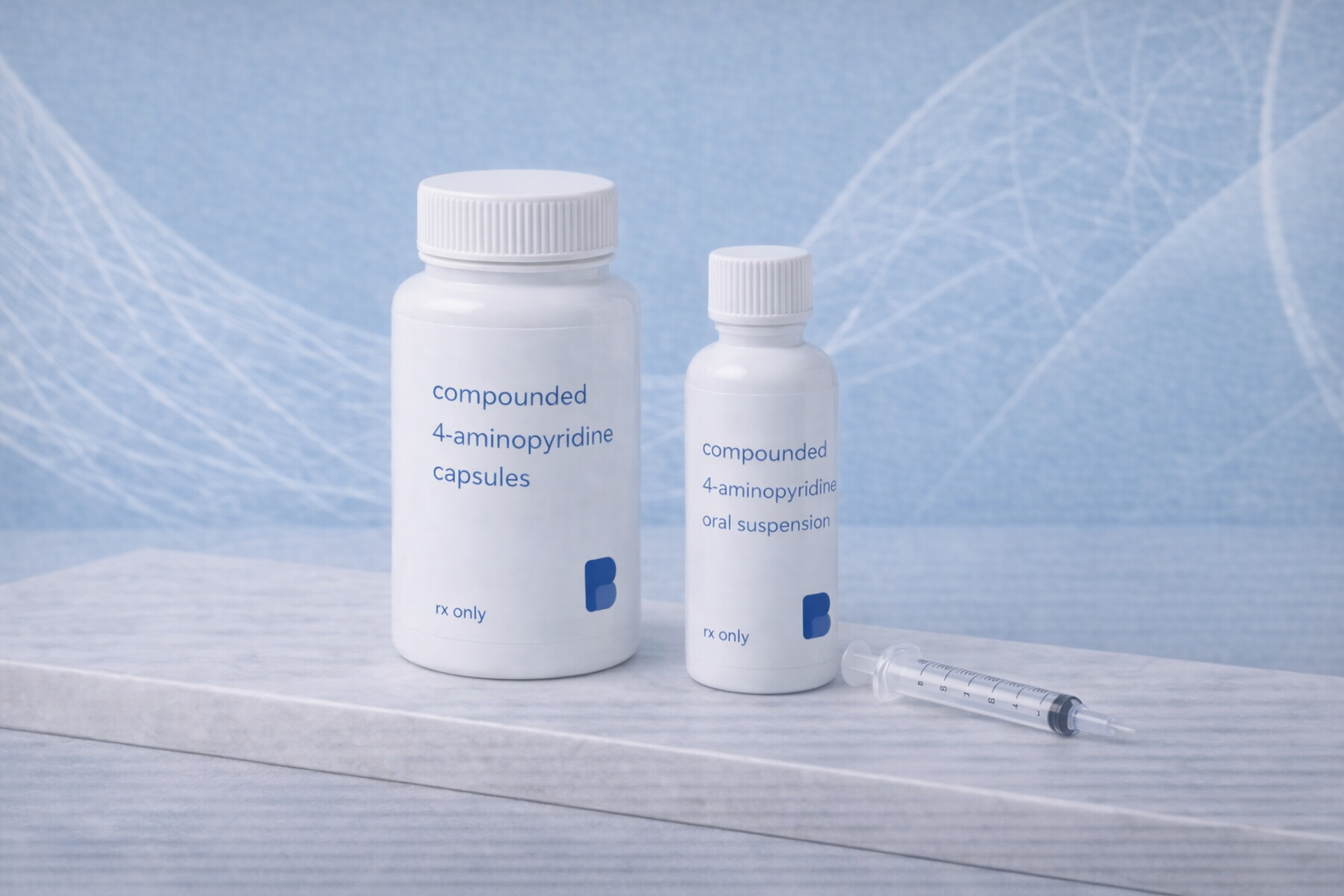
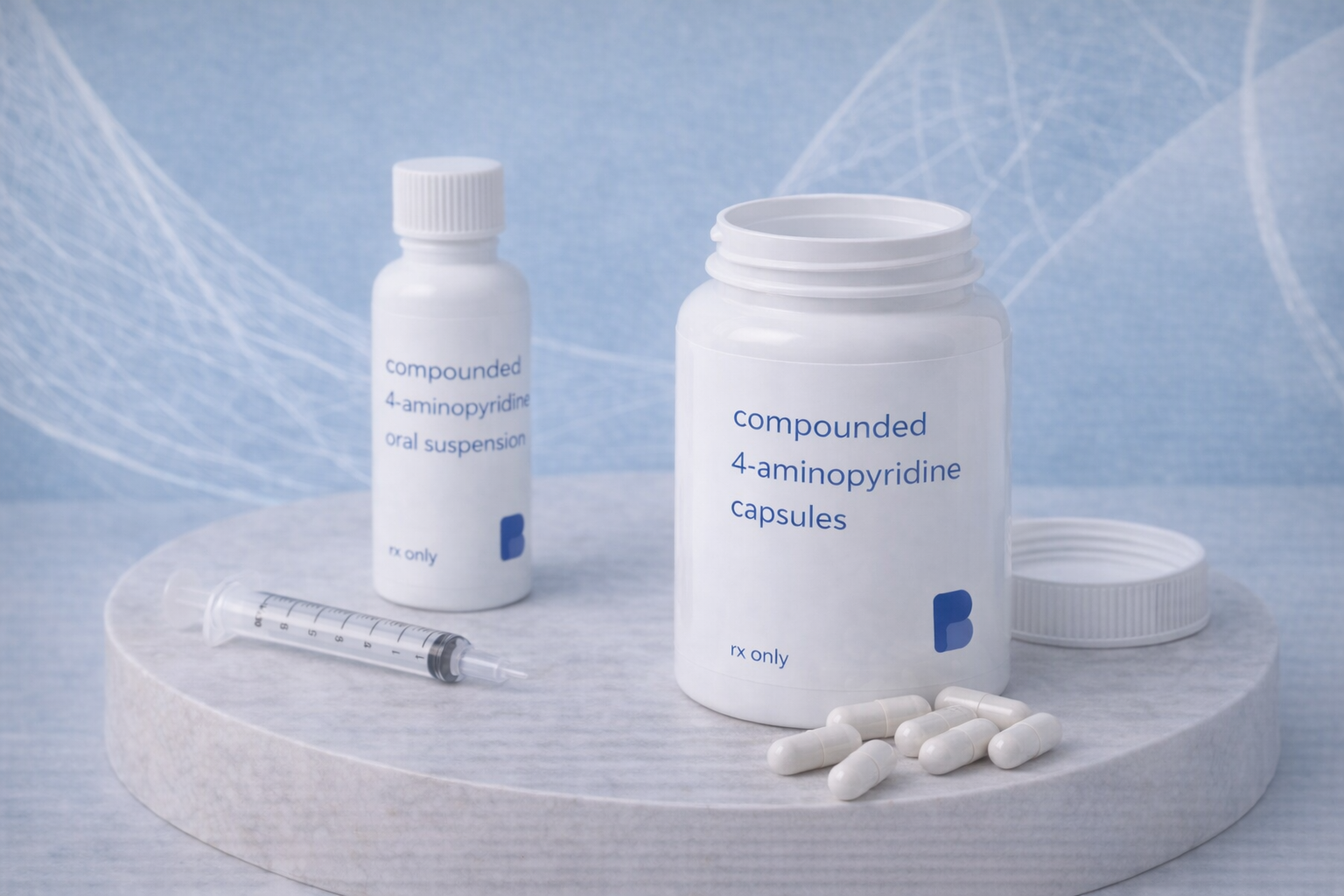
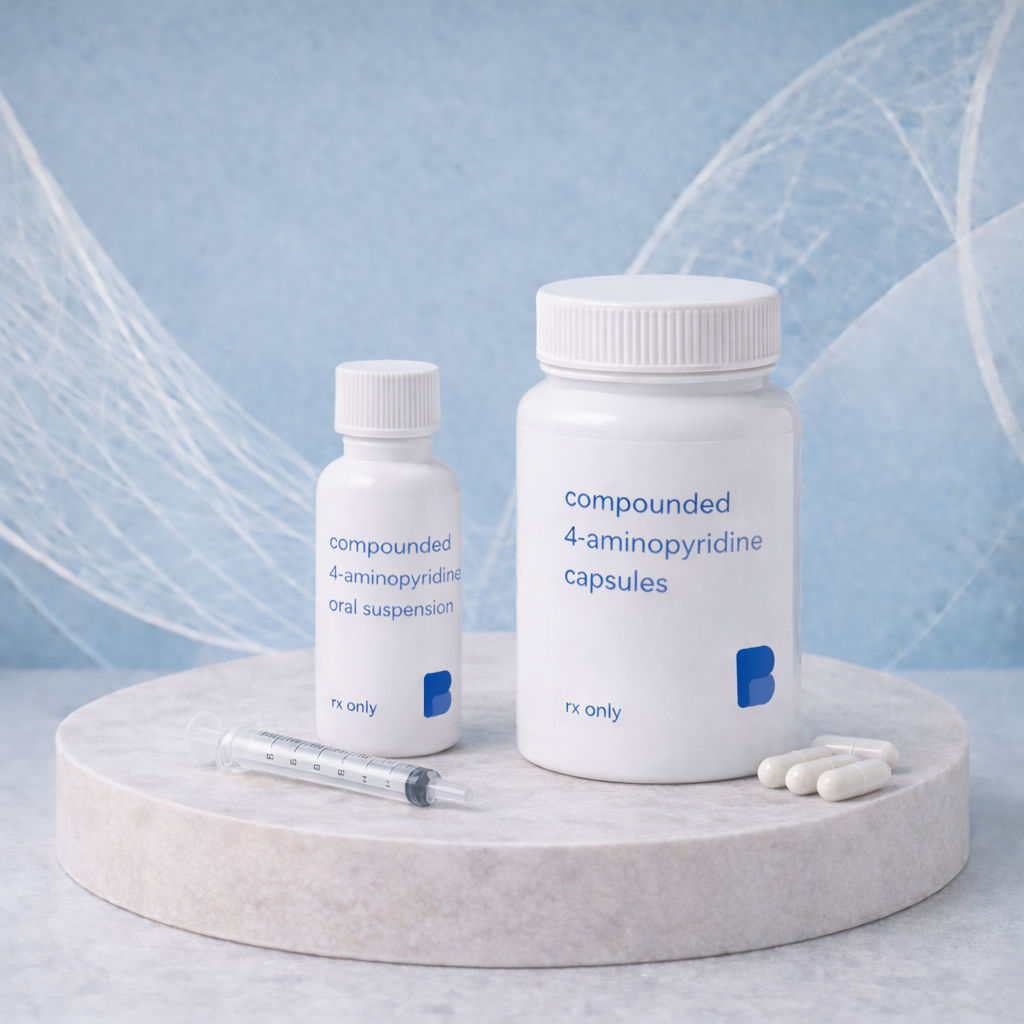
Bayview Pharmacy compounds 4-aminopyridine in forms that tablet does not cover: sustained-release capsules in strengths other than 10 mg, and an oral suspension measured by the dose. A prescriber may choose these when a patient needs a dose the tablet does not provide or cannot swallow a tablet whole, and neurologists also prescribe 4-aminopyridine off-label for some other nerve conditions. Your prescriber decides whether 4-aminopyridine fits your situation, and a valid prescription is required.
How does 4-aminopyridine work?
Nerve fibers carry signals along a protective coating called myelin. In MS that coating is damaged. 4-Aminopyridine blocks potassium channels, and in animal studies blocking these channels helped damaged nerve fibers carry signals. Exactly how it improves walking is not fully understood (prescribing information).
What is 4-aminopyridine prescribed for?
- Walking in multiple sclerosis. This is the FDA-approved use of the dalfampridine tablet (prescribing information).
- Downbeat nystagmus. In a randomized, placebo-controlled crossover trial of 27 people with this eye movement disorder, eye drift slowed significantly from its starting level on 4-aminopyridine 5 mg four times a day but not on placebo; a 10 mg dose did not slow it significantly. One person was withdrawn because of a change on the heart tracing (ECG) (Claassen 2013).
- Episodic ataxia type 2. In a small crossover trial of 10 people with episodic ataxia type 2 or a related inherited ataxia, attacks of imbalance were less frequent on 4-aminopyridine 5 mg three times a day than on placebo (Strupp 2011). A later trial in 30 people (22 completed) compared prolonged-release fampridine, acetazolamide, and placebo: attacks fell to 63% of the placebo rate with fampridine and 52% with acetazolamide, and fampridine caused fewer side effects (Muth 2021).
- Spinal cord injury (not supported). Two large trials of a sustained-release form for spasticity after chronic spinal cord injury did not meet their main goals (Cardenas 2014).
Uses other than MS walking are off-label, the evidence comes from small studies, and none of these studies tested Bayview's preparations. Lambert-Eaton myasthenic syndrome is treated with amifampridine (3,4-diaminopyridine), a different medicine (amifampridine label).
Why is 4-aminopyridine compounded?
The FDA-approved tablet comes in one strength, 10 mg, and must be swallowed whole: it cannot be divided, crushed, chewed, or dissolved (prescribing information). A prescriber who wants a different dose, or a patient who cannot swallow a tablet, has no manufactured option.
How fast 4-aminopyridine is released matters. Immediate-release 4-aminopyridine reaches its peak quickly and has a shorter apparent half-life (about 3 to 4 hours, compared with 6 to 8 hours for sustained-release forms), and an FDA medical review noted that early studies linked its toxicity to peak blood levels (FDA medical review). In the tablet's studies, an oral solution reached a higher peak, sooner, than the tablet (prescribing information). Bayview's capsules use a hypromellose base intended to slow release, but like every compounded preparation, their release has not been evaluated by FDA.
| Sustained-release capsules | Oral suspension | |
|---|---|---|
| What it is | A capsule made with hypromellose, a base used to slow release | A liquid with 2 mg of 4-aminopyridine in each mL (10 mg per 5 mL) |
| Strengths Bayview prepares | 5 mg and 12.5 mg; other strengths on prescription | 2 mg/mL, with the dose measured in mL |
| How it is taken | Swallowed whole on the schedule your prescriber sets, often twice a day about 12 hours apart | Measured with an oral syringe at each dose, on the schedule your prescriber sets |
This comparison is for education only and is not a statement that either form is better or more effective. Your prescriber chooses the form, strength, and schedule.
Side effects & safety
Seizures are the main risk. In the tablet's studies, seizures were more common at higher doses, and most seizures reported after approval happened at the usual dose, in people with no history of seizures, within days to weeks of starting. Anyone who has a seizure should stop 4-aminopyridine and not restart it (prescribing information).
Kidney function matters because the kidneys clear almost all of the drug. Reduced kidney function raises blood levels and the seizure risk, so prescribers check kidney function before starting and at least once a year (prescribing information).
Common side effects with the tablet include urinary tract infection, trouble sleeping, dizziness, headache, nausea, weakness, back pain, and problems with balance. Serious allergic reactions, including hives, swelling of the throat or tongue, and trouble breathing, have been reported. Cimetidine can raise blood levels of 4-aminopyridine (prescribing information).
Too much 4-aminopyridine can cause seizures, confusion, shaking, sweating, and memory loss (prescribing information). Reported overdoses include cases where a compounded product contained far more 4-aminopyridine than prescribed (Ballesta Méndez 2014; LiverTox).
Who should not use it?
Do not use 4-aminopyridine if you have ever had a seizure, if you have moderate or severe kidney disease, or if you are allergic to 4-aminopyridine or any ingredient in your prescription (prescribing information). Do not take it together with dalfampridine tablets or any other 4-aminopyridine product. Tell your prescriber if you have mild kidney problems, take cimetidine, or are pregnant or breastfeeding (prescribing information). MedlinePlus also asks patients to tell their doctor about any pharmacist-prepared 4-AP they take (MedlinePlus).
How do I get started?
Talk with the neurologist or other prescriber who manages your condition. A licensed prescriber decides whether 4-aminopyridine is appropriate and chooses the form, strength, and schedule. Bayview Pharmacy does not provide consultations or determine appropriateness. Already have a prescription at another pharmacy? You can transfer it to Bayview. Once you have a prescription, your prescriber can order through Bayview, and a pharmacist is available if you have questions. 4-Aminopyridine is part of our compounded medications catalog, alongside custom oral suspensions and low dose naltrexone.
Clinical details for prescribers
Regulatory. Dalfampridine extended-release 10 mg tablets were approved January 22, 2010 (NDA 022250) to improve walking in adults with MS, as demonstrated by an increase in walking speed (Drugs@FDA). Labeling: 10 mg twice daily about 12 hours apart, with no evidence of additional benefit above that dose; swallow whole; contraindicated with any history of seizure and with CrCl 50 mL/min or less; section 5.3 advises avoiding concomitant use with other forms of 4-aminopyridine, and the Medication Guide names compounded 4-AP (labeling). At approval, the REMS told prescribers to discontinue pharmacy-compounded 4-AP before starting the tablet and not to substitute compounded forms because their pharmacokinetics are unknown (REMS). Not a controlled substance. Compounded 4-aminopyridine is not FDA-approved. Under section 503A, a compounded product that uses a commercial product's active ingredient at the same, a similar (within 10%), or an easily substitutable strength, by the same route, is essentially a copy unless the prescriber documents a significant difference for the patient; for a 10 mg capsule, note the patient-specific change and why it is needed (FDA 503A guidance).
Dosing, monitoring, and pharmacokinetics (labeling):
- Estimate CrCl before starting and at least annually. In mild renal impairment (CrCl 51 to 80 mL/min), exposure may approach that of 15 mg twice daily; weigh benefit against seizure risk.
- Seizures: more frequent at 20 mg twice daily in controlled trials; in open-label extensions, 1.7 per 100 patient-years at 15 mg twice daily versus 0.4 at 10 mg twice daily. Discontinue permanently after a seizure.
- OCT2 inhibitors such as cimetidine increase exposure (cimetidine raised AUC to 125% of reference). No interaction with baclofen.
- Extended-release tablet: Tmax 3 to 4 hours, half-life 5.2 to 6.5 hours, about 96% of a dose recovered in urine, mostly unchanged. An oral solution gave a higher, earlier peak (about 1.3 hours) with the same total exposure. The FDA medical review gives an apparent half-life of about 3 to 4 hours for immediate-release 4-AP versus 6 to 8 hours for sustained-release forms (reflecting slower absorption) and notes that earlier studies related toxicity to peak serum levels (FDA medical review). Bayview's suspension is immediate-release: at 10 mg, an oral solution gave roughly twice the tablet's peak level (42.7 versus 17.3 to 21.6 ng/mL), so mg-for-mg conversion from the tablet is not equivalent (labeling).
- Overdose: seizures, confusion, tremor, diaphoresis, and amnesia, sometimes status epilepticus. Published compounding errors include products containing 90 to 126 mg per tablet instead of 10 mg (LiverTox) and pharmacy-prepared pills containing more than 80 mg instead of 10 mg (Ballesta Méndez 2014).
Off-label evidence:
- Downbeat nystagmus: randomized double-blind crossover, n = 27, 4-AP 5 mg four times daily for 3 days, then 10 mg four times daily for 4 days; slow-phase velocity 2.42 to 1.38 deg/s on 5 mg (versus baseline, p = 0.04), 2.03 on 10 mg (not significant); placebo arm 2.02 to 1.25 (not significant); no direct 4-AP versus placebo test; 57% responders; one withdrawal for QTc prolongation (Claassen 2013). A review suggests 5 mg two to four times daily (or sustained-release 10 mg once or twice daily) with an ECG at baseline and about 45 minutes after a dose (Kalla et al. 2016).
- Episodic ataxia type 2 and related familial episodic ataxias: crossover, n = 10 (7 with genetically confirmed EA2), 5 mg three times daily; median attacks per month 6.50 on placebo versus 1.65 on 4-AP (p = 0.03), attack duration not significantly changed (Strupp 2011). EAT2TREAT, three-arm crossover, 30 enrolled and 22 completed: prolonged-release fampridine 10 mg twice daily and acetazolamide 250 mg three times daily reduced the attack rate to 63% and 52% of placebo (Class II evidence that both reduce attacks); acetazolamide gave a larger absolute reduction than fampridine (difference 8.39 attacks per 30 days, 95% CI 3.39 to 13.39), and the fampridine versus placebo absolute difference (minus 8.00, 95% CI minus 17.91 to 1.91) crossed zero; adverse events 26.5% fampridine, 44.9% acetazolamide, 28.6% placebo (Muth 2021).
- Chronic spinal cord injury: two phase 3 trials (n = 212 and 203) of fampridine-SR 25 mg twice daily did not meet their primary endpoints (Cardenas 2014).
- KCNA2 gain-of-function developmental and epileptic encephalopathy: n-of-1 trials in 11 patients, 9 with benefit; specialist use (Hedrich 2021).
- Lambert-Eaton myasthenic syndrome: amifampridine (3,4-diaminopyridine) is the FDA-approved treatment, a different drug (amifampridine labeling).
What Bayview compounds (2026 fills):
- 4-Aminopyridine 5 mg and 12.5 mg sustained-release capsules (hypromellose matrix, Methocel E4M). Strengths differ from the 10 mg tablet by more than 10%, and the tablet cannot be divided.
- 4-Aminopyridine 2 mg/mL (10 mg/5 mL) oral suspension, 180 or 360 mL, dosed by oral syringe; no manufactured liquid exists.
- Writing the prescription: the strength and form (for example 4-aminopyridine 5 mg sustained-release capsules), directions with the total daily dose, any titration written out in mL, an ICD-10 code for the indication, quantity, and refills. A 10 mg capsule needs the patient-specific change and reason.
Licensed to dispense in RI, MA, CT, NJ, NH, FL, ME, and PA. Ordering and account setup are covered on our for providers page.
This information is about prescription medications and is not medical advice. Compounded medications are prescription-only and are not FDA-approved. Your prescriber determines whether 4-aminopyridine is appropriate and sets the form, strength, and schedule.
References
- Dalfampridine extended-release tablets (Ampyra), prescribing information and Medication Guide, revised March 2025
- Drugs@FDA: NDA 022250, dalfampridine, approved January 22, 2010
- FDA medical review of dalfampridine (NDA 022250), 2009
- Ampyra Risk Evaluation and Mitigation Strategy (REMS), January 2010
- MedlinePlus: dalfampridine
- LiverTox (NIH): dalfampridine
- Ballesta Méndez et al. 2014: prolonged toxic encephalopathy after accidental 4-aminopyridine overdose (Case Rep Neurol Med)
- Claassen et al. 2013: 4-aminopyridine in downbeat nystagmus, randomized crossover trial (J Neurol Neurosurg Psychiatry)
- Kalla et al. 2016: update on the pharmacotherapy of cerebellar and central vestibular disorders (J Neurol)
- Strupp et al. 2011: 4-aminopyridine in episodic ataxia type 2, randomized crossover trial (Neurology)
- Muth et al. 2021: fampridine and acetazolamide in episodic ataxia type 2, EAT2TREAT trial (Neurol Clin Pract)
- Cardenas et al. 2014: sustained-release fampridine in chronic spinal cord injury, two phase 3 trials (Spinal Cord)
- Hedrich et al. 2021: 4-aminopyridine in KCNA2 gain-of-function epileptic encephalopathy (Sci Transl Med)
- Amifampridine (3,4-diaminopyridine) prescribing information, revised July 2025
- FDA guidance: compounded drugs that are essentially copies (503A)
- U.S. EPA: 4-aminopyridine reregistration eligibility decision, 2007