




Spironolactone is a prescription medicine that blocks the hormone aldosterone and also blocks androgen receptors. Its FDA-approved forms are taken by mouth: tablets of 25, 50, and 100 mg, and an oral suspension of 25 mg per 5 mL. The tablets are approved for heart failure, as an add-on treatment for high blood pressure, for fluid buildup from liver or kidney disease, and for primary hyperaldosteronism (prescribing information); the oral suspension is approved for some of the same uses (oral suspension label). Because it blocks androgens, spironolactone taken by mouth is also used off-label for acne, which the American Academy of Dermatology's 2024 guideline covers (Reynolds et al. 2024), and for pattern hair loss in women (Wang et al. 2023). MedlinePlus notes its use for unwanted facial hair in women (MedlinePlus).
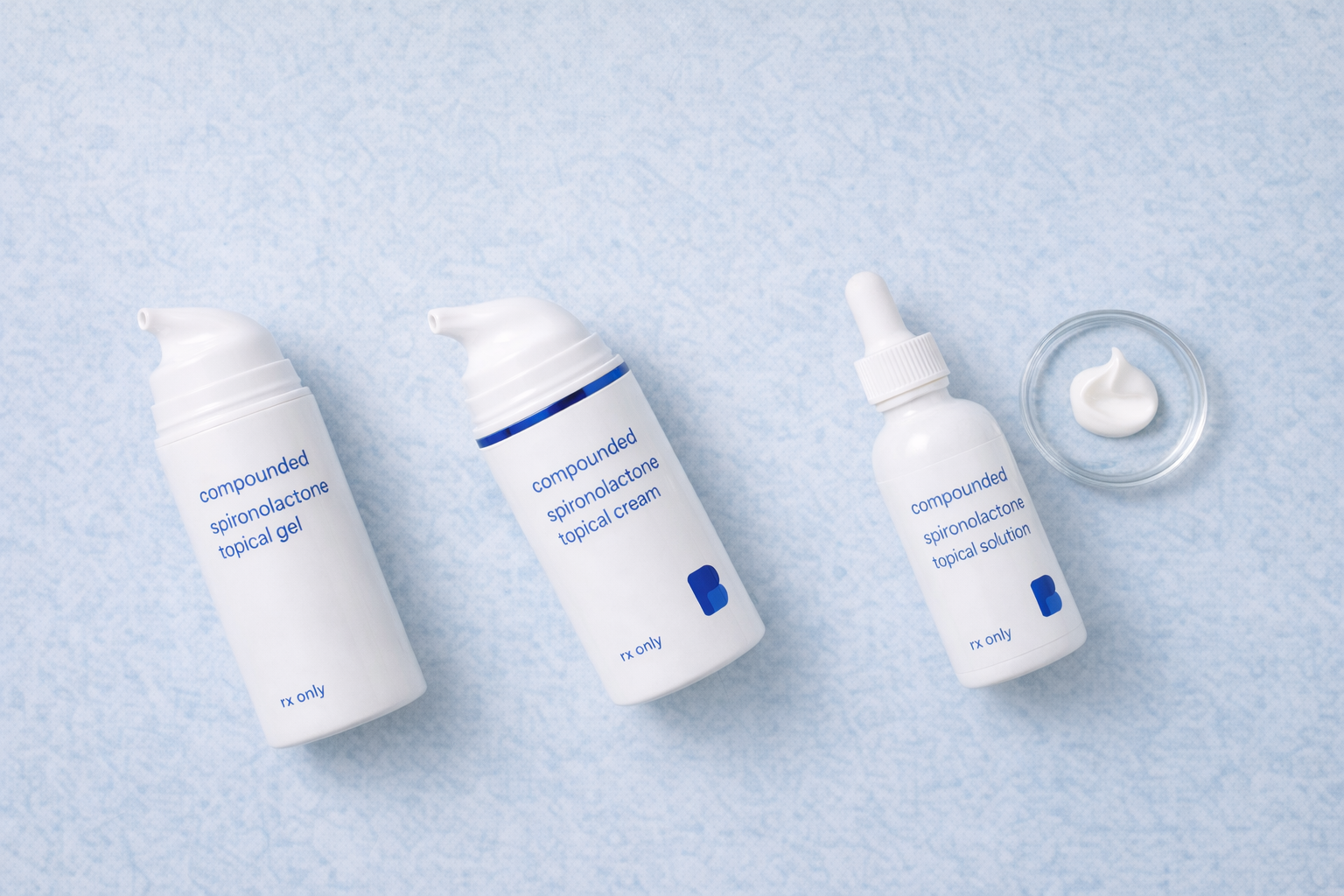
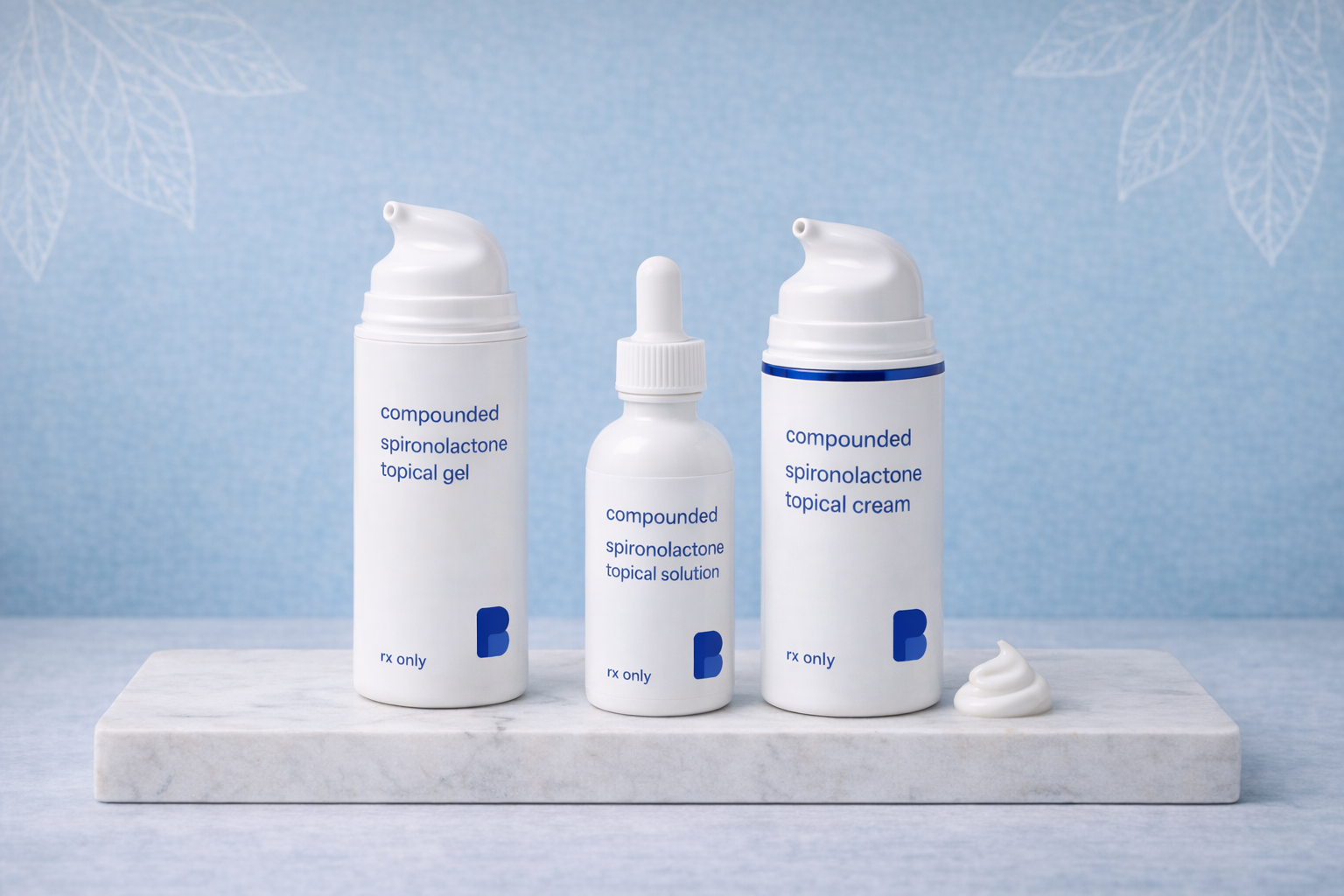
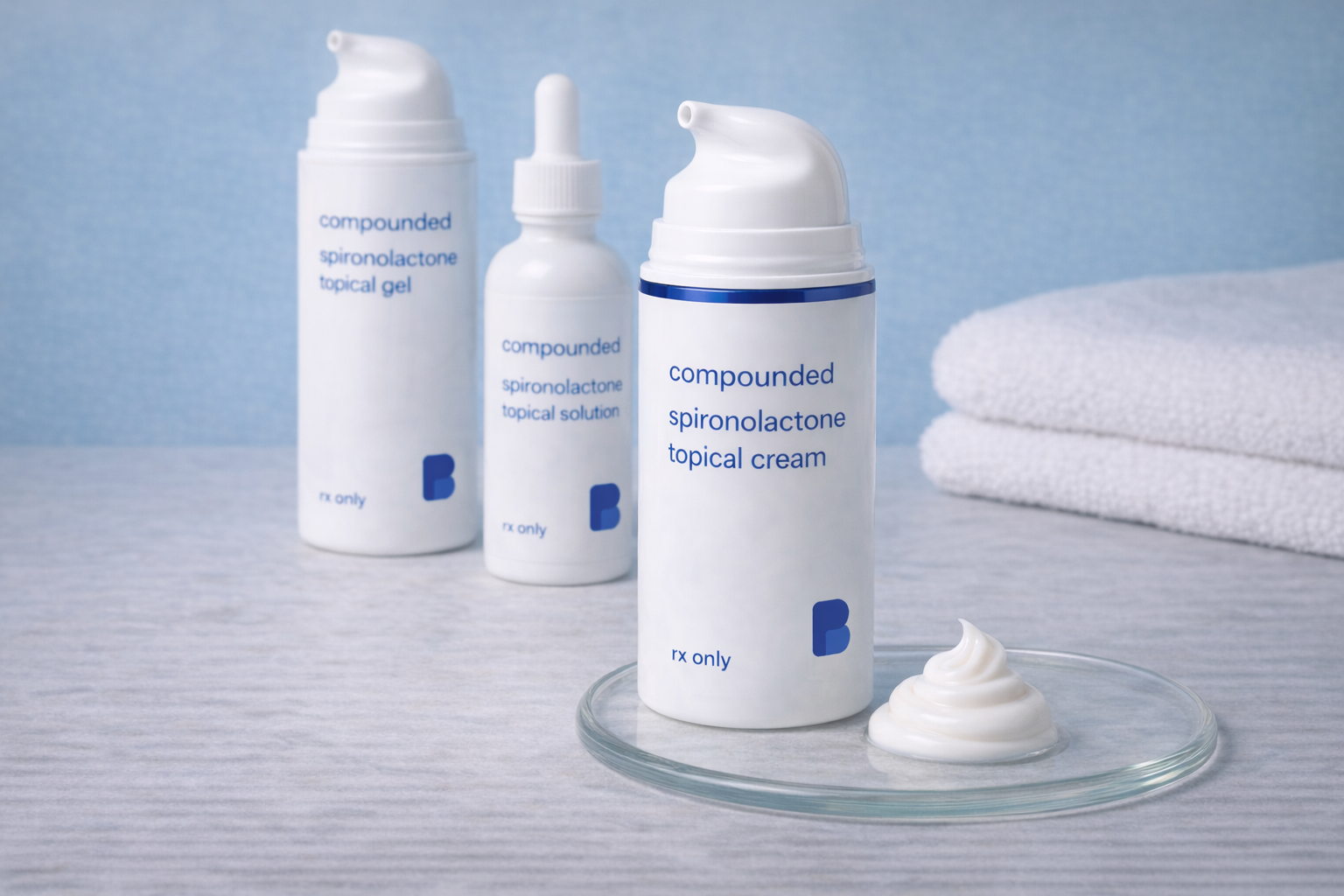
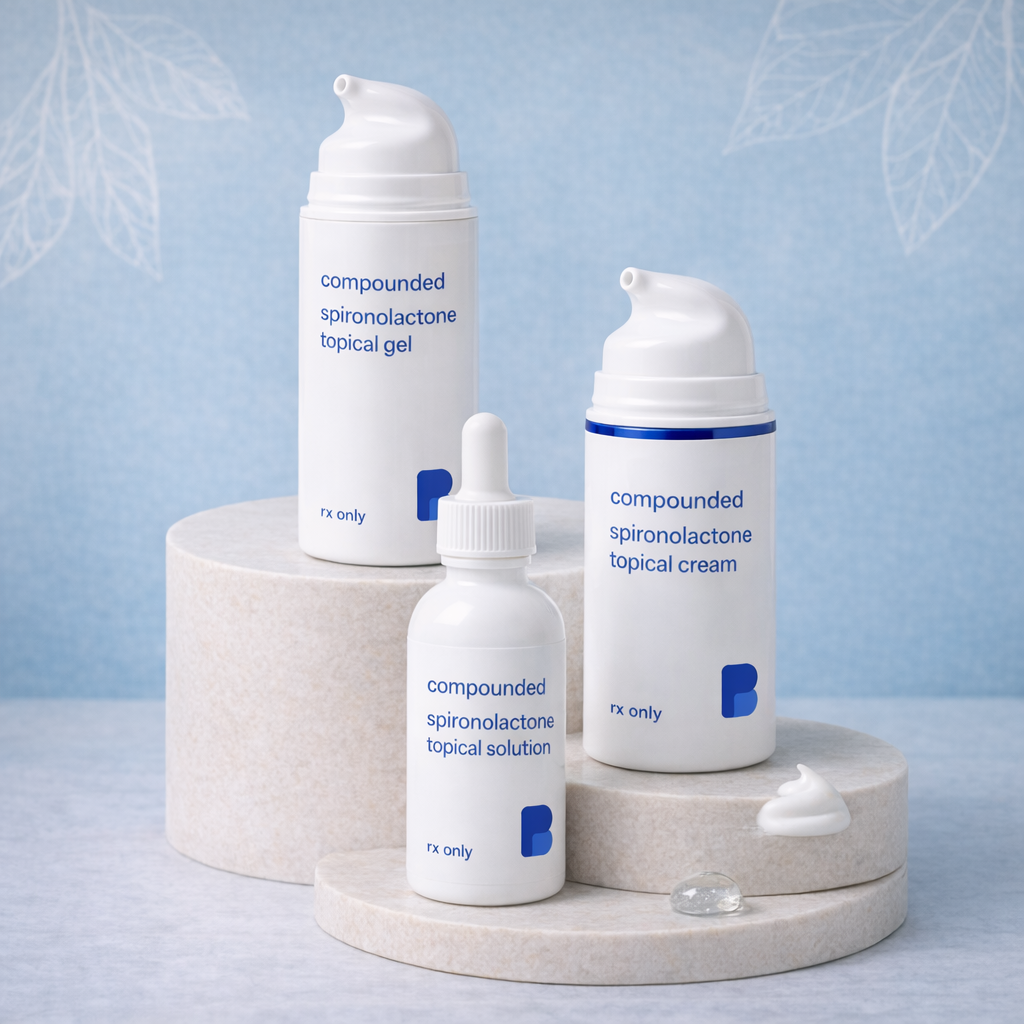
Topical spironolactone is spironolactone compounded into a gel, cream, solution, or lotion that is applied to the skin or scalp. No topical spironolactone product is FDA-approved, so it is made by a compounding pharmacy to a prescriber's order. Bayview Pharmacy prepares it in several bases and strengths and in combination with other acne ingredients. Your prescriber decides whether topical spironolactone fits your situation, and a valid prescription is required.
How does topical spironolactone work?
Androgens, such as testosterone and dihydrotestosterone, act on receptors in the oil glands and hair follicles of the skin. In acne they contribute to oil production, and in pattern hair loss they are thought to play a role in the shrinking of scalp hair follicles, although their role in women is less clear. Spironolactone blocks androgen receptors (Del Rosso et al.). Taken by mouth, it acts throughout the body; applied to the skin, the aim is to act where it is applied, while keeping the amount that reaches the rest of the body low.
An FDA-approved topical medicine works on the same target: clascoterone 1% cream, an androgen receptor inhibitor, was approved in 2020 to treat acne in people 12 years and older (approval history). It is a different drug from spironolactone.
What is topical spironolactone prescribed for?
All of these uses are off-label: no topical spironolactone is FDA-approved for them, and the studies are small.
Acne. In a randomized trial of 78 people with mild to moderate acne, a 5% spironolactone gel lowered the total number of lesions compared with a placebo gel, but did not significantly change an acne severity score (Afzali et al. 2012). Other small trials compared it with clindamycin or dapsone, with mixed results across the measures used (2021 study; Gharib et al. 2024). A 2023 review of five trials with 195 patients rated two at high risk of bias and three with some concerns, and called for larger studies (Rehan et al. 2023).
Thinning hair in women. Small studies have used a 1% spironolactone gel or a 5% solution on the scalp, alone or with minoxidil, for female or androgen-related pattern hair loss, with mixed results (Abdel-Raouf et al. 2021; Hassan et al. 2025; El Sayed et al. 2025). A 2023 systematic review found fewer side effects with topical than with oral spironolactone and called for higher-quality randomized trials (Wang et al. 2023).
Unwanted hair growth. Evidence is very limited. A small 2001 study of a 2% cream on one side of the face in 12 women found no effect on hair growth (Saadat et al. 2001).
Why is topical spironolactone compounded?
Every FDA-approved spironolactone product is taken by mouth. A prescriber who wants spironolactone on the skin or scalp, instead of or alongside a tablet, needs it compounded. Compounding also lets the prescriber choose the base, from a water-free gel to a cream or a light solution for the scalp, and combine spironolactone with other acne ingredients such as clindamycin, tretinoin, or niacinamide in one product. For the scalp, spironolactone is often combined with minoxidil; those formulas are on our minoxidil and finasteride for hair loss page.
| Gel or cream | Solution or lotion | |
|---|---|---|
| What it is | A water-free gel, or a cream in a pump, spread in a thin layer | A thin liquid or lotion that spreads easily over hair-bearing skin |
| Strengths Bayview prepares | 5% gel; 5% or 10% cream | 1% solution; 3% or 5% lotion |
| Where it is often used | The face and other areas of skin, as your prescriber directs | The scalp or larger areas of skin, as your prescriber directs |
This comparison is for education only and is not a statement that either form is better or more effective. Your prescriber chooses the form, strength, and schedule.
Side effects & safety
Skin reactions. In small studies, the side effects reported with topical spironolactone were mostly where it was applied, such as a burning feeling (Gharib et al. 2024). In a scalp study that compared it with minoxidil gel, contact dermatitis and scalp irritation were reported, more often with minoxidil (Hassan et al. 2025). Combination products with tretinoin can add dryness, peeling, and sun sensitivity.
Potassium. Spironolactone taken by mouth can raise blood potassium, and the risk is higher with kidney disease, potassium supplements, salt substitutes, and some blood pressure medicines (prescribing information). In one small 1988 study in six healthy men, canrenone, an active breakdown product of spironolactone, could not be measured in the blood for three days after a 5% cream was applied to more than half the body (Rey et al. 1988). We found no study that measured blood potassium or long-term use, so tell your provider about every medicine you take, especially spironolactone tablets.
Pregnancy and breastfeeding. The tablet label advises avoiding spironolactone in pregnancy or explaining the potential risk to a male fetus, because in rat studies it feminized male fetuses (prescribing information). Tell your prescriber if you are pregnant or planning a pregnancy. LactMed reports limited data showing that spironolactone taken by mouth is poorly excreted into breast milk, and says it appears to be acceptable during breastfeeding (LactMed); ask your provider about using it on the skin while breastfeeding.
Who should not use it?
Do not use topical spironolactone if you are allergic to spironolactone or any ingredient in your prescription. The tablet is not used in people with high potassium, Addison's disease, or who take eplerenone (prescribing information); tell your prescriber if any of these apply to you. Tell your prescriber if you are pregnant, planning a pregnancy, or breastfeeding, and about any spironolactone or potassium you already take.
How do I get started?
Talk with the dermatologist or other prescriber who manages your skin or hair. A licensed prescriber decides whether topical spironolactone is appropriate and chooses the form, strength, and schedule. Bayview Pharmacy does not provide consultations or determine appropriateness. Already have a prescription at another pharmacy? You can transfer it to Bayview. Once you have a prescription, your prescriber can order through Bayview, and a pharmacist is available if you have questions. Topical spironolactone is part of our compounded medications catalog, alongside our acne treatments and hair loss treatments.
Clinical details for prescribers
Regulatory. FDA-approved spironolactone is oral only: tablets 25, 50, and 100 mg (initial U.S. approval 1960; labeling revised November 2025) for NYHA class III to IV heart failure with reduced ejection fraction, add-on treatment of hypertension, edema with cirrhosis or nephrotic syndrome, and primary hyperaldosteronism; and a 25 mg/5 mL oral suspension, which its label states is not therapeutically equivalent to the tablets (tablet labeling; oral suspension labeling). Tablet contraindications: hyperkalemia, Addison's disease, and concomitant eplerenone. No topical spironolactone is FDA-approved; a 2026 review describes clascoterone 1% cream, approved in 2020, as the only FDA-approved topical hormonal agent for acne as of 2025 (Del Rosso et al. 2026; approval history). The 2024 AAD acne guideline makes a conditional recommendation for oral spironolactone and for topical clascoterone (Reynolds et al. 2024).
503A. FDA's copies guidance states that it generally does not consider a compounded drug a copy when the commercially available product is oral and the compounded product is topical (FDA guidance), so FDA generally would not consider topical spironolactone an essential copy of the oral products.
Published evidence on topical spironolactone:
- Acne: Afzali et al. 2012, double-blind RCT, n=78, 5% gel vs placebo: total lesion count lower with spironolactone (p=0.007), acne severity index not significantly different (p=0.052) (J Dermatolog Treat). A 2021 single-blind comparative study, n=68, 2% solution vs 1.5% clindamycin solution twice daily for 12 weeks: comedones fell significantly with spironolactone (p<0.0001); the abstract reports p>0.05 for pustules and the severity index, although the authors concluded in favor of spironolactone (Cureus). Gharib et al. 2024, n=28, 5% gel vs 5% dapsone gel twice daily for 12 weeks: more good responses with spironolactone; burning reported (Arch Dermatol Res).
- Acne evidence quality: Rehan et al. 2023, 5 trials, 195 patients, two at high risk of bias and three with some concerns on RoB 2 (J Dermatol); Del Rosso et al. 2026 summarize six clinical studies (193 patients in the abstract; 5% cream, 5% gel, 2% solution, 1% nanogel) and describe the data as limited, with some conflicting results (J Clin Aesthet Dermatol).
- Pattern hair loss: Abdel-Raouf et al. 2021, n=60, 12 months, 5% minoxidil gel, 1% spironolactone gel, or both, with improvement reported in all arms and no between-arm statistics in the abstract (Dermatol Ther); Hassan et al. 2025, 80 women, 1% spironolactone gel vs 5% minoxidil gel for 6 months, similar response grades (Int J Trichol); El Sayed et al. 2025, 45 women in three arms of 15 (topical finasteride, spironolactone, or minoxidil): the 5% spironolactone solution showed no trichoscopic change over 16 weeks, and the authors favored finasteride and minoxidil (Dermatol Pract Concept); Wang et al. 2023 systematic review, 7 studies, 618 patients, oral and topical (Clin Cosmet Investig Dermatol).
- Hirsutism: Saadat et al. 2001, split-face, n=12, 2% cream twice daily for 3 months: no effect on hair growth (Iran J Endocrinol Metab).
- Systemic exposure: Rey et al. 1988, double-blind crossover in 6 healthy men, 5% cream over about 55% of body surface: plasma canrenone undetectable and no change in measured hormones over 72 hours (J Endocrinol Invest). No study we found measured serum potassium or long-term use in women; Del Rosso et al. note no supporting pharmacokinetic data for compounded preparations.
Labeling points that may matter for topical use:
- Hyperkalemia risk with oral use rises with renal impairment, potassium supplements or salt substitutes, and ACE inhibitors or ARBs (labeling). Systemic exposure from topical use has not been characterized beyond the small 1988 study above.
- Pregnancy (section 8.1): avoid spironolactone in pregnant women or advise of the potential risk to a male fetus; rat embryofetal studies report feminization of male fetuses (labeling).
- Lactation: LactMed reports that limited data indicate spironolactone is poorly excreted into milk (infant canrenone dose estimated at about 0.2% of the maternal dose) and that oral use appears acceptable during breastfeeding (LactMed).
What Bayview compounds (2026 fills):
- Spironolactone 5% topical gel in an anhydrous base, 30, 60, or 90 g; the single-agent product filled most often.
- Spironolactone 5% or 10% topical cream (VersaBase); 1% topical solution; 3% or 5% topical lotion.
- Acne combinations: spironolactone 5% / clindamycin 1% cream; clindamycin 1% / spironolactone 5% / tretinoin 0.1% cream; tretinoin 0.025% / niacinamide 2% / spironolactone 5% gel.
- Scalp combinations with minoxidil (solutions and foams) are on the minoxidil and finasteride page.
- Writing the prescription: the strength, base, and form (for example spironolactone 5% topical gel, anhydrous base), the area and frequency of application, an ICD-10 code for the indication, quantity in grams or mL, and refills.
Licensed to dispense in RI, MA, CT, NJ, NH, FL, ME, and PA. Ordering and account setup are covered on our for providers page.
This information is about prescription medications and is not medical advice. Compounded medications are prescription-only and are not FDA-approved. Your prescriber determines whether topical spironolactone is appropriate and sets the form, strength, and schedule.