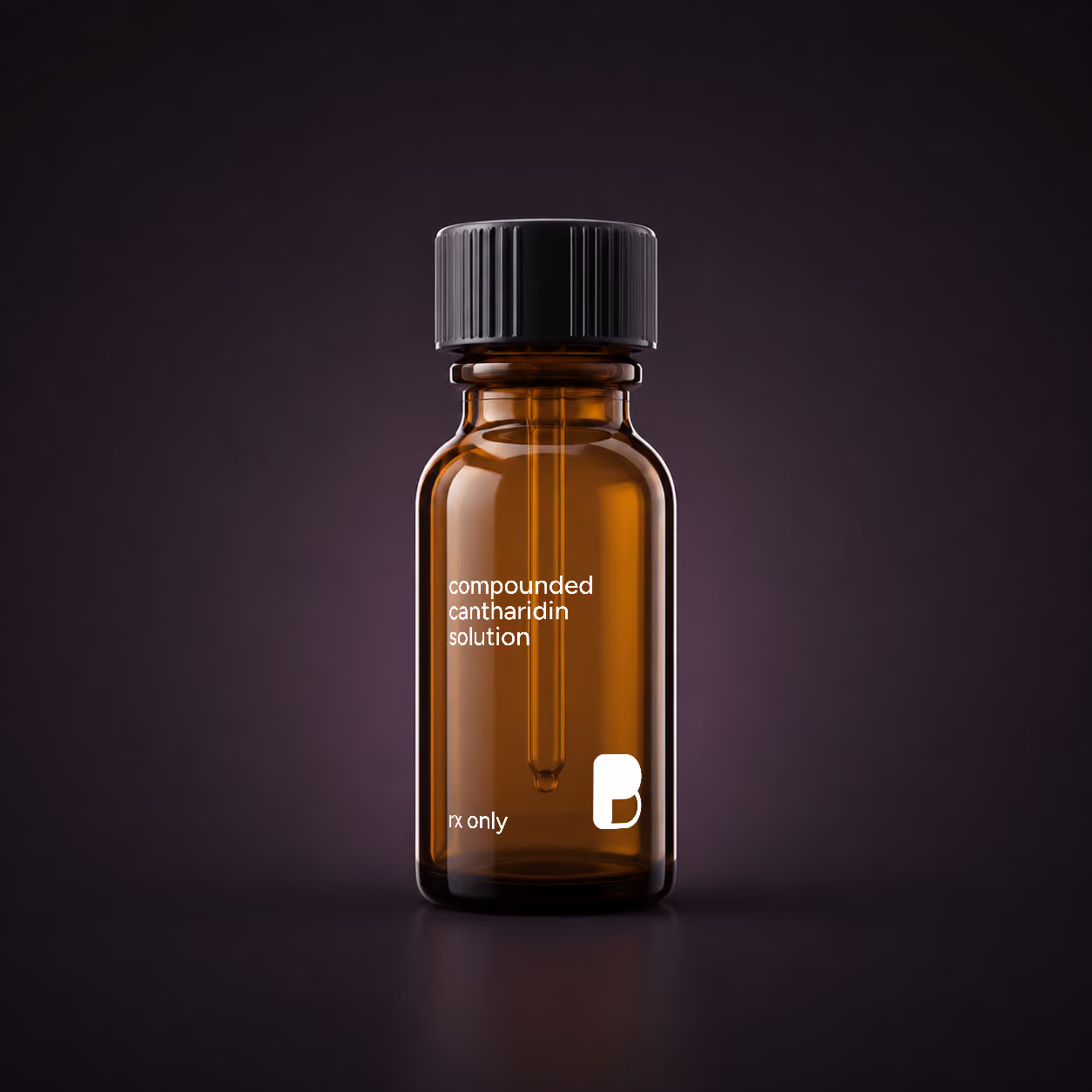
Cantharidin is a compounded, prescription-only topical blistering agent that a clinician applies in office to treat molluscum contagiosum and certain warts. It is not a take-home medication. Bayview prepares compounded cantharidin pursuant to a prescription written for one named patient, and the provider applies it during that patient's visit.
Compounded medications are not FDA-approved. A proprietary cantharidin product is now FDA-approved for molluscum, and the decision about which option fits a patient belongs to the treating provider, not to the pharmacy.
What is cantharidin?
Cantharidin is a vesicant, which is the clinical term for a blistering agent. When it is applied to a lesion, it causes a small, controlled blister that lifts the lesion away as it heals. Because of how it works, cantharidin is applied by a provider during an office visit, and it is not a medication a patient uses at home.
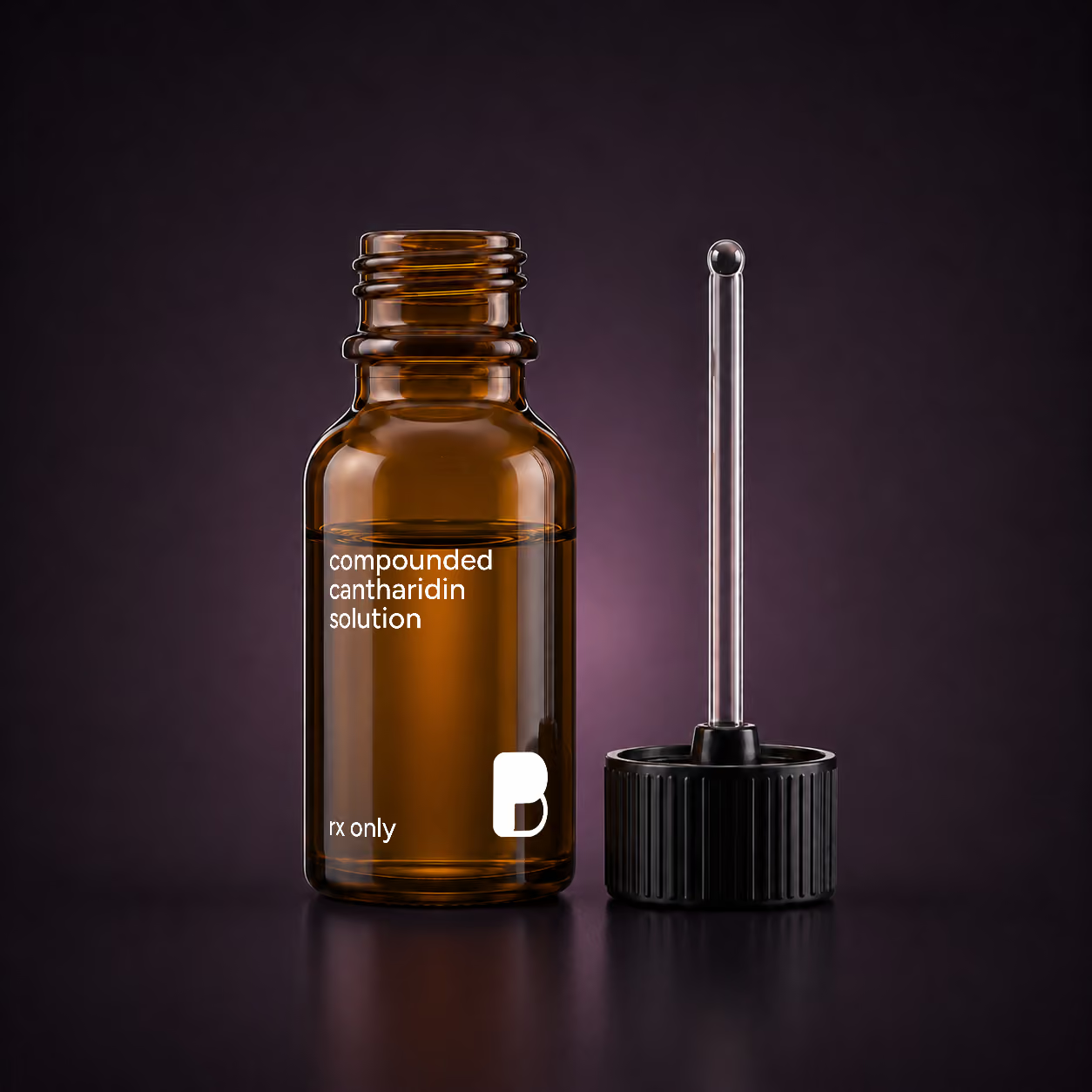
Bayview compounds two cantharidin preparations, both in 5 mL: a cantharidin 1% topical solution, and a combination cantharidin 1% / podophyllin 5% / salicylic acid 30% topical liquid often used for more resistant warts. Only a licensed provider can decide whether either is appropriate for a patient.
Why do people call cantharidin beetle juice?
"Beetle juice" is a nickname people use when they search for this preparation. It refers to the same thing described on our cantharidin formulation page: a compounded, prescription-only topical blistering agent that a clinician applies in office, supplied in a 5 mL quantity in one of two formulas. Both formulas and their ingredients are listed further down this page.
How does cantharidin work?
Cantharidin acts within the upper layer of the skin, the epidermis. Applied to a lesion, it prompts the epidermal cells to separate, forming a blister beneath the lesion without reaching the deeper skin, which is why healing typically occurs without scarring (StatPearls, molluscum contagiosum).
In the combination liquid, two additional agents are included for wart treatment: salicylic acid, a keratolytic that softens and removes thickened skin, and podophyllin, a plant resin with antimitotic activity. The provider controls exactly where and how much is applied.
What is cantharidin used for?
Clinicians use cantharidin to treat molluscum contagiosum and certain warts (verrucae). A valid prescription is required, and only a licensed provider can decide whether treatment is appropriate. Bayview Pharmacy does not provide consultations and does not determine appropriateness.
Cantharidin for molluscum
Molluscum contagiosum is a skin infection caused by a virus. It shows up as small, firm, dome-shaped bumps on the skin, spreads by skin-to-skin contact and by shared towels and other objects, and is most common in children.
The single-agent 1% solution is commonly used for molluscum. For background on the condition itself rather than on the preparation, two published references are cited on our formulation page: StatPearls (NCBI Bookshelf) on molluscum contagiosum, and the American Academy of Dermatology's patient page on molluscum contagiosum diagnosis and treatment. Whether a lesion is molluscum, and whether treating it with cantharidin is appropriate, is for a licensed provider to decide.
Cantharidin wart removal
For warts, the cantharidin / podophyllin / salicylic acid combination is typically reserved for more resistant verrucae. "Cantharidin wart removal" is the phrase searchers use; the mechanism described above is what the preparation actually does, which is raise a small controlled blister beneath the lesion. Whether that approach suits a particular wart on a particular patient is a clinical judgment the treating provider makes.
Which cantharidin preparations does Bayview compound?
| Preparation | Size | Typical use | Status |
|---|---|---|---|
| Cantharidin 1% topical solution | 5 mL | Molluscum contagiosum | Compounded, not FDA-approved |
| Cantharidin combination liquid | 5 mL | More resistant warts | Compounded, not FDA-approved |
The combination liquid is cantharidin 1% / podophyllin 5% / salicylic acid 30%. Both preparations are listed for education only, and listing them is not a statement that either is better, stronger or more effective than the other. Both are for professional in-office application and neither is dispensed for patient self-application at home. The treating provider determines which preparation is appropriate.
What happens at the appointment?
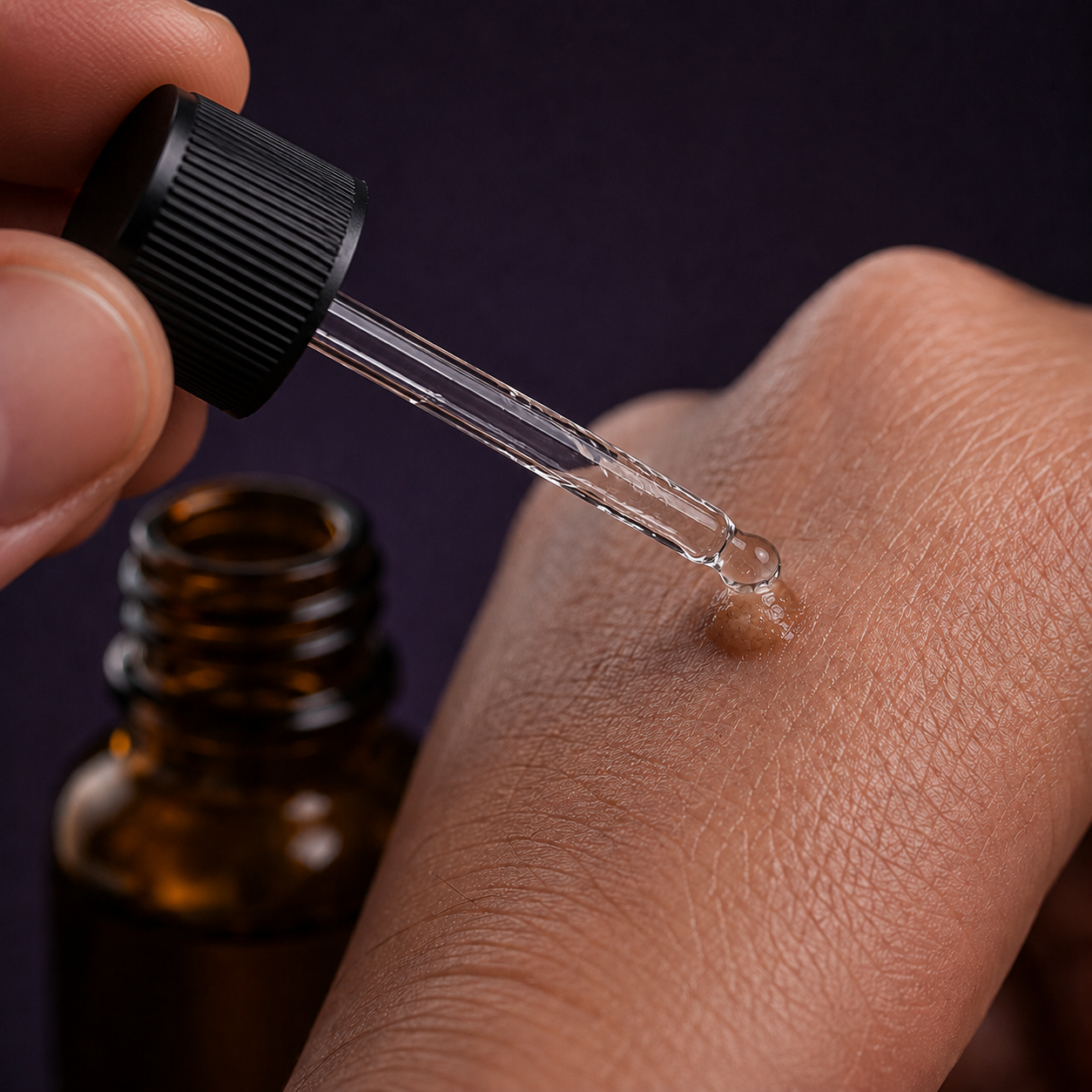
During the appointment, the provider applies a small amount of cantharidin to each lesion. Application is generally painless at the time, which can make it a useful option for children. Over the next several hours a blister usually forms at each treated spot, and the provider gives instructions on when to wash the medication off and how to care for the area.
| Stage | Timing | What to expect |
|---|---|---|
| Provider applies it | At the visit | Generally painless at the time |
| Blister forms | About 24 to 48 hours | One blister per treated spot |
| Blisters settle | 1 to 2 weeks | Blisters dry and resolve |
The wash-off time is set by the provider as part of the aftercare instructions given at the visit. Following those instructions, including when to wash the medication off, helps limit excess blistering. Some tenderness, redness or itching at the treated sites is expected, and more than one visit may be needed.
Contact the treating provider about blisters that are unusually large or painful, spreading redness, drainage or other signs of infection at a treated site, or any reaction that concerns the patient.
Why is cantharidin not sent home with the patient?
Cantharidin is for professional topical use only and is highly toxic if swallowed. It must never be taken by mouth, it must be kept away from the eyes, lips and other mucous membranes, and it must be kept out of the reach of children. The solution can also be flammable, so it is kept away from heat and open flame. It is applied only to the intended lesions, not to healthy surrounding skin, which is the other reason placement is the provider's job rather than the patient's.
Cantharidin preparations are handled by the clinician and stored per the label, away from heat and open flame, and secured out of the reach of children. Because these are professional-use topical preparations, they are not dispensed for home storage or self-application.
There is a regulatory reason as well. Bayview is a 503A compounding pharmacy, so cantharidin is prepared pursuant to a prescription for an individual patient and applied by the provider during that patient's visit. We do not supply cantharidin as bulk office stock or for general office use: that is the role of a 503B outsourcing facility, which Bayview is not. Our posts on 503A versus 503B compounding and what a compounding pharmacy is cover that distinction in more detail.
Is there an FDA-approved cantharidin product?
Yes. A proprietary cantharidin product is now FDA-approved for molluscum. Compounded cantharidin preparations like the two described on this page are not FDA-approved; they are prepared by a licensed pharmacy pursuant to a prescription for an individual patient.
Bayview does not present either as better, stronger or more effective than the other, and a compounded preparation is not offered here as a substitute for an approved product. That choice sits with the treating provider.
When is cantharidin not appropriate?
A provider determines suitability for each patient and lesion. Cantharidin is generally avoided on the face, near the eyes and on mucous membranes, and on irritated or inflamed skin. The combination liquid contains podophyllin, which should not be used during pregnancy and is used cautiously and in limited amounts.
Patients should tell their provider about pregnancy, skin conditions, circulation problems (such as diabetes) and any sensitivity to the ingredients, so the provider can decide whether treatment is appropriate. Which preparation to use, how much to apply and whether to treat at all are the prescriber's decisions.
What does compounded cantharidin cost?
Compounded cantharidin starts at $150 for a 5 mL quantity and is priced as a cash prescription. The office visit at which it is applied is separate from the prescription, and Bayview does not bill for the visit. Our post on whether compounding pharmacies take insurance covers how compounded prescriptions are paid for at Bayview.
What Bayview compounds for this
On a prescriber's order, Bayview prepares compounded cantharidin as a cantharidin 1% topical solution in a 5 mL quantity, and cantharidin 1% / podophyllin 5% / salicylic acid 30% topical liquid in a 5 mL quantity. Each order is prepared in small batches under USP 795 non-sterile compounding, pursuant to a prescription for an individual patient, and both preparations are for professional in-office application. Cantharidin is a noncontrolled medication.
Cantharidin sits in our dermatology compounding line. Bayview also compounds BLT numbing cream for use before procedures, which our post on numbing cream before a tattoo, laser or microneedling describes, along with prescription topical lines for acne and rosacea and redness. The full searchable catalog lists what else Bayview prepares to order.
Talk to your prescriber
If someone in your family has molluscum or warts and you have read about cantharidin, the conversation to have is with the clinician who would do the application. Ask whether they use it, and whether either of the two compounded preparations suits the lesions they are looking at.
If they decide to prescribe it, they can e-prescribe to Bayview Pharmacy in Warwick, Rhode Island, or send the order by fax or phone. The prescription is written for a named patient, the preparation is dispensed for that patient, and the provider applies it at the visit. For questions about where Bayview can send a prescription, see the states where Bayview is licensed on our FAQ page.
Frequently asked questions
Is cantharidin safe?
Used as intended, applied only to the lesions by a provider, the effects are localized (blistering, redness, tenderness). Cantharidin is highly toxic if swallowed and must be kept away from the eyes and mucous membranes, which is one reason it is applied by a clinician rather than at home.
Is compounded cantharidin FDA-approved?
No. A separate proprietary cantharidin product is FDA-approved for molluscum, but the compounded preparations Bayview makes are not FDA-approved. They are prepared by a licensed pharmacy pursuant to a prescription.
Can Bayview supply cantharidin for general office use?
No. Bayview is a 503A compounding pharmacy, so we prepare cantharidin pursuant to a prescription for an individual patient. Bulk stock for general office use is the role of a 503B outsourcing facility, which Bayview is not.
What are the two preparations?
A cantharidin 1% topical solution, commonly used for molluscum contagiosum, and a cantharidin 1% / podophyllin 5% / salicylic acid 30% liquid, typically used for more resistant warts. Both come in 5 mL. The provider chooses the appropriate one.
What does the treatment feel like?
Application is generally painless at the time, which is why it can be a good option for children. Over the next 24 to 48 hours a blister usually forms at each treated spot; the sites are then often tender or itchy and resolve over one to two weeks.
Is cantharidin applied at home or in the office?
In the office. Cantharidin is a blistering agent, so a trained provider applies it precisely to each lesion and tells you exactly when to wash it off at home, typically within a few hours. It is never dispensed for patients to apply themselves. Bayview compounds it on a patient-specific prescription for the treating provider.
Do I need a prescription?
Yes. All of our medications require a valid prescription from a licensed provider. We're a dispensing and compounding pharmacy, so we don't provide consultations or write prescriptions. If you don't have one yet, you'll need to see a provider first.
Can you fill a prescription from my own provider?
Yes. Your provider can send your prescription to Bayview Pharmacy by e-prescribe, fax, or phone, or you can transfer an existing prescription from another pharmacy.
What is compounding?
Compounding is the practice of preparing a medication tailored to an individual patient's prescription. Instead of a mass-produced product, a compounding pharmacy makes the medication to the specific strength, form, or combination your provider orders.
Examples on this site include medications compounded as liquids for people who cannot swallow pills, thyroid capsules made to a T3/T4 ratio no manufactured product offers, and all-purpose nipple ointment, which combines three actives that are not sold together commercially.
What aftercare does the provider give after cantharidin is applied?
The provider gives aftercare instructions at the visit, including when to wash the medication off and how to care for each treated area. Following those instructions helps limit excess blistering. Some tenderness, redness or itching at the treated sites is expected. Contact the treating provider about blisters that are unusually large or painful, spreading redness, drainage or other signs of infection at a treated site.
Can cantharidin be used during pregnancy?
A provider determines suitability for each patient and lesion. The combination liquid contains podophyllin, which should not be used during pregnancy and is used cautiously and in limited amounts. Patients should tell their provider about pregnancy, skin conditions, circulation problems (such as diabetes) and any sensitivity to the ingredients, so the provider can decide whether treatment is appropriate. Bayview does not determine appropriateness.
Why is cantharidin not sent home with the patient?
Cantharidin is for professional topical use only and is highly toxic if swallowed. It must never be taken by mouth, must be kept away from the eyes, lips and other mucous membranes, and must be kept out of the reach of children. The solution can also be flammable. It is applied only to the intended lesions, sparing healthy surrounding skin, so placement is the provider's job.
What does compounded cantharidin cost at Bayview?
Compounded cantharidin starts at $150 for a 5 mL quantity and is priced as a cash prescription. The office visit at which a provider applies it is separate from the prescription, and Bayview does not bill for the visit. Our post on whether compounding pharmacies take insurance covers how compounded prescriptions are paid for at Bayview.
Can cantharidin be used on the face?
A provider determines suitability for each patient and lesion. Cantharidin is generally avoided on the face, near the eyes and on mucous membranes, and on irritated or inflamed skin. It is applied only to the intended lesions, sparing healthy surrounding skin. Bayview Pharmacy does not provide consultations or determine appropriateness, so whether a particular lesion is treated, and with which preparation, is the treating provider's decision.
What Bayview compounds for this
Important: Compounded medications are prepared to a prescriber's order for an individual patient. They are not FDA-approved, and the FDA has not evaluated them for safety, effectiveness, or manufacturing quality. This article is educational and is not a substitute for advice from your prescriber or pharmacist.
This preparation contains a controlled substance. Controlled-substance prescriptions carry refill limits, must be e-prescribed, and can only be shipped to states where Bayview holds the required licensure.
Uses discussed here may be off-label, meaning they are not part of any FDA-approved labeling. Off-label use is a decision for you and your prescriber, based on the available evidence.
Veterinary preparations are compounded to a veterinarian's order for a specific animal and are not FDA-approved animal drugs. Never give a compounded human medication to an animal without veterinary direction.
Compounded prescriptions are paid for directly rather than billed through insurance. Most are HSA/FSA-eligible, and many patients submit the receipt to their plan for possible reimbursement. Pricing depends on the strength, dose form and quantity your prescriber orders. Read more about cost and insurance.
Compounded cantharidin starts at $150 for a 5 mL quantity and is priced as a cash prescription. The office visit at which a provider applies it is separate from the prescription, and Bayview does not bill for the visit. For more, see our post on whether compounding pharmacies take insurance.
Bayview Pharmacy is a compounding pharmacy in Warwick, Rhode Island, licensed to fill and ship compounded prescriptions for patients in Rhode Island, Massachusetts, Connecticut, New Jersey, New Hampshire, Florida, Maine and Pennsylvania. Prescriptions for New York patients are filled on a limited basis, and controlled substances are not shipped to New York addresses. See every state we ship to.
Related reading