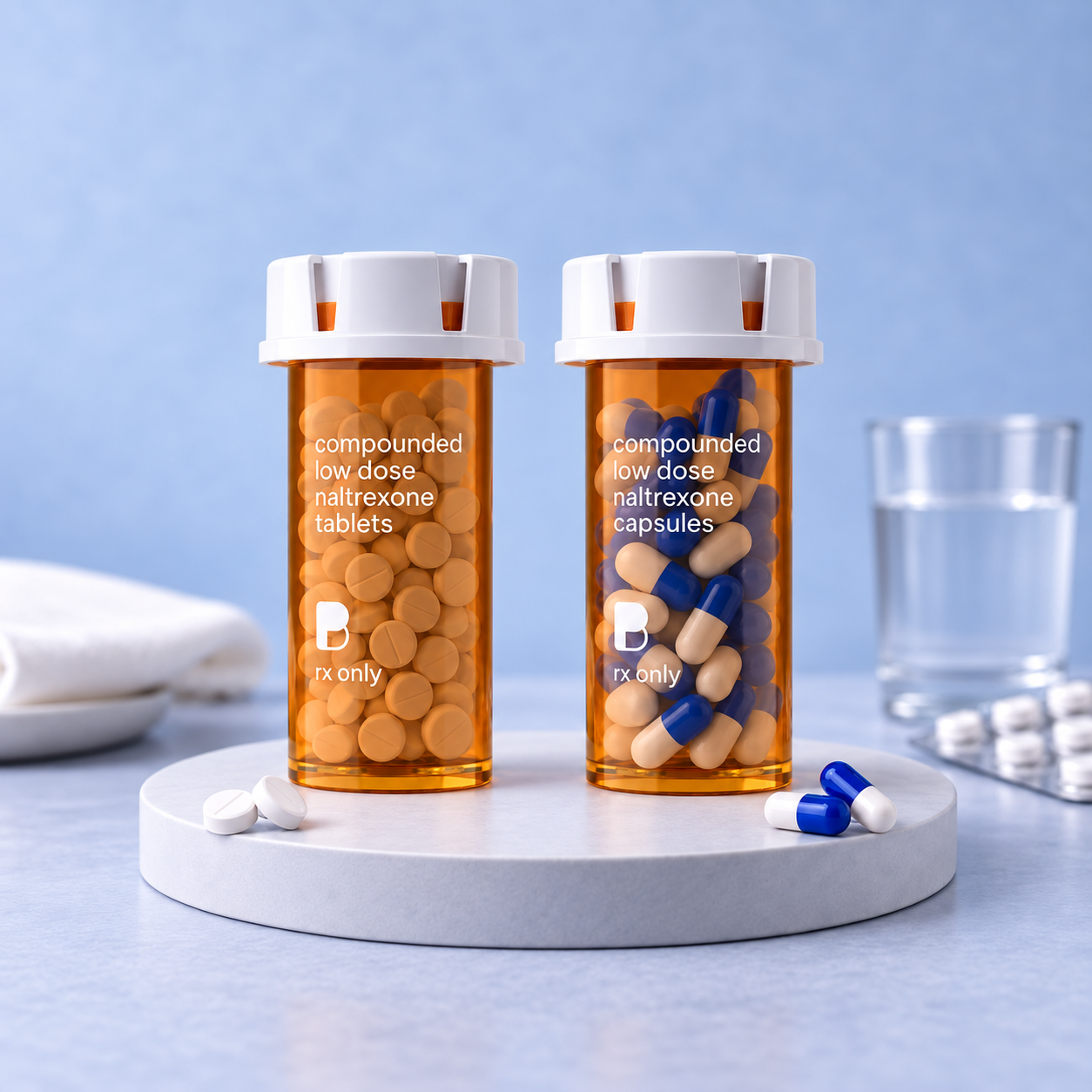
There is no low-dose-specific safety data for naltrexone in pregnancy or in breastfeeding, which means no website can tell you whether it is appropriate for you. Low Dose Naltrexone (LDN) is a compounded, prescription-only preparation of naltrexone hydrochloride, prepared at a small fraction of the 50 mg strength the FDA has approved. Compounded preparations are not FDA-approved, and at these low doses every use of naltrexone is off-label, including for Hashimoto's, long COVID and fibromyalgia.
This post takes four questions people ask about LDN and answers each one with what the published literature actually contains. Some of those answers are shorter than people expect. Bayview Pharmacy compounds LDN to a prescriber's order. We do not diagnose, we do not recommend it, and we do not decide whether it suits you.
Can you take low dose naltrexone during pregnancy or while breastfeeding?
There is no low-dose-specific safety data in pregnancy or breastfeeding. The manufacturer's labeling for standard-dose naltrexone states that there are no adequate and well-controlled studies in pregnant women, and that it is not known whether naltrexone passes into human milk. Reviews of LDN describe the available data as insufficient.
That is the whole of it. Bayview will not describe LDN as safe in pregnancy, and will not describe it as dangerous, because the published record supports neither statement. If you are pregnant, planning a pregnancy, or breastfeeding, this is a conversation to have with your prescriber and your obstetric clinician together, because they are the people who can weigh your situation against the gaps in the data.
Two practical notes. Naltrexone is not a controlled substance. And if a conversation with your prescriber ends with a decision to stop, tell them rather than stopping on your own.
What does the published evidence look like, condition by condition?
The most recent independent review was published in Advances in Therapy in 2026 by Gouda and colleagues. It examined 105 studies of LDN, of which only 15 were randomized controlled trials, and concluded that current evidence does not support routine clinical use. Most published LDN research consists of case reports and small studies with no comparison group.
Here is how that breaks down for the conditions on this page, alongside two others that have been studied more formally:
| Condition | Best evidence | Result | Status |
|---|---|---|---|
| Fibromyalgia | Two randomized trials, 2024 and 2026 | No significant difference vs placebo | Off-label |
| Long COVID, ME/CFS | No randomized controlled trial | Uncontrolled reports only | Off-label |
| Thyroid conditions | No human studies at low doses | No evidence | Off-label |
| Multiple sclerosis | Randomized trial, 96 participants | No significant difference vs placebo | Off-label |
| Crohn's disease | Two small randomized trials, 46 participants | Insufficient evidence, 2018 Cochrane review | Off-label |
Every row carries the same status token because the regulatory position does not change with the evidence: naltrexone is approved at 50 mg for alcohol use disorder and opioid use disorder, so all low-dose prescribing is off-label whether a condition has two trials behind it or none. In Crohn's disease one of the two small trials met its main outcome, and the 2018 Cochrane review concluded there is insufficient evidence to allow any firm conclusions. The pattern across the table is the one the 2026 review described: the better designed the study, the smaller the reported effect tends to be.
Low dose naltrexone for Hashimoto's: what is actually known?
Hashimoto's is a thyroid condition, and for thyroid conditions the published record at low naltrexone doses is empty. There are no human studies of LDN at these doses in thyroid disease. Not negative trials, not small positive trials, no studies.
That matters because LDN is discussed widely in thyroid patient communities, and discussion is easy to mistake for data. If you have read that LDN does something for a thyroid condition, that claim does not come from a human trial at low doses, because none exists to draw it from. There is also no published low-dose-specific interaction data for thyroid medication, so if you take levothyroxine or a compounded thyroid preparation, your prescriber is working without a study to consult there either.
Bring the full list of what you take to your prescriber and to our pharmacist. We can tell you exactly what is in a preparation we compound, which is a different question from whether it belongs in your regimen.
Low dose naltrexone for long COVID and ME/CFS
There is no published randomized controlled trial of LDN in long COVID or in ME/CFS. The available reports are uncontrolled, which means they describe what happened to people who took it without comparing them to a group that did not.
Uncontrolled reports are not worthless, and they are often how a research question starts. They simply cannot separate the medication from everything else that changes over the months of a report: the natural course of the illness, other treatments, and the response people have to being enrolled and observed. In LDN trials that did include a placebo group, 18 to 40% of participants receiving placebo also reported improvement. That is the size of the effect an uncontrolled report cannot rule out.
So the answer for long COVID is that LDN has not been tested against placebo in a published controlled trial, and anyone considering it is working from uncontrolled reports.
Low dose naltrexone for fibromyalgia: what did the trials find?
Fibromyalgia has the strongest body of controlled evidence of any proposed LDN use, and the results were negative. Two parallel-group randomized trials have been run, with 99 and 98 participants, published in 2024 and 2026, the first of them in The Lancet Rheumatology. Neither trial found a significant difference from placebo on its main outcome.
Those are the trials designed to answer the question with a placebo comparison group, and both failed their main outcome. A negative main outcome does not mean nobody in those trials reported feeling better. It means the reported change could not be separated from the change on placebo.
Why do online accounts sound so much more positive than the trials?
Three reasons, all documented in the reviews:
- The striking response rates that circulate online almost all come from studies with no placebo group.
- In trials that did include a placebo group, 18 to 40% of people on placebo reported improvement, so a high response rate on its own tells you very little.
- Doses get confused. Research conducted at 50 mg or higher is often cited as though it were LDN evidence, and it is not.
On tolerability, the picture is different from the picture on effect. Reviews describe tolerability as the best-supported part of the LDN evidence base, and in the two largest randomized trials the overall rate of reported side effects was about the same on naltrexone as it was on placebo. Vivid or abnormal dreams and nausea are the effects reported more often on LDN than on placebo in pooled trial data. Our companion post on LDN side effects and what to avoid covers the opioid interaction, which is the single most important thing to understand before taking it.
What should I ask my prescriber about a condition with no controlled trials?
Dose and appropriateness are your prescriber's decisions, not ours and not a website's. These are reasonable questions to bring to the appointment:
- What would we be watching for, and how would we know it was not working?
- How long will we try this before deciding either way?
- What would make you stop it?
- Is there an approved option for my condition that we should consider first?
- How does this fit with everything else I take?
- If I am pregnant, planning a pregnancy, or breastfeeding, who else should be part of this decision?
If your prescriber wants background written for clinicians, our LDN provider guide sets out the same literature with the trial details and the perioperative considerations.
Why does low dose naltrexone have to be compounded at all?
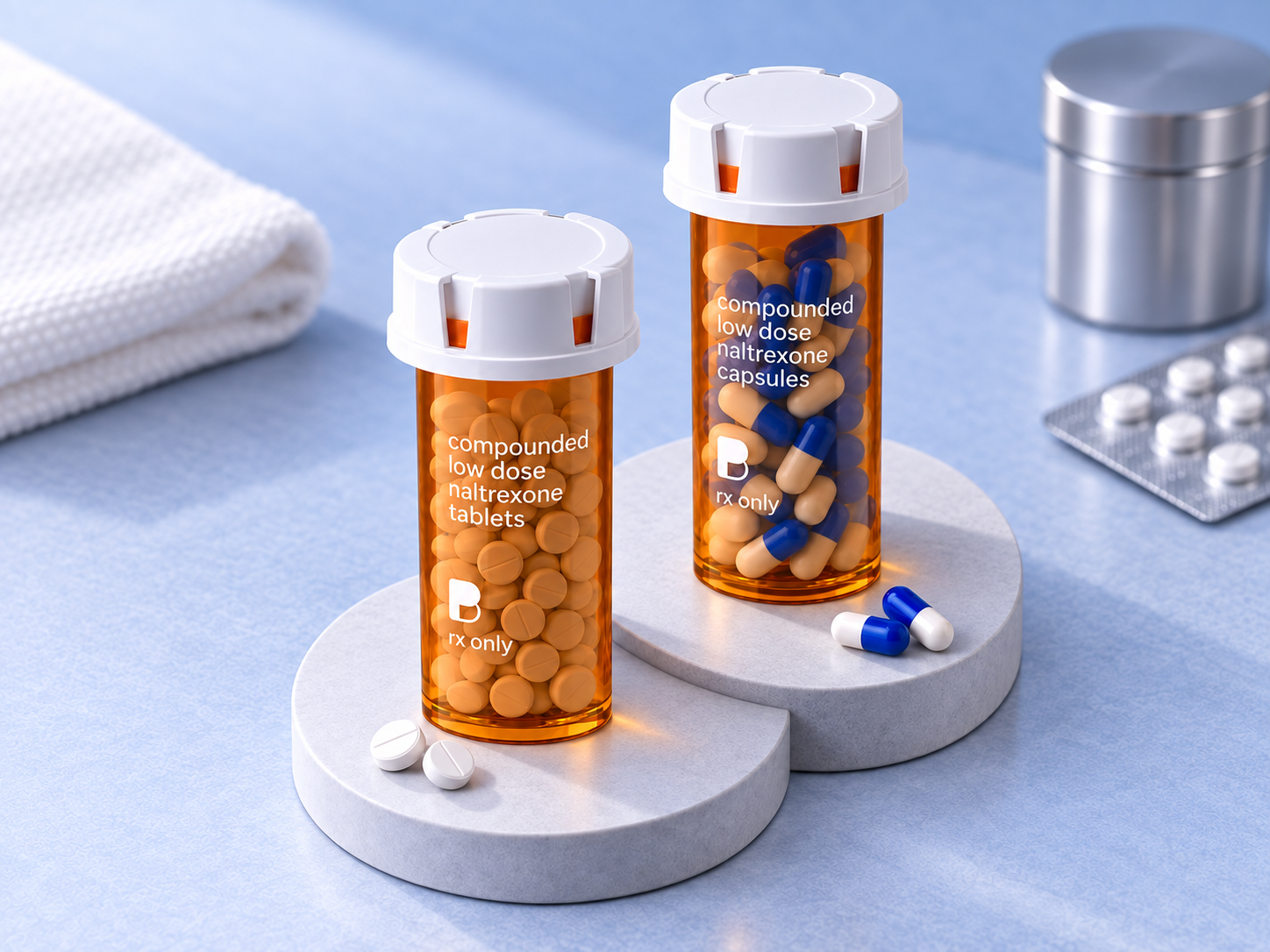
Naltrexone is commercially manufactured only as a 50 mg tablet. There is no mass-produced 1.5 mg or 4.5 mg product on any shelf, so the low strengths have to be prepared by a compounding pharmacy. That is the entire reason LDN is a compounded medication. It is not because a compounded version is different or better, but because the strength a prescriber wants does not exist commercially.
Please do not try to make your own by splitting or dissolving 50 mg tablets. A 50 mg tablet is roughly ten to thirty times a typical low dose, tablet splitting cannot deliver that kind of accuracy, and there is no published stability data supporting home-prepared naltrexone solutions. Ask your prescriber to send a prescription instead. Our post on finding a compounding pharmacy for LDN walks through how that works.
What does Bayview compound for this?
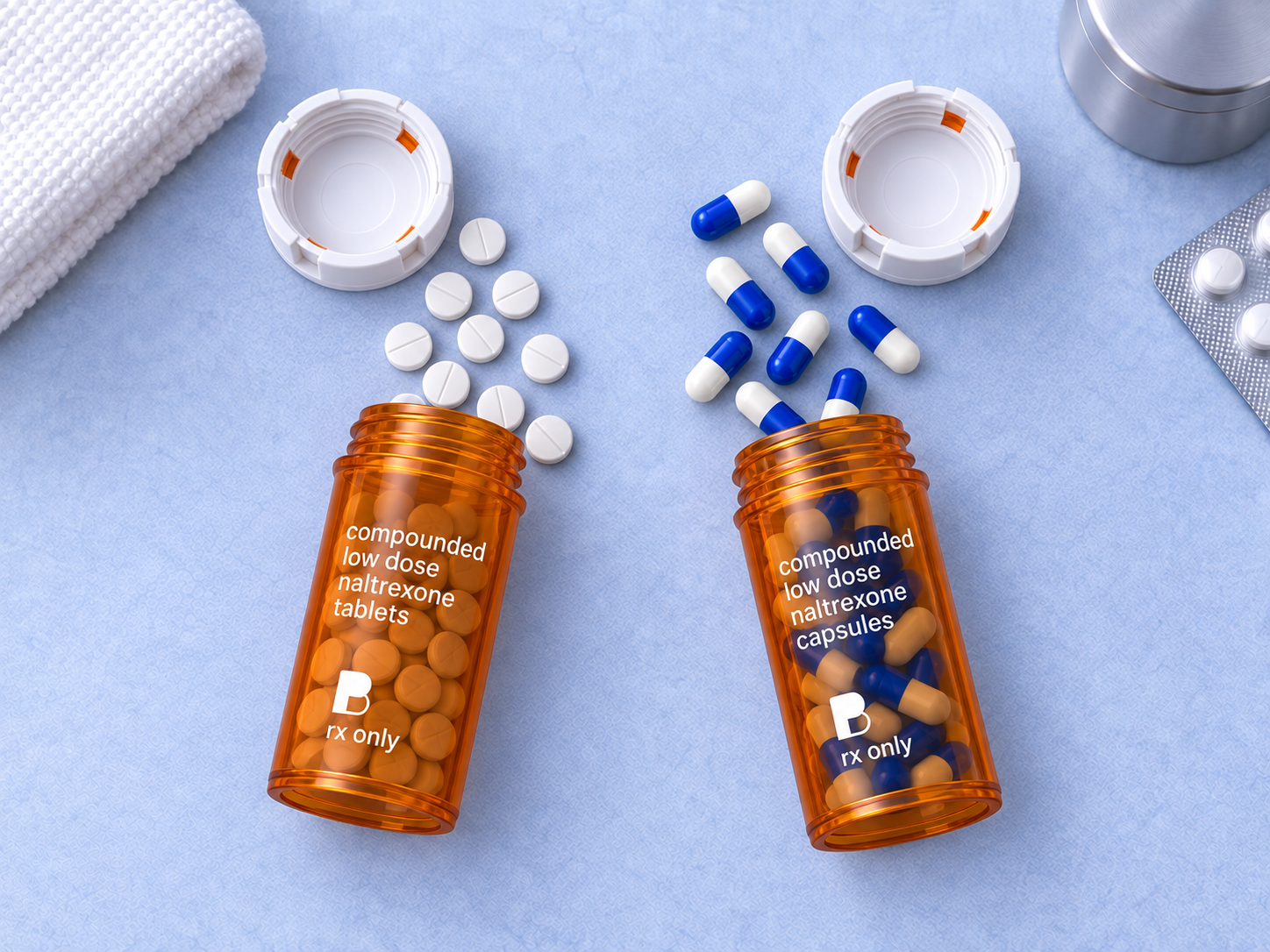
On a prescriber's order, Bayview prepares naltrexone hydrochloride as pressed tablets in 1.5, 3 and 4.5 mg, as capsules from 0.125 mg up to 9 mg including the strengths between the tablet steps, and as an oral liquid in 0.1, 0.2, 0.4, 1, 5 and 9 mg/mL, either as a suspension or as a flavored solution. Other strengths are compounded to order. All of it is USP 795 non-sterile compounding, prepared in small batches to the strength and form the prescription specifies. The oral liquid exists for patients who cannot swallow a solid dose or whose prescriber wants increments smaller than a capsule can give. The full catalog of preparations is at our compounded medications page.
How do I order low dose naltrexone?
Start with your prescriber. If they decide LDN is appropriate for you, they can e-prescribe, fax or phone the order to Bayview naming the strength and form, and we will fill it and ship it to you. LDN is priced as a cash prescription, and our post on whether compounding pharmacies take insurance explains how compounded prescriptions are paid for. Our pharmacists are available to answer questions about your prescription, and common questions are collected on our FAQ page.
Frequently asked questions
What is Low Dose Naltrexone?
Low Dose Naltrexone, often called LDN, is naltrexone prepared in much smaller doses than the commercially available 50 mg tablet. Because these low strengths are not sold as a standard manufactured product, they are commonly prepared by a compounding pharmacy with a prescription.
Is Low Dose Naltrexone FDA-approved?
Naltrexone is FDA-approved at standard doses for opioid and alcohol use disorders. Low Dose Naltrexone is prescribed off-label and compounded at lower strengths, so it is not FDA-approved for these uses. Your prescriber determines whether it is appropriate for your treatment plan.
Why does low dose naltrexone have to be compounded?
Naltrexone is commercially manufactured only as a 50 mg tablet. There is no mass-produced 1.5 mg or 4.5 mg product, so low strengths have to be prepared by a compounding pharmacy. That is the only reason it is compounded, not because a compounded version is different or better. Do not try to split or dissolve a 50 mg tablet at home; the accuracy is not there and no stability data supports it.
What strengths are available?
Bayview Pharmacy prepares LDN in the strength and form your prescriber orders. Compounded tablets, pressed in our own pharmacy, are available in 1.5, 3 and 4.5 mg. Capsules cover the strengths in between and the very low starting doses, from 0.125 mg up to 9 mg. An oral liquid is also available, which allows very small dose steps for patients who need them or who cannot swallow a solid dose. Other strengths can be compounded to order. Many providers start at a lower strength and adjust gradually.
How long does it take to notice a response?
LDN does not produce an immediate effect. Patient-facing references commonly suggest allowing up to eight to ten weeks, though no clinical trial has established a reliable time-to-response figure, and published studies describe it inconsistently. Response can vary with the individual, the dose, and the overall treatment plan. Follow your prescriber’s instructions and check in as directed rather than stopping early on your own.
What are the most common low dose naltrexone side effects?
The effects reported more often than placebo in pooled trial data are vivid or abnormal dreams and nausea. Trouble sleeping, headache, dizziness, fatigue, and stomach upset are also commonly mentioned, and small studies often describe them as appearing early and as transient. In the two largest randomized trials the overall side-effect rate was about the same on naltrexone as on placebo. Report anything that concerns you.
What should I avoid when taking low dose naltrexone?
Opioids, above all. Naltrexone blocks opioid receptors, so opioid pain medicines may not work as expected, and in someone physically dependent on opioids it can cause sudden, severe withdrawal. Avoid opioid-containing cough, cold, and antidiarrheal products for the same reason, and never take extra opioid to overcome the blockade. Tell any surgeon, dentist, or emergency clinician that you take naltrexone, in advance where possible.
Can I take LDN if I use opioid pain medication?
You should not take LDN with opioid medications unless your prescriber specifically determines it is safe. Naltrexone blocks opioid receptors, which may reduce the effect of opioid pain medications and may trigger withdrawal in someone who is physically dependent on opioids. Tell your provider and pharmacist about all medications you take.
How much does low dose naltrexone cost?
Compounded LDN starts at $100 for 90 capsules at Bayview, and the price varies with the strength, the form, and the quantity your prescriber ordered — capsules, compounded tablets, and the 1 mg/mL oral liquid are not priced alike. Compounded preparations are cash-priced and are generally eligible for HSA and FSA cards. Call us at 401-284-4505 with the strength and quantity on your prescription and we will quote it before we make it.
Can I use a compounded medication while pregnant or breastfeeding?
That decision belongs to you and your prescriber, and it has to be made for your specific medication and situation rather than from a general rule.
Some compounded preparations are used routinely during pregnancy and lactation. Others contain ingredients that are avoided. And a few carry handling precautions that matter even when you are not the person taking the medication — certain hormone creams, for instance, can transfer through skin contact.
Tell your prescriber and our pharmacists if you are pregnant, trying to become pregnant, or breastfeeding before you start a new compounded medication. Our pharmacists are glad to review your formulation and talk it through with your prescriber. Call us at 401-284-4505.
Can I take low dose naltrexone while pregnant or breastfeeding?
There is no low-dose-specific safety data in pregnancy or breastfeeding. The manufacturer's labeling for standard-dose naltrexone states there are no adequate and well-controlled studies in pregnant women, and that it is not known whether naltrexone passes into human milk. Reviews of LDN describe the available data as insufficient. If you are pregnant, planning a pregnancy, or breastfeeding, this is a decision for your prescriber and your obstetric clinician, not for a website.
Is low dose naltrexone studied for Hashimoto's or other thyroid conditions?
No. For thyroid conditions there are no human studies of naltrexone at low doses, so there is no published evidence either way. Hashimoto's is a thyroid condition, and claims you may read about LDN and thyroid conditions do not come from a low-dose human trial, because none has been published. There is also no low-dose-specific interaction data for thyroid medication.
Does low dose naltrexone have evidence for long COVID or ME/CFS?
There is no published randomized controlled trial of LDN in long COVID or ME/CFS. The available reports are uncontrolled, meaning they describe people who took it without comparing them to a group that did not. That design cannot separate the medication from the natural course of the illness or from placebo response, which ran 18 to 40% in LDN trials that did include a placebo group.
What did the fibromyalgia trials of low dose naltrexone find?
Two parallel-group randomized trials have been published, with 99 and 98 participants, in 2024 and 2026, the first in The Lancet Rheumatology. Neither found a significant difference from placebo on its main outcome. Fibromyalgia has the largest body of controlled LDN evidence of any proposed use, and the controlled results were negative. In LDN trials that did include a placebo group, 18 to 40% of participants on placebo also reported improvement.
Should I consider LDN for a condition with no controlled trials?
That is a decision for your prescriber. A 2026 narrative review in Advances in Therapy examined 105 studies, of which 15 were randomized controlled trials, and concluded that current evidence does not support routine clinical use. Useful questions to bring to the appointment: what would we watch for, how long would we try it, what would make you stop it, and is there an approved option to consider first?
What Bayview compounds for this
Important: Compounded medications are prepared to a prescriber's order for an individual patient. They are not FDA-approved, and the FDA has not evaluated them for safety, effectiveness, or manufacturing quality. This article is educational and is not a substitute for advice from your prescriber or pharmacist.
This preparation contains a controlled substance. Controlled-substance prescriptions carry refill limits, must be e-prescribed, and can only be shipped to states where Bayview holds the required licensure.
Uses discussed here may be off-label, meaning they are not part of any FDA-approved labeling. Off-label use is a decision for you and your prescriber, based on the available evidence.
Veterinary preparations are compounded to a veterinarian's order for a specific animal and are not FDA-approved animal drugs. Never give a compounded human medication to an animal without veterinary direction.
Compounded prescriptions are paid for directly rather than billed through insurance. Most are HSA/FSA-eligible, and many patients submit the receipt to their plan for possible reimbursement. Pricing depends on the strength, dose form and quantity your prescriber orders. Read more about cost and insurance.
Compounded LDN at Bayview starts at $100 for 90 tablets, and the price depends on the strength, form and quantity your prescriber orders. It is priced as a cash prescription. Ask the pharmacy for the price of your exact preparation before the prescription is filled.
Bayview Pharmacy is a compounding pharmacy in Warwick, Rhode Island, licensed to fill and ship compounded prescriptions for patients in Rhode Island, Massachusetts, Connecticut, New Jersey, New Hampshire, Florida, Maine and Pennsylvania. Prescriptions for New York patients are filled on a limited basis, and controlled substances are not shipped to New York addresses. See every state we ship to.
Related reading