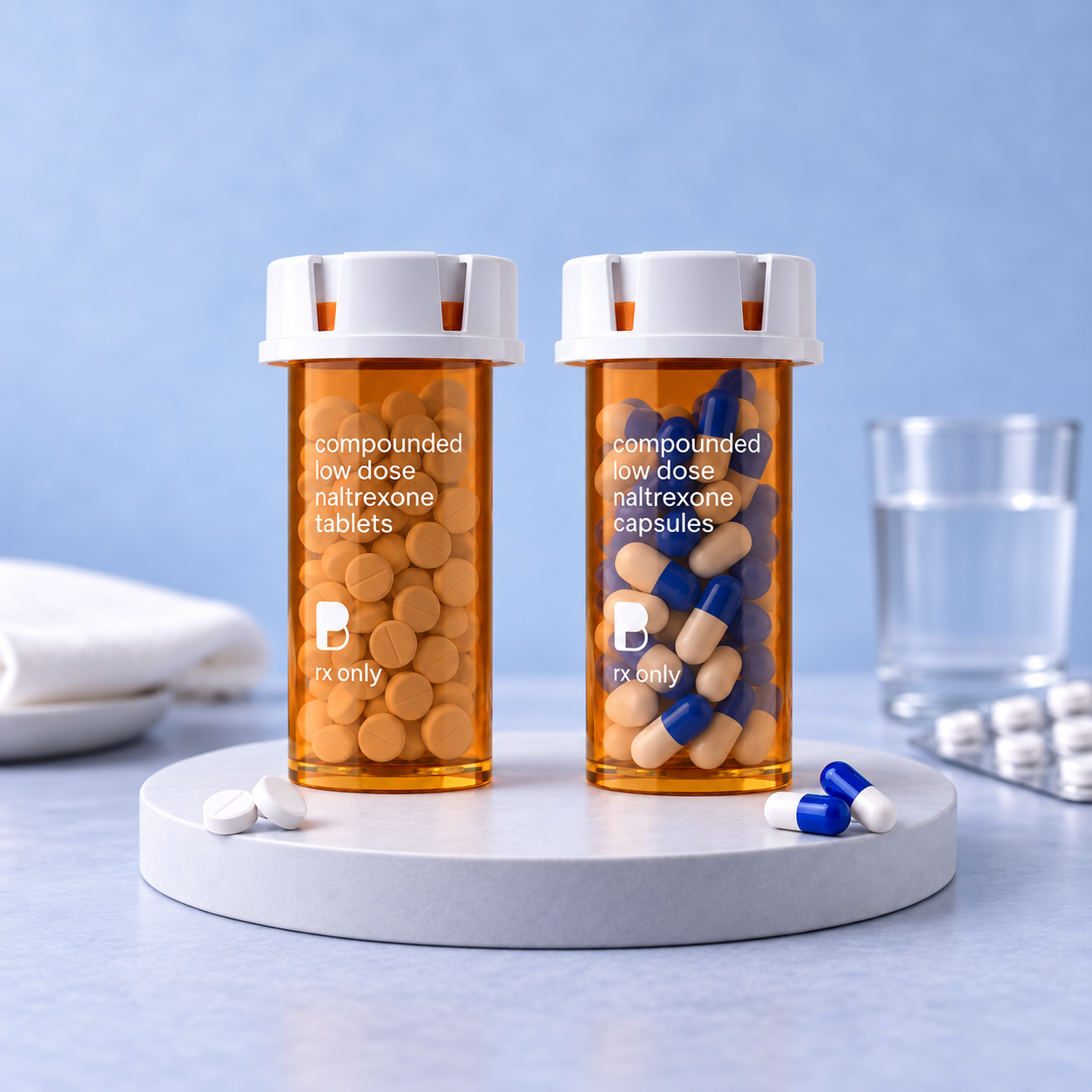
Low-dose naltrexone, usually shortened to LDN, is the opioid-blocking drug naltrexone prepared at roughly 1.5 to 4.5 mg, a small fraction of the 50 mg dose the FDA approved for opioid use disorder and alcohol use disorder. No manufacturer makes a naltrexone product at that strength, so it is compounded by a pharmacy against an individual prescription, and every use of it at these doses is off-label. The published literature on it is small trials, open-label studies and case series, so it is not established therapy for any condition.
It comes up often in conversations about chronic pain and autoimmune conditions, and it is also widely misdescribed online. This article sets out what compounded low-dose naltrexone actually is, what is proposed about how it works, what the evidence does and does not currently support, and the opioid interaction that everyone taking it needs to know about.
What is low-dose naltrexone?
Naltrexone is an opioid antagonist, meaning it binds opioid receptors and blocks other substances from acting on them. At the approved 50 mg dose that blockade is sustained, which is why it is used in opioid and alcohol use disorder.
Low-dose naltrexone uses a small fraction of that amount. There is no FDA-approved low-dose naltrexone product, which is the reason it has to be compounded: a pharmacy takes the drug and prepares it at the strength written on the prescription. Compounded preparations are not FDA-approved and are not reviewed by the FDA for safety or effectiveness. If you want to see how that differs from picking up a manufactured tablet, we cover it in our piece on compounding and retail pharmacies.
A prescriber decides whether it is appropriate, at what dose, and for how long. Bayview Pharmacy does not provide consultations and does not determine whether a medication is right for you. If your prescriber wants the clinical detail, we keep a separate prescribing guide for clinicians, covering strengths, titration and the evidence.
How is low-dose naltrexone thought to work?
Two mechanisms are proposed, and both are still being studied rather than settled.
The first is a rebound effect. A brief, partial blockade of opioid receptors at a low dose is thought to prompt the body to increase its own endorphin production, with the effect outlasting the blockade itself. The second involves glial cells in the central nervous system. Naltrexone appears to act on toll-like receptor 4 on those cells, and since activated glia contribute to neuroinflammation and to how pain signals are amplified, damping that activity is the proposed route by which low doses might affect chronic pain.
Both are plausible and neither is proven in the way an approved indication is proven. Anyone telling you the mechanism is settled is ahead of the evidence.
What does the evidence actually show?
This is the part that usually gets skipped, and it is the part worth reading.
Most published work on low-dose naltrexone consists of small trials, open-label studies, and case series. The most-cited work is in fibromyalgia and in Crohn's disease, where small randomized studies have reported improvement in symptom scores. Reviews of that literature consistently reach the same conclusion: the early signals are interesting, the studies are small and often short, and larger confirmatory trials have generally not been done.
Low-dose naltrexone is also discussed in connection with multiple sclerosis, complex regional pain syndrome, and various inflammatory conditions. The evidence in those areas is thinner still.
The table below is a map of that literature. Read the middle column first: it is the honest measure of how much is known about each use.
| Use | Evidence | Status |
|---|---|---|
| Fibromyalgia | Small trials, case series | Off-label, compounded |
| Crohn's disease | Small trials | Off-label, compounded |
| Multiple sclerosis | Small trials, mixed results | Off-label, compounded |
| Complex regional pain syndrome | Case series | Off-label, compounded |
| Other inflammatory conditions | Case reports | Off-label, compounded |
| Opioid or alcohol use disorder | Randomized trials | FDA-approved at 50 mg |
What that means in practice: LDN is not established therapy, it is not FDA-approved at these doses for any condition, and it should not be presented as a treatment that reliably works. If your prescriber suggests it, a fair question is what result they are hoping for and by when they would reassess. That is a reasonable question for any therapy and a particularly reasonable one here.

Does low-dose naltrexone block opioid pain medicine?
Yes, and this is the single most important thing to understand before you start it. Naltrexone is an opioid antagonist. At the approved 50 mg dose it blocks opioid pain medicines outright. At 1.5 to 4.5 mg the blockade is shorter and only partial, but the interaction has not gone away, and prescribers treat it as real.
Products that act through opioid receptors are the ones to watch for. That includes prescription opioid analgesics such as morphine, oxycodone, hydrocodone, codeine, tramadol and fentanyl. It also includes cough and cold preparations that contain an opioid such as codeine or hydrocodone, and antidiarrheal products that work through opioid receptors, such as loperamide and diphenoxylate. Loperamide is sold over the counter, so it is easy to take without thinking of it as an opioid at all.
In a person who is physically dependent on opioids, naltrexone can precipitate withdrawal. That is why prescribers ask about opioid use before writing it, and why an accurate medication list matters more here than in most conversations you will have at a pharmacy counter. If chronic pain is what brought you here, our article on compounded alternatives to opioids covers the other routes prescribers use.
Surgery and procedures deserve their own mention. Tell your surgeon, your anesthesiologist and your dentist that you take low-dose naltrexone, and tell them well before the date rather than on the morning of. Opioid analgesia is part of many procedures, and the team needs to plan around a drug that blunts it. Whether to pause it, and for how long, is your prescriber's decision, not something to work out from an article.
The same applies in an emergency. Keep low-dose naltrexone on the medication list you carry, so that anyone treating you for an injury knows it is on board.
What side effects are reported at low doses?
Reported side effects at low doses are usually mild and include vivid dreams or trouble sleeping, headache, nausea, and stomach upset. Sleep effects are common enough that prescribers sometimes adjust the time of day it is taken. A closer look at low dose naltrexone side effects and what to avoid while taking it goes through each of these and the products that interact.
Tell your prescriber and pharmacist about every medication and supplement you take, and about liver problems or pregnancy. A compounded preparation carries the same interaction questions as a manufactured one, and the answers are specific to you.
What does Bayview compound for low-dose naltrexone?
Bayview prepares low-dose naltrexone against an individual prescription, in the strength and dose form the prescriber specifies, using USP 795 non-sterile compounding. Strengths and forms are listed on the low-dose naltrexone formulation page, which starts at $100.
Capsules
Capsules are the usual form, commonly compounded between 1.5 mg and 4.5 mg with a filler such as lactose, or an alternative filler where a patient cannot take lactose. Prescribers frequently start low and increase gradually. Take it as directed and at a consistent time; if you miss a dose, take it when you remember unless your next dose is close, in which case skip the missed one rather than doubling up.
Oral liquid
Where a prescriber wants a dose between capsule strengths, or where swallowing a capsule is a problem, naltrexone can be prepared as a liquid instead. That is the same approach behind our custom oral suspensions, which measure a dose by the milliliter rather than by the capsule.
Creams and gels
Naltrexone is also compounded into topical preparations, sometimes combined with other ingredients at a prescriber's direction. Topical use of naltrexone is off-label and is supported by less evidence than the oral low-dose form, which is limited to begin with. Apply only to the area and for the period your prescriber specifies, and stop and contact them if you get stinging, burning, or irritation that does not settle.
What else might a prescriber order for chronic pain?
Low-dose naltrexone is one item on a long list, and a prescriber managing chronic pain has other compounded routes available. A topical pain cream is applied to the skin at the site rather than swallowed.
Compounded diclofenac is prepared at strengths above the 1% gel sold over the counter, and as acid-resistant oral capsules.
The rest of the pain and palliative care preparations are grouped together on the site.
The full searchable catalog of compounded preparations covers every therapy area we prepare. Which of these, if any, suits you is a question for the person writing the prescription.
How do you get low-dose naltrexone from Bayview?
Bayview is a 503A compounding pharmacy in Warwick, Rhode Island, founded in 2006. Every preparation is made against a prescription written for a named patient. Prescribers can e-prescribe to Bayview Pharmacy, 3844 Post Rd, Warwick, RI 02886, or fax 401-284-4506; account setup and ordering are covered on the for providers page. A separate guide covers getting low dose naltrexone from a compounding pharmacy, including strengths and cost.
Compounded preparations are generally paid for directly rather than billed through insurance, because a compounded item has no manufacturer product code to bill against. Questions about cost, refills, and the states where Bayview is licensed are answered in the frequently asked questions.
If you are looking for a compounding pharmacy near you, that piece explains what to ask before you send a prescription anywhere.
Talk to your prescriber
If low-dose naltrexone is something you are considering, bring three things to the conversation: your full medication list including anything over the counter, any planned surgery or dental work, and a clear question about what result your prescriber is hoping for and when they would reassess. Whether it is appropriate for you, at what dose, and for how long are all decisions for you and your prescriber to make together.
If you already hold a prescription and have a question about the preparation itself, a Bayview pharmacist is happy to answer it.
Frequently asked questions
What is Low Dose Naltrexone?
Low Dose Naltrexone, often called LDN, is naltrexone prepared in much smaller doses than the commercially available 50 mg tablet. Because these low strengths are not sold as a standard manufactured product, they are commonly prepared by a compounding pharmacy with a prescription.
Is Low Dose Naltrexone FDA-approved?
Naltrexone is FDA-approved at standard doses for opioid and alcohol use disorders. Low Dose Naltrexone is prescribed off-label and compounded at lower strengths, so it is not FDA-approved for these uses. Your prescriber determines whether it is appropriate for your treatment plan.
Why is LDN compounded?
Naltrexone is commercially manufactured only as a 50 mg tablet, so the low doses commonly used, such as 1.5 mg, 3 mg, or 4.5 mg, are not available as a standard product. Compounding allows a licensed pharmacy to prepare naltrexone at the exact strength your provider prescribes, and in the form that suits you: a capsule, a tablet, or an oral liquid. Please do not attempt to split or dissolve a 50 mg tablet at home, that cannot deliver an accurate low dose.
What strengths are available?
Bayview Pharmacy prepares LDN in the strength and form your prescriber orders. Compounded tablets, pressed in our own pharmacy, are available in 1.5, 3 and 4.5 mg. Capsules cover the strengths in between and the very low starting doses, from 0.125 mg up to 9 mg. An oral liquid is also available, which allows very small dose steps for patients who need them or who cannot swallow a solid dose. Other strengths can be compounded to order. Many providers start at a lower strength and adjust gradually.
How do I take LDN?
Take LDN exactly as prescribed by your provider, whether it is a capsule, a tablet, or an oral liquid. It is often taken once daily, sometimes at bedtime, but your directions may be different. If you have been prescribed the liquid, measure each dose with the oral syringe provided rather than a household spoon. Do not change your dose, timing, or frequency unless your prescriber tells you to.
Can I take LDN if I use opioid pain medication?
You should not take LDN with opioid medications unless your prescriber specifically determines it is safe. Naltrexone blocks opioid receptors, which may reduce the effect of opioid pain medications and may trigger withdrawal in someone who is physically dependent on opioids. Tell your provider and pharmacist about all medications you take.
What side effects can happen with LDN?
LDN is generally well tolerated at these doses. The effects reported most often, and more often than with placebo in pooled trial data, are vivid or unusual dreams and nausea. Others reported include sleep disturbance, headache, dizziness, stomach upset, and fatigue. Worth knowing: in the two largest randomized trials the overall rate of side effects was about the same on naltrexone as on placebo, so many reported effects were not attributable to the medication. Contact your prescriber if anything is bothersome, persistent, or unexpected.
How long does it take to notice a response?
LDN does not produce an immediate effect. Patient-facing references commonly suggest allowing up to eight to ten weeks, though no clinical trial has established a reliable time-to-response figure, and published studies describe it inconsistently. Response can vary with the individual, the dose, and the overall treatment plan. Follow your prescriber’s instructions and check in as directed rather than stopping early on your own.
How should I store LDN?
Store capsules and tablets at room temperature unless the prescription label says otherwise. Keep the container tightly closed, away from excess heat, moisture, and direct light, a bathroom cabinet is a poor choice because of humidity. If you have been prescribed a liquid, check your label to see whether it needs refrigeration. Keep all medication out of reach of children and pets, and do not use any preparation past the beyond-use date on the label.
Do I need a prescription?
Yes. All of our medications require a valid prescription from a licensed provider. We're a dispensing and compounding pharmacy, so we don't provide consultations or write prescriptions. If you don't have one yet, you'll need to see a provider first.
Do you accept insurance?
Most compounded medications are not covered by insurance. We can always try and run your insurance prior to compounding your prescription if you wish.
How much do compounded medications cost?
Pricing varies depending on ingredients and formulation complexity.
What states do you ship to?
Bayview fills and ships prescriptions for patients in Rhode Island, Massachusetts, Connecticut, New Jersey, New Hampshire, Florida, Maine, and Pennsylvania.
New York: Bayview currently serves eligible New York patients on a limited basis under New York's isolated-transaction criteria. Full nonresident pharmacy registration is pending. We do not ship controlled substances to New York addresses.
If you are not sure whether your prescription is affected, call us at (401) 284-4505 and we will check before anything is prepared.
Can a compounded medication interact with my other medications?
Yes. Compounded preparations contain the same active ingredients as commercially manufactured drugs, so they carry the same interaction potential — with prescriptions, over-the-counter products, and supplements alike.
Give us your complete medication list, including anything filled at another pharmacy. This matters more than people expect. If we are not your only pharmacy, we cannot see the full picture on our own, and neither can they. Supplements are worth naming specifically; patients often leave them out, and several interact meaningfully with prescription therapy.
Our pharmacists screen for interactions when we prepare your medication and will contact your prescriber if something needs attention before we dispense.
If you start anything new while you are on a compounded therapy, call us at 401-284-4505 and we will check it against what you are taking.
Are compounded medications FDA-approved?
Compounded medications are not FDA-approved. They're prepared by a licensed pharmacy pursuant to a valid prescription for an individual patient, under USP standards. The FDA does not review compounded medications for safety or effectiveness.
What Bayview compounds for this
Important: Compounded medications are prepared to a prescriber's order for an individual patient. They are not FDA-approved, and the FDA has not evaluated them for safety, effectiveness, or manufacturing quality. This article is educational and is not a substitute for advice from your prescriber or pharmacist.
This preparation contains a controlled substance. Controlled-substance prescriptions carry refill limits, must be e-prescribed, and can only be shipped to states where Bayview holds the required licensure.
Uses discussed here may be off-label, meaning they are not part of any FDA-approved labeling. Off-label use is a decision for you and your prescriber, based on the available evidence.
Veterinary preparations are compounded to a veterinarian's order for a specific animal and are not FDA-approved animal drugs. Never give a compounded human medication to an animal without veterinary direction.
Compounded prescriptions are paid for directly rather than billed through insurance. Most are HSA/FSA-eligible, and many patients submit the receipt to their plan for possible reimbursement. Pricing depends on the strength, dose form and quantity your prescriber orders. Read more about cost and insurance.
Compounded low-dose naltrexone starts at $100 at Bayview, and the final price depends on the strength, the dose form and the quantity your prescriber writes. Compounded preparations are generally paid for directly rather than billed through insurance, because a compounded item has no manufacturer product code for a plan to bill against. A pharmacist can quote a specific prescription before it is prepared.
Bayview Pharmacy is a compounding pharmacy in Warwick, Rhode Island, licensed to fill and ship compounded prescriptions for patients in Rhode Island, Massachusetts, Connecticut, New Jersey, New Hampshire, Florida, Maine and Pennsylvania. Prescriptions for New York patients are filled on a limited basis, and controlled substances are not shipped to New York addresses. See every state we ship to.
Related reading