
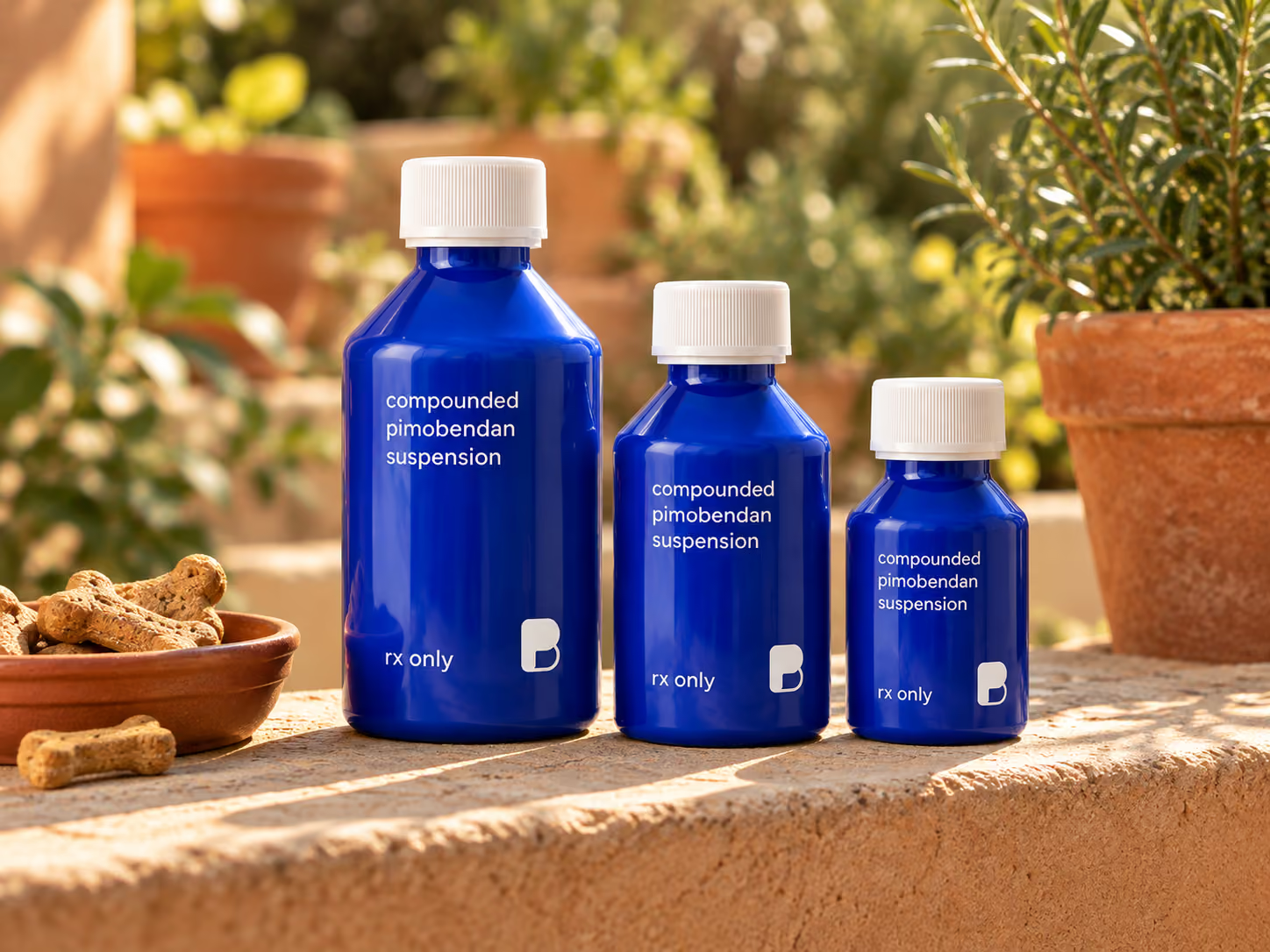
Pimobendan is a prescription heart medication that veterinarians use in dogs with certain forms of heart disease, and an FDA-approved pimobendan product for dogs (Vetmedin) is available and is the first-choice option. Bayview Pharmacy compounds pimobendan for dogs only when the approved product does not meet a specific patient's need, for example a very small dog needing a strength or form that is not commercially available. A compounded preparation is prescription-only, requires a prescription from a licensed veterinarian, and is not FDA-approved.
If your dog has just been prescribed a heart medication, the rest of this page explains what pimobendan is, what forms exist, and which decisions belong to your veterinarian. It is not a reason to ask for a change to what you were already given.
What is pimobendan, and how does this dog heart medication work?

Pimobendan is described as an "inodilator." It helps the heart pump more strongly while widening blood vessels to ease the heart's workload. That is the drug's class description, not a statement about any one dog's outcome.
Veterinarians may prescribe pimobendan as part of a treatment plan for certain forms of canine heart disease and congestive heart failure, such as those caused by degenerative mitral valve disease or dilated cardiomyopathy, as diagnosed and directed by the veterinarian. Whether it is appropriate, and at what point, is determined by your veterinarian based on examination and diagnostic testing.
Dose and appropriateness are the prescriber's decisions. A pharmacy prepares what the prescription says; it does not decide whether a medication fits your dog.
A heart medication is also usually one piece of a larger plan. Your veterinarian may be tracking your dog's current body weight, examination findings, diagnostic testing, and other medications at the same time. When you have a question about the plan, the clinic is the place to ask, since they are the only ones looking at your dog's record.
Why would a veterinarian order compounded pimobendan when Vetmedin exists?
The FDA-approved product is the first-choice option because it has been reviewed by the FDA for safety, effectiveness, manufacturing quality, and labeling. Compounding is used to fill a gap the approved product cannot: a very small amount measured in fractions of a milligram, or a different form for a dog that will not take the commercial version.
Compounding is not a generic substitute, and a compounded preparation is not claimed to be equivalent to or better than the approved product. The FDA has cautioned that compounded formulations of pimobendan have not been reviewed for safety or effectiveness and may vary in quality and potency.
That is why this is a veterinary decision rather than an owner preference. If the commercial product works for your dog, that is the option your veterinarian is likely to keep using.
What forms and strengths can be compounded?
Bayview prepares compounded pimobendan to the strength and form your veterinarian orders, with pet-friendly flavors available. The table below is for education only. Your veterinarian specifies what is dispensed for your dog.
| Form | Typical strengths | Practical notes | Status |
|---|---|---|---|
| Commercial chewable | Fixed commercial sizes | First-choice option | FDA-approved |
| Flavored oral suspension | 1.25 to 10 mg/mL, to order | Measured by syringe | Compounded, not FDA-approved |
| Capsules | Fractions of a mg upward | Precise small strengths | Compounded, not FDA-approved |
The suspension is a liquid drawn up and measured with an oral syringe, which is a form a prescriber may order for a very small dog or a dog that will not take a tablet. Capsules are made in custom strengths, from fractions of a milligram up to several milligrams, for precise small strengths that are not available commercially. Forms and strengths are listed for education only and are not a statement that any option is better, stronger, or more effective. Both the suspension and the capsules are non-sterile oral preparations made under USP 795 non-sterile compounding.
The reason two forms exist is that the obstacle is different from dog to dog. For one dog the problem is arithmetic: the amount the veterinarian calculated sits between the commercial sizes, and a capsule can be made at the number on the prescription. For another dog the problem is the form, and the veterinarian writes for a measured liquid because the dog cannot take the commercial version. Which of those applies, and whether either applies at all, is something the clinic works out before it writes the order.
How is pimobendan dosage for dogs decided?
Your veterinarian sets the exact dose based on your dog's weight and condition, and tells you how often to give it. The prescription is then compounded to that order, which is the whole reason a custom strength exists: the preparation is built around the number on the prescription rather than the other way around.
This page does not list dose amounts, because the amount is not a general number. It belongs to one dog, one body weight, and one veterinary assessment. Never adjust the amount on your own, and do not change the dose or stop the medication without veterinary guidance. Ask your veterinarian about giving it in relation to food.
Strength ranges like 1.25 to 10 mg/mL describe what can be prepared, not what should be given. If the strength on your label looks different from what you expected, call the clinic rather than changing anything.
How do you give a compounded liquid or capsule to a dog?
A flavored oral suspension is given by mouth and measured with an oral syringe, following the directions on the label. A capsule is given by mouth as directed. Both are given on the schedule the clinic sets, often at consistent times each day.
- Store the medication as directed on the label.
- Ask your pharmacist how to store the specific form you receive.
- Do not use it past the beyond-use date on the label.
- Keep it out of reach of children and pets.
Pet-friendly flavors are available. The flavor is part of what your veterinarian orders, along with the strength and the form, so it appears on the prescription like everything else.
What should I watch for, and when should I call the veterinarian?
Commonly reported side effects in dogs are reduced appetite, lethargy, and digestive upset. Tell your veterinarian about all of your pet's health conditions and other medications, so they can decide whether this preparation is appropriate.
Get veterinary care if your dog has any of the following:
- Worsening cough, difficulty breathing, or unusual tiredness
- Collapse, fainting, or weakness
- Refusal to eat or vomiting
- Any change that concerns you
Pimobendan is only for dogs a veterinarian has diagnosed with heart disease and prescribed it for. It may not be appropriate for a dog with a condition where increasing the heart's output could be harmful, for example hypertrophic cardiomyopathy with outflow obstruction, unless your veterinarian specifically directs its use.
What else does a compounding pharmacy prepare for dogs and cats?
Veterinary compounding is a routine part of what a compounding pharmacy does for dogs and cats, usually when an animal needs a strength or a form the commercial market does not carry. Other preparations made to a veterinarian's order include trilostane for dogs, ursodiol for pets, and cisapride. Cats have their own common request, a transdermal methimazole gel. The searchable list is in the compounded medications catalog.
What does compounded pimobendan cost, and is it billed to insurance?
Compounded pimobendan starts at $65 for 30 mL, and the final price depends on the strength, form, and quantity your veterinarian orders. It is priced as a cash prescription, and our post on whether compounding pharmacies take insurance explains how compounded prescriptions are paid for. Ask the pharmacy for the price of your exact preparation before the prescription is filled.
What Bayview compounds for this
On a veterinarian's order, Bayview prepares compounded pimobendan for dogs as a flavored oral suspension from 1.25 to 10 mg/mL, measured by syringe, and as capsules in custom strengths from fractions of a milligram up to several milligrams. Both are oral preparations. Each one is prescribed by a veterinarian for a specific animal, and the strength, form, flavor, and quantity come from that prescription.
How to talk to your veterinarian about it
Start with the clinic, not with the pharmacy. If your dog is struggling with the commercial chewable, or if the amount your veterinarian calculated falls between the sizes that are sold, say so at the appointment and let them decide what to prescribe. Useful questions to bring: what are we watching for, how often should we recheck the weight, and what should make me call you?
If your veterinarian decides a compounded preparation is the right order for your dog, they can send the prescription to us by e-prescribing platform, fax, or phone, and we can prepare it and ship it to you. Have the clinic include your dog's species, breed, and current body weight so the order can be verified.
Frequently asked questions
What should I watch for?
Tell your veterinarian about worsening cough, labored or rapid breathing, unusual tiredness, fainting or collapse, or refusal to eat. These can signal that heart disease is progressing and the plan needs adjusting, not necessarily that the medication is failing. Keep every recheck, since dosing is guided by exam and imaging findings.
Which dogs should not take it?
Only dogs diagnosed with heart disease by a veterinarian should take it, and it may be unsafe in some conditions, such as hypertrophic cardiomyopathy with outflow obstruction, unless your veterinarian directs it.
How is it given?
By mouth, usually a flavored liquid, capsule, or chew. Your veterinarian sets the dose based on your dog's weight and condition and tells you how often to give it. Do not adjust the amount on your own.
Is compounded pimobendan the same as Vetmedin?
No. A compounded preparation is not FDA-reviewed and is not a generic substitute; the FDA has cautioned that compounded pimobendan can vary in quality and potency. It is used only to fill a gap the approved product cannot, at your veterinarian's direction.
Isn't there an approved product already?
Yes, Vetmedin is FDA-approved for dogs and is the first-choice option. Bayview compounds pimobendan only when the approved product cannot meet a specific need, such as a very small dog needing a dose or form that is not sold commercially.
What is pimobendan used for?
Veterinarians prescribe pimobendan for certain forms of canine heart disease and congestive heart failure. It helps the heart pump more strongly and eases its workload, as diagnosed and directed by your veterinarian.
How is the compounded liquid measured and given to a dog?
The flavored oral suspension is measured with an oral syringe and given by mouth, following the directions on the label. Follow the schedule the clinic sets, often at consistent times each day, and ask your veterinarian about giving it in relation to food. If anything about measuring or giving a dose is unclear, a Bayview pharmacist can walk you through the preparation you were dispensed.
What should I do if I miss a dose of my dog's pimobendan?
Call your veterinary clinic and ask. The formulation page for this preparation does not cover missed doses, and we will not invent guidance that your veterinarian did not give. The instruction that applies to your dog is the one on your label and from the clinic that wrote the prescription. Do not change the dose or stop the medication without veterinary guidance, and do not double up on your own.
Does the flavoring change the medication?
Pet-friendly flavors are available, and Bayview prepares compounded pimobendan to the strength, form, and flavor the prescription specifies. The flavor is part of the order your veterinarian wrote rather than a substitution made at the pharmacy. Ask your pharmacist how to store the specific flavored form you receive, and do not use it past the beyond-use date on the label.
What Bayview compounds for this
Important: Compounded medications are prepared to a prescriber's order for an individual patient. They are not FDA-approved, and the FDA has not evaluated them for safety, effectiveness, or manufacturing quality. This article is educational and is not a substitute for advice from your prescriber or pharmacist.
This preparation contains a controlled substance. Controlled-substance prescriptions carry refill limits, must be e-prescribed, and can only be shipped to states where Bayview holds the required licensure.
Uses discussed here may be off-label, meaning they are not part of any FDA-approved labeling. Off-label use is a decision for you and your prescriber, based on the available evidence.
Veterinary preparations are compounded to a veterinarian's order for a specific animal and are not FDA-approved animal drugs. Never give a compounded human medication to an animal without veterinary direction.
Compounded prescriptions are paid for directly rather than billed through insurance. Most are HSA/FSA-eligible, and many patients submit the receipt to their plan for possible reimbursement. Pricing depends on the strength, dose form and quantity your prescriber orders. Read more about cost and insurance.
Compounded pimobendan for dogs starts at $65 for 30 mL, and the final price depends on the strength, form, and quantity your veterinarian orders. It is priced as a cash prescription. Ask the pharmacy for the price of your exact preparation before the prescription is filled.
Bayview Pharmacy is a compounding pharmacy in Warwick, Rhode Island, licensed to fill and ship compounded prescriptions for patients in Rhode Island, Massachusetts, Connecticut, New Jersey, New Hampshire, Florida, Maine and Pennsylvania. Prescriptions for New York patients are filled on a limited basis, and controlled substances are not shipped to New York addresses. See every state we ship to.
Related reading