A topical steroid potency chart sorts topical corticosteroids into seven classes, class I superpotent through class VII least potent, so an agent can be matched to a site and a diagnosis. The full chart is directly below, followed by the same data sorted by molecule for lookup. What a chart cannot tell you is where a compounded corticosteroid sits, because a strength or base no manufacturer makes has not been assigned a class. This guide covers both, plus what the vehicle changes and what compounded fluocinonide and compounded triamcinolone acetonide are actually prepared as.
What is the topical steroid potency chart?
The chart follows the class assignments used in the StatPearls chapter on topical corticosteroids, the reference cited on Bayview's own formulation pages. The seven-class scale is derived largely from vasoconstrictor (skin blanching) assay data on marketed products, and it is long-established published pharmacology rather than any one pharmacy's classification.
| Class | Potency | Representative agents |
|---|---|---|
| I | Superpotent | Clobetasol propionate 0.05%, halobetasol propionate 0.05% |
| II | High | Fluocinonide 0.05%, desoximetasone 0.25%, halcinonide 0.1% |
| III | Upper mid | Betamethasone valerate 0.1% ointment, triamcinolone acetonide 0.5% |
| IV | Mid | Triamcinolone acetonide 0.1%, mometasone furoate 0.1% |
| V | Lower mid | Hydrocortisone butyrate 0.1%, fluticasone propionate 0.05% cream |
| VI | Mild | Desonide 0.05%, alclometasone dipropionate 0.05%, fluocinolone acetonide 0.01% |
| VII | Least potent | Hydrocortisone 0.5%, 1%, 2.5% |
Two cautions travel with every version of this chart. Class assignments vary slightly between published references, so a molecule that appears in class II in one source may appear in class I or III in another. And potency describes how strongly a corticosteroid acts on skin in an assay, not how a given patient will respond: a higher class is not automatically the correct choice, and selection remains a clinical decision.
Which topical steroid is in which potency class?
The lookup below is the same published classification sorted by molecule rather than by class, for the common case of having an agent in hand and needing its class. Where a source specifies a vehicle, it is shown, because the same molecule at the same percentage can sit in different classes in different vehicles.

| Agent | Strength and vehicle | Class |
|---|---|---|
| Alclometasone dipropionate | 0.05% | VI |
| Betamethasone dipropionate | 0.05% | II |
| Betamethasone dipropionate, augmented | 0.05% | I |
| Betamethasone valerate | 0.1% ointment | III |
| Clobetasol propionate | 0.05% | I |
| Desonide | 0.05% | VI |
| Desoximetasone | 0.25% | II |
| Fluocinolone acetonide | 0.01% | VI |
| Fluocinonide | 0.05% | II |
| Fluocinonide | 0.1% cream | I |
| Fluticasone propionate | 0.005% ointment | III |
| Fluticasone propionate | 0.05% cream | V |
| Halcinonide | 0.1% | II |
| Halobetasol propionate | 0.05% | I |
| Hydrocortisone base | 0.5%, 1%, 2.5% | VII |
| Hydrocortisone butyrate | 0.1% | V |
| Hydrocortisone valerate | 0.2% | IV |
| Mometasone furoate | 0.1% cream | IV |
| Triamcinolone acetonide | 0.025% cream | V |
| Triamcinolone acetonide | 0.1% | IV |
| Triamcinolone acetonide | 0.5% | III |
Triamcinolone acetonide is the clearest illustration of why a chart entry is a molecule plus a number plus a vehicle rather than a molecule alone: its three common strengths sit in three different classes, III through V. Fluocinonide spans two, with the 0.05% preparations in class II and the 0.1% cream in class I.
Does the vehicle change a topical corticosteroid's potency?
Yes, and it is recognized in the published classification itself, which is why several rows above name a cream or an ointment rather than a percentage alone. An ointment base is occlusive and increases hydration of the stratum corneum, and the same corticosteroid is generally placed higher on the scale in an ointment than in a cream, lotion or solution. Published sources do not agree on a fixed conversion factor for this effect, and none is offered here.
Vehicle selection is also a practical matter separate from potency. Ointments hold moisture on dry, lichenified skin. Creams are used on weeping or acute areas. Gels, solutions, lotions and foams spread through hair and dry without residue. Sprays reach skin that is painful to touch. If you want a longer treatment of bases, emulsifiers and preservatives, the post on what goes into a compounded cream covers the vehicle side in detail.
Does compounding a steroid into a different vehicle change its class?
This is the question the chart cannot answer, and it should be stated plainly. Potency classes are assigned to specific marketed products that went through blanching assays at defined concentrations in defined vehicles. A compounded strength or base that no manufacturer makes has not been assigned a class, and it is not correct to read a class across from the nearest commercial product. Nothing in this guide assigns a class to any compounded preparation, and vehicle effects are described qualitatively rather than as a step up or down the scale.

Practically, this means the chart is a starting frame for agent selection, and the prescription itself is where the specifics live: the strength, the base, the site, the frequency, the course length, and whether occlusion is permitted. Dose, potency selection and appropriateness are the prescriber's decisions.
What corticosteroid strengths and forms does Bayview compound?
Bayview is a 503A compounding pharmacy, which means preparations are made pursuant to a prescription for an individual patient and not supplied as office or clinic stock. The distinction, and what it rules in and out, is covered in the post on 503A versus 503B pharmacies. Where a manufactured triamcinolone or fluocinonide product fits the order, that product is dispensed as such. The table below is the compounded side only.
| Preparation | Strengths | Forms | FDA status |
|---|---|---|---|
| Triamcinolone acetonide | 0.025%, 0.1%, 0.5% | Cream, ointment | Compounded, not FDA-approved |
| Triamcinolone acetonide | 0.5% | Gel | Compounded, not FDA-approved |
| Triamcinolone acetonide | 0.05% | Lotion | Compounded, not FDA-approved |
| Triamcinolone acetonide | 0.1% | Topical solution | Compounded, not FDA-approved |
| Triamcinolone acetonide | 0.04% | Topical spray | Compounded, not FDA-approved |
| Triamcinolone acetonide | 0.025%, 0.1% | Medicated shampoo | Compounded, not FDA-approved |
| Triamcinolone acetonide | 0.1% | Oral adhesive paste | Compounded, not FDA-approved |
| Triamcinolone acetonide | 0.1%, 0.2%, 0.4% | Oral rinse | Compounded, not FDA-approved |
| Fluocinonide | 0.01%, 0.015%, 0.025% | Ointment, lotion | Compounded, not FDA-approved |
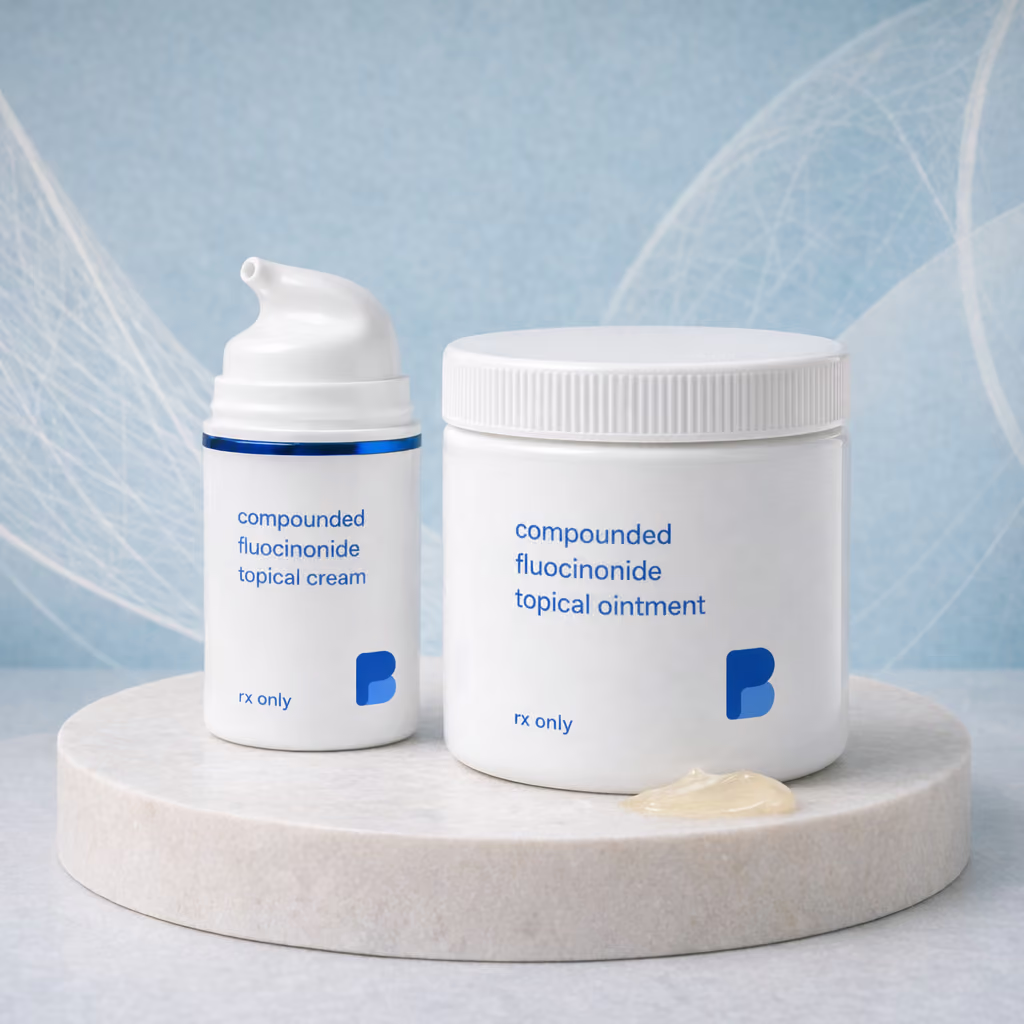
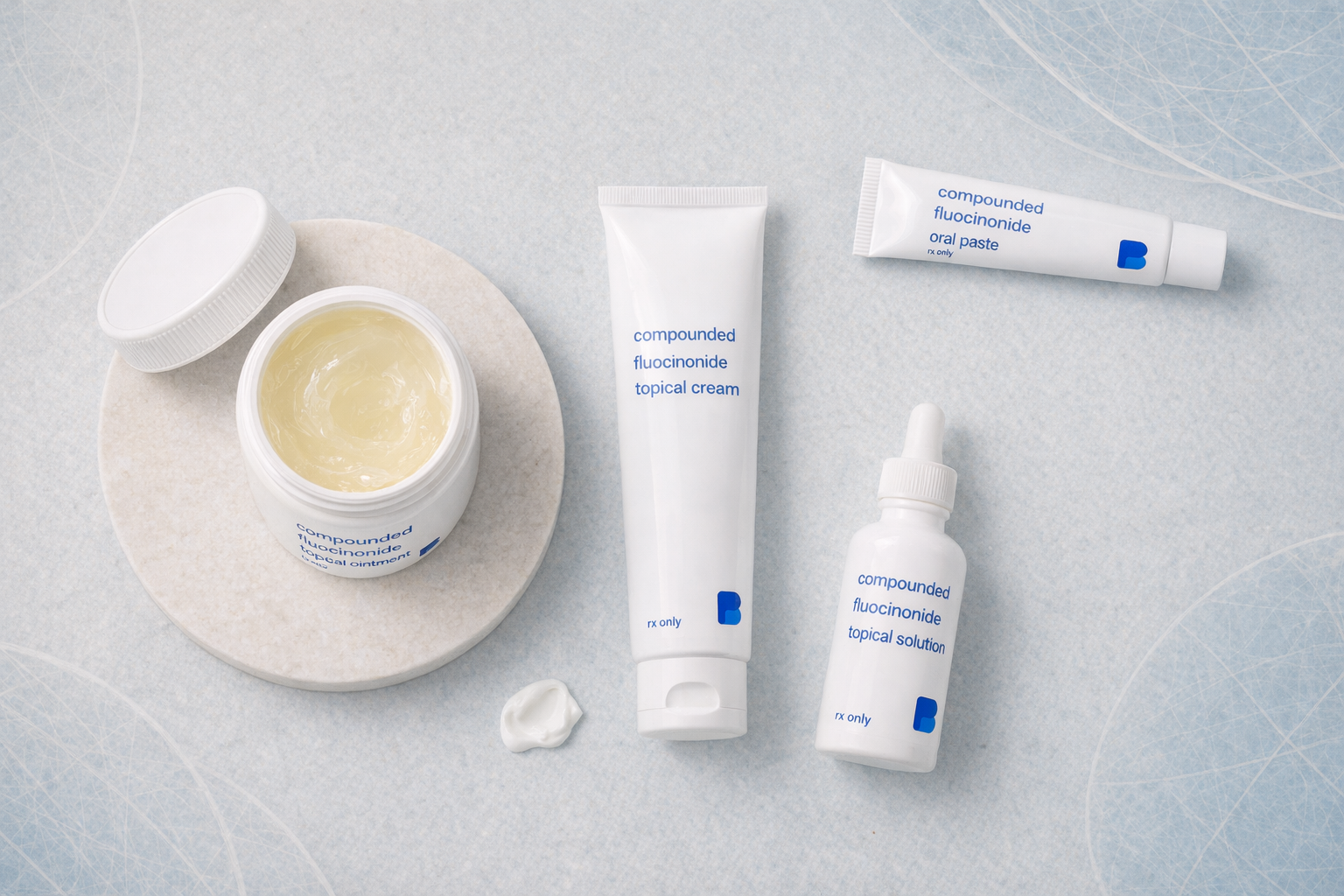
| Fluocinonide | 0.05% | Cream, ointment, gel, solution, lotion | Compounded, not FDA-approved |
| Fluocinonide | 0.1% | Ointment, gel, solution | Compounded, not FDA-approved |
| Fluocinonide | 0.05% | Oral adhesive paste, rinse | Compounded, not FDA-approved |
Container sizes on the triamcinolone page run 15 g to 120 g for cream and ointment, 60 mL or 120 mL for lotion and solution, and 240 mL for the rinse and the shampoo. Fluocinonide is dispensed 15 g, 30 g or 60 g, with 300 mL for the rinse. The 0.4% triamcinolone rinse is prepared preservative-free, as are simplified cream and ointment bases ordered for patients who react to an excipient in a manufactured tube. Full strength and size lists sit on the triamcinolone formulation page and the fluocinonide formulation page.
The swish-and-spit oral rinse is the item on that list with no manufactured counterpart, which is why it is compounded at all. The medicated shampoo, the 0.5% gel, the 0.1% solution and the preservative-free or simplified bases exist for the same reason: the manufactured line does not cover them. Intraoral corticosteroid orders are worth a separate note. The manufactured triamcinolone acetonide 0.1% dental paste is FDA-approved for oral inflammatory and ulcerative lesions, while the compounded oral rinses and the fluocinonide oral paste are not FDA-approved, and published sources describe topical corticosteroids in a paste or a rinse as first-line for symptomatic oral lichen planus.
Which other compounded preparations contain a corticosteroid?
A corticosteroid also turns up as one component of several multi-ingredient preparations. Each of these is compounded, and several involve an off-label route or an off-label population.

| Preparation | Corticosteroid | Route | Status |
|---|---|---|---|
| All-purpose nipple ointment | Betamethasone dipropionate 0.05% | Topical | Off-label in breastfeeding |
| Budesonide irrigation capsules | Budesonide 0.6 mg | Nasal irrigation | Off-label route |
| Hydroquinone brightening blends | Hydrocortisone 1% | Topical | Compounded, not FDA-approved |
| Nystatin combination cream | Hydrocortisone 3% | Vaginal, topical | Compounded, not FDA-approved |
| Diltiazem and lidocaine ointment | Hydrocortisone | Rectal | Off-label |
| Minoxidil scalp combinations | Fluocinolone 0.025% | Scalp | Compounded, not FDA-approved |
The budesonide irrigation capsule is the one on that list with randomized evidence behind the route: a double-blind trial by Tait and colleagues in 2018 compared budesonide added to large-volume low-pressure saline irrigation against saline alone in chronic rhinosinusitis, and a long-term safety analysis by Smith and colleagues reported that asymptomatic HPA-axis suppression can occur in selected patients. Budesonide is a CYP3A4 substrate, so azole antifungals and certain antivirals raise systemic exposure. Delivering budesonide by sinus irrigation remains off-label.
The all-purpose nipple ointment combines mupirocin 1%, betamethasone dipropionate 0.05% and miconazole 2%, and its use during breastfeeding is off-label. The hydroquinone brightening blends follow the Kligman pattern of hydroquinone plus a retinoid plus a low-potency corticosteroid, and the steroid-containing versions are ordered in defined cycles, commonly 8 to 12 weeks, with a planned break or a steroid-free maintenance blend rather than continuous facial steroid exposure.
How do I write a compounded corticosteroid prescription?
Name the molecule, the salt or ester, the percentage and the base, because the base is part of the identity of the preparation and not a packaging detail. Then write directions that name the anatomic site, the frequency, the course length, and whether occlusion is permitted. If the EHR does not carry the compound, enter it as a compound or free-text prescription with each ingredient and strength named.
- Strength and base. For example triamcinolone acetonide 0.1% ointment, preservative-free; or fluocinonide 0.05% oral adhesive paste.
- Directions. Site, frequency, duration, and occlusion permitted or not. Oral rinses are expectorated, with nothing by mouth for 30 minutes after.
- Diagnosis code. Commonly L20.9, L40.0, L21.9, L30.9 or L93.0 for skin; L43.9, K12.0 or K12.1 for oral preparations.
- Quantity. 15 g, 30 g, 60 g or 120 g; 60 mL or 120 mL for lotion and solution; 240 mL or 300 mL for a rinse.
- Refills. As clinically appropriate, with a reassessment point rather than open-ended renewal.
Combinations with nystatin, an antibiotic, coal tar, urea or a local anesthetic are separate preparations, so name every ingredient and every strength on the order. Example directions on the formulation pages reflect common regimens and are educational; they are not dosing recommendations.
What safety points belong beside the chart?
Product labeling and the standard references put the same three limits around potent topical corticosteroids: bounded area, bounded time, no unplanned occlusion. Systemic absorption producing reversible HPA-axis suppression, and less commonly Cushing's syndrome, hyperglycemia or glucosuria, rises with higher strengths, larger treated surface areas, occlusive dressings, prolonged courses and pediatric use. Where a large area is treated for a long period, labeling suggests considering urinary free cortisol or ACTH stimulation testing, and withdrawing, reducing frequency or substituting a lower-potency agent if suppression is found.
Local effects follow the same gradient: burning, dryness, folliculitis, hypertrichosis, acneiform eruptions, hypopigmentation, perioral dermatitis, allergic contact dermatitis, atrophy, striae and telangiectasia. Facial, intertriginous and genital skin is where atrophy appears earliest, which is why steroid-sparing agents are discussed for those sites and for maintenance. Compounded tacrolimus, a calcineurin inhibitor with no collagen effect, is the alternative Bayview prepares for the face, flexures and the ear canal, and the published evidence for its non-ointment routes is small prospective studies and case series rather than randomized trials.
For intraoral courses, oropharyngeal candidiasis is the expected complication, and a concurrent antifungal is worth considering for extended use. Pediatric patients absorb proportionally more corticosteroid relative to body weight, and growth suppression and HPA effects are documented, so the lowest workable strength and the shortest course apply with more force. In pregnancy, labeling for the manufactured creams directs use only where the potential benefit justifies the potential risk to the fetus; in lactation, guidance is to use the lowest potency on the smallest area and to keep it off the nipple before feeding.
How do I send an order to Bayview?
Bayview Pharmacy compounds in Warwick, Rhode Island, and prepares corticosteroid orders as single-agent creams, ointments, gels, lotions, solutions, sprays, shampoos, oral adhesive pastes and oral rinses in the strength and base named on the prescription. Neither triamcinolone nor fluocinonide is a controlled substance. E-prescribe to Bayview Pharmacy, 3844 Post Rd, Warwick, RI 02886, NCPDP 4106882, or fax 401-284-4506. Account setup, licensing and order forms are on the for providers page, and the searchable catalog of preparations is at compounded medications.
For a wider view of what a compounding pharmacy can do in dermatology, including the vehicle and combination work that sits alongside corticosteroid orders, see the introduction to dermatology compounding. Questions about a specific strength, base or container size before you write can go to the pharmacy at 401-284-4505.
Frequently asked questions
How much does compounded fluocinonide cost?
Compounded fluocinonide starts at $98 for 15 g, and the price varies with the strength, base, and size. Where a manufactured fluocinonide product fits your prescriber's order, that is what we dispense and it may cost less — compounding is for the strengths, bases, and oral forms no manufacturer makes. Compounded preparations are cash-priced and are generally eligible for HSA and FSA cards. Call us at 401-284-4505 with the preparation and quantity your prescriber ordered and we will quote it before we make it.
Is fluocinonide the same as triamcinolone?
No. Both are topical corticosteroids, but they sit in different potency classes. Fluocinonide 0.05% is class II (high potency); triamcinolone acetonide 0.1% is class IV (mid potency), which is why triamcinolone is the more common choice for larger areas and longer courses and fluocinonide for shorter courses on stubborn patches. They are not interchangeable, and swapping one for the other is a prescriber's decision.
Can fluocinonide be used on the face?
Generally no, unless your prescriber specifically directs it. Fluocinonide is high-potency, and the skin of the face, groin, and skin folds is thin and absorbs more, so those areas carry a higher risk of thinning, stretch marks, visible small blood vessels, and perioral dermatitis. When a prescriber does use it there, it is usually for a short, deliberate course. Use it only on the areas named in your directions.
How long can I use fluocinonide?
High-potency topical steroids are generally limited to about two weeks of continuous use and then stopped or stepped down to a milder agent. Your prescriber sets the course length, the area, and how often to apply, and those directions matter more than the general rule. Longer or wider use raises the chance of skin thinning, stretch marks, and visible small blood vessels, and enough can be absorbed to affect the body's own steroid production. Do not extend a course or move it to a new area without asking your prescriber.
How strong is fluocinonide compared with other steroid creams?
Topical steroids are grouped into seven potency classes, class I being the strongest and class VII the mildest. Fluocinonide 0.05% sits in class II (high potency) and the 0.1% cream in class I (superpotent). For comparison, triamcinolone acetonide 0.1% is class IV and over-the-counter hydrocortisone 1% is class VII — so fluocinonide is several steps up from anything sold without a prescription. The base matters too: the same steroid is generally more potent in an ointment than in a cream or lotion. A stronger class is not automatically a better choice; your prescriber selects the agent and strength.
Can I use fluocinonide on my face or on a child?
Not unless your prescriber specifically directs it. Facial skin, the groin, underarms, and skin folds are thin and absorb more steroid, so they are more likely to be damaged by a high-potency product; prescribers usually choose a milder steroid or a steroid-sparing option such as compounded tacrolimus for those areas. Children absorb proportionally more steroid than adults, so fluocinonide is used in children only under a pediatric prescriber's direction, at the lowest strength for the shortest time, and never under a diaper or plastic pants.
What are the side effects of a strong steroid like fluocinonide?
Most are local: burning or stinging when applied, itching, dryness, redness, acne-like bumps, and lightening of the skin. Used for too long, on thin skin, or under a covering, potent steroids can thin the skin, cause stretch marks and visible blood vessels, and be absorbed in amounts that affect the body's own steroid production, which can show up as unusual tiredness, weight gain, a rounded face, or muscle weakness. Children absorb more through their skin and can have slowed growth. Inside the mouth, the usual problem is thrush. Contact your prescriber if any of these happen.
How do I apply it, and for how long?
Apply a thin film to the affected skin as often as your prescriber directs, usually one to four times a day, and rub it in gently. Do not cover the area with plastic wrap or a bandage unless told to. Keep it off the face, groin, and skin folds and away from the eyes unless your prescriber directs otherwise. Fluocinonide is potent, so it is usually prescribed for a set course of about two weeks or less; finish that course and do not keep using it afterward without checking in. For the oral paste, dry the spot, dab on a small amount, and avoid eating or drinking for 30 minutes. For the rinse, swish for the time directed and spit it out.
What is fluocinonide prescribed for?
Skin conditions that respond to corticosteroids: eczema and atopic dermatitis, plaque psoriasis, contact dermatitis, lichen planus, discoid lupus, and similar inflammatory rashes, usually on thicker skin such as the arms, legs, trunk, hands, feet, and scalp. The oral adhesive paste and rinse are prescribed for lichen planus and other sore, inflamed patches inside the mouth. Your prescriber decides whether it is appropriate for you and at what strength.
Why would my prescriber order a compounded strength instead of the regular 0.05%?
The manufactured products cover 0.05% in four bases and 0.1% as a cream. A prescriber may want something in between or outside that range: a lower strength such as 0.01% or 0.025% for a larger area or for stepping down after a stronger course, a 0.1% ointment or gel for thick plaques, a lotion for the scalp, or a form that is not manufactured at all, such as an adhesive paste or rinse for the mouth. When a manufactured product fits the order, Bayview dispenses the manufactured product.
What is compounded fluocinonide?
Fluocinonide is a high-potency corticosteroid used on the skin for inflammatory conditions such as eczema, psoriasis, and lichen planus. Manufactured fluocinonide comes as 0.05% cream, ointment, gel, and solution and as a 0.1% cream. Bayview compounds it when your prescriber wants a different strength, a different base, or an oral paste or rinse for the inside of the mouth. The compounded preparations are not FDA-approved and are prepared to your prescriber's order.
What are the topical corticosteroid potency classes?
United States dermatology references sort topical corticosteroids into seven potency classes. Class I is superpotent and includes clobetasol propionate 0.05% and halobetasol propionate 0.05%. Class VII is the least potent and covers hydrocortisone base at 0.5%, 1% and 2.5%. The scale comes largely from vasoconstrictor assay data on marketed products. Class assignments vary slightly between published sources, and potency describes assay behavior rather than how any individual patient will respond.
What potency class is triamcinolone acetonide?
It depends on the strength and the vehicle. In the published classification, triamcinolone acetonide 0.5% is class III, 0.1% is class IV, and 0.025% cream is class V, so the molecule spans three classes. Some references place the 0.025% preparation differently depending on the vehicle. A compounded triamcinolone strength or base that no manufacturer markets has not been assigned a class, and reading one across from the nearest commercial product is not correct.
Is fluocinonide a class 1 or class 2 steroid?
Both, depending on the presentation. In the published classification, fluocinonide 0.05% preparations sit in class II (high potency) and the 0.1% cream sits in class I (superpotent). That is why fluocinonide is written for short, defined courses rather than open-ended use, with the site, frequency and course length specified on the prescription and a reassessment point rather than automatic renewal.
Does an ointment make a steroid stronger than a cream?
The published classification recognizes a vehicle effect: an ointment base is occlusive and increases stratum corneum hydration, and the same corticosteroid is generally placed higher on the scale in an ointment than in a cream, lotion or solution. Several rows of the standard chart name a vehicle for that reason. Published sources do not agree on a fixed conversion factor, so the effect is described qualitatively rather than quantified.
What is a compounded corticosteroid?
It is a corticosteroid prepared by a pharmacy to a prescriber's written order in a strength, base or dose form that no manufacturer supplies, for one named patient. Compounded preparations are not FDA-approved. Common reasons a prescriber writes for one include a preservative-free or simplified base, a strength between or beyond the marketed ones, a medicated shampoo, or a swish-and-spit oral rinse, which has no marketed counterpart. Use on the oral mucosa is off-label.
How do I write a prescription for a compounded steroid?
Name the molecule, the salt or ester, the percentage and the base, since the base is part of the identity of the preparation. Add directions naming the anatomic site, the frequency, the course length and whether occlusion is permitted. Include a diagnosis code, the quantity in grams or milliliters, and refills with a reassessment point. If the EHR does not carry the compound, enter it as a compound or free-text prescription with every ingredient and strength named.
What is a steroid-sparing alternative for the face?
Topical calcineurin inhibitors are the usual steroid-sparing option discussed for facial, flexural and periocular skin, because they have no collagen effect and so do not produce the atrophy, striae and telangiectasia that follow prolonged corticosteroid use at those sites. Bayview compounds tacrolimus as ear drops, gels, creams, foams and shampoos. Published evidence for the non-ointment routes is limited to small prospective studies and case series rather than randomized trials.
What Bayview compounds for this
Important: Compounded medications are prepared to a prescriber's order for an individual patient. They are not FDA-approved, and the FDA has not evaluated them for safety, effectiveness, or manufacturing quality. This article is educational and is not a substitute for advice from your prescriber or pharmacist.
This preparation contains a controlled substance. Controlled-substance prescriptions carry refill limits, must be e-prescribed, and can only be shipped to states where Bayview holds the required licensure.
Uses discussed here may be off-label, meaning they are not part of any FDA-approved labeling. Off-label use is a decision for you and your prescriber, based on the available evidence.
Veterinary preparations are compounded to a veterinarian's order for a specific animal and are not FDA-approved animal drugs. Never give a compounded human medication to an animal without veterinary direction.
Compounded prescriptions are paid for directly rather than billed through insurance. Most are HSA/FSA-eligible, and many patients submit the receipt to their plan for possible reimbursement. Pricing depends on the strength, dose form and quantity your prescriber orders. Read more about cost and insurance.
Compounded corticosteroid preparations are cash-priced and are not billed through a pharmacy benefit plan, because a plan adjudicates against a national drug code that identifies a specific manufactured product and a patient-specific preparation does not have one. Price varies with the active, the strength, the base, the dose form and the container size. Where a manufactured triamcinolone or fluocinonide product fits the order, that product is dispensed and is usually the less expensive route. Compounded preparations are generally eligible for HSA and FSA cards. Call 401-284-4505 with the preparation and quantity ordered for a quote before it is made.
Bayview Pharmacy is an NABP-accredited compounding pharmacy in Warwick, Rhode Island, licensed to fill and ship compounded prescriptions for patients in Rhode Island, Massachusetts, Connecticut, New Jersey, New Hampshire, Florida, New York and Maine. Controlled substances are not shipped to New York addresses. See where we ship and how to get started.