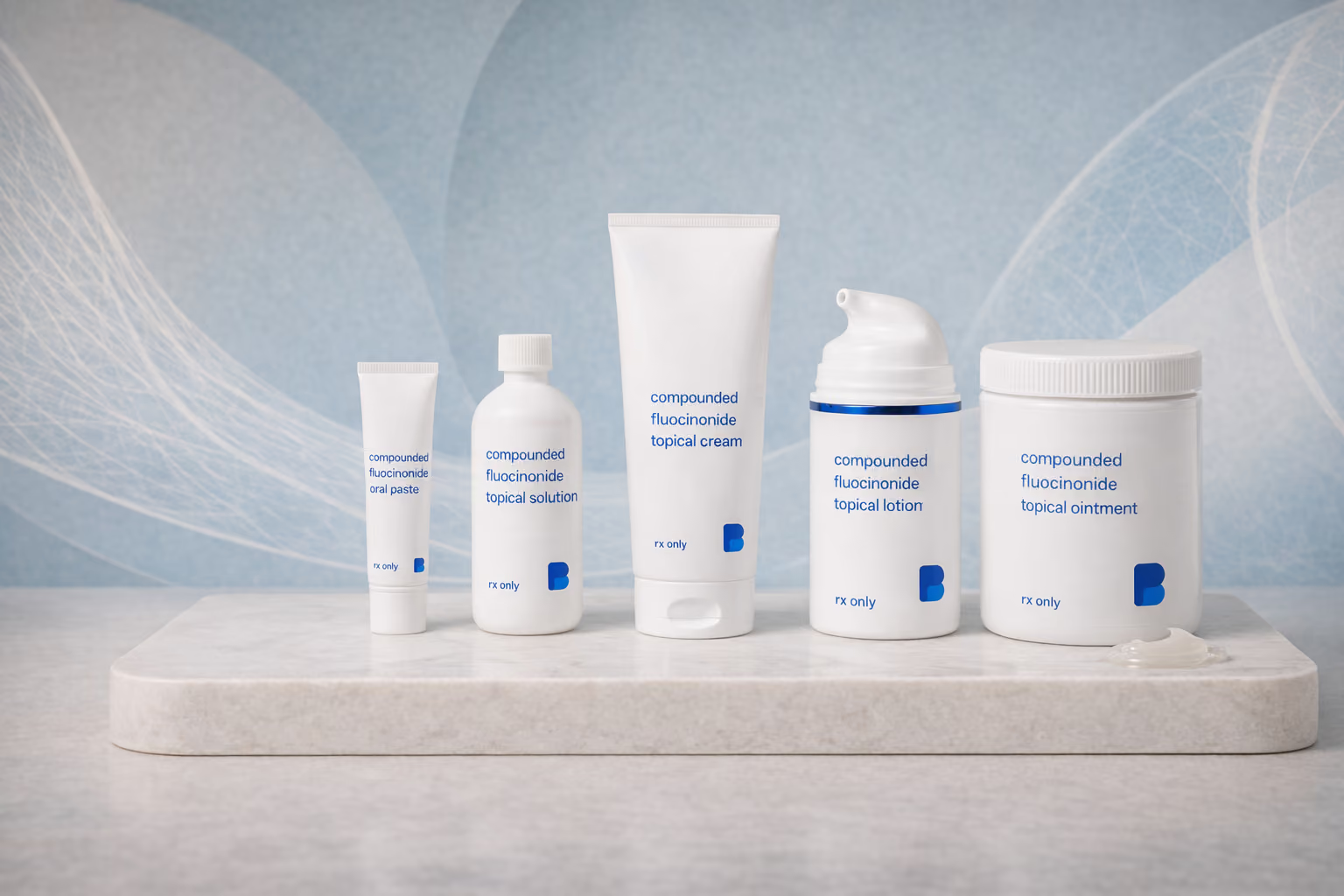

A compound cream is three things written on a prescription: one or more active ingredients, a base to carry them, and a strength for each. The pharmacy weighs the actives into the base the prescriber names, in the quantity ordered. None of it is standardized, which is why two creams both called "pain cream" can contain entirely different drugs at entirely different concentrations.
The version ordered most at Bayview is the custom topical pain cream, a prescriber-designed blend applied over a sore joint, muscle, or nerve. This article covers the bases, the actives, what the literature reports (including a randomized trial that did not favor these creams), and how a prescriber writes the order.
What is a compound cream?
Compounding is the preparation of a medication to a prescriber's specification for a named patient, and a compound cream is that idea in topical form. The pharmacist starts with pharmaceutical-grade drug substance, calculates how much is needed for the ordered percentage, and mixes it into a base until the drug is uniformly distributed.

Three parts of the order matter, and all three belong to the prescriber:
- The actives. Which drugs, and how many. Multi-ingredient pain creams commonly contain three to five.
- The strength. Written as a percentage (5% diclofenac means 50 mg of diclofenac per gram of cream) or occasionally as mg per mL for a metered pump.
- The base. The vehicle the drug sits in. It determines how the preparation feels, how it spreads, and how readily the drug moves into skin.
Compounded preparations are not FDA-approved. The FDA does not review them for safety, effectiveness, or quality before they are dispensed, and a valid prescription is required.
What are the common bases, and why does the base matter?
The base is not filler. Two creams with identical actives at identical percentages behave differently if the bases differ, because the vehicle governs how much drug is released and how well it moves into skin. Prescribers usually name a base by category or by product name and leave the rest to the pharmacy.

| Base | What it is | Commonly ordered for |
|---|---|---|
| PLO gel | Lecithin and poloxamer, water and oil | Multi-ingredient pain creams |
| Anhydrous transdermal | Water-free, penetration-enhancing lipids | Several actives at once |
| Emollient cream | Oil-in-water, rubs in | Large or hairy areas |
| Ointment | Petrolatum-based, occlusive | Dry or fissured skin |
| Gel | Water-based or alcohol-based, quick-drying | Scalp, areas under clothing |
PLO gel (pluronic lecithin organogel) thickens at skin temperature and carries both water-soluble and oil-soluble drugs, anhydrous bases include Lipoderm and similar permeation gels ordered when the prescriber wants more drug moving past the surface, ointments stay in place rather than absorbing quickly, and gels leave no residue. The container is chosen alongside the base. A metered pump delivers roughly the same amount per press, which is how prescribers control dose on a topical; a jar requires a fingertip or measured dose instruction. If a preparation stings, a change of base is often the first thing a prescriber and pharmacist discuss.
What goes into compounded pain cream formulations?
Prescribers build these creams by pain mechanism, pairing an agent for inflammation with one for nerve signaling or muscle spasm. Below are the actives that appear most often, the class each belongs to, and what the published literature reports. Every use in this table is off-label in a compounded cream.

| Ingredient | Class | Topical status | Topical evidence |
|---|---|---|---|
| Diclofenac | NSAID | FDA-approved 1% to 2% | Cochrane review, 2016 |
| Ketoprofen | NSAID | No US product | Limited trials |
| Lidocaine | Local anesthetic | FDA-approved 5% patch | Trials, postherpetic neuralgia |
| Bupivacaine | Local anesthetic | Injectable only | Little published data |
| Cyclobenzaprine | Muscle relaxant | Oral only, off-label topically | No trials identified |
| Baclofen | Muscle relaxant | Oral and intrathecal only | Sparse data |
| Gabapentin | Anticonvulsant | Oral only, off-label topically | Absorption unresolved |
| Amitriptyline | Tricyclic antidepressant | Oral only, off-label | Small trials, mixed |
| Ketamine | NMDA-receptor antagonist | Schedule III, off-label | Small trials, inconsistent |
| DMSO | Penetration enhancer | Not approved topically | Poor-quality trials |
The 2016 Cochrane review covered approved topical NSAIDs in hand and knee osteoarthritis rather than compounded concentrations above 2%, lidocaine blocks the sodium channels nerve fibers use to signal pain, gabapentin is well established orally for certain neuropathic pain conditions, ketoprofen appears in compounded blends at 10% to 20%, and a 2008 systematic review of DMSO in knee osteoarthritis judged every trial too poor in method to support a conclusion.
What does the evidence on compounded pain cream formulas actually show?
Weaker than the popularity of these creams suggests, and we would rather say so than imply otherwise. A randomized trial published in Annals of Internal Medicine in 2019 (Brutcher et al.) enrolled 399 patients with localized pain and compared compounded pain creams against placebo creams. The creams were built the way these formulas usually are, with combinations selected for neuropathic, nociceptive, and mixed pain, including ketamine, gabapentin, cyclobenzaprine, baclofen, ketoprofen, and lidocaine. At one month, the compounded creams were not better than placebo for the pain types studied.
A National Academies review of compounded topical pain preparations landed in a similar place, noting that well-designed trials here are few. That does not mean nothing in a compounded cream does anything: individual actives, particularly topical NSAIDs at approved strengths for hand and knee osteoarthritis, have real evidence behind them. What is missing is evidence that assembling several into one custom cream produces more than a single agent or a placebo does. Our own topical pain cream page says the same. Whether to try one is a clinical judgment your prescriber makes with you.
Why do strengths matter in a compound cream for pain?
Because strength is the main thing compounding changes, and there are hard ceilings above the drugstore shelf.

| Drug | OTC | Rx, FDA-approved | Compounded, not approved |
|---|---|---|---|
| Diclofenac | 1% gel | 1.5% and 2% solution | 4% to 20% |
| Lidocaine | Up to 4% | 5% patch, ointment | 5% to 30% |
| Cyclobenzaprine | None | Oral tablets, capsules | 0.5% to 5% |
| DMSO | None | 50% bladder instillation | 10% gel, 50% cream |
Approved diclofenac also includes a 1.3% patch, and compounded strengths are prepared as creams, ointments, gels, or sprays, alone or in combination, at any custom percentage the prescriber writes. Higher is not automatically better, and nothing above is a recommendation. A higher percentage over a larger area means more drug crossing into the bloodstream, which is why the prescriber, not the patient, sets strength, surface area, and frequency.
Why is there no commercial multi-ingredient pain cream?
Because each combination is legally its own drug product. A manufacturer would have to take that blend, at those percentages, in that base, through FDA approval, and the economics do not support it: no single blend fits every patient, and no one funds trials on dozens of permutations. So multi-ingredient creams exist only through compounding, one prescription at a time. They are not FDA-approved, and they are not generic or equivalent versions of any approved product.
What about a compound cream for nerve pain?
Neuropathic formulas are built differently from inflammatory ones. Prescribers reach for gabapentin, amitriptyline, ketamine, and lidocaine rather than leading with an NSAID, because the target is nerve signaling rather than prostaglandin-driven inflammation. Peripheral neuropathy, postherpetic neuralgia, and localized nerve pain after surgery are common reasons one is written. The 2019 trial above included neuropathic pain among the types studied, so the same caution applies.

What is a ketamine cream compound?
A topical preparation containing ketamine, usually at 5% to 10%, often blended with amitriptyline, lidocaine, or a muscle relaxant. Ketamine is an NMDA-receptor antagonist, and the interest in it topically comes from small trials and case series in neuropathic pain that have reported inconsistent results.
Ketamine is a Schedule III controlled substance. It is dispensed only on a prescription written for a named patient, ketamine-containing formulas must be sent by electronic controlled-substance prescribing, and controlled substances are not shipped to New York addresses. Bayview also compounds ketamine in other forms, including ketamine troches, which carry the same controlled-substance requirements.
What is a diltiazem compound cream?
Not a pain cream in the musculoskeletal sense, but it surfaces in the same searches. Diltiazem is a calcium channel blocker compounded as a 2% rectal ointment or gel for chronic anal fissures, available only through compounding because no FDA-approved topical or rectal diltiazem product exists. The 2023 clinical practice guideline from the American Society of Colon and Rectal Surgeons discusses topical calcium channel blockers as a first-line non-surgical option for chronic fissures.
What about compounded progesterone cream and compounded estrogen cream?
Both are compounded topicals with a different purpose entirely: compounded progesterone and compounded estradiol cream are hormone preparations prescribed as part of hormone therapy, not for localized pain, and each has its own strengths, evidence, and prescribing considerations.
How does a prescriber write for a compounded cream?
Clearly and completely, because there is no NDC to look up. A usable order names each active with its strength (for example, diclofenac 5% / gabapentin 10% / lidocaine 7% topical cream), the base or container if the prescriber has a preference, directions with area and frequency, the quantity, a diagnosis code, and refills. Prescribers can e-prescribe it as a compound or free-text prescription, fax, or call it in; ketamine formulas must go through electronic controlled-substance prescribing.
What Bayview compounds for this
On a prescriber's order, Bayview prepares custom topical pain creams to the exact ingredient list and strengths written, as a cream or gel, in PLO, anhydrous transdermal, emollient, ointment, or gel bases, in jars or metered pumps, typically in 30 to 120 g or mL. Examples we have compounded include diclofenac 5% / gabapentin 10% / lidocaine 7%; cyclobenzaprine 2% / gabapentin 6% / ketoprofen 15% / lidocaine 5%; and ketamine 6% / amitriptyline 4% / cyclobenzaprine 5%, which is controlled. Single-agent preparations are compounded the same way, all under USP 795 non-sterile compounding standards. The full list is in our compounded medications catalog.
A custom topical pain cream starts at $120, and multi-ingredient creams are priced by the ingredients in the formula and the quantity dispensed, so a five-active 120 g order costs more than a two-active 30 g one. These are generally paid in cash rather than billed through a pharmacy benefit, which we cover in do compounding pharmacies take insurance. Call with the prescription in hand and we can quote it before anything is prepared.
Talk to your prescriber
Whether a compounded cream is appropriate, which ingredients go in it, at what strengths, in what base, and how it is applied are all your prescriber's decisions. Bayview does not provide consultations and does not decide whether a medication is right for you. If you and your prescriber agree to try one, they can send the prescription electronically, by fax, or by phone, and we fill and ship to the states where Bayview is licensed, listed on our FAQ. Our guide to finding a compounding pharmacy near you covers what to ask.
Frequently asked questions
How do I use it?
Apply the measured or fingertip amount your provider describes directly over the painful area, such as a joint, muscle, or the path of a nerve. Avoid broken skin, eyes, and mucous membranes, and wash your hands afterward unless you are treating your hands. Give it a consistent trial; topical medications build effect with regular use.
Does it actually work?
Evidence for compounded topical pain creams is limited and mixed, so results vary by ingredient and person. Bayview makes no claim that any formula is proven or better than standard care, your provider decides if it is worth trying.
How does a topical pain cream compare to oral pain medication?
Applying medicine to the skin can mean less whole-body exposure than taking the same drugs by mouth, but some absorption still happens. Use only the amount and area your provider specifies.
What is in it?
Your prescriber selects the mix by pain type: NSAIDs like diclofenac or ketoprofen, anesthetics like lidocaine, and agents like gabapentin, amitriptyline, cyclobenzaprine, or baclofen. Some formulas add ketamine, which has extra requirements.
What kind of pain is it for?
Providers use these creams for localized musculoskeletal or nerve pain, such as arthritic joints or peripheral neuropathy. Whether it fits your situation is your provider's call, and it is used off-label.
What is a custom pain cream?
A compounded cream that blends several prescriber-chosen pain ingredients, such as an anti-inflammatory, an anesthetic, and a nerve-pain agent, applied over a sore area so the medicine works mainly where it is rubbed in.
What is a compound cream?
A compound cream is a topical preparation made by a pharmacy to a prescriber's specification for one named patient. The prescription names the active ingredient or ingredients, the strength of each (usually as a percentage), and the base that carries them. The pharmacy weighs the drug substance and incorporates it into that base in the quantity ordered. Compounded preparations are not FDA-approved and require a valid prescription.
What is in a compounded pain cream?
It depends entirely on the prescription. Common actives include NSAIDs such as diclofenac or ketoprofen, local anesthetics such as lidocaine or bupivacaine, muscle relaxants such as cyclobenzaprine or baclofen, and gabapentin, amitriptyline, or ketamine for nerve-related pain. DMSO is sometimes added as a penetration enhancer. Prescribers usually combine three to five actives chosen by the type of pain. Every one of these uses is off-label in a compounded cream.
Does compounded pain cream work?
The evidence is limited and mixed. A randomized trial published in Annals of Internal Medicine in 2019 (Brutcher et al.) enrolled 399 patients and found compounded pain creams no better than placebo creams at one month for the localized pain types studied. A National Academies review also noted that well-designed trials in this area are few. Some individual actives, such as topical NSAIDs at approved strengths for hand and knee osteoarthritis, have stronger evidence. Your prescriber weighs all of that.
What is PLO gel?
PLO stands for pluronic lecithin organogel. It is a water-and-oil base held together by lecithin and a poloxamer that thickens to a gel at skin temperature. It has been the long-standing base for multi-ingredient compounded pain creams because it can carry both water-soluble and oil-soluble drugs in the same preparation. Anhydrous transdermal bases such as Lipoderm are the other common choice. Which base is used is the prescriber's call.
Is ketamine cream a controlled substance?
Yes. Ketamine is a Schedule III controlled substance, so a compounded cream containing it is dispensed only on a prescription written for a named patient, must be sent by electronic controlled-substance prescribing, and is not shipped to New York addresses. Creams without ketamine, such as NSAID, anesthetic, and neuropathic combinations, are noncontrolled. Topical ketamine has been studied in small trials and case series for neuropathic pain with inconsistent findings.
Why can't I buy a multi-ingredient pain cream at the pharmacy?
Because each specific combination, at those specific percentages, in that specific base, is legally its own drug product and would need to go through FDA approval as one. No manufacturer funds that for dozens of possible blends when no single blend fits every patient. So multi-ingredient pain creams exist only through compounding, prepared one prescription at a time, and they are not FDA-approved or equivalent to any approved product.
How strong can a compounded cream be?
Higher than the over-the-counter ceiling, and the range depends on the drug. Over-the-counter diclofenac stops at 1% and lidocaine at 4%; compounded diclofenac is prepared from 4% to 20% or a custom strength, and compounded lidocaine from 5% to 30%. Cyclobenzaprine and DMSO have no topical product at all, so any topical strength is compounded. Higher is not automatically better, and strength, area, and frequency are set by your prescriber.
How does a doctor write a prescription for a compounded cream?
The order names each active ingredient with its strength (for example, diclofenac 5% / gabapentin 10% / lidocaine 7% topical cream), the base or container if the prescriber has a preference, directions including the area and frequency, the quantity, a diagnosis code matching the pain type, and refills. It can be e-prescribed as a compound or free-text prescription, faxed, or phoned in. Ketamine-containing formulas require electronic controlled-substance prescribing.
What Bayview compounds for this
Important: Compounded medications are prepared to a prescriber's order for an individual patient. They are not FDA-approved, and the FDA has not evaluated them for safety, effectiveness, or manufacturing quality. This article is educational and is not a substitute for advice from your prescriber or pharmacist.
This preparation contains a controlled substance. Controlled-substance prescriptions carry refill limits, must be e-prescribed, and can only be shipped to states where Bayview holds the required licensure.
Uses discussed here may be off-label, meaning they are not part of any FDA-approved labeling. Off-label use is a decision for you and your prescriber, based on the available evidence.
Veterinary preparations are compounded to a veterinarian's order for a specific animal and are not FDA-approved animal drugs. Never give a compounded human medication to an animal without veterinary direction.
Compounded prescriptions are paid for directly rather than billed through insurance. Most are HSA/FSA-eligible, and many patients submit the receipt to their plan for possible reimbursement. Pricing depends on the strength, dose form and quantity your prescriber orders. Read more about cost and insurance.
A custom topical pain cream starts at $120. Multi-ingredient creams are priced by the ingredients in the formula and the quantity dispensed, so a five-active 120 g order costs more than a two-active 30 g one. Compounded preparations are generally paid in cash rather than billed to a pharmacy benefit, because a compounded preparation has no NDC for a plan to adjudicate against and most plans exclude them. Call with the prescription in hand and we can quote the exact price before anything is prepared.
Bayview Pharmacy is an NABP-accredited compounding pharmacy in Warwick, Rhode Island, licensed to fill and ship compounded prescriptions for patients in Rhode Island, Massachusetts, Connecticut, New Jersey, New Hampshire, Florida, New York and Maine. Controlled substances are not shipped to New York addresses. See where we ship and how to get started.