
A compounded pain cream is a topical preparation built to your own ingredient list: usually two to four actives with different mechanisms, at concentrations no manufacturer offers, in a base chosen for the application site. Bayview compounds compounded pain cream as a cream or gel on a prescription written for an individual patient. These multi-ingredient preparations are not FDA-approved, their use is off-label, and the published evidence behind them is limited and mixed.
This guide is written for prescribers. It covers the compounded pain cream formulations Bayview prepares, the actives that can go in them, what the literature reports for each class, the available strengths and bases, what to put on the prescription, and how the preparation is dispensed and paid for.
What is a compounded topical analgesic?

It is a single cream or gel containing several pain-relieving actives, selected by the prescriber, applied over a defined painful area. Because each active works locally in the skin and the tissue underneath, the preparation concentrates drug at the site with less systemic exposure than the same agents given orally.
The preparations described here are compounded under USP 795 non-sterile compounding, in small batches, pursuant to a prescription for a named patient. Bayview is a 503A pharmacy and does not supply topical analgesics as clinic or office stock, which is the role of a 503B outsourcing facility. If that distinction matters to how you want to order, see 503A versus 503B compounding.
Prescribers order these creams for localized musculoskeletal or neuropathic pain: an arthritic joint, a myofascial trigger point, a peripheral neuropathy in a defined area. The use is off-label and prescriber-determined, and the cream is meant to fit into the rest of the care plan rather than replace it. Dose, strength, ingredient selection, and whether a compounded preparation is appropriate at all are the prescriber's decisions, not the pharmacy's.
What are the compounded pain cream ingredients to choose from?
Ingredients are selected by the pain mechanism being targeted. The table below groups the actives Bayview compounds into topical analgesic preparations, with the regulatory status of the topical route and the quality of the evidence that exists for it.

| Active | Mechanism target | Status | Evidence |
|---|---|---|---|
| diclofenac, ketoprofen | Inflammatory, joint | Compounded above 2%, off-label | Cochrane review, approved strengths |
| lidocaine, bupivacaine | Surface and nerve conduction | Compounded above 4%, off-label | StatPearls background only |
| gabapentin, amitriptyline | Neuropathic | Compounded, off-label | No single-agent topical trials |
| cyclobenzaprine, baclofen | Muscle spasm | Compounded, off-label | One negative combination RCT |
| menthol | Cooling counterirritant | Compounded, off-label | No trials in our sources |
| DMSO | Vehicle, local inflammation | Compounded, off-label | Older trials, poor methodology |
| ketamine | Neuropathic, central | Schedule III, compounded | Outside this guide's sources |
Two points about that table. First, the evidence column describes the published literature on the drug or the route, not the compounded blend you prescribe: no multi-ingredient compounded cream has been studied as a finished preparation. Second, every active in a blend brings its own cautions and interaction profile, so the risk review is per ingredient and not per cream. Single-agent pages carry the detail: diclofenac gel and oral forms, lidocaine cream and ointment, cyclobenzaprine topical gel, and DMSO cream and gel.
Which compounded pain cream formulas does Bayview prepare most often?
Each cream is compounded to the exact ingredient list and strengths on the prescription. These are examples Bayview has compounded, listed so you can see the shape of a typical order rather than as recommendations:
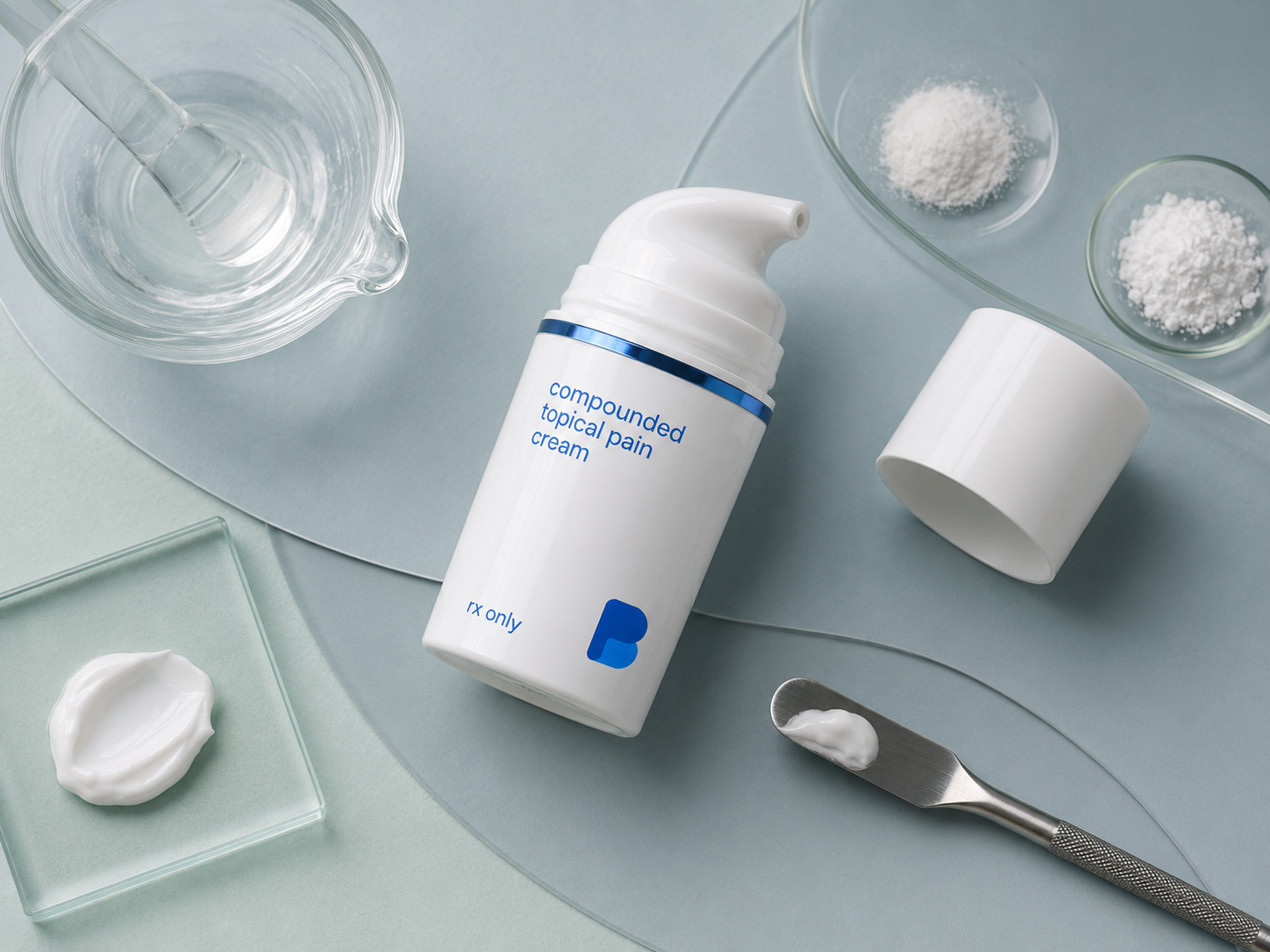
- Diclofenac 5% / gabapentin 10% / lidocaine 7%: an NSAID, a neuropathic agent, and an anesthetic in one cream.
- Cyclobenzaprine 2% / gabapentin 6% / ketoprofen 15% / lidocaine 5%: muscle, nerve, and inflammatory targets combined.
- Amitriptyline 2% / diclofenac 5% / gabapentin 5%: one of the two most frequently dispensed diclofenac combination gels.
- Ketamine 6% / amitriptyline 4% / cyclobenzaprine 5%: contains a controlled substance and carries added prescription requirements.
- A fully custom combination, with ingredients and strengths set by the prescriber.
Diclofenac combination gels are also compounded with baclofen, menthol, or DMSO. Cyclobenzaprine combination gels are ordered on the topical pain cream form rather than the single-agent cyclobenzaprine form, which keeps the ingredient list in one place.
What does the published evidence actually show?
Worth being plain with patients about this, because the literature does not support a strong pitch. A National Academies review of compounded topical pain creams notes that well-designed trials are few, so any local effect is expected to vary by ingredient and by person. In a randomized, placebo-controlled trial of 399 patients with localized chronic pain, a nociceptive-pain cream combining ketoprofen 10%, baclofen 2%, cyclobenzaprine 2%, and lidocaine 2% did not reduce average pain more than placebo cream at one month (Brutcher et al., Annals of Internal Medicine, 2019). No trial of a single-agent topical cyclobenzaprine gel was identified in that literature.

The single-ingredient picture is better where an approved product exists. A Cochrane systematic review of topical NSAIDs for chronic musculoskeletal pain in adults reported meaningful pain reduction for a substantial minority of people with hand and knee osteoarthritis, with results comparable to oral NSAIDs and fewer systemic side effects (Derry et al., Cochrane Database of Systematic Reviews, 2016). The same review noted that most of the trial evidence sits at the FDA-approved 1% to 2% concentrations, so a higher compounded percentage has no comparative trial data behind it. For DMSO alone in knee osteoarthritis, a systematic review found two of four randomized trials reported less pain than the comparator but judged all four to be of poor methodology, with possible unblinding from the characteristic odor, and drew no definitive conclusion (Brien et al., Osteoarthritis and Cartilage, 2008).
The practical reading from the primary page's prescriber notes is that evidence for multi-agent topical analgesia is strongest for localized neuropathic pain, and that ingredients should be matched to the pain mechanism rather than stacked. Frame expectations accordingly when you counsel.
What topical pain cream strengths and bases are available?
Two things determine what reaches the tissue: the concentration and the base. The concentration describes how much drug is in the vehicle; how much of it crosses the skin depends on the base, the surface area treated, the frequency, occlusion, heat, and the individual. A higher percentage is not automatically a different clinical result.
| Active | Approved topical | Compounded, off-label |
|---|---|---|
| diclofenac | 1% gel, OTC | 4% to 20%, or custom |
| lidocaine | 4% OTC ceiling | 5% to 30% |
| cyclobenzaprine | None, tablets only | 0.5% to 5% |
| DMSO | None for skin | 10% gel, 50% cream |
| gabapentin | None | 5% to 10% in blends |
Diclofenac is also compounded at the discrete strengths 1.3%, 4%, 5%, 6%, 7.5%, 8%, 10%, 15%, and 20%, as topical or transdermal gel. FDA-approved topical diclofenac exists as the 1% OTC gel, the 1.5% and 2% prescription solution, and the 1.3% patch; nothing above 2% and no combination gel is approved. For lidocaine, the FDA-approved topical presentations are the 5% patch for postherpetic neuralgia and lidocaine/prilocaine cream, with over-the-counter external analgesics capped at 4%. Cyclobenzaprine is approved only as 5, 7.5, and 10 mg tablets and 15 and 30 mg extended-release capsules, indicated for up to 2 or 3 weeks. The only approved DMSO products are the 50% intravesical solution for interstitial cystitis and the 45.5% vehicle in an approved diclofenac solution.
| Base | Handling | Commonly ordered for | Status |
|---|---|---|---|
| Cream | Absorbs and dries | Repeated daily use, small area | Compounded, off-label |
| Ointment | Stays on skin longer | Dry or thickened skin | Compounded, off-label |
| Anhydrous gel | Metered pump, quick-drying | Consistent per-press amount | Compounded, off-label |
| Spray | No rubbing required | Areas painful to touch | Compounded, off-label |
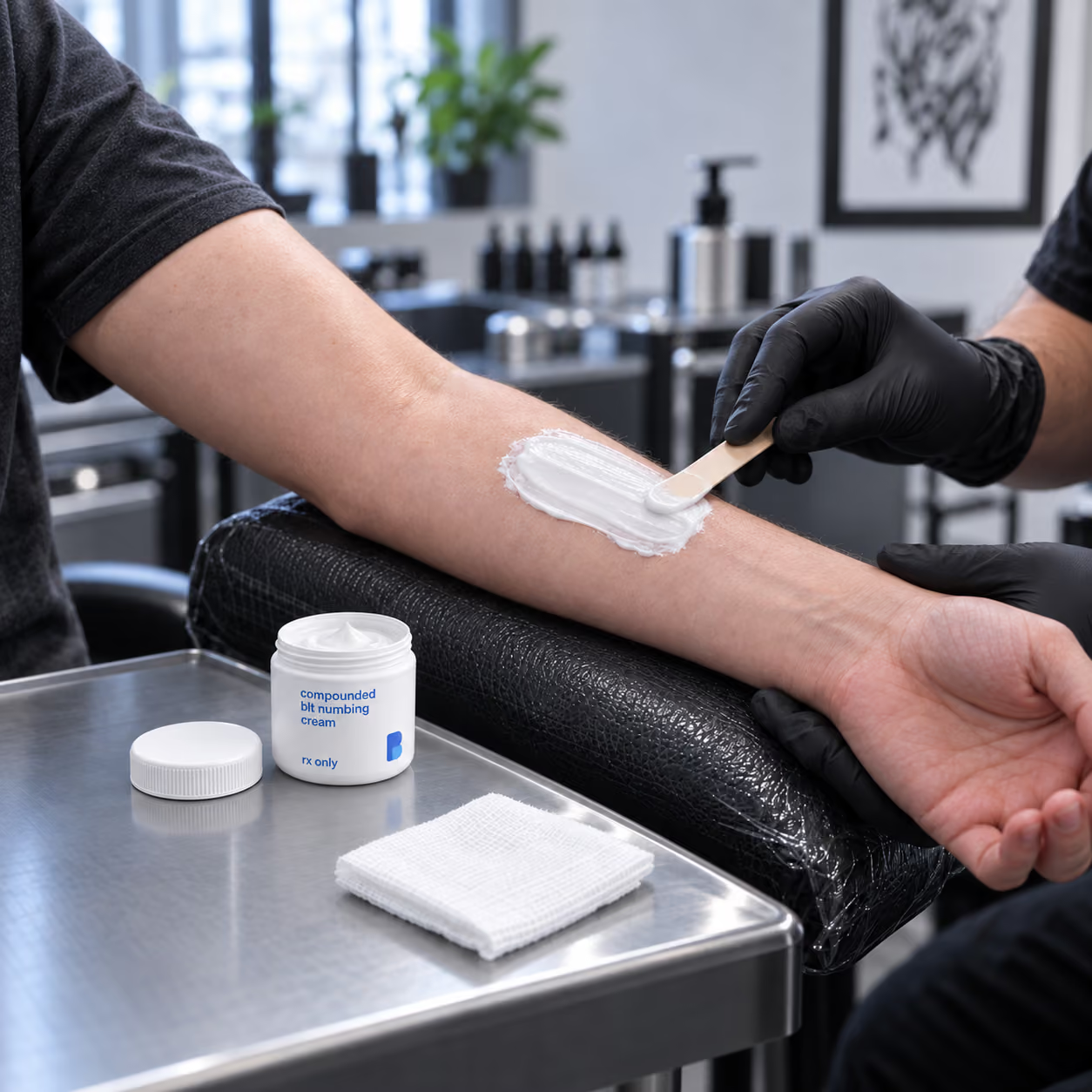
| Film-forming ointment | Sets on the skin | In-office procedure numbing | Compounded, off-label |
The anhydrous gel base in a metered pump is the standard for cyclobenzaprine preparations, dispensed in 30 to 100 g; DMSO goes out in a metered pump in 30 g or 60 g. The film-forming (plasticized) base is the lidocaine 30% preparation that prescribers generally apply and remove in the office. A dye-free or preservative-free base, or a pump instead of a jar, is also a legitimate reason to compound when a patient reacts to an ingredient in a commercial product or cannot manage a tube. Those are compounding reasons, not claims of a better outcome.
How do I prescribe a compounded pain cream?
Send it as a compound or free-text prescription if your EHR does not carry the preparation. Include all five of the following, which is what prevents a clarification call:

- Each active ingredient and its strength, for example diclofenac 5% / gabapentin 10% / lidocaine 7% topical cream.
- The dosage form and the base, plus the container if a metered pump matters.
- Directions naming the site, the amount, the frequency, a maximum daily application, and whether occlusion is permitted.
- An ICD-10 diagnosis code matching the pain type.
- Quantity and refills as clinically appropriate.
Commonly reported directions on these preparations are a thin layer to the affected area two to three times daily, typically dispensed in 60 to 120 g. Those reflect common regimens rather than treatment recommendations. ICD-10 codes that come up on pain preparations include M17.11 (unilateral primary osteoarthritis, right knee), M19.041 (primary osteoarthritis, right hand), M77.11 (lateral epicondylitis, right elbow), M25.511 (pain in right shoulder), M62.830 (muscle spasm of back), M54.50 (low back pain), M79.18 (myalgia), and B02.29 (postherpetic neuralgia). Specify a duration on any cyclobenzaprine-containing order, since the approved oral course is 2 to 3 weeks and a topical route is not a reason to extend it.
Noncontrolled blends can arrive by e-prescribing, fax, or phone. Account setup, licensing, and the order form are on the for providers page, and the rest of the pain line is on pain management compounding.
What changes if the formula contains ketamine?
Ketamine-containing creams are Schedule III. Ketamine is a controlled substance, dispensed only on a prescription written for a named patient, and must be e-prescribed through EPCS rather than faxed or called in. Controlled substances are not shipped to New York addresses. Everything else on this page describes noncontrolled NSAID, anesthetic, muscle relaxant, and neuropathic combinations, which carry no EPCS requirement.
What should I counsel the patient on?
These points come from the prescriber notes on the preparations above and apply across most blends:
- Limit the application area and the frequency; systemic absorption of lidocaine and ketamine over large surfaces can be clinically significant.
- Apply to clean, intact skin only, never to broken skin, wounds, or mucous membranes, and not under occlusion or heat unless specifically directed.
- Counsel on glove use or prompt hand-washing once the application is done, and on keeping the product away from children and pets.
- Local application-site irritation is the most common adverse effect, and a base change often resolves intolerance.
- Numbed skin cannot register heat, cold, or injury until sensation returns, so the area needs protecting while it is numb.
- Counsel on the early signs of local anesthetic systemic toxicity: perioral numbness, metallic taste, tinnitus, dizziness.
- A DMSO-containing preparation produces a garlic-like taste within minutes and breath and skin odor for up to 72 hours, which is the usual reason patients discontinue it.
Screen per ingredient. For diclofenac blends, review cardiovascular and gastrointestinal risk, renal or hepatic impairment, NSAID or aspirin hypersensitivity, concurrent oral NSAIDs, anticoagulants, and pregnancy from 20 weeks, where FDA advises against NSAID use. For cyclobenzaprine blends, the tablet contraindications carry across: an MAOI within 14 days, acute recovery from myocardial infarction, arrhythmias or conduction disturbance, heart failure, and hyperthyroidism, with serotonin syndrome warnings alongside antidepressants, tramadol, meperidine, bupropion, or verapamil, and Beers criteria advising against use at 65 and older. For lidocaine above the over-the-counter range, use caution with class I antiarrhythmics, other lidocaine-containing products, hepatic impairment, and G6PD deficiency. For DMSO, note histamine release, potentiation of co-applied agents, and the animal lens findings that led the approved labeling to recommend slit-lamp examination at baseline and periodically.
One patient-facing reference point that comes up: in March 2024 the FDA warned the public against unapproved over-the-counter numbing products containing lidocaine above 4%, some sold at up to 40%, after reports of serious harm when they were applied over large areas or under wraps. It is a useful answer when a patient asks why the prescription version requires an order at all.
What does Bayview compound for this?
On a prescriber's order, Bayview prepares multi-ingredient topical pain creams and gels to the exact actives and strengths written, in 60 to 120 g; single-agent diclofenac topical and transdermal gels from 1.3% through 20%, plus diclofenac oral liquids at 5, 10, and 15 mg/mL, 50 and 75 mg acid-resistant capsules, and 50 mg suppositories; lidocaine 5% and 10% cream or gel, 10% and 15% ointment, 10% spray, and 30% cream or film-forming ointment in 30 g and 60 g; cyclobenzaprine 0.5%, 1%, 2%, and 5% topical gel in an anhydrous pump base, the same strengths as a cream on request, 1 and 2 mg/mL oral liquid, 10 mg troches, and custom-strength capsules; and DMSO 10% gel and 50% cream in 30 g or 60 g. Custom strengths, bases, and combinations are prepared to order. The full catalog is at compounded medications.
What does a compounded pain cream cost, and how is it billed?
Compounded pain cream starts at $120 for 60 mL. For comparison, single-agent diclofenac gel starts at $132 for 60 mL, lidocaine cream and ointment at $90 for 30 g, cyclobenzaprine topical gel at $90 for 60 mL, and DMSO cream and gel at $90 for 30 g. The price of a specific blend depends on the actives, the strengths, the base, and the quantity, so a patient asking for a figure should call for a quote on the exact formula.
Compounded preparations are cash-priced rather than billed through a pharmacy benefit plan. That is worth saying at the visit, because patients who expect a copay are the ones who abandon the prescription at pickup. The longer explanation is in do compounding pharmacies take insurance.
How do I send an order?
E-prescribe to Bayview Pharmacy, 3844 Post Rd, Warwick, RI 02886, NCPDP 4106882. Noncontrolled blends also arrive by fax at 401-284-4506 or by phone at 401-284-4505; ketamine-containing formulas must come through EPCS. Each preparation is dispensed on an individual patient's prescription and shipped within the states where Bayview is licensed, which are listed on our FAQ.
Bayview does not diagnose, does not run consultations, and does not decide whether a preparation suits a particular patient. Send the formula you want and the pharmacy prepares it. If a patient found us by searching for a compounding pharmacy near me, or wants background on what a compounding pharmacy is, those pages answer the questions that otherwise come back to your front desk.
Frequently asked questions
What is a custom pain cream?
A compounded cream that blends several prescriber-chosen pain ingredients, such as an anti-inflammatory, an anesthetic, and a nerve-pain agent, applied over a sore area so the medicine works mainly where it is rubbed in.
What kind of pain is it for?
Providers use these creams for localized musculoskeletal or nerve pain, such as arthritic joints or peripheral neuropathy. Whether it fits your situation is your provider's call, and it is used off-label.
What is in it?
Your prescriber selects the mix by pain type: NSAIDs like diclofenac or ketoprofen, anesthetics like lidocaine, and agents like gabapentin, amitriptyline, cyclobenzaprine, or baclofen. Some formulas add ketamine, which has extra requirements.
How does a topical pain cream compare to oral pain medication?
Applying medicine to the skin can mean less whole-body exposure than taking the same drugs by mouth, but some absorption still happens. Use only the amount and area your provider specifies.
Does it actually work?
Evidence for compounded topical pain creams is limited and mixed, so results vary by ingredient and person. Bayview makes no claim that any formula is proven or better than standard care, your provider decides if it is worth trying.
How do I use it?
Apply the measured or fingertip amount your provider describes directly over the painful area, such as a joint, muscle, or the path of a nerve. Avoid broken skin, eyes, and mucous membranes, and wash your hands afterward unless you are treating your hands. Give it a consistent trial; topical medications build effect with regular use.
What goes into a compounded pain cream?
The prescriber chooses. Common actives include NSAIDs such as diclofenac or ketoprofen for inflammatory pain, anesthetics such as lidocaine or bupivacaine for surface and nerve conduction, gabapentin, amitriptyline, cyclobenzaprine, or baclofen for nerve and muscle targets, menthol for a cooling effect, and DMSO as a vehicle. Some formulas include ketamine, a controlled substance with added prescription requirements. Every active in a blend carries its own cautions.
Is a compounded pain cream FDA-approved?
No. Multi-ingredient compounded pain creams are not FDA-approved as finished products, and the use is off-label. Some individual drugs in them are FDA-approved in other presentations: diclofenac sodium 1% gel over the counter, a 1.5% and 2% solution and a 1.3% patch by prescription, and a 5% lidocaine patch for postherpetic neuralgia. There is no approved topical diclofenac above 2% and no approved diclofenac combination gel.
What does the evidence say about compounded topical pain creams?
It is limited and mixed. A National Academies review of compounded topical pain creams notes that well-designed trials are few. In a randomized placebo-controlled trial of 399 patients with localized chronic pain, a cream combining ketoprofen, baclofen, cyclobenzaprine, and lidocaine did not reduce average pain more than placebo at one month (Brutcher et al., 2019). Single-ingredient topical NSAIDs have stronger data at the FDA-approved concentrations.
How do I write a compounded pain cream prescription?
Send it as a compound or free-text prescription naming each active ingredient and strength, the dosage form and base, directions with site, amount, frequency, a maximum daily application and whether occlusion is permitted, an ICD-10 code matching the pain type, and a quantity with refills. Commonly reported directions are a thin layer two to three times daily, typically dispensed in 60 to 120 g.
What strengths does Bayview compound for topical pain preparations?
Diclofenac topical and transdermal gels run 1.3% through 20% or a custom concentration. Single-agent lidocaine runs 5% to 30% as cream, ointment, gel, or spray. Cyclobenzaprine runs 0.5% to 5% in an anhydrous gel pump base or a cream on request. DMSO is prepared as a 10% gel or a 50% cream. Strength selection is the prescriber's decision.
Do ketamine-containing creams need EPCS?
Yes. Ketamine-containing topical formulas are Schedule III. Ketamine is a controlled substance dispensed only on a prescription written for a named patient, and the order must be e-prescribed through EPCS rather than faxed or phoned in. Controlled substances are not shipped to New York addresses. Noncontrolled NSAID, anesthetic, muscle relaxant, and neuropathic blends carry no EPCS requirement and can arrive by fax or phone.
How much does a compounded pain cream cost?
Compounded pain cream starts at $120 for 60 mL. Single-agent comparisons: diclofenac gel from $132 for 60 mL, lidocaine cream and ointment from $90 for 30 g, cyclobenzaprine topical gel from $90 for 60 mL, and DMSO cream and gel from $90 for 30 g. The figure for a specific blend depends on the actives, the strengths, the base, and the quantity, so call for a quote on the exact formula.
Can Bayview supply pain cream as office stock?
No. Bayview is a 503A compounding pharmacy and prepares each order pursuant to a prescription for an individual named patient, in small batches to that order. Supplying topical preparations as clinic or office stock is the role of a 503B outsourcing facility, which Bayview is not. Each finished preparation is dispensed on that individual patient's prescription.
What Bayview compounds for this
Important: Compounded medications are prepared to a prescriber's order for an individual patient. They are not FDA-approved, and the FDA has not evaluated them for safety, effectiveness, or manufacturing quality. This article is educational and is not a substitute for advice from your prescriber or pharmacist.
This preparation contains a controlled substance. Controlled-substance prescriptions carry refill limits, must be e-prescribed, and can only be shipped to states where Bayview holds the required licensure.
Uses discussed here may be off-label, meaning they are not part of any FDA-approved labeling. Off-label use is a decision for you and your prescriber, based on the available evidence.
Veterinary preparations are compounded to a veterinarian's order for a specific animal and are not FDA-approved animal drugs. Never give a compounded human medication to an animal without veterinary direction.
Compounded prescriptions are paid for directly rather than billed through insurance. Most are HSA/FSA-eligible, and many patients submit the receipt to their plan for possible reimbursement. Pricing depends on the strength, dose form and quantity your prescriber orders. Read more about cost and insurance.
Compounded pain cream starts at $120 for 60 mL, and the figure for a particular blend depends on the actives, the strengths, the base, and the quantity ordered. Compounded preparations are cash-priced rather than billed through a pharmacy benefit plan, so the patient pays the pharmacy directly and should expect a quote rather than a copay.
Bayview Pharmacy is a compounding pharmacy in Warwick, Rhode Island, licensed to fill and ship compounded prescriptions for patients in Rhode Island, Massachusetts, Connecticut, New Jersey, New Hampshire, Florida, Maine and Pennsylvania. Prescriptions for New York patients are filled on a limited basis, and controlled substances are not shipped to New York addresses. See every state we ship to.
Related reading