Check out our most popular compounded medications! Get Started

Hydromorphone Hydrochloride is a potent opioid analgesic used in the management of moderate to severe pain, particularly in patients who require continuous, around-the-clock relief.
Hydromorphone Hydrochloride is an opioid analgesic indicated for pain severe enough to require an opioid analgesic and for which alternative treatments are inadequate.[1] Chemically, it is a hydrogenated ketone of morphine,[1] and it is more potent than morphine on a milligram basis.[3]
Hydromorphone is a full opioid agonist that is relatively selective for the mu-opioid receptor.[1] Bayview Pharmacy compounds Hydromorphone Hydrochloride preparations on a prescriber's order.
Hydromorphone is indicated for moderate-to-severe acute pain and severe chronic pain, and extended-release forms are limited to opioid-tolerant patients.[2] Prescribers should consider the patient's opioid tolerance, potential side effects, and the risks of addiction, abuse, and misuse when prescribing this medication.[1]
Because of its potency, careful titration and monitoring are necessary to minimize adverse effects such as respiratory depression, sedation, and nausea.[1] Close monitoring for respiratory depression is especially important during the first 24 to 72 hours of therapy and after dose changes.[2]
Incorporating Hydromorphone Hydrochloride into a pain management regimen requires an understanding of its pharmacokinetics and pharmacodynamics, so that healthcare providers can balance pain relief with safety in acute and chronic pain.[2]
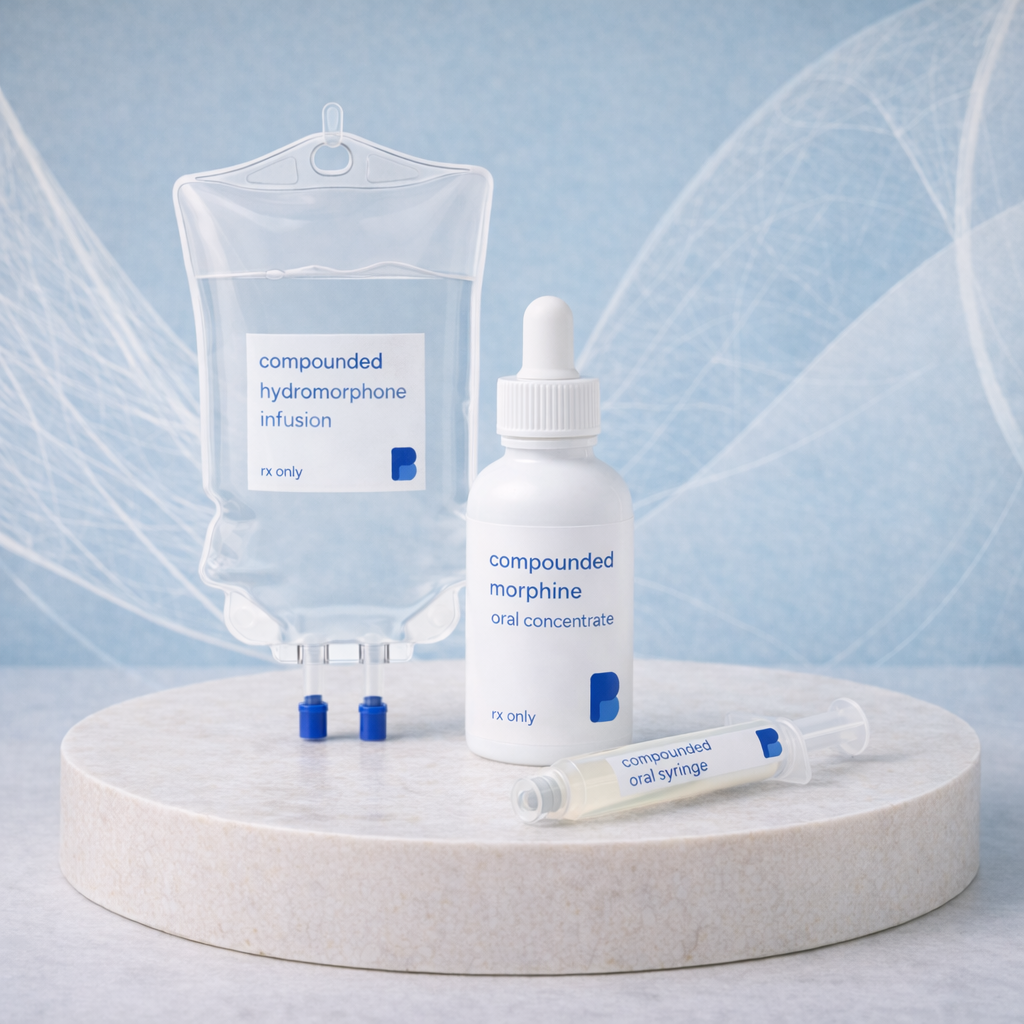
Each of these is compounded to order at our pharmacy and requires a prescription.
A sample of preparations from our formulary. Strengths and dose forms are customised to the prescription.
The claim that hydromorphone is safe in renal failure is overstated. Hydromorphone is not free of active metabolites: its glucuronide metabolite accumulates in renal impairment in a pattern similar to morphine's M3G and M6G, and accumulation can present as myoclonus, hyperalgesia, and agitated delirium.
Fentanyl and methadone are the opioids described in the literature as having no clinically significant active metabolites. Dose adjustment or opioid selection in renal impairment is the prescriber's decision.
Subcutaneous tissue absorbs only roughly 3 mL per hour. A patient whose ordered hourly dose is high cannot receive that dose subcutaneously at commercially available dilute concentrations, which is why 20 mg/mL and 30 mg/mL preservative-free preparations exist.
Preservative-free matters separately: benzyl alcohol and similar preservatives irritate continuous subcutaneous infusion sites and accumulate at higher infusion volumes. The prescriber selects the concentration; the pharmacy prepares what is ordered.
Other salt forms of this molecule, and ingredients commonly compounded alongside it.
This page describes an active pharmaceutical ingredient, not a finished drug product. Bayview Pharmacy compounds preparations containing it only on a prescriber's order for an individual patient.
Compounded preparations are not FDA-approved, and the FDA has not evaluated them for safety, effectiveness, or manufacturing quality. Nothing on this page is a claim that any preparation is effective for any condition.
A valid prescription is required. Availability depends on Bayview's licensure in your state. This page is general information, not medical advice — discuss your situation with a licensed healthcare provider.
Our pharmacists work with prescribers to build preparations around a patient's dose, form and tolerances. Ask us what is possible with this ingredient.