
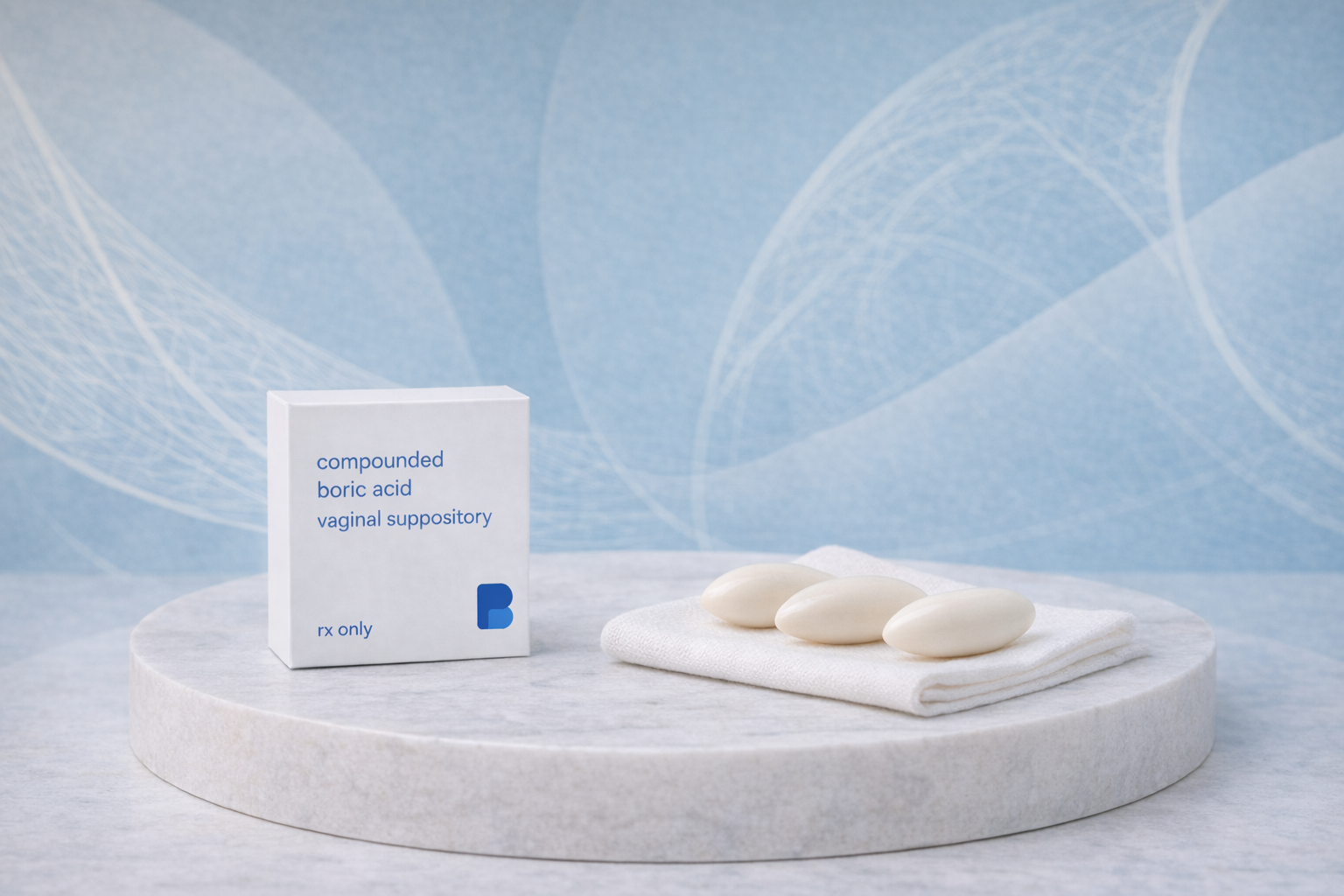
Boric acid suppositories go in the vagina, never in the mouth. The usual directions are one 600 mg suppository or capsule a day, most often at bedtime, for the number of days your provider sets. Guideline courses run 14 to 21 days.
Two cautions come before anything else. Boric acid is poisonous if swallowed. Guidelines also recommend avoiding it during pregnancy. And no boric acid product, prescription or over the counter, is FDA-approved for vaginal use.
This guide walks through how to insert one, how long a course lasts, what side effects people report, and how a prescription preparation differs from the boxes sold online. Whether boric acid fits your situation is your provider's call. Bayview Pharmacy does not provide consultations or decide whether a medication is right for you.
What are boric acid suppositories?
Boric acid is a weak acid with a long history in antiseptics, according to MedlinePlus. A boric acid suppository holds a measured dose, usually 600 mg, in a small solid form that dissolves inside the vagina. The same dose also comes in a gelatin capsule that you insert vaginally, and pharmacies also make a boric acid vaginal gel.
No boric acid product has FDA approval for vaginal use. Compounding pharmacies prepare it on a prescription, and stores and websites sell it over the counter (Mittelstaedt and colleagues, Sexually Transmitted Diseases, 2021). Bayview compounds boric acid vaginal suppositories, capsules, and gel only on a prescription.
How do you insert a boric acid suppository?
Follow the directions on your label. The steps below are the general technique MedlinePlus gives for vaginal suppositories.

- Wash your hands.
- Take one suppository or capsule out of its wrapper. Never swallow it.
- Lie on your back with your knees bent and drawn up, or stand with your feet apart and your knees bent.
- Gently push the suppository into the vagina as far as it comfortably goes, with your finger or with the applicator if one came with it.
- Wash your hands again. Clean or throw away the applicator as its instructions say.
MedlinePlus puts vaginal doses at bedtime, and lying down afterward cuts down on leakage. Studies report a watery discharge during treatment, so wear a panty liner. Our guide to using a compounded suppository covers the dosage form itself in more detail.
How long do you use boric acid suppositories?
Your provider sets the length of your course. Every regimen in the published guidelines uses 600 mg once a day.
| Situation | Regimen described | Source |
|---|---|---|
| Yeast infection from non-albicans Candida that comes back after treatment | 600 mg gelatin capsule vaginally, once daily for 3 weeks | CDC |
| Yeast infection from non-albicans Candida | 600 mg capsule vaginally, daily for at least 14 days | ACOG |
| Bacterial vaginosis that keeps coming back | 7 days of oral metronidazole or tinidazole, then 600 mg vaginally daily for 21 days, then metronidazole gel twice weekly for 4 to 6 months | CDC |
The medical literature also describes longer and twice-weekly schedules for infections that keep returning. A provider sets those case by case (Mittelstaedt and colleagues). Finish the full course you were prescribed, and tell your provider if symptoms continue or come back.
What do boric acid suppositories do?
Boric acid has antiseptic properties. CDC treatment guidelines describe vaginal boric acid for two situations.

- A yeast infection caused by non-albicans Candida, such as C. glabrata, that comes back after treatment. These species respond less well to the standard azole antifungal medicines.
- Bacterial vaginosis that keeps coming back. Here boric acid is one step in a longer sequence that starts with oral metronidazole or tinidazole and ends with metronidazole gel. CDC calls the data for this regimen limited.
Boric acid is not where treatment usually starts. CDC lists azole antifungals such as miconazole, clotrimazole, or a single dose of oral fluconazole for most yeast infections, and metronidazole or clindamycin for bacterial vaginosis. Other infections cause the same symptoms. CDC advises an exam and testing for anyone whose symptoms persist after an over-the-counter product or return within two months.
What are the side effects of boric acid suppositories?
Most reported side effects stay local. People describe irritation, burning, and a watery discharge during treatment (Mittelstaedt and colleagues). Canadian STI guidelines put vaginal burning at fewer than 10% of users. Safety data on vaginal boric acid are limited overall.
Tell your provider about irritation that does not settle, or any effect that worries you. Get medical care right away for signs of a serious allergic reaction, such as a rash, swelling, or trouble breathing.
Are boric acid suppositories safe?
Published reports of vaginal use at 600 mg mostly describe local side effects. The authors of a 2021 review of those reports still called the safety data sparse (Mittelstaedt and colleagues). The clearest danger is swallowing it.
Boric acid is poisonous if swallowed. MedlinePlus lists blue-green vomit, diarrhea, and a bright red skin rash as the main signs of boric acid poisoning, with seizures and collapse in severe cases. If anyone swallows it, call Poison Help at 1-800-222-1222 or 911 right away.
ACOG advises counseling patients to use boric acid only in the vagina and to keep it away from children. If kids live in your house, take this part more seriously than any side effect. Keep boric acid in its own container, apart from anything taken by mouth, somewhere children and pets cannot reach.
Can you use boric acid suppositories while pregnant?
No. Current guidelines recommend avoiding vaginal boric acid during pregnancy. Human data are limited, and some studies have raised concern about birth defects (Mittelstaedt and colleagues). ACOG also advises reliable contraception while using it. If you are pregnant, could be pregnant, or are trying to conceive, tell your provider before you start.
Over the counter vs. prescription boric acid suppositories
Boric acid suppositories are easy to buy online and in stores. The 2021 review counted more than 20 brands on one large online retailer, many sold as homeopathic products, with formulations that vary. Its authors concluded that a provider should prescribe boric acid, and that they could not recommend unregulated use of over-the-counter products (Mittelstaedt and colleagues). CDC adds that people often use over-the-counter vaginal products without a diagnosis, which can delay treatment for a different infection.
| Prescription, compounded | Over the counter | |
|---|---|---|
| FDA-approved | No | No |
| Who decides it fits | Your provider, after a diagnosis | You |
| Dose and form | 600 mg suppository or capsule, or 30% gel, as ordered | Varies by brand |
| Directions | Course set by your provider | Package label |
Neither is FDA-approved, and this table does not claim one works better than the other. The difference is who decides boric acid is the right choice, and who sets the dose and the length of the course.
What does Bayview compound for this?
On a prescriber's order, Bayview prepares boric acid 600 mg vaginal suppositories, 600 mg vaginal capsules, and a 30% vaginal gel, under USP 795 non-sterile compounding standards. These are compounded medications and are not FDA-approved, and a valid prescription is required. Forms and ordering details are on the boric acid formulation page.
Boric acid suppositories start at $92 for 21 suppositories as a cash price. The final price depends on the form and quantity your provider orders. Most compounded prescriptions are paid out of pocket rather than through insurance, and HSA and FSA cards generally work. Do compounding pharmacies take insurance explains why.
How do you get boric acid suppositories from Bayview?
Start with your provider, who diagnoses the infection and decides whether boric acid fits. If they agree, they can e-prescribe, fax, or call the prescription to Bayview Pharmacy in Warwick, Rhode Island. Boric acid is not a controlled substance. We fill and ship to patients in the states where Bayview is licensed, which are listed on our FAQ.
Frequently asked questions
How do you use boric acid suppositories?
Wash your hands, unwrap one suppository or capsule, and push it into the vagina as far as it comfortably goes while lying on your back with your knees bent. Most people use it at bedtime. Use one a day for the number of days your provider sets, and never swallow it.
Are boric acid suppositories safe?
Safety data on vaginal boric acid are limited. Published reports of vaginal use mostly describe local side effects, such as irritation and a watery discharge. Boric acid is poisonous if swallowed, and guidelines recommend avoiding it during pregnancy, so use it only as your provider prescribes.
What do boric acid suppositories do?
Boric acid is a weak acid with antiseptic properties. CDC guidelines describe vaginal boric acid for yeast infections caused by non-albicans Candida that come back after treatment, and as one step in a regimen for bacterial vaginosis that keeps returning. It is not usually a first treatment, and no boric acid product is FDA-approved for vaginal use.
Are boric acid suppositories used for BV?
Sometimes, for bacterial vaginosis that keeps coming back. Based on limited data, CDC describes 7 days of oral metronidazole or tinidazole, then boric acid 600 mg vaginally once daily for 21 days, then metronidazole gel twice weekly for 4 to 6 months. The usual first treatments for BV are metronidazole or clindamycin. Your provider decides which fits.
Are boric acid suppositories used for yeast infections?
For specific ones. Most yeast infections are treated with an azole antifungal. CDC describes boric acid 600 mg vaginally once daily for 3 weeks when a yeast infection caused by non-albicans Candida comes back after treatment. A vaginal culture or PCR test shows which species is involved.
What are the side effects of boric acid suppositories?
The most common side effects reported in studies were vaginal burning, in fewer than 10% of cases, watery discharge during treatment, and vaginal redness. Safety data on vaginal boric acid are limited. It is poisonous if swallowed and is not recommended during pregnancy, so use it only as your provider prescribes and tell your provider about any effect that concerns you.
How long do you use boric acid suppositories?
CDC and StatPearls describe one 600 mg dose placed in the vagina once daily for 14 to 21 days, depending on the infection. Your provider sets the length of your treatment. Finish the full course, and tell your provider if symptoms continue or come back.
Can I use boric acid while pregnant?
No. Current guidelines recommend avoiding intravaginal boric acid during pregnancy, because data on its safety in pregnancy are limited. If you are pregnant or could be pregnant, talk with your provider about other treatment options.
What happens if boric acid is swallowed?
Swallowed boric acid is poisonous and can be fatal. It can cause vomiting, diarrhea, a red skin rash, and seizures. If anyone swallows it, call Poison Help at 1-800-222-1222 or 911 right away. Keep boric acid out of reach of children and pets, and store it apart from medicines taken by mouth.
Can you buy boric acid suppositories over the counter?
Yes. Many brands sell them online and in stores, but none is an FDA-approved drug, and formulations vary. A 2021 review of the safety data concluded that a provider should prescribe boric acid rather than patients choosing it themselves. Bayview compounds boric acid only on a prescription.
Do I need a prescription for boric acid suppositories?
Bayview compounds boric acid only with a valid prescription from a licensed provider. A provider visit also confirms what is causing your symptoms, since boric acid is used for specific recurrent infections rather than as a first treatment. Once we receive your prescription, we compound it in the form your provider orders.
What is the difference between boric acid suppositories and capsules?
Both hold a 600 mg dose of boric acid and are placed in the vagina, never swallowed. A suppository softens and dissolves inside the vagina; a capsule is a gelatin shell that dissolves there. CDC's regimen for non-albicans yeast describes the gelatin capsule. Your provider chooses the form; Bayview also compounds a 30% vaginal gel.
Is watery discharge normal with boric acid suppositories?
Studies report a watery discharge during treatment with vaginal boric acid, and a panty liner helps. Tell your provider about any discharge or irritation that worries you or does not settle.
Can you use boric acid suppositories on your period?
The guideline regimens for boric acid do not say to pause during a period. For a different vaginal medicine, miconazole, MedlinePlus advises continuing through a period. Ask your provider or a Bayview pharmacist before you skip or stop a dose.
What Bayview compounds for this
Important: Compounded medications are prepared to a prescriber's order for an individual patient. They are not FDA-approved, and the FDA has not evaluated them for safety, effectiveness, or manufacturing quality. This article is educational and is not a substitute for advice from your prescriber or pharmacist.
This preparation contains a controlled substance. Controlled-substance prescriptions carry refill limits, must be e-prescribed, and can only be shipped to states where Bayview holds the required licensure.
Uses discussed here may be off-label, meaning they are not part of any FDA-approved labeling. Off-label use is a decision for you and your prescriber, based on the available evidence.
Veterinary preparations are compounded to a veterinarian's order for a specific animal and are not FDA-approved animal drugs. Never give a compounded human medication to an animal without veterinary direction.
Compounded prescriptions are paid for directly rather than billed through insurance. Most are HSA/FSA-eligible, and many patients submit the receipt to their plan for possible reimbursement. Pricing depends on the strength, dose form and quantity your prescriber orders. Read more about cost and insurance.
Compounded boric acid suppositories start at $92 for 21 suppositories, and the price depends on the form and quantity your provider orders. Compounded preparations at Bayview are cash-priced rather than billed through insurance, and they are generally eligible for HSA and FSA cards. Do compounding pharmacies take insurance covers this in more detail.
Bayview Pharmacy is a compounding pharmacy in Warwick, Rhode Island, licensed to fill and ship compounded prescriptions for patients in Rhode Island, Massachusetts, Connecticut, New Jersey, New Hampshire, Florida, Maine and Pennsylvania. Prescriptions for New York patients are filled on a limited basis, and controlled substances are not shipped to New York addresses. See every state we ship to.
Related reading