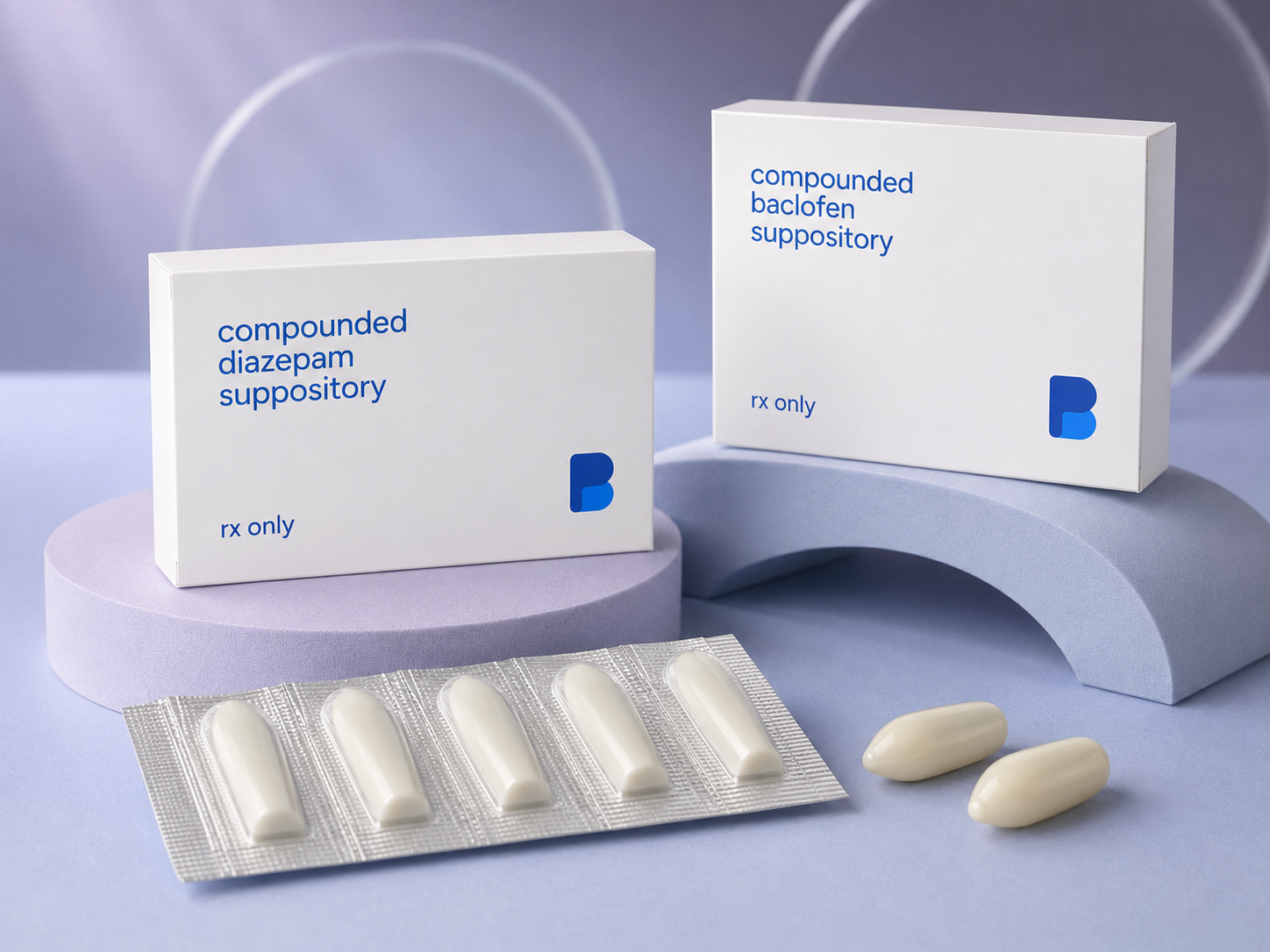
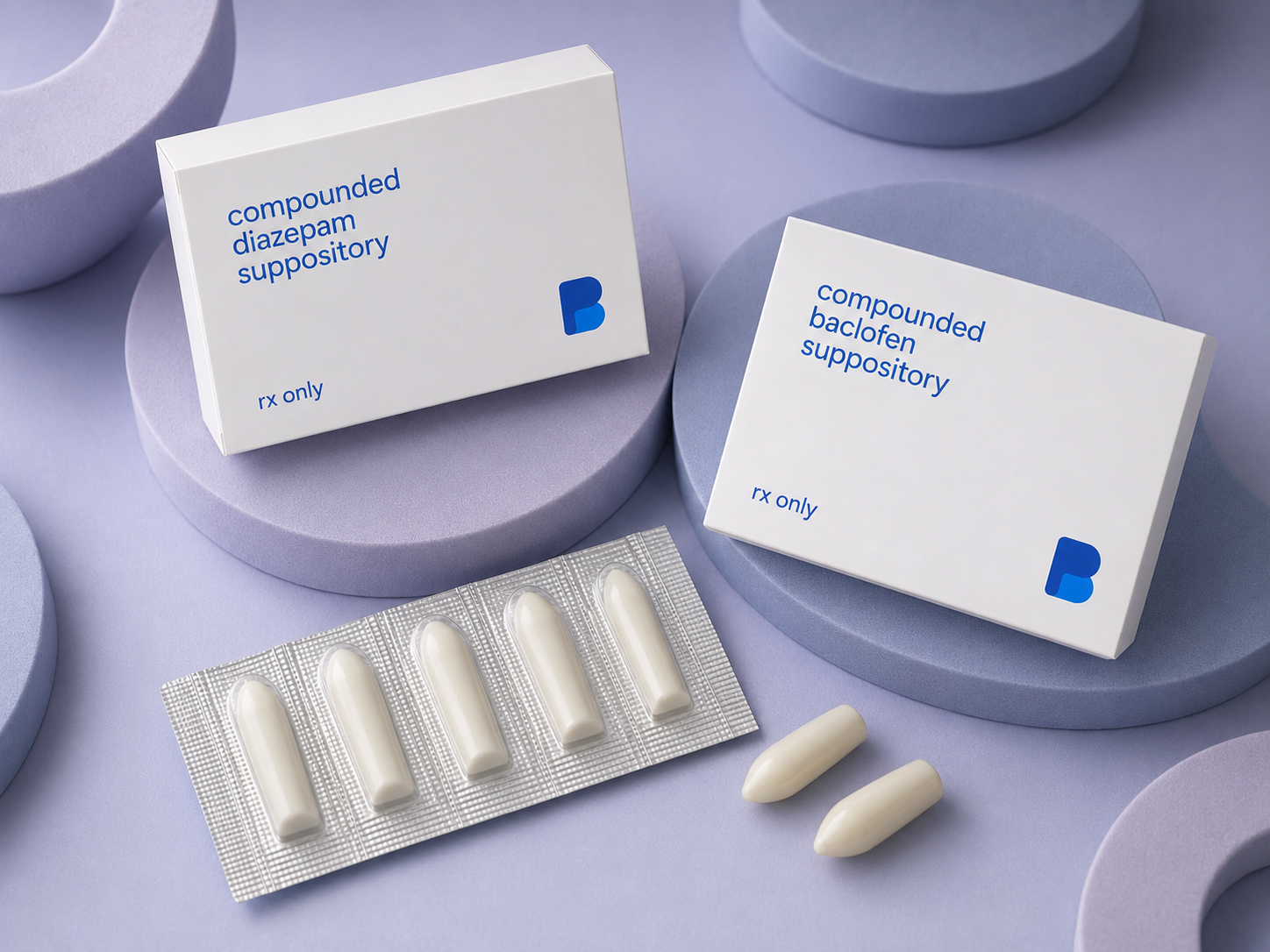
A suppository is a solid dose of medication, molded into a small shape and inserted into the vagina or the rectum instead of swallowed. You use one as the label on your prescription directs: wash your hands, take the wrapper off, insert one suppository as the label describes, and wash your hands again afterward. Strength, route, and schedule are your prescriber's decisions, and Bayview Pharmacy does not determine whether a medication is appropriate for you.
This post is about the dosage form itself, not an argument for any one medication. Bayview compounds several kinds of suppository on a prescriber's order, including diazepam and baclofen suppositories, a preparation whose own page states plainly that benefit is not established: a randomized placebo-controlled trial of nightly vaginal diazepam (Crisp et al., Int Urogynecol J 2013, N=21) found no difference from placebo in resting vaginal EMG at any time point or on any validated questionnaire, a second placebo-controlled trial in 2019 also showed no benefit, and a 2025 systematic review found the evidence base small and of low quality.
What is a suppository made of?
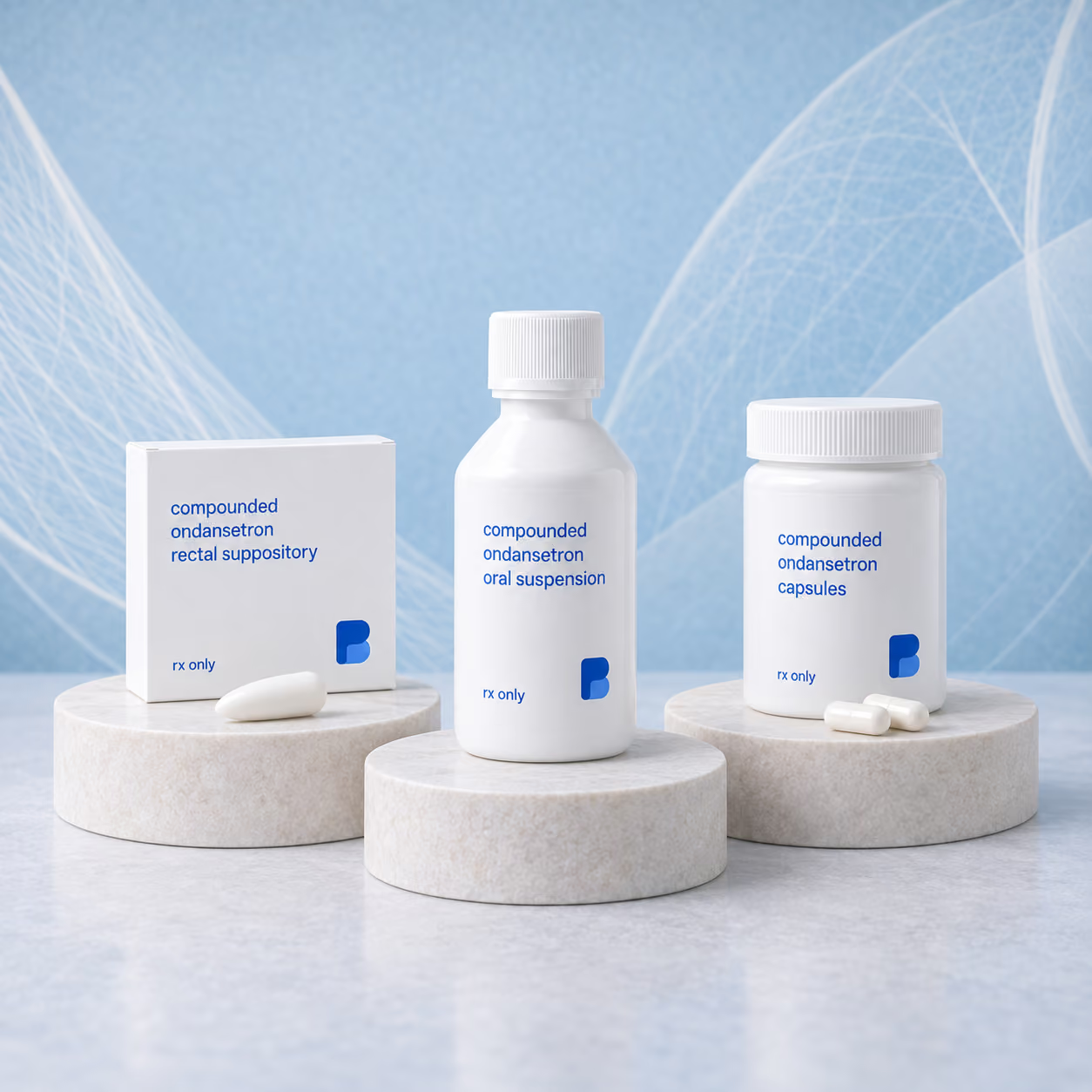
Two things: one or more active drugs, and a base holding them in a solid shape until insertion. The base decides how your suppository is stored and how it behaves after you use it. Bayview prepares suppositories through USP 795 non-sterile compounding, in the strengths and the base a prescriber specifies. Compounded preparations are not FDA-approved.
The two bases that come up most often on our formulation pages are polyethylene glycol (PEG), which is water soluble, and cocoa butter or similar fatty bases. Your label names the storage condition the pharmacy assigned, because that condition follows the base.
| Base | Typical storage | Property |
|---|---|---|
| Polyethylene glycol (PEG) | Controlled room temperature | Water soluble |
| Cocoa butter, fatty bases | Refrigerated, 2 to 8 degrees C | Melts if warm |
Those ranges are the ones printed on the diazepam and baclofen formulation page, which also allows fatty bases to be kept below 25 degrees C rather than refrigerated. Follow your own label rather than a general rule, because the base in your prescription may be neither of these.
How do you insert a suppository?
The steps come from your prescriber and from your label. In general pharmacy practice, patients are directed to wash their hands, unwrap the suppository, insert one as the label describes (vaginally or rectally, whichever was prescribed), and then wash their hands again. The e-prescribed directions a pharmacy receives read, for example, "insert 1 unwrapped suppository vaginally," a useful reminder that the wrapper comes off first.

Bedtime is a common time to use one, for two reasons that appear on our formulation pages. Lying down afterward reduces leakage. And with the diazepam and baclofen preparation, sedation is an expected effect of diazepam, which is one reason a prescriber may order it at bedtime. Benefit for that preparation is still not established, and its page says so.
If your suppository contains diazepam, do not drive or do anything that requires alertness until you know how it affects you, and do not drink alcohol while using it. If you miss a dose, do not double up; ask your prescriber what they want you to do.
What is the difference between a vaginal and a rectal suppository?
The difference is where it goes, and the prescription says which. Some compounded suppositories are vaginal only. Others, including the diazepam and baclofen preparation, are prepared for either route, and the prescriber writes the route on the order. What changes between them is the medication inside and what is actually known about that medication.
| Preparation | Route | Status | Evidence position |
|---|---|---|---|
| Diazepam 5 mg / baclofen 10 mg | Vaginal or rectal | Compounded, off-label | Randomized trials found no benefit |
| Estradiol 0.1 mg suppository | Vaginal | Compounded | Guideline supports low-dose vaginal estrogen |
| Nystatin 100,000 units suppository | Vaginal | Compounded | CDC lists nystatin intravaginally |
Behind those cells: the diazepam and baclofen suppository is an off-label use of both drugs in an unapproved dosage form: no FDA-approved vaginal or rectal suppository of diazepam, baclofen, or any combination of them exists, the randomized evidence is negative as described above, and baclofen suppositories have no completed randomized trial. For low-dose vaginal estrogen as a class, the 2025 AUA/SUFU/AUGS guideline on genitourinary syndrome of menopause gives a Strong Recommendation that clinicians offer it, and compounded estradiol vaginal cream and suppositories are prepared when a prescriber determines that the FDA-approved vaginal estrogen products, which do exist, do not give a patient what she needs. Nystatin suppositories are compounded because no FDA-approved nystatin vaginal product is currently marketed in the United States, and the CDC lists nystatin among the medicines a provider may use inside the vagina when first-line treatment has not worked.
Absorption depends on the drug, not the shape of the dose. The estradiol page describes a low local dose with blood levels that stay low. The diazepam and baclofen page says the opposite about diazepam: measurable diazepam appears in the bloodstream after vaginal dosing, so this is not a local-only treatment. The nystatin page notes that nystatin is essentially not absorbed from mucous membranes.
A dosage form is also not a treatment plan. For hypertonic (high-tone) pelvic floor dysfunction, which is what prescribers order the diazepam and baclofen suppository for, the formulation page states that pelvic floor physical therapy is the intervention with actual evidence, that no urogynecology, urology, or gynecology society guideline endorses these suppositories as standard therapy, and that they are at best an adjunct to it.
How long does a suppository take to dissolve?
None of our three suppository formulation pages gives a dissolving time, so there is no number to quote. What the pages describe is the consequence: the base releases its contents and then some of the base comes back out, which is why leakage and staining are listed as expected local effects, and why bedtime, with time spent lying down, is the common pattern.

As a matter of general pharmacy practice, a water-soluble PEG base dissolves in the moisture already present in the vagina or rectum, while a fatty base such as cocoa butter softens near body temperature. If you want to know how long to stay lying down, ask the pharmacy that filled your prescription, because the answer depends on the base used.
Is suppository leakage normal?
Leakage and staining from the base are listed as common local effects on these formulation pages, alongside vaginal irritation, itching, or discharge. It is a property of the form, not a sign that something went wrong. A panty liner is the usual practical answer, and both the diazepam and baclofen page and the nystatin page mention one.
A new or persistent symptom is different. Tell your prescriber about irritation that does not settle. Cream and oil-containing bases can weaken latex condoms and diaphragms, and the nystatin page makes the same point about some suppository bases, so ask your pharmacist about the base in your own preparation before relying on latex.
How should you store a suppository?
Follow your label, because storage depends on the base. PEG-based suppositories are generally kept at controlled room temperature, while cocoa butter and other fatty bases are generally refrigerated at 2 to 8 degrees C, or at least below 25 degrees C, so they do not melt. The nystatin page notes that compounded suppositories are commonly refrigerated so they stay firm, and should not be allowed to freeze.

Protect them from light and heat, and do not store them in a bathroom. Keep them in the container they came in, tightly closed and out of the reach of children. Discard them after the beyond-use date on your label, and dispose of what is left through a drug take-back program rather than flushing it. Because diazepam is a controlled substance, suppositories containing it have to be kept secured as well as out of reach, and never shared.
What suppositories does Bayview compound?
On a prescriber's order, Bayview prepares diazepam and baclofen suppositories for vaginal or rectal use: diazepam 5 mg with baclofen 10 mg in a 15-count or 30-count, diazepam 10 mg with baclofen 10 mg in a 30-count, custom combinations of diazepam 2 to 10 mg with baclofen 5 to 20 mg as ordered, and ketamine-containing versions. Those strengths are listed for reference only. As the formulation page itself puts it, none of them has been shown in a randomized trial to be better than placebo for hypertonic pelvic floor dysfunction, and listing them is not a statement that any of them works or that one is better than another.
Several things apply to every order containing diazepam. Diazepam is a Schedule IV controlled substance, dispensed only on a prescription written for a named patient, and controlled substances are not shipped to New York addresses. The benzodiazepine boxed warnings apply: taken with opioids, benzodiazepines can cause profound sedation, life-threatening respiratory depression, coma, and death; they carry risks of abuse, misuse, and addiction; and continued use can cause physical dependence, so stopping abruptly can cause withdrawal reactions, including seizures. Do not stop on your own, and ask your prescriber about tapering. Baclofen also needs tapering rather than a sudden stop, because abrupt withdrawal can cause seizures, fever, confusion, muscle stiffness, and hallucinations.
Vaginal diazepam is also not confined to the pelvic floor. Because measurable diazepam reaches the bloodstream after vaginal dosing, ordinary systemic benzodiazepine effects and interactions apply, including with alcohol and opioids. Any description of these suppositories as acting locally only, or as having minimal systemic absorption, is inaccurate, and the formulation page says so in those terms.
If your prescription includes ketamine, read the FDA's warning of October 10, 2023 about compounded ketamine products. It cited sedation, dissociation, worsening of psychiatric symptoms, elevated blood pressure, respiratory depression, abuse and misuse, and lower urinary tract and bladder toxicity, and it specifically warned about use at home without monitoring by a health care provider. Ketamine has no controlled evidence for this route or indication, and Bayview does not promote the ketamine-containing version.
Other suppositories are prepared on the same basis, a prescriber's order for a named patient: compounded vaginal estradiol as a 0.1 mg suppository alongside the 0.01% and 0.02% creams, and compounded nystatin as a 100,000-unit vaginal suppository in a 14-count or 30-count. The rest is in the compounded medications catalog, there is a longer piece on what goes into compounded rectal suppositories, and if a suppository is not the form you had in mind, sublingual compounding is another route the pharmacy prepares.
What does a compounded suppository cost?
Compounded preparations at Bayview are cash-priced. Diazepam and baclofen suppositories start at $154 for 30 suppositories. Compounded vaginal estradiol starts at $50 for 20 mL, and nystatin suppositories start at $90 for 14. Each is a starting price for a starting quantity, so what you pay depends on what your prescriber orders. Compounded preparations are generally eligible for HSA and FSA cards, and there is a fuller explanation in do compounding pharmacies take insurance.
How do you get a compounded suppository filled?
Start with your prescriber, because appropriateness, strength, route, and schedule are their decisions, not ours. If the preparation you are asking about is the diazepam and baclofen suppository, ask how it would fit alongside pelvic floor physical therapy rather than in place of it, since physical therapy is the intervention with the evidence behind it, and ask what would count as a reason to stop.
If your prescriber agrees, they can e-prescribe or fax the prescription to Bayview Pharmacy in Warwick, Rhode Island, naming each active ingredient and strength, the route, and the base. A valid prescription is required. We can then fill it and ship to the states where Bayview is licensed, which are listed on our FAQ, with the New York exception noted above for anything containing diazepam. If this kind of pharmacy is new, what a compounding pharmacy is, how 503A and 503B pharmacies differ, and how to find one near you cover the background.
Frequently asked questions
How should I store them?
Follow your label, because storage depends on the base: PEG-based suppositories are generally kept at controlled room temperature, while cocoa butter and other fatty bases are generally refrigerated at 2 to 8 °C, or at least below 25 °C, so they do not melt. Because diazepam is a controlled substance, keep them secured and out of the reach of children and others, and never share them.
What side effects should I expect?
Expect sedation. Drowsiness, dizziness, impaired coordination, falls, and problems with memory or concentration are the most common, and alcohol and opioids make them worse. Baclofen adds drowsiness and muscle weakness and must be tapered rather than stopped suddenly. Locally, vaginal irritation, discharge, and leakage or staining from the suppository base are common. Extra caution applies in older adults.
How are they used?
Use them exactly as your prescriber directs. As commonly prescribed, one suppository is inserted vaginally or rectally at bedtime, or twice daily, often as a defined two-to-four-week trial timed around pelvic floor physical therapy rather than as open-ended refills. Wash your hands before and after. Because sedation is expected, do not drive until you know how it affects you, and a panty liner helps with base leakage.
Is diazepam a controlled substance?
Yes. Diazepam is a Schedule IV controlled substance and the benzodiazepine boxed warnings apply. Taken with opioids it can cause profound sedation, life-threatening respiratory depression, coma, and death. Abuse, misuse, and addiction are risks, and continued use can cause physical dependence, so stopping abruptly can cause withdrawal including seizures. Do not stop on your own, ask your prescriber about tapering.
Is this a local-only treatment?
No. Vaginal diazepam is not confined to the pelvic floor, pharmacokinetic studies show measurable diazepam in the bloodstream after vaginal dosing. That means the ordinary systemic effects of a benzodiazepine apply, including sedation, impaired driving and coordination, and interactions with alcohol and opioids. Any description of these suppositories as acting locally only, or as having minimal systemic absorption, is not accurate.
Do these suppositories work?
Benefit is not established. In the best-designed study, nightly 10 mg vaginal diazepam over four weeks produced no difference in resting pelvic floor EMG at any time point and no difference on any validated questionnaire compared with placebo, and a second double-blind, placebo-controlled trial also failed to show benefit.
Pelvic floor physical therapy is the intervention with actual evidence for hypertonic pelvic floor dysfunction. If you are considering these, ask your prescriber how they fit alongside physical therapy rather than in place of it.
How do I insert a suppository?
Follow the directions on your label, because your prescriber sets the route and the schedule. In general pharmacy practice, patients are directed to wash their hands, take the wrapper off, insert one suppository vaginally or rectally as the label describes, and then wash their hands again. The e-prescribed directions a pharmacy receives read, for example, "insert 1 unwrapped suppository vaginally." Ask the pharmacy that filled your prescription if anything on the label is unclear.
How long does a suppository take to dissolve?
Bayview's suppository formulation pages do not state a dissolving time, so there is no figure to quote. As a matter of general pharmacy practice, a water-soluble polyethylene glycol base dissolves in the moisture already present, while a fatty base such as cocoa butter softens near body temperature. Bedtime dosing with time spent lying down is the common pattern because lying down reduces leakage. Ask the pharmacy about the base in your own prescription.
Is it normal for a suppository to leak?
Leakage and staining from the suppository base are listed as common local effects on these formulation pages, alongside vaginal irritation, itching, or discharge. It is a property of the dosage form. A panty liner is the usual practical answer, and both the diazepam and baclofen page and the nystatin page mention one. Tell your prescriber about irritation that does not settle or about any new symptom.
Do compounded suppositories need to be refrigerated?
It depends on the base, and your label says which. Polyethylene glycol suppositories are generally kept at controlled room temperature. Cocoa butter and other fatty bases are generally refrigerated at 2 to 8 degrees C, or at least kept below 25 degrees C, so they do not melt. The nystatin page notes that compounded suppositories are commonly refrigerated so they stay firm and should not be allowed to freeze. Follow your own label.
Are compounded suppositories billed through insurance?
Compounded preparations at Bayview are cash-priced. Diazepam and baclofen suppositories start at $154 for 30 suppositories, compounded vaginal estradiol starts at $50 for 20 mL, and nystatin suppositories start at $90 for 14. Each is a starting price for a starting quantity, so what you pay depends on what your prescriber orders. Compounded preparations are generally eligible for HSA and FSA cards.
Can I use a vaginal suppository during my period?
Ask your prescriber, because the answer belongs to the specific prescription. The nystatin formulation page states that nystatin vaginal suppositories are generally continued through a menstrual period unless the prescriber says otherwise. That instruction is written for nystatin, so do not apply it to a different preparation without asking. Your prescriber sets the schedule, including whether to pause or continue.
What Bayview compounds for this
Important: Compounded medications are prepared to a prescriber's order for an individual patient. They are not FDA-approved, and the FDA has not evaluated them for safety, effectiveness, or manufacturing quality. This article is educational and is not a substitute for advice from your prescriber or pharmacist.
This preparation contains a controlled substance. Controlled-substance prescriptions carry refill limits, must be e-prescribed, and can only be shipped to states where Bayview holds the required licensure.
Uses discussed here may be off-label, meaning they are not part of any FDA-approved labeling. Off-label use is a decision for you and your prescriber, based on the available evidence.
Veterinary preparations are compounded to a veterinarian's order for a specific animal and are not FDA-approved animal drugs. Never give a compounded human medication to an animal without veterinary direction.
Compounded prescriptions are paid for directly rather than billed through insurance. Most are HSA/FSA-eligible, and many patients submit the receipt to their plan for possible reimbursement. Pricing depends on the strength, dose form and quantity your prescriber orders. Read more about cost and insurance.
Compounded diazepam and baclofen suppositories start at $154 for 30 suppositories, and the price depends on the strengths, base, and count your prescriber orders. Compounded preparations at Bayview are cash-priced rather than billed through insurance, and they are generally eligible for HSA and FSA cards. Do compounding pharmacies take insurance covers this in more detail.
Bayview Pharmacy is a compounding pharmacy in Warwick, Rhode Island, licensed to fill and ship compounded prescriptions for patients in Rhode Island, Massachusetts, Connecticut, New Jersey, New Hampshire, Florida, Maine and Pennsylvania. Prescriptions for New York patients are filled on a limited basis, and controlled substances are not shipped to New York addresses. See every state we ship to.
Related reading