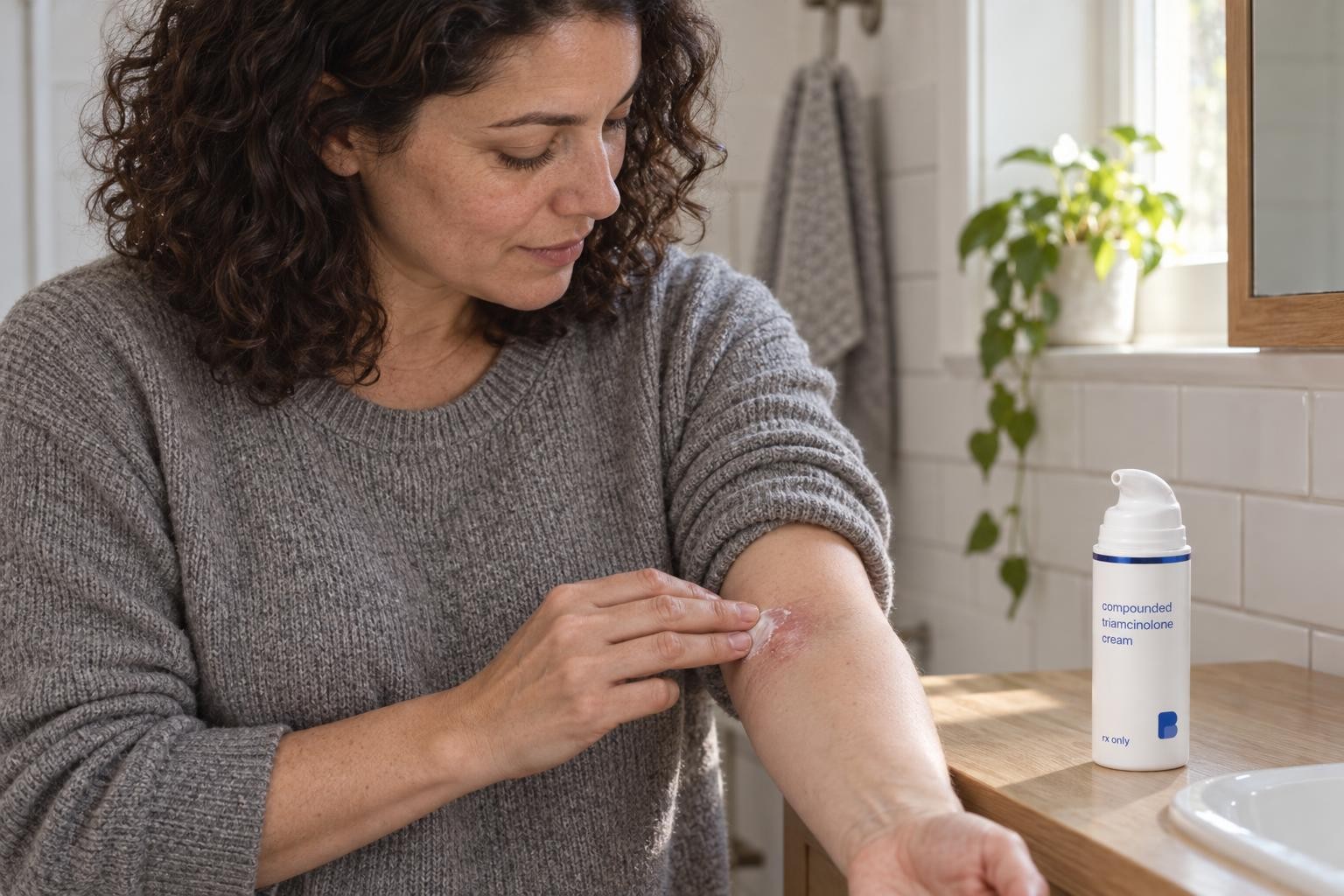
Triamcinolone and hydrocortisone are both corticosteroids that calm red, itchy, inflamed skin. The main difference is strength. Hydrocortisone 1% and 2.5% sit in the lowest potency group, while triamcinolone acetonide 0.1% and 0.5% sit in the medium group, one or more potency groups higher (Stacey and McEleney, 2021). Hydrocortisone up to 1% is sold over the counter. Triamcinolone for the skin needs a prescription (FDA OTC Monograph M017; DailyMed, triamcinolone cream label).
That difference in strength shapes where each one is used, who it suits, and how long it is used. This guide compares the two side by side. It explains what the published labels and guidance say, and it is not a treatment plan. Bayview Pharmacy does not diagnose skin conditions or decide which steroid is right for you. Your prescriber makes that call.
What are triamcinolone and hydrocortisone?
Both are topical corticosteroids, often called steroid creams. They are not the muscle-building kind of steroid. Applied to the skin, they relieve the inflammation and itch of skin conditions that respond to steroids, such as eczema (atopic dermatitis) and psoriasis (Stacey and McEleney, 2021); the labels describe these as corticosteroid-responsive skin conditions (DailyMed, triamcinolone cream label; FDALabel, hydrocortisone 2.5%). A 2021 review in American Family Physician rates the evidence for using topical steroids in psoriasis and atopic dermatitis as strong, its highest grade (Stacey and McEleney, 2021).

- Hydrocortisone comes as a cream, ointment, lotion, spray, and solution (Stacey and McEleney, 2021). Strengths of 0.25% to 1% can be sold without a prescription under the FDA's over-the-counter rules (FDA OTC Monograph M017). The 2.5% strength is labeled prescription only (FDALabel, hydrocortisone 2.5%).
- Triamcinolone acetonide comes as a 0.025%, 0.1%, or 0.5% cream or ointment, a lotion, a spray, and a 0.1% dental paste for the inside of the mouth. The skin and mouth products are labeled prescription only (Stacey and McEleney, 2021; DailyMed, triamcinolone cream label; DailyMed, triamcinolone dental paste label).
Triamcinolone vs. hydrocortisone at a glance
Topical steroids are ranked in seven potency classes, with class I the strongest and class VII the mildest. The table below follows the 2021 American Family Physician review, which groups classes III to V as medium potency and classes VI to VII as low potency. Class assignments vary between references, and the base (cream, ointment, or lotion) can move a product up or down (Stacey and McEleney, 2021; Merck Manual). The table describes how each strength is generally used and is not a treatment plan.
| Product | Potency group | Prescription or OTC | Forms | Where guidance generally places it |
|---|---|---|---|---|
| Hydrocortisone 1% (OTC strengths 0.25% to 1%) | Low (class VI to VII) | Over the counter | Cream, ointment, lotion, spray | Short-term relief of minor itchy rashes; the label says not for diaper rash and not for children under 2 without a doctor |
| Hydrocortisone 2.5% | Low (class VI to VII) | Prescription | Cream, ointment, lotion, solution | The low-potency group used for the face, eyelids, skin folds, diaper area, and children |
| Triamcinolone acetonide 0.025% | Low (class VI to VII) | Prescription | Cream, ointment, lotion | Milder courses and larger areas, as directed |
| Triamcinolone acetonide 0.1% | Medium (class III to V) | Prescription | Cream, ointment, lotion | Most areas of the body; face, groin, and skin folds only in short courses if directed |
| Triamcinolone acetonide 0.5% | Medium (class III to V) | Prescription | Cream, ointment | Most areas of the body, as directed |
| Triamcinolone acetonide 0.1% dental paste | Not ranked on the skin scale | Prescription | Paste | Sore, inflamed spots inside the mouth |
Sources for the table: Stacey and McEleney, 2021; FDA OTC Monograph M017; DailyMed, hydrocortisone 1% cream; FDALabel, hydrocortisone 2.5%; DailyMed, triamcinolone dental paste label; AAP, 2021.
Is triamcinolone stronger than hydrocortisone?
Yes, at 0.1% and 0.5%. Triamcinolone 0.1% is in the medium group, and hydrocortisone 1% and 2.5% are in the low group (Stacey and McEleney, 2021). Triamcinolone 0.025% overlaps with hydrocortisone, in the low group in that review. The Merck Manual places hydrocortisone 1% and 2.5% in class VII and triamcinolone 0.025% cream in class VI, so the mildest triamcinolone is only one step above hydrocortisone in that reference (Merck Manual). For a full list of classes, see our topical steroid potency chart.
The percentage on the tube does not compare strength across different steroids. Hydrocortisone 2.5% has a higher percentage than triamcinolone 0.1%, but triamcinolone 0.1% is the stronger of the two (Stacey and McEleney, 2021). Some hydrocortisone products are also stronger than plain hydrocortisone: hydrocortisone butyrate 0.1% and hydrocortisone valerate 0.2% are in the medium group, not the low one (Stacey and McEleney, 2021). Check the full name on the label.
Does a stronger steroid work better?
Stronger does not mean better for every rash or every part of the body. A 2022 Cochrane review of 104 trials in more than 8,400 children and adults with eczema found that medium- and high-potency steroids led to treatment success more often than low-potency ones (moderate-certainty evidence), but most trials lasted only 1 to 6 weeks and most enrolled people with moderate or severe eczema (Lax et al., 2022). The same review found that applying a steroid once a day is probably as effective as twice a day (Lax et al., 2022).
Guidance chooses potency by the condition, its severity, and where it is on the body. Low-potency steroids are used for children, for mild or widespread disease, and for thin skin such as the face and groin, while medium- to high-potency steroids are used for most other areas of the body (Stacey and McEleney, 2021). Your prescriber weighs all of this.
Using them on the face, skin folds, and genitals
Thin skin, such as on the face and in skin folds, is more prone to side effects, and the risk rises when steroids are applied to thinner skin such as the face and genitals (Stacey and McEleney, 2021). The American Family Physician review lists the face, eyelids, skin folds (intertrigo), diaper area, and the skin around the anus among the areas usually treated with a low-potency steroid, and it suggests treating the face, groin, and skin folds in 1 to 2 week intervals (Stacey and McEleney, 2021). The American Academy of Pediatrics says only a low-potency steroid should be used on a child's face (AAP, 2021).

Over-the-counter hydrocortisone 1% is labeled for external genital, feminine, and anal itching, with limits: do not use it for genital itching if you have a vaginal discharge, do not put it inside the rectum, ask a doctor before using it for anal itching in a child under 12, and stop and ask a doctor if bleeding occurs (DailyMed, hydrocortisone 1% cream). Triamcinolone on the face, groin, or skin folds is a decision for your prescriber. Using a steroid for a long time on the face or genitals can also lead to a rebound of redness, scaling, stinging, and burning when it is stopped (Stacey and McEleney, 2021).
Triamcinolone vs. hydrocortisone for children
Children absorb more steroid through the skin for their size than adults do, so they are more prone to effects on the whole body, including suppression of the body's own steroid hormones and slowed growth (DailyMed, triamcinolone cream label; Stacey and McEleney, 2021). Guidance calls for lower potencies and shorter courses in children (Stacey and McEleney, 2021). The American Academy of Pediatrics gives hydrocortisone 1% or 2.5% ointment as an example of a low-potency option for an infant's eczema flare, and triamcinolone 0.1% as an example of a mid-potency option for an adolescent (AAP, 2021).
The over-the-counter hydrocortisone label says not to use it on children under 2 without asking a doctor, and not to use it for diaper rash (FDA OTC Monograph M017). If a steroid is prescribed for the diaper area, the labels say not to cover it with tight diapers or plastic pants, because covering the skin increases how much is absorbed (DailyMed, triamcinolone cream label; MedlinePlus, Hydrocortisone Topical). Any steroid for a child should be used as the child's prescriber directs.
Side effects and safety
Both medicines share the same kinds of side effects, and the risk rises with potency, the size of the area, how long they are used, and covering the skin. Side effects are rare with low-potency steroids (Stacey and McEleney, 2021).
- On the skin: burning, itching, irritation, dryness, inflamed hair follicles, extra hair growth, acne-like bumps, lighter skin color, and a rash around the mouth (perioral dermatitis). Thinning skin and stretch marks are also listed (DailyMed, triamcinolone cream label), and prolonged use raises the risk (Stacey and McEleney, 2021). Skin thinning and stretch marks are among the most common side effects of topical steroids as a group (Stacey and McEleney, 2021).
- In the body: enough steroid can be absorbed to suppress the adrenal glands, cause Cushing's syndrome, or raise blood sugar, especially with stronger steroids, large areas, or covering the skin (DailyMed, triamcinolone cream label). This is reported for hydrocortisone too (FDALabel, hydrocortisone 2.5%).
- In the mouth: the triamcinolone dental paste can cause local irritation, and it should not be used during a fungal, viral, or bacterial infection of the mouth or throat (DailyMed, triamcinolone dental paste label).
Do not wrap or bandage treated skin unless your prescriber tells you to, and keep steroid creams out of the eyes (DailyMed, triamcinolone cream label; MedlinePlus, Hydrocortisone Topical). Call your prescriber about a severe rash, or redness, swelling, or other signs of skin infection (MedlinePlus, Hydrocortisone Topical).
How long can you use each one?
For over-the-counter hydrocortisone, the label is specific: stop and ask a doctor if the rash gets worse, lasts more than 7 days, or clears up and comes back within a few days, and do not start another hydrocortisone product without asking (FDA OTC Monograph M017). For prescription hydrocortisone, MedlinePlus says to call your doctor if you are not better in the first 2 weeks (MedlinePlus, Hydrocortisone Topical).

For prescription steroids, the length of the course is set by your prescriber. The American Family Physician review suggests using medium- and high-potency steroids for no more than 12 weeks at a time, gives no fixed limit for low-potency steroids, and suggests shorter courses for the face, groin, and skin folds (Stacey and McEleney, 2021). These are general review recommendations, not limits for any one person. For mouth sores, the dental paste label advises further investigation if a sore has not healed significantly in 7 days (DailyMed, triamcinolone dental paste label).
Can you use triamcinolone and hydrocortisone together, or switch between them?
Do not combine or switch steroids on your own. The over-the-counter label tells people not to start another hydrocortisone product without asking a doctor (FDA OTC Monograph M017), and the prescription labels say to use the medicine only as directed and only for the condition it was prescribed for (DailyMed, triamcinolone cream label). Guidance describes a stronger steroid being used intermittently or switched to a milder one once the skin is under control, but it does not address layering two steroids on the same patch of skin (Stacey and McEleney, 2021). If you have both at home, ask your prescriber which to use, where, and for how long.
Triamcinolone dental paste and mouth sores
Hydrocortisone creams are for the skin, not the inside of the mouth. Triamcinolone acetonide 0.1% dental paste is FDA-approved for the temporary relief of symptoms of inflamed and ulcerated spots in the mouth caused by injury, and as an add-on treatment. A small dab is pressed onto the sore, not rubbed in, at bedtime and, if needed, two or three times a day after meals (DailyMed, triamcinolone dental paste label).
The original brand, Kenalog in Orabase, is listed as discontinued by the FDA (Drugs@FDA, NDA 012097). A generic triamcinolone acetonide 0.1% dental paste remains on the market under its own approval (DailyMed, triamcinolone dental paste label). For erosive oral lichen planus, topical steroids are widely used as first-line treatment, but a Cochrane review found only weak evidence for any single treatment, mainly because the trials were small (Cheng et al., 2012).
Cost and availability
Hydrocortisone up to 1% is sold without a prescription (FDA OTC Monograph M017). Hydrocortisone 2.5% and every triamcinolone skin product need a prescription (FDALabel, hydrocortisone 2.5%; DailyMed, triamcinolone cream label). Manufactured triamcinolone cream, ointment, lotion, spray, and dental paste are FDA-approved products, and when one of them fits a prescription, that is what Bayview dispenses. Where a manufactured product fits, it is usually the less expensive route.
What does Bayview compound?
On a prescriber's order, Bayview prepares compounded triamcinolone acetonide when a strength, base, or form is needed that the manufactured products do not offer. The triamcinolone page lists 0.025%, 0.1%, and 0.5% cream or ointment in a preservative-free or simplified base, a 0.5% gel, a 0.05% lotion, a 0.1% topical solution, a 0.04% spray, a 0.025% or 0.1% medicated shampoo, a 0.1% oral adhesive paste, and a 0.1%, 0.2%, or 0.4% swish-and-spit oral rinse, with the 0.4% prepared preservative-free. Bayview also prepares compounded fluocinonide (manufactured fluocinonide 0.05% is a class II, high-potency steroid; Stacey and McEleney, 2021) and mouth rinses and pastes for oral lichen planus.
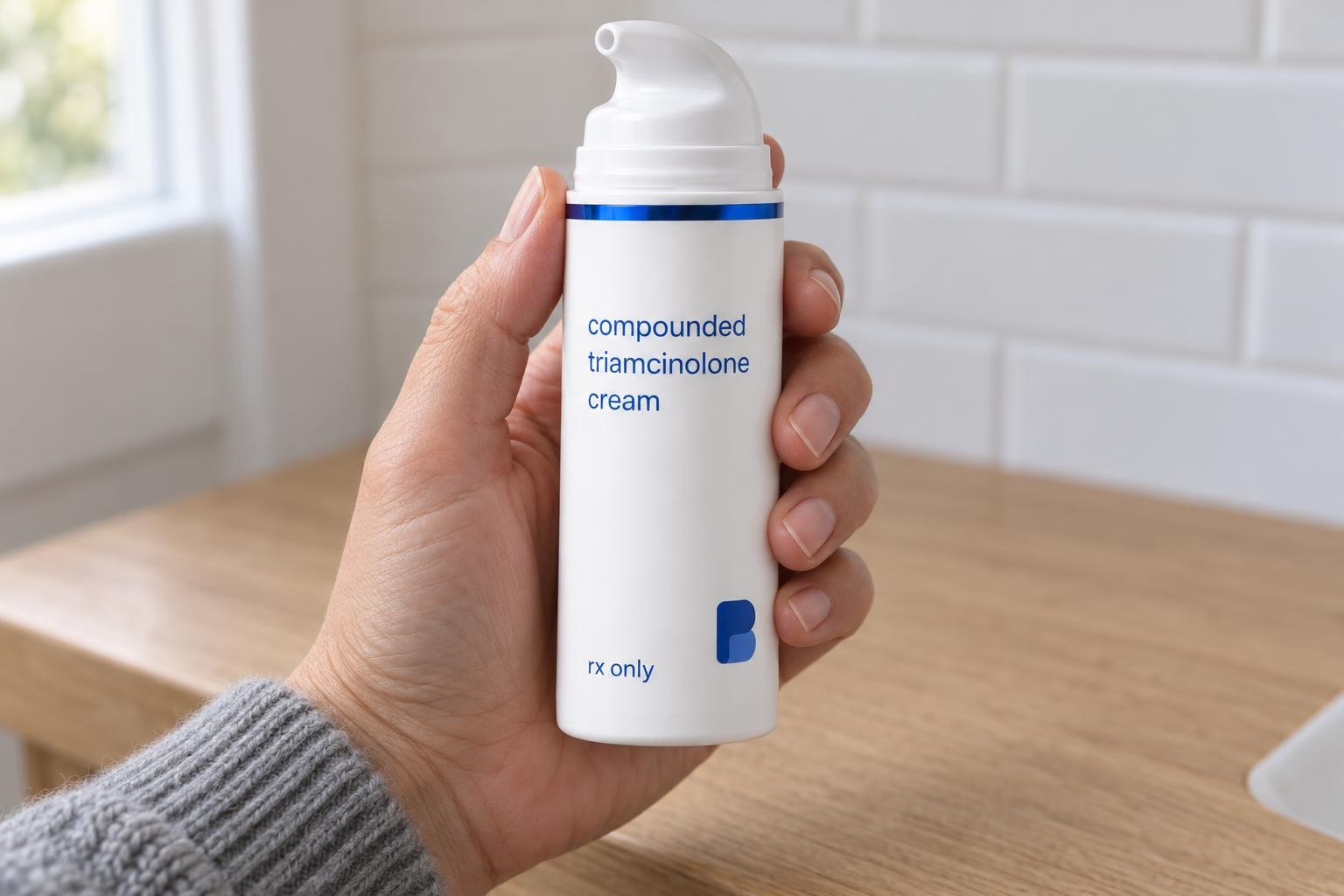
These are compounded medications. They are not FDA-approved, the FDA does not verify their safety, effectiveness, or quality before they are marketed, and a valid prescription is required (FDA, Compounding Q&A). Bayview makes no claim that a compounded preparation works better or is safer than a manufactured one.
How do you get a prescription filled at Bayview?
Start with your prescriber, who decides whether you need a steroid, which one, at what strength, and for how long. If they prescribe triamcinolone, manufactured or compounded, they can e-prescribe, fax, or call it to Bayview Pharmacy in Warwick, Rhode Island. Already have a prescription at another pharmacy? You can transfer it to Bayview. We fill and ship to patients in the states where Bayview is licensed, which are listed on our FAQ.
Frequently asked questions
Can I use hydrocortisone instead of triamcinolone?
Not without asking your prescriber. Hydrocortisone 1% and 2.5% are in the lowest potency group, while triamcinolone 0.1% is medium potency, so they are not interchangeable doses of the same thing (Stacey and McEleney, 2021). Your prescriber chose a strength for your condition and the area being treated, and only they should change it.
Is hydrocortisone 2.5% stronger than triamcinolone 0.1%?
No. The percentage only compares strengths of the same steroid. Hydrocortisone 2.5% is a low-potency steroid, and triamcinolone acetonide 0.1% is a medium-potency steroid, so triamcinolone 0.1% is the stronger of the two despite the smaller number (Stacey and McEleney, 2021).
Which is better for eczema, triamcinolone or hydrocortisone?
Neither is better for everyone. A 2022 Cochrane review found that medium- and high-potency steroids led to treatment success more often than low-potency ones in eczema, but most trials were short and enrolled people with moderate or severe eczema (Lax et al., 2022). Guidance still uses low-potency steroids for the face, skin folds, and children, so the choice depends on where the eczema is, how severe it is, and who has it (Stacey and McEleney, 2021; AAP, 2021).
Can I buy triamcinolone cream over the counter?
No. Triamcinolone cream for the skin is labeled prescription only (DailyMed, triamcinolone cream label), and no triamcinolone skin product is sold over the counter. Hydrocortisone in strengths up to 1% is the steroid cream that can be sold without a prescription (FDA OTC Monograph M017). A pharmacist can help you find the over-the-counter option, but a stronger steroid needs a prescriber.
Can I use hydrocortisone or triamcinolone on diaper rash?
Not on your own. The over-the-counter hydrocortisone label says not to use it for diaper rash and not to use it on children under 2 without asking a doctor (FDA OTC Monograph M017). If a prescriber does order a steroid for the diaper area, the labels say not to cover it with tight diapers or plastic pants, because that increases how much is absorbed (DailyMed, triamcinolone cream label).
How long can I use over-the-counter hydrocortisone?
The label says to stop and ask a doctor if the rash gets worse, lasts more than 7 days, or clears up and comes back within a few days, and not to switch to another hydrocortisone product without asking (FDA OTC Monograph M017). Adults and children 2 and older can apply it no more than 3 to 4 times a day.
Is Kenalog in Orabase still available?
The FDA lists the brand Kenalog in Orabase as discontinued (Drugs@FDA, NDA 012097). A generic triamcinolone acetonide 0.1% dental paste is still marketed by prescription for the temporary relief of sore, inflamed spots in the mouth caused by injury (DailyMed, triamcinolone dental paste label). Your dentist or prescriber can tell you whether it fits your situation.
Does an ointment make triamcinolone or hydrocortisone stronger?
Potency charts often rank the same steroid higher as an ointment than as a cream or lotion (Merck Manual). Small trials, though, suggest creams, ointments, and lotions work about equally well, and a 2021 review suggests choosing the base by the skin's condition, cost, and preference rather than by strength (Stacey and McEleney, 2021).
What Bayview compounds for this
Important: Compounded medications are prepared to a prescriber's order for an individual patient. They are not FDA-approved, and the FDA has not evaluated them for safety, effectiveness, or manufacturing quality. This article is educational and is not a substitute for advice from your prescriber or pharmacist.
This preparation contains a controlled substance. Controlled-substance prescriptions carry refill limits, must be e-prescribed, and can only be shipped to states where Bayview holds the required licensure.
Uses discussed here may be off-label, meaning they are not part of any FDA-approved labeling. Off-label use is a decision for you and your prescriber, based on the available evidence.
Veterinary preparations are compounded to a veterinarian's order for a specific animal and are not FDA-approved animal drugs. Never give a compounded human medication to an animal without veterinary direction.
Compounded prescriptions are paid for directly rather than billed through insurance. Most are HSA/FSA-eligible, and many patients submit the receipt to their plan for possible reimbursement. Pricing depends on the strength, dose form and quantity your prescriber orders. Read more about cost and insurance.
Hydrocortisone up to 1% is sold over the counter, and manufactured triamcinolone products are dispensed when they fit the prescription, which is usually the less expensive route. Compounded triamcinolone is priced by strength, base, form, and size, is cash-priced rather than billed through insurance, and is generally eligible for HSA and FSA cards. Call 401-284-4505 with the preparation and quantity your prescriber ordered for a quote before it is made. A prescription is required.
Bayview Pharmacy is a compounding pharmacy in Warwick, Rhode Island, licensed to fill and ship compounded prescriptions for patients in Rhode Island, Massachusetts, Connecticut, New Jersey, New Hampshire, Florida, Maine and Pennsylvania. Prescriptions for New York patients are filled on a limited basis, and controlled substances are not shipped to New York addresses. See every state we ship to.