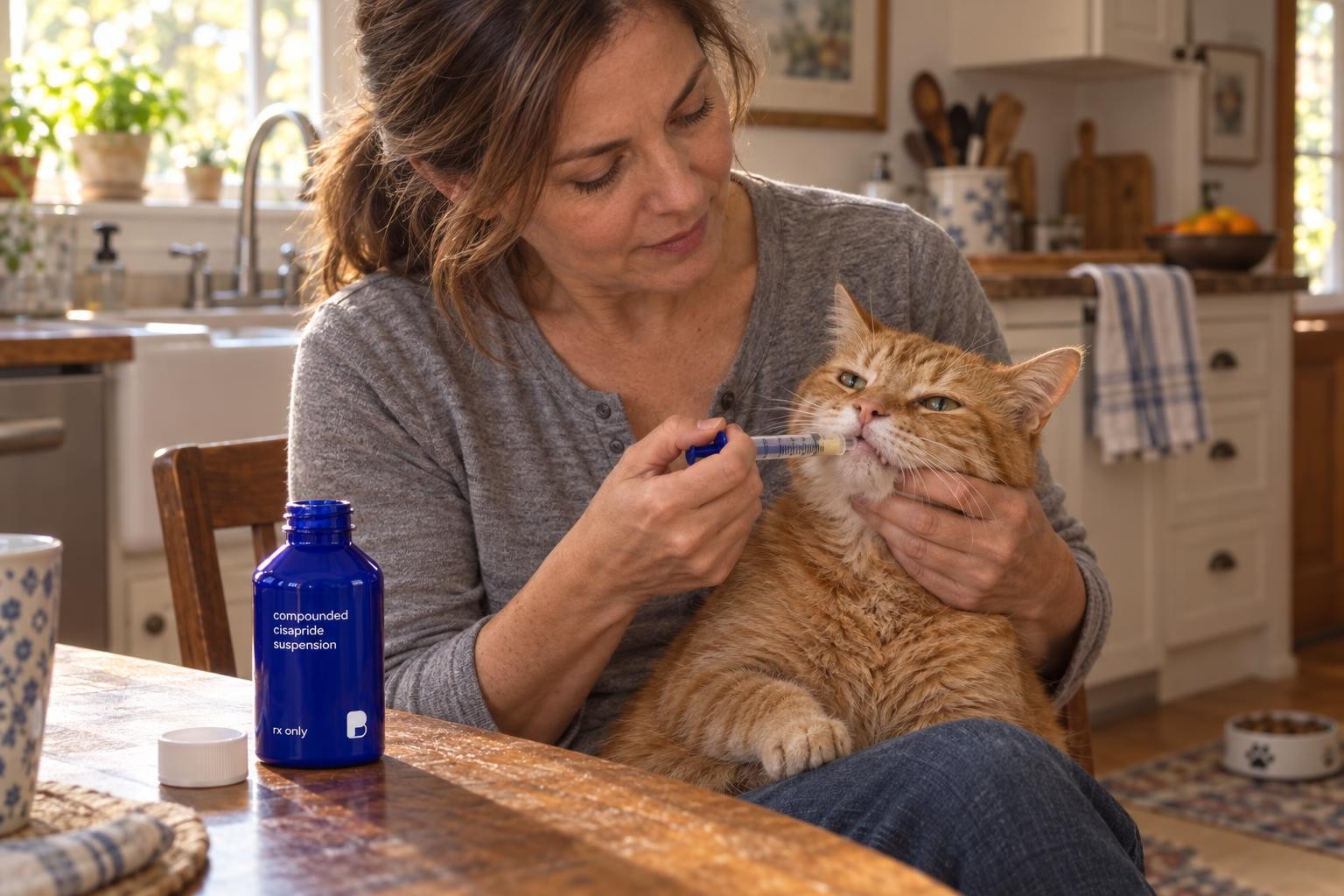
Cisapride is given by mouth. Bayview Pharmacy prepares cisapride for cats and dogs as a flavored oral suspension that is measured with an oral syringe, or as custom-strength capsules, and it is often given before meals. A licensed veterinarian prescribes it for one specific animal and sets the amount and the schedule.
There has never been an FDA-approved animal form of cisapride, and no commercially manufactured version is available in North America. Veterinary use is off-label, and the only way to obtain it for a pet is through a compounding pharmacy that prepares it to a veterinarian's order. This compounded preparation is not FDA-approved. What follows covers the forms, the flavors, who makes which decision, and what to ask at your next appointment.
How is cisapride given to a cat or a dog?
By mouth, in one of two forms. The flavored oral suspension is a liquid drawn up and measured with an oral syringe, which is the usual choice for cats because small, weight-based amounts can be measured accurately. Capsules are the other option, compounded to the custom strength a veterinarian sets.
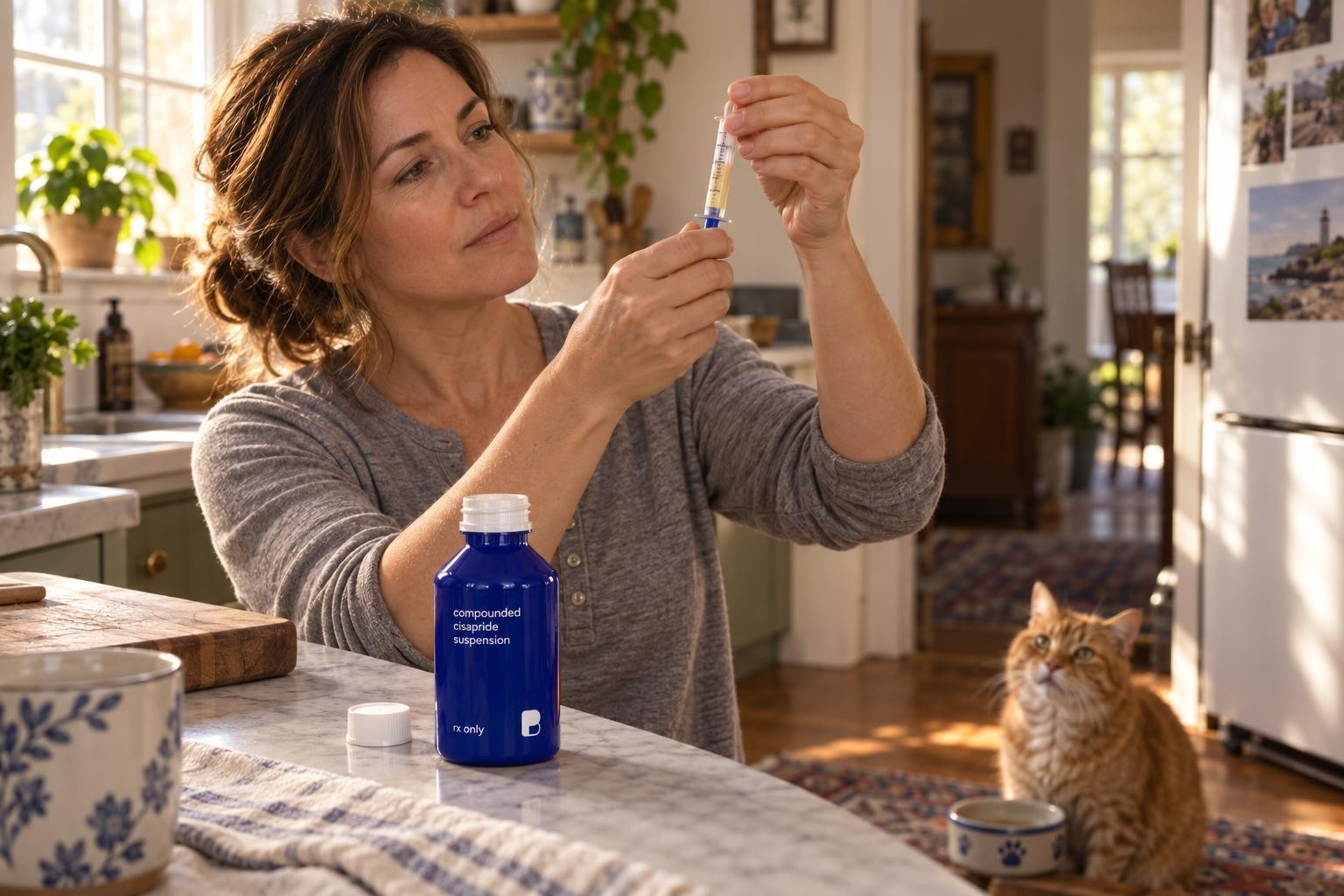
It is often given before meals. Beyond that, the pharmacy label from Bayview is the instruction that matters: give it exactly as directed and do not change the amount on your own. If a dose is hard to give, or your pet refuses it, call your veterinary office rather than adjusting anything yourself.
Who sets the dose and schedule?
Your veterinarian does, and nobody else can. There is no general cisapride for cats dosage that applies to every animal: the amount and the schedule depend on your pet's species, weight, and condition, which is why a prescription for a named animal is required before anything is compounded.

Whether cisapride is appropriate for your pet at all, how it fits into a larger plan, and when it should be changed or stopped are all decisions your veterinarian makes. Bayview compounds what the prescription says and does not decide whether a medication is right for an animal.
Why is this medication available only from a compounding pharmacy?
The human cisapride product, Propulsid, was withdrawn from the U.S. market in 2000 because of rare but serious heart-rhythm risks in people (QT prolongation and arrhythmias). No FDA-approved veterinary version was ever developed, before or since.
So the drug did not disappear from veterinary medicine, but the manufactured supply did. Compounding is the only remaining route, and it is a recognized off-label use in veterinary medicine when a veterinarian orders it within an existing relationship with you and your pet.
What is a prokinetic, and how is cisapride thought to act?
A gastrointestinal prokinetic is a drug that stimulates the muscular movement, or motility, that pushes contents through the digestive tract. Cisapride is thought to act on the nerves and smooth muscle of the gut to promote coordinated contractions that move contents through the stomach and intestines.
In laboratory work on colon tissue from cats with megacolon (Hasler and Washabau, Journal of Veterinary Internal Medicine), cisapride was shown to stimulate contraction of the affected smooth muscle. That is tissue work in a laboratory, not a measured outcome in treated animals, and it is described as the proposed basis for use in feline motility problems rather than as evidence of a result. The published support here is laboratory work on tissue, not controlled clinical trials.
What do veterinarians prescribe it for?
Most often for cats with constipation or megacolon, a condition in which the colon becomes enlarged and contracts poorly. It is sometimes prescribed for other gastrointestinal motility problems, and it is also used in dogs. Every one of those uses is off-label, because no animal-labeled product exists.
Cisapride is not usually the only thing a veterinarian addresses. It fits into an overall treatment plan, and the notes for prescribers place its use after medical management of the underlying cause. How those pieces fit together, and in what order, is determined by your veterinarian and not by the pharmacy.
What forms and flavors does Bayview prepare?
| Form | Typical strengths | How given | Status |
|---|---|---|---|
| Flavored oral suspension | About 5 mg/mL | Measured with an oral syringe | Compounded, off-label |
| Custom-strength capsules | Set by the veterinarian | Given whole by mouth | Compounded, off-label |
| Pet-friendly flavoring | Added to liquids | Chosen for cats or dogs | Compounded |
The forms above are listed for education only. Naming them is not a statement that one option is better, stronger, or more effective than another, and your veterinarian chooses which preparation to order. Flavors are available to make dosing easier for cats and dogs, and the pharmacy prepares the suspension with the flavor your veterinarian specifies on the prescription. If your pet takes other drugs that only come as tablets, Bayview also prepares custom oral suspensions on the same basis.

How should you store it?
Store it as directed on the label from Bayview Pharmacy, and keep it out of the reach of children and pets. If the compounded liquid needs refrigeration, the pharmacy label will say so. Do not use it past its beyond-use date.
Which pets should not be given it?
Cisapride should not be given to a pet with a known or suspected gastrointestinal obstruction or blockage, because increasing gut contractions could be harmful. A veterinarian rules that out before starting. It should also not be given to a pet that has had an allergic reaction to cisapride, or to any pet whose veterinarian has advised against it based on that animal's health.
It is used with caution in pets with heart-rhythm problems and in pets taking interacting medications. Tell your veterinarian about all of your pet's health conditions before the first dose.
What should you tell your veterinarian about other medications?
All of them, including supplements. Cisapride has many potential drug interactions, and certain antifungal and antibiotic medications, among others, can raise its blood levels. That is why your veterinarian reviews every medication and supplement your pet takes before prescribing, and why a new prescription from another clinic is worth a phone call.

What side effects should you watch for?
Vomiting, diarrhea, and abdominal cramping or discomfort are the common side effects listed for cisapride. Veterinary references note that this medication should be used carefully and only under veterinary supervision.
| What to watch | Examples | What to do |
|---|---|---|
| Common side effects | Vomiting, diarrhea, abdominal cramping | Tell your veterinarian |
| Urgent signs | Persistent or severe vomiting or diarrhea | Get veterinary care |
| Urgent signs | Abdominal pain, weakness, or collapse | Get veterinary care |
| Anything else | Any reaction that concerns you | Call your veterinary office |
Changes to the amount or the schedule come from the veterinarian, not from the pharmacy.
What does it cost, and is it billed through insurance?
The compounded oral suspension starts at $67 for 60 mL. Compounded preparations are made to order for one named patient and are priced as cash prescriptions rather than billed through insurance. Our post on whether compounding pharmacies take insurance explains how that works.
What else does Bayview compound for cats and dogs?
What Bayview compounds for this: on a veterinarian's written order, cisapride for cats and dogs is prepared as a flavored oral suspension at about 5 mg/mL or as capsules in custom, weight-based strengths, with pet-friendly flavors added to the liquid. The starting quantity is 60 mL. Strength, form, flavor, and quantity all come from the prescription.
Bayview compounds other veterinary preparations to a veterinarian's order, including ursodiol for pets, methimazole for cats, and pimobendan for dogs. The full list is in the compounded medications catalog.
If this is your first compounded prescription for an animal, our post on how a compounding pharmacy for pets works covers the basics. We also have posts on transdermal methimazole gel and on compounded pimobendan liquid.
How do you order it, and what should you ask your veterinarian?

Start with the appointment. Useful questions: why cisapride rather than another approach, what to watch for, which other medications and supplements need reviewing, and whether the suspension or capsules suit your pet and your routine better. Ask which flavor to request, since that goes on the prescription.
Your veterinarian then sends the prescription to Bayview Pharmacy in Warwick, Rhode Island by e-prescribing platform, fax, or phone, including your pet's species, breed, and current body weight so the order can be verified. Cisapride is not a controlled substance. Prescriptions are filled for patients in the states where Bayview is licensed, which are listed on our FAQ page. Call the pharmacy with questions about the preparation itself, and call your veterinary clinic with questions about your pet.
Frequently asked questions
What side effects are common?
Most pets tolerate cisapride well. The most common signs are stomach-related: vomiting, diarrhea, or cramping, which sometimes improve as the pet adjusts. Contact your veterinarian if signs are severe or persistent, if your pet stops eating, or if anything about their behavior concerns you after starting it.
Which pets should not take it?
Cisapride should not be given to a pet with a suspected gut blockage, and it is used cautiously in pets with heart-rhythm problems. Your veterinarian reviews your pet's history before prescribing.
Are there drug interactions?
Yes, several medications, including certain antifungals and antibiotics, can raise cisapride's blood levels. Tell your veterinarian about every medicine and supplement your pet takes.
How is it given?
Cisapride is given by mouth, usually as a flavored liquid or a capsule, and often before meals. Your veterinarian sets the exact amount and schedule for your pet's species, weight, and condition.
Why isn't cisapride sold commercially?
The human product (Propulsid) was withdrawn from the US market over rare heart-rhythm risks, and no FDA-approved animal version was ever made. It is available only through compounding, used off-label at your veterinarian's direction.
What is cisapride used for?
Veterinarians most often prescribe cisapride for cats with constipation or megacolon, a large, poorly-contracting colon, to help move contents through the gut. It is also used for other motility problems and in dogs.
Are compounded medications FDA-approved?
Compounded medications are not FDA-approved. They're prepared by a licensed pharmacy pursuant to a valid prescription for an individual patient, under USP standards. The FDA does not review compounded medications for safety or effectiveness.
Can you fill a prescription from my own provider?
Yes. Your provider can send your prescription to Bayview Pharmacy by e-prescribe, fax, or phone, or you can transfer an existing prescription from another pharmacy.
How does shipping work?
Once your prescription is verified, we prepare your medication and ship it discreetly in plain packaging either via UPS or USPS. A pharmacy technician confirms the details with you before it goes out, and we're available if you have any questions.
How should I store my compounded medication?
Always follow the storage instructions printed on your label. They are specific to your preparation and they override any general advice, including this answer.
Most compounded medications are stored at controlled room temperature, roughly 68 to 77 °F, in the original container with the cap closed tightly, away from heat, direct light and moisture. A bathroom cabinet is usually a poor choice because of the humidity. Some preparations must be refrigerated, and the label will say so. Do not freeze a medication unless the label tells you to, and never warm one in a microwave.
Every compounded preparation carries a beyond-use date on the label. That date is assigned under USP standards and reflects how long the preparation is expected to stay stable. Do not use it past that date, even if there is medication left in the container.
Keep all medications out of reach of children and pets. Controlled substances should be stored secured and out of sight. If you are not sure how to store something, call us at 401-284-4505.
What is compounding?
Compounding is the practice of preparing a medication tailored to an individual patient's prescription. Instead of a mass-produced product, a compounding pharmacy makes the medication to the specific strength, form, or combination your provider orders.
Examples on this site include medications compounded as liquids for people who cannot swallow pills, thyroid capsules made to a T3/T4 ratio no manufactured product offers, and all-purpose nipple ointment, which combines three actives that are not sold together commercially.
What is the right cisapride dosage for a cat?
Your veterinarian decides, and no general figure applies to every animal. The amount and the schedule depend on your pet's species, weight, and condition, which is why a prescription written for a named animal is required before anything is compounded. Bayview prepares what the prescription specifies and does not set or change a dose. Ask your veterinary clinic before adjusting anything.
Can compounded cisapride be flavored for a picky cat?
Yes. Bayview adds pet-friendly flavors to compounded liquids, with options for cats and for dogs, and the flavor is specified on the prescription. Ask your veterinarian which flavor to request so it is on the order when it reaches the pharmacy. Flavors are listed for education only, and naming them is not a statement that any option is better or stronger than another.
What does compounded cisapride cost at Bayview?
The compounded oral suspension starts at $67 for 60 mL. Compounded preparations are made to order for a single named patient and are priced as cash prescriptions rather than billed through insurance. Strength, form, flavor, and quantity all come from the prescription, so call the pharmacy for a current price on an unusual strength or quantity.
Do you need a prescription for cisapride?
Yes. It is prescription-only and requires a prescription from a licensed veterinarian written for a specific animal. Cisapride is not a controlled substance. Your veterinarian can send the order to Bayview Pharmacy in Warwick, Rhode Island by e-prescribing platform, fax, or phone, including your pet's species, breed, and current body weight so the order can be verified.
What Bayview compounds for this
Important: Compounded medications are prepared to a prescriber's order for an individual patient. They are not FDA-approved, and the FDA has not evaluated them for safety, effectiveness, or manufacturing quality. This article is educational and is not a substitute for advice from your prescriber or pharmacist.
This preparation contains a controlled substance. Controlled-substance prescriptions carry refill limits, must be e-prescribed, and can only be shipped to states where Bayview holds the required licensure.
Uses discussed here may be off-label, meaning they are not part of any FDA-approved labeling. Off-label use is a decision for you and your prescriber, based on the available evidence.
Veterinary preparations are compounded to a veterinarian's order for a specific animal and are not FDA-approved animal drugs. Never give a compounded human medication to an animal without veterinary direction.
Compounded prescriptions are paid for directly rather than billed through insurance. Most are HSA/FSA-eligible, and many patients submit the receipt to their plan for possible reimbursement. Pricing depends on the strength, dose form and quantity your prescriber orders. Read more about cost and insurance.
The compounded cisapride oral suspension starts at $67 for 60 mL. Compounded preparations are made to order for one named patient and are priced as cash prescriptions rather than billed through insurance. Strength, form, flavor, and quantity all come from the prescription, so call the pharmacy for a current price on an unusual order.
Bayview Pharmacy is a compounding pharmacy in Warwick, Rhode Island, licensed to fill and ship compounded prescriptions for patients in Rhode Island, Massachusetts, Connecticut, New Jersey, New Hampshire, Florida, Maine and Pennsylvania. Prescriptions for New York patients are filled on a limited basis, and controlled substances are not shipped to New York addresses. See every state we ship to.
Related reading