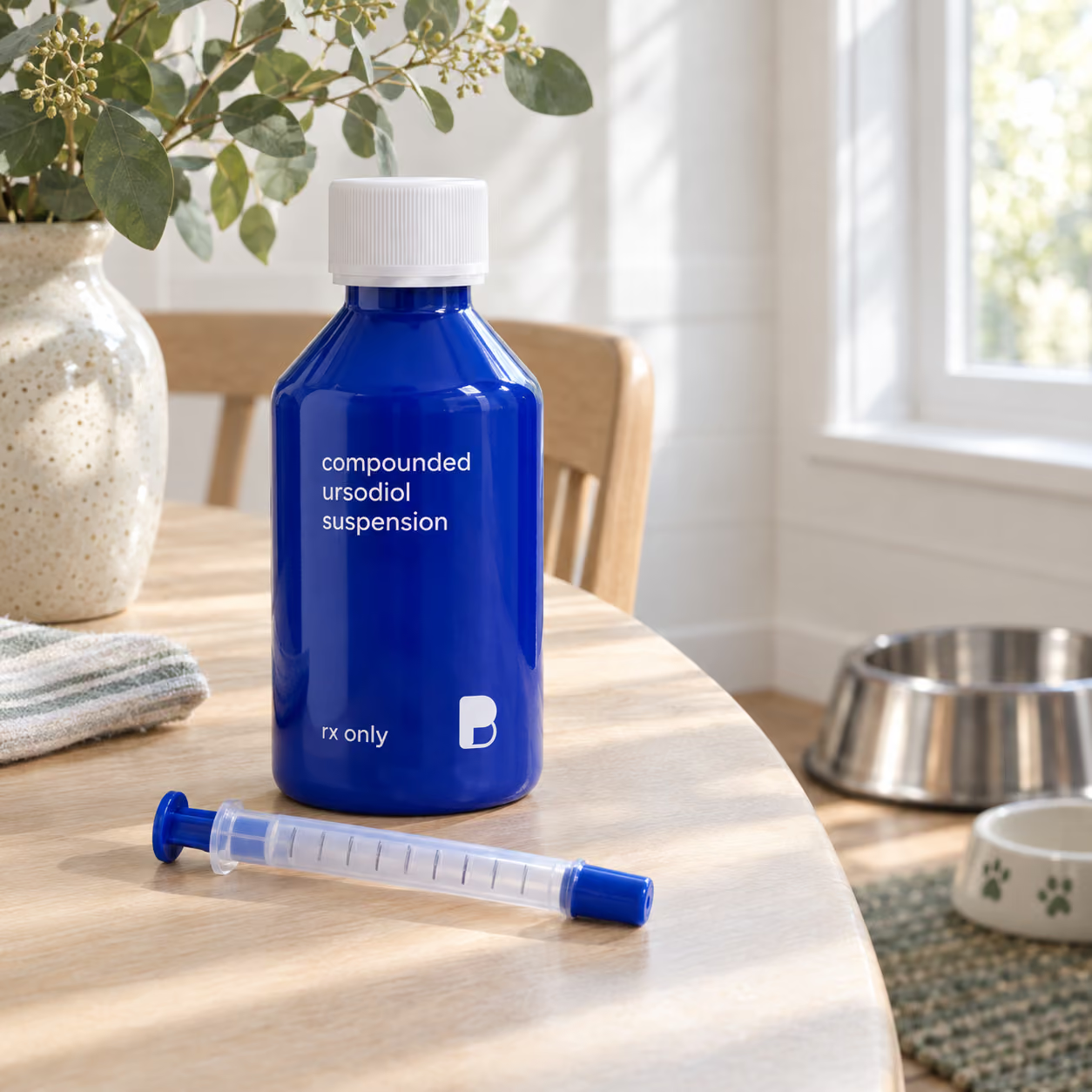
Ursodiol is given by mouth, usually with food to aid absorption and reduce stomach upset. Bayview Pharmacy prepares ursodiol for dogs and cats as a pet-friendly flavored oral suspension measured with a syringe, or as smaller custom capsules, to the strength and form your veterinarian orders. Your veterinarian sets the exact amount and the schedule, so what follows is the mechanics of giving it and the questions to bring to the appointment, not a dose.
This is a compounded, prescription-only preparation, prescribed by a veterinarian for a specific animal. There is no FDA-approved animal form of ursodiol, so its use in dogs and cats is off-label and guided by your veterinarian.
What is ursodiol, and why is it compounded for pets?
Ursodiol, also called ursodeoxycholic acid, is a bile acid found naturally in the body. Given as a medication, it shifts the balance of bile acids toward gentler, less irritating forms and helps bile move more freely through the liver and biliary system.
Ursodiol is thought to add a gentler bile acid to a pet's bile acid pool, which may reduce the harshness of bile on liver cells and cholangiocytes, encourage bile secretion, and offer a cytoprotective effect. These proposed mechanisms are why the drug is described as choleretic and hepatoprotective in the medical literature, in StatPearls on the NIH's NCBI Bookshelf.
Veterinarians may prescribe it for certain dogs and cats with liver or gallbladder and biliary conditions, such as some forms of liver disease, biliary sludge, or gallbladder disease. Hepatobiliary disease and gallbladder mucocele are examples of the diagnoses involved. It is used as part of a treatment plan your veterinarian determines for your pet's specific diagnosis.
MedlinePlus describes ursodiol as approved for people to help with gallstones and certain liver conditions, and no product is made and approved for animals. Veterinarians use it in dogs and cats by professional judgment, and compounding makes practical pet amounts and flavors that the limited human capsule sizes cannot provide.
Should you ask for a liquid or capsules?
The commercial human capsules come in only a few sizes that are often too large or awkward to split for a cat or small dog. Bayview compounds ursodiol into a flavored oral suspension and into smaller custom-strength capsules, so a pet can receive an accurate amount that is easier to give, at your veterinarian's direction.

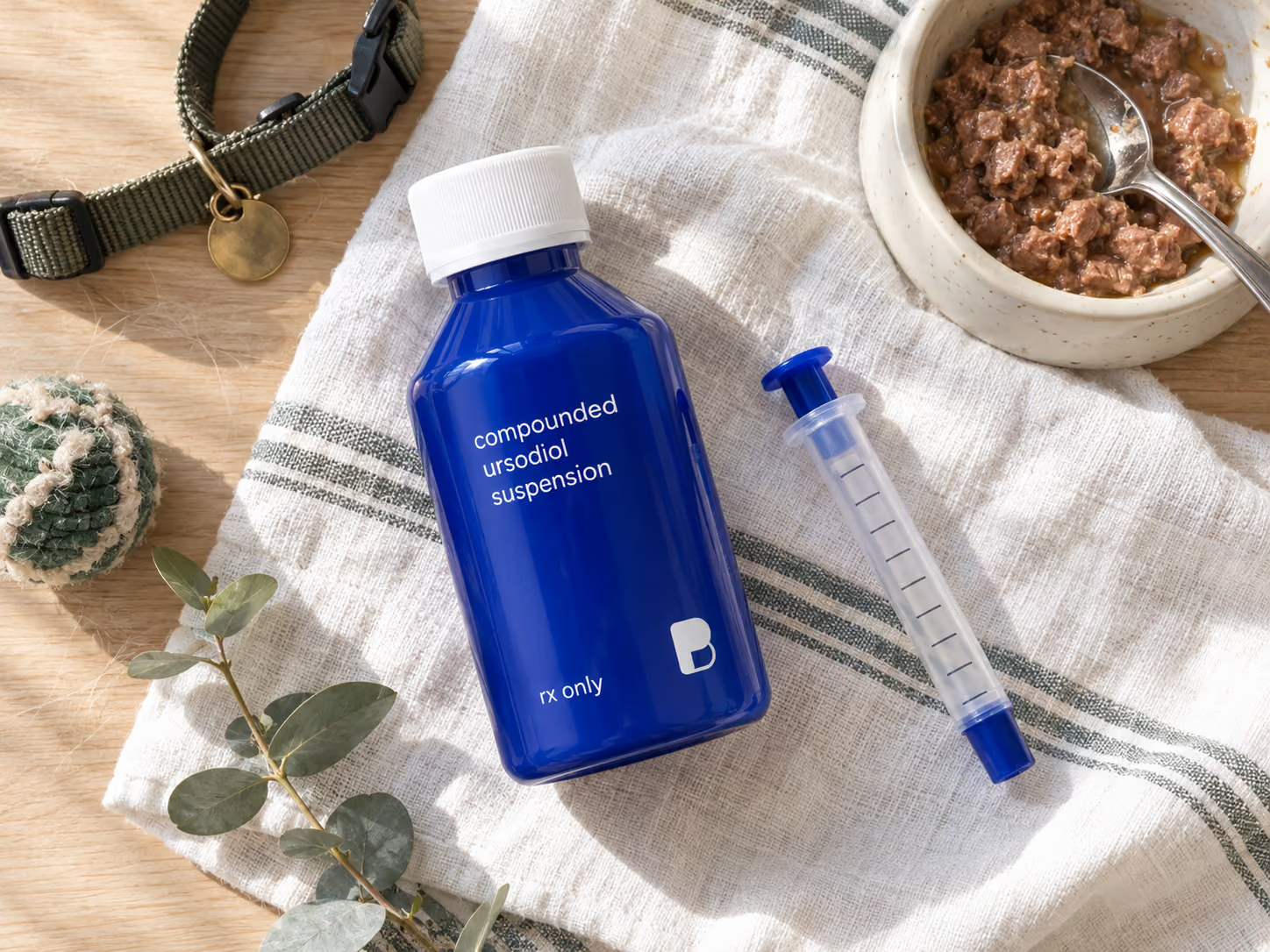
The flavored oral suspension is the liquid form. It is measured by syringe, pet-friendly flavors are available, and it is shaken well and given with food. Capsules are the other option, and custom small strengths allow accurate dosing in cats and small dogs. Which form your pet gets is your veterinarian's decision, not a preference you choose at the pharmacy.
| Form | What it is | Status |
|---|---|---|
| Flavored oral suspension | 50, 80 or 100 mg/mL | Compounded, off-label in pets |
| Custom capsules | Custom milligram strengths | Compounded, off-label in pets |
| Human capsules | A few fixed sizes | FDA-approved for people |
The human capsules are approved for people, not for animals, so giving them to a dog or cat is off-label, as is the compounded suspension or capsule your veterinarian orders. The strengths above are the strengths that are prepared, never a dose: the suspension is made at 50, 80 or 100 mg/mL, and capsules are made in custom milligram strengths below commercial capsule sizes. Forms and strengths are listed for education only and are not a statement that any option is better, stronger or more effective.
How do you give the flavored suspension to a dog?
- Shake the suspension well before each dose.
- Draw up the amount written on the label, using the oral syringe provided.
- Give it by mouth, usually with food, as the label directs.
- Give exactly as your veterinarian directs and do not change the amount yourself.
- Keep the container tightly closed and store it as the label states.
Shaking is a step before every dose, not only when the bottle is new. If you are unsure how the liquid should be given, ask your veterinarian rather than improvising. Keep it out of the reach of children and pets, and discard any leftover medication after the beyond-use date your pharmacy provides.
What is different about giving it to a cat?
Ursodiol for cats is the same compounded suspension and the same custom capsules. Human capsule sizes are hard to split accurately for a cat, and custom small strengths allow accurate dosing in cats and small dogs. Flavoring and a syringe-measured liquid are there to make dosing easier.
Whether ursodiol is appropriate for a cat, and at what amount, is a decision the veterinarian makes for that individual animal. Bayview compounds other preparations for cats to a veterinarian's order, including methimazole for cats. For another compounded preparation given to cats and dogs, see how to give cisapride to a cat.
Who decides the dosage, and what does your veterinarian need to know?
The dosage is set by your veterinarian, not by the pharmacy. That is the direct answer to a search for ursodiol dosage for dogs: your veterinarian sets the exact amount and schedule based on your pet's weight and condition, and the instruction is to follow their directions rather than adjusting the dose yourself. This post gives no numbers for that reason.
A veterinary prescription for this preparation includes the patient's species, breed and current body weight so the amount can be verified, along with the form and strength, the directions, the diagnosis, the quantity and any refills.
Tell your veterinarian about all other medications your pet receives, and expect that they may monitor your pet's bloodwork during treatment.
Why does it go with food?
Ursodiol is usually given with food to aid absorption and reduce stomach upset. Bile acid absorption depends on it, which is why giving ursodiol with food is part of the instruction rather than a convenience.
If anything about the schedule is unclear, ask your veterinarian rather than changing the amount on your own.
What side effects should you watch for?
The ursodiol side effects named for dogs and cats are mild digestive upset, such as soft stool, and occasional vomiting, as described by MedlinePlus. Your veterinarian may recheck bloodwork periodically to monitor the liver.
Contact your veterinarian if your pet has ongoing vomiting or diarrhea. Seek veterinary care if your pet has:
- Ongoing or repeated vomiting
- Ongoing diarrhea
- Signs of an allergic reaction, such as facial swelling or trouble breathing
Report anything new or persistent to your veterinarian.
When should ursodiol not be given?
Do not give it if your pet has a complete blockage of the bile duct, if your pet has had an allergic reaction to ursodiol, or if your veterinarian has not prescribed it for your pet. Ursodiol is not appropriate when there is a complete blockage of the bile duct, because bile cannot flow past the obstruction.
Tell your veterinarian about your pet's full history and any other medications so they can decide whether ursodiol is appropriate for your pet. Because a compounded preparation is dispensed on a prescription written for one named animal, it is not something to pass along to another pet in the household.
What does Bayview compound, and what does it cost?
On a veterinarian's order, Bayview prepares ursodiol as a pet-friendly flavored oral suspension at 50, 80 or 100 mg/mL, measured by syringe and with flavors available, and as smaller custom-strength capsules in milligram strengths below commercial capsule sizes. It is compounded as part of Bayview's veterinary compounding line. The Ursodiol for Pets page lists a starting price of $186 for 90 mL of the suspension. What you pay depends on the strength, flavor and quantity your veterinarian orders.
Bayview also prepares Custom Oral Suspensions for other medications on a prescriber's order, and other veterinary preparations compounded to a veterinarian's order include trilostane for dogs and compounded pimobendan liquid. The searchable catalog lists what is prepared. For how compounded prescriptions are paid for, see do compounding pharmacies take insurance.
How do you get a prescription filled?
Ask your veterinarian whether a compounded form suits your pet. If they agree, they can send the prescription to Bayview Pharmacy, 3844 Post Rd, Warwick, RI 02886, through their e-prescribing platform, by fax or by phone. Ursodiol is not a controlled substance. Including the species, breed and current body weight lets the pharmacy verify the amount.
If this is your first compounded prescription for an animal, compounding pharmacy for pets covers how veterinary compounding works and how to order, and gabapentin for dogs and cats is another post about a compounded preparation for animals. The route is the same either way: the veterinarian writes the prescription, the pharmacy prepares it, and the label is the instruction you follow.
Frequently asked questions
What is ursodiol used for in pets?
Veterinarians prescribe ursodiol for certain dogs and cats with liver or gallbladder and biliary conditions. It improves bile flow and helps protect liver cells, as part of a plan your veterinarian determines.
Why is it compounded for pets?
Ursodiol is an FDA-approved human drug with no animal version, and the human capsules come in sizes that are often too big for pets. Bayview compounds flavored liquids and smaller capsules for accurate, easier dosing.
Is it safe?
It is generally well tolerated; the most common effect is mild digestive upset, such as soft stool. It should not be used when there is a complete bile-duct blockage. Your veterinarian may monitor bloodwork.
What forms does it come in?
Bayview compounds ursodiol as a flavored oral suspension, about 100 mg/mL, and as smaller custom-strength capsules for pets that need a dose the human capsules cannot provide. Flavors such as chicken or fish make daily dosing far easier for most dogs and cats. Everything is prepared to your veterinarian's order.
When should I call the vet?
Contact your veterinarian for ongoing vomiting or diarrhea, a pet that stops eating, worsening lethargy, or yellowing of the eyes, gums, or skin. Seek care promptly for signs of an allergic reaction such as facial swelling, hives, or trouble breathing. Routine follow-up bloodwork is also part of monitoring most liver conditions.
Do I need a prescription?
Yes. All of our medications require a valid prescription from a licensed provider. We're a dispensing and compounding pharmacy, so we don't provide consultations or write prescriptions. If you don't have one yet, you'll need to see a provider first.
Can you fill a prescription from my own provider?
Yes. Your provider can send your prescription to Bayview Pharmacy by e-prescribe, fax, or phone, or you can transfer an existing prescription from another pharmacy.
How do you give ursodiol to a dog?
It is given by mouth, usually with food to aid absorption and reduce stomach upset. Bayview prepares a flavored oral suspension that is shaken well and measured with an oral syringe, or smaller custom capsules. Follow the label your veterinarian wrote rather than adjusting the amount yourself, and ask your veterinarian if you are unsure how the liquid should be given.
Is there a liquid version of ursodiol for dogs?
There is no FDA-approved animal product in any form, so a liquid has to be compounded. Bayview prepares ursodiol as a pet-friendly flavored oral suspension at 50, 80 or 100 mg/mL, measured by syringe, on a veterinarian's order. Those are the strengths that are prepared, not a dose. Your veterinarian decides which strength and which form to order for your pet.
Who decides the ursodiol dosage for a dog?
Your veterinarian does. They set the exact amount and the schedule based on your pet's weight and condition, and the instruction to owners is to follow those directions rather than changing the dose themselves. The pharmacy prepares what is prescribed and asks for the species, breed and current body weight so the amount can be verified, which is why no dose number appears here.
What are the common ursodiol side effects in pets?
The named side effects are mild digestive upset, such as soft stool, and occasional vomiting, as described by MedlinePlus. Your veterinarian may recheck bloodwork periodically to monitor the liver. Contact your veterinarian about ongoing vomiting or diarrhea, and seek veterinary care for signs of an allergic reaction such as facial swelling or trouble breathing. Report anything new or persistent to your veterinarian.
Does ursodiol have to be given with food?
It is usually given with food to aid absorption and reduce stomach upset, and bile acid absorption depends on it. Treat it as part of the instruction on the label rather than a convenience. If anything about the schedule is unclear, ask your veterinarian rather than changing the amount on your own.
Is ursodiol FDA-approved for dogs and cats?
No. Ursodiol is approved for people, for gallstones and certain liver conditions according to MedlinePlus, but there is no FDA-approved animal version. Use in dogs and cats is off-label and guided by your veterinarian. The compounded preparation is itself not FDA-approved and requires a prescription from a licensed veterinarian written for a specific animal.
Can a cat take compounded ursodiol?
A veterinarian may prescribe it for certain cats with liver or gallbladder and biliary conditions, as part of a treatment plan they determine for that animal. The reason for compounding is the same as in small dogs: the human capsule sizes are hard to split accurately, and custom small strengths allow accurate dosing. Appropriateness and amount are your veterinarian's decision, not the pharmacy's.
What does compounded ursodiol for pets cost?
The Ursodiol for Pets page lists a starting price of $186 for 90 mL of the flavored oral suspension. What you pay depends on the strength, the flavor and the quantity your veterinarian orders, so the published figure is a starting point rather than a final price. For how compounded prescriptions are paid for, see the post on whether compounding pharmacies take insurance.
What Bayview compounds for this
Important: Compounded medications are prepared to a prescriber's order for an individual patient. They are not FDA-approved, and the FDA has not evaluated them for safety, effectiveness, or manufacturing quality. This article is educational and is not a substitute for advice from your prescriber or pharmacist.
This preparation contains a controlled substance. Controlled-substance prescriptions carry refill limits, must be e-prescribed, and can only be shipped to states where Bayview holds the required licensure.
Uses discussed here may be off-label, meaning they are not part of any FDA-approved labeling. Off-label use is a decision for you and your prescriber, based on the available evidence.
Veterinary preparations are compounded to a veterinarian's order for a specific animal and are not FDA-approved animal drugs. Never give a compounded human medication to an animal without veterinary direction.
Compounded prescriptions are paid for directly rather than billed through insurance. Most are HSA/FSA-eligible, and many patients submit the receipt to their plan for possible reimbursement. Pricing depends on the strength, dose form and quantity your prescriber orders. Read more about cost and insurance.
The Ursodiol for Pets page lists a starting price of $186 for 90 mL of the flavored oral suspension. Because each order is prepared to the strength, flavor and quantity the veterinarian specifies, the final figure depends on that order. For how compounded prescriptions are paid for rather than billed, see do compounding pharmacies take insurance.
Bayview Pharmacy is a compounding pharmacy in Warwick, Rhode Island, licensed to fill and ship compounded prescriptions for patients in Rhode Island, Massachusetts, Connecticut, New Jersey, New Hampshire, Florida, Maine and Pennsylvania. Prescriptions for New York patients are filled on a limited basis, and controlled substances are not shipped to New York addresses. See every state we ship to.
Related reading