Check out our most popular compounded medications! Get Started


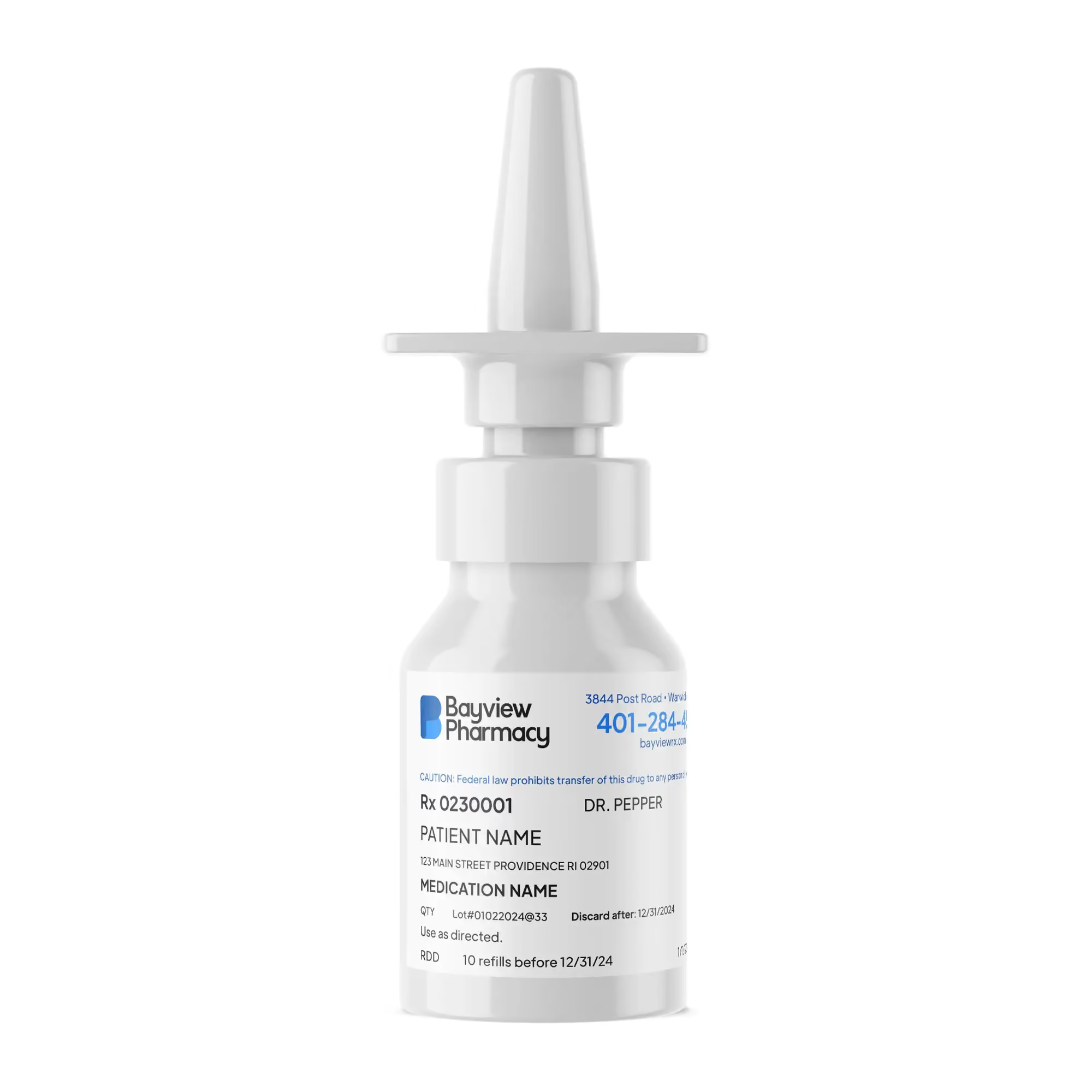


Caffeine 2.5% Nasal Spray is a liquid formulation delivered in a spray form, specifically designed for administration into the nasal cavity. This formulation provides targeted local or systemic effects through the nostrils, offering a rapid onset of action.
It is used to treat conditions such as migraine headaches and nasal congestion, leveraging the vasoconstrictive and stimulant properties of caffeine to alleviate symptoms effectively.

Licensed to fill prescriptions for patients in RI, MA, CT, NJ, NH, FL, ME and PA. New York patients are served on a limited basis while nonresident registration is pending.

Caffeine 2.5% Nasal Spray is a specially formulated liquid medication designed for administration into the nasal cavity using a spray mechanism. By delivering caffeine directly through the nasal passages, this formulation allows for rapid absorption into the bloodstream via the nasal mucosa's rich vascular network. This route can potentially lead to a quicker onset of action compared to traditional oral caffeine intake.
This nasal spray offers an alternative for individuals who require the stimulating effects of caffeine but may experience gastrointestinal discomfort with oral consumption or have difficulties swallowing pills. The nasal administration bypasses the digestive system, reducing the risk of stomach irritation and minimizing first-pass metabolism in the liver, which can enhance the bioavailability of caffeine.
For prescribers, Caffeine 2.5% Nasal Spray provides a novel method to deliver caffeine in a controlled manner. It can be particularly useful in situations where rapid alertness or wakefulness is desired. The precise dosing afforded by the nasal spray mechanism ensures consistent delivery of caffeine, which can be important for patients who need to manage their caffeine intake carefully.
Patients using this formulation should be aware of possible side effects associated with caffeine, including increased heart rate, jitteriness, insomnia, and potential nasal irritation or dryness due to the method of administration. It is important to use the nasal spray as directed and report any adverse effects to a healthcare professional promptly.
Before starting therapy with Caffeine 2.5% Nasal Spray, patients should inform their healthcare provider of all medications they are currently taking, as caffeine can interact with certain drugs, such as other stimulants or medications that affect heart rhythm. Additionally, individuals with conditions like hypertension, cardiovascular diseases, or anxiety disorders should use this medication with caution.
If you have any questions or need further information about Caffeine 2.5% Nasal Spray, please reach out to us.
Caffeine 2.5% Nasal Spray is a specialized formulation designed for intranasal administration, allowing for rapid absorption through the nasal mucosa. This method of delivery can provide both local and systemic effects, making it a versatile option for various therapeutic applications. However, like all medications, it is important to consider potential drug interactions that may affect its efficacy and safety.
Patients and prescribers should be aware that caffeine, as a central nervous system stimulant, can interact with a variety of medications. One of the primary concerns is its interaction with other central nervous system stimulants, such as amphetamines or methylphenidate, which may lead to excessive stimulation, resulting in increased heart rate, elevated blood pressure, and heightened anxiety. It is advisable to monitor patients closely if these medications are used concurrently.
Caffeine can also interact with medications that affect the cardiovascular system. For instance, it may potentiate the effects of beta-adrenergic agonists, leading to increased heart rate and blood pressure. Conversely, it may reduce the efficacy of beta-blockers, which are used to manage hypertension and other cardiovascular conditions. Patients on these medications should be monitored for any changes in their cardiovascular status.
Additionally, caffeine is metabolized by the cytochrome P450 1A2 enzyme. Medications that inhibit this enzyme, such as fluvoxamine or ciprofloxacin, can lead to increased caffeine levels in the body, potentially resulting in toxicity. Symptoms of caffeine toxicity include restlessness, insomnia, tremors, and palpitations. It is important to adjust the dosage of caffeine nasal spray or consider alternative therapies if patients are taking strong CYP1A2 inhibitors.
Furthermore, caffeine may interact with anticoagulants like warfarin. Although the interaction is not fully understood, there is a potential for caffeine to alter the metabolism of warfarin, affecting its anticoagulant effect. Patients on warfarin should have their INR levels monitored more frequently when starting or stopping caffeine nasal spray.
Patients should also be advised to limit their intake of other caffeine-containing products, such as coffee, tea, energy drinks, and certain over-the-counter medications, to avoid excessive caffeine consumption, which can exacerbate side effects and interactions.
For prescribers, it is crucial to review the patient's current medication list for potential interactions and to counsel patients on the signs of caffeine-related side effects. Adjustments to the treatment regimen may be necessary based on the patient's response and any concurrent medications.
If you have any questions or need further information regarding the use of Caffeine 2.5% Nasal Spray and its potential drug interactions, please reach out to us at Bayview Pharmacy. We are here to assist both patients and healthcare providers in ensuring safe and appropriate use of this formulation.
Caffeine 2.5% Nasal Spray is a specialized liquid formulation designed for intranasal administration, allowing for the direct delivery of caffeine into the nasal cavity. This method of delivery is particularly advantageous due to the rich vascularization of the nasal mucosa, which facilitates rapid absorption of caffeine into the bloodstream. By bypassing the gastrointestinal tract, the nasal spray offers a faster onset of action compared to oral caffeine consumption.
Upon administration, the caffeine molecules are absorbed through the nasal epithelium and enter the systemic circulation. This rapid absorption is beneficial for achieving prompt therapeutic effects, which can be crucial in managing conditions that require immediate attention. The nasal route also minimizes the first-pass metabolism effect seen with oral administration, potentially enhancing the bioavailability of caffeine and allowing for lower doses to achieve the desired effect.
Caffeine acts as a central nervous system stimulant, primarily by antagonizing adenosine receptors. Adenosine is a neurotransmitter that promotes sleep and relaxation, and by blocking its receptors, caffeine increases neuronal activity and the release of other neurotransmitters such as dopamine and norepinephrine. This results in increased alertness, improved concentration, and reduced perception of fatigue, which can be beneficial in treating conditions characterized by excessive sleepiness or fatigue.
In addition to its stimulating effects, caffeine has vasoconstrictive properties, which can be useful in managing headaches, particularly migraines. By constricting blood vessels, caffeine can reduce the dilation that often contributes to headache pain. The nasal spray formulation allows for targeted delivery, which may enhance its efficacy in treating headaches with a rapid onset of action.
For patients and prescribers considering Caffeine 2.5% Nasal Spray, it is important to understand the potential benefits and limitations of this formulation. While it offers rapid absorption and onset of action, individual responses may vary, and it is essential to use the spray as directed to avoid potential side effects such as insomnia, jitteriness, or increased heart rate. As with any medication, it is crucial to consider the patient's overall health status and any concurrent medications they may be taking.
If you have any questions or need further information about Caffeine 2.5% Nasal Spray, please reach out to us at Bayview Pharmacy. Our team of compounding pharmacists is here to assist you with any inquiries or concerns you may have regarding this formulation.
Caffeine 2.5% Nasal Spray is used to deliver caffeine directly through the nasal cavity, providing targeted local or systemic effects. It can be used for conditions where caffeine's stimulating effects are desired, such as enhancing alertness or reducing fatigue.
The nasal spray delivers caffeine directly into the nasal cavity, where it can be absorbed through the mucous membranes. This allows for rapid absorption into the bloodstream, potentially providing quicker effects compared to oral administration.
To use the nasal spray, insert the nozzle into one nostril while closing the other, and spray the recommended dose. Follow the specific instructions provided by your healthcare provider or pharmacist for optimal use.
Possible side effects may include nasal irritation, dryness, or a burning sensation. Systemic effects of caffeine, such as increased heart rate or jitteriness, may also occur. Consult your healthcare provider if you experience any adverse effects.
If you are pregnant or breastfeeding, consult your healthcare provider before using Caffeine 2.5% Nasal Spray to ensure it is safe for you and your baby.
The frequency of use will depend on your specific needs and the guidance of your healthcare provider. It is important to follow their instructions to avoid potential overuse or side effects.
Use in children should be determined by a healthcare provider. It is important to follow their guidance to ensure safe and appropriate use for younger individuals.
Store the nasal spray in a cool, dry place away from direct sunlight. Keep it out of reach of children and pets to prevent accidental use.
If you miss a dose, use it as soon as you remember. If it is close to the time for your next dose, skip the missed dose and resume your regular schedule. Do not double the dose to catch up.
Before using the nasal spray with other medications, consult your healthcare provider to ensure there are no potential interactions. They can provide guidance on safe use with other treatments you may be taking.
This formulation is compounded by Bayview Pharmacy on a prescriber's order for an individual patient. It is not an FDA-approved drug product, and the FDA has not evaluated it for safety, effectiveness, or manufacturing quality.
A valid prescription is required. Availability depends on Bayview's licensure in your state. This page is general information, not medical advice. Discuss your situation with a licensed healthcare provider.
Search by NCPDP 4106882, or by name and ZIP: Bayview Pharmacy, Warwick, RI 02886. Select it as the destination pharmacy and save it as a favorite. Click any value to copy it.
Compounded preparations have no NDC, so this formula will not appear in your EHR's drug search. Use your system's compound, non-formulary, or free-text prescription entry and name the preparation exactly as written in step 3. If your EHR forces you to pick a listed drug, pick the closest entry for the active ingredient and put the full formula in the prescription body (the Sig or directions field), not in Notes to Pharmacy.
Compounded preparations have no NDC and will not appear in your drug search. For EPCS to validate, select a drug entry your EHR recognizes as controlled, usually the bulk powder entry for the active ingredient (for example Ketamine (bulk) powder, not a branded product), then put the full formula from step 3 in the prescription body. A free-text entry that does not validate as controlled will be rejected by your EPCS module.
Quantity and directions are starting points for this dose form, not treatment recommendations. Dosing remains the prescriber's responsibility.
Transmit from your EHR. For this non-controlled preparation we also accept fax to (401) 284-4506 and phoned orders at (401) 284-4505. Order forms are on the formulation pages and in the prescriber portal.
Transmit with two-factor authentication through your EPCS-enabled EHR. No order form is offered for this preparation; e-prescribing guides for our controlled preparations are on the formulation pages.
Licensed to dispense in RI, MA, CT, NJ, NH, FL, ME, and PA; New York is served on a limited basis while nonresident registration is pending. Compounded preparations are not FDA-approved. A valid prescription is required. Full guide, including steps by EHR: How to e-prescribe to Bayview. Questions about this formula: call (401) 284-4505.
Inhale intranasally

