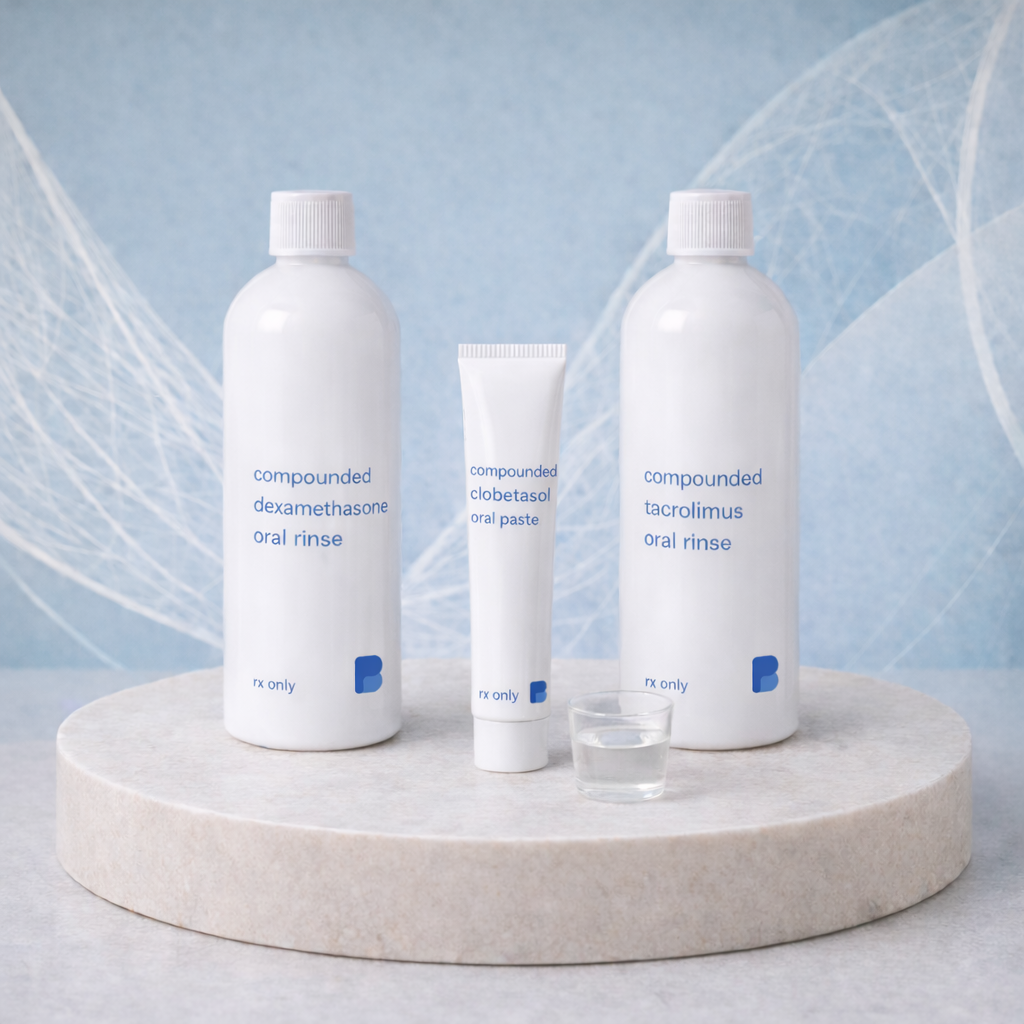
Check out our most popular compounded medications! Get Started

Tacrolimus is a calcineurin inhibitor immunosuppressant that Bayview compounds to a prescriber's order.
Tacrolimus is an immunosuppressive agent used to prevent organ rejection in kidney, liver, heart, and lung transplant recipients, and topical tacrolimus is FDA-approved for moderate to severe atopic dermatitis in patients who respond inadequately to other topical treatments.[1] As a calcineurin inhibitor, it binds the intracellular protein FKBP-12 and blocks calcineurin phosphatase activity, preventing T-cell activation and proliferation.[1] Off-label uses include graft-versus-host disease, rheumatoid arthritis, myasthenia gravis, and dermatologic conditions such as vitiligo and oral lichen planus.[1]
Topical tacrolimus has minimal systemic absorption, with blood concentrations often below quantifiable limits.[1] Tacrolimus labeling carries boxed warnings for increased risks of lymphoma, other malignancies, and serious infections.[1]
Bayview compounds tacrolimus preparations on a prescriber's order.
Compounded at Bayview
Patient guides for the preparations we make most often. Each one is compounded to order and requires a prescription.
For prescribers
Every preparation in our formulary that contains this ingredient. Strength, base and dose form are set by the prescription.
Tacrolimus works gradually rather than immediately, and burning or stinging in the first few days is common and usually fades as the skin settles. The approved ointment label directs treating for a defined stretch rather than continuously, and prescribers generally set a course length and a point to reassess. Ask your prescriber what result they are expecting and by when they will decide whether it is working — a fair question for any treatment, and particularly for the compounded routes, where the supporting evidence is limited.
Compounded tacrolimus starts at $122 for a 15 mL otic solution, and the price varies with the form, strength, base, and quantity. Tacrolimus is an expensive active ingredient, so the drug itself drives most of the cost rather than the base or the container size. Compounded preparations are cash-priced and are generally eligible for HSA and FSA cards. Call us at 401-284-4505 with the preparation and quantity your prescriber ordered and we will quote it before we make it.
Commercially, tacrolimus is manufactured as a topical ointment in 0.03% and 0.1%, as oral capsules and granules, and as an injection. Everything else — ear drops, rectal enemas, anhydrous gels, creams, foams, and shampoos — is compounded to a prescriber's order and used off-label, because no manufacturer makes tacrolimus in those forms. Compounded preparations are not FDA-approved.
Those are the two strengths of the commercially manufactured ointment. The FDA-approved label covers 0.03% for ages 2 through 15 and 0.1% for age 16 and older, and neither strength for children under 2. A higher percentage is not automatically the better choice, since more tacrolimus in contact with inflamed or broken skin also means more of it is absorbed. Compounded tacrolimus is most often prepared at 0.1%, with 0.2% used in otic solutions. Your prescriber selects the strength.
No. Tacrolimus ointment 0.03% and 0.1% is a commercially manufactured, FDA-approved product available through any pharmacy, so there is no reason to compound a version of it. Bayview compounds the forms no manufacturer makes: otic solutions, rectal enemas, anhydrous gels, creams, foams, and shampoos, plus prescriber-designed combinations such as tacrolimus with ketotifen. Those preparations are used off-label and are not FDA-approved.
Other salt forms of this molecule, and ingredients commonly compounded alongside it.
This page describes an active pharmaceutical ingredient, not a finished drug product. Bayview Pharmacy compounds preparations containing it only on a prescriber's order for an individual patient.
Compounded preparations are not FDA-approved, and the FDA has not evaluated them for safety, effectiveness, or manufacturing quality. Nothing on this page is a claim that any preparation is effective for any condition.
A valid prescription is required. Availability depends on Bayview's licensure in your state. This page is general information, not medical advice — discuss your situation with a licensed healthcare provider.
Our pharmacists work with prescribers to build preparations around a patient's dose, form and tolerances. Ask us what is possible with this ingredient.