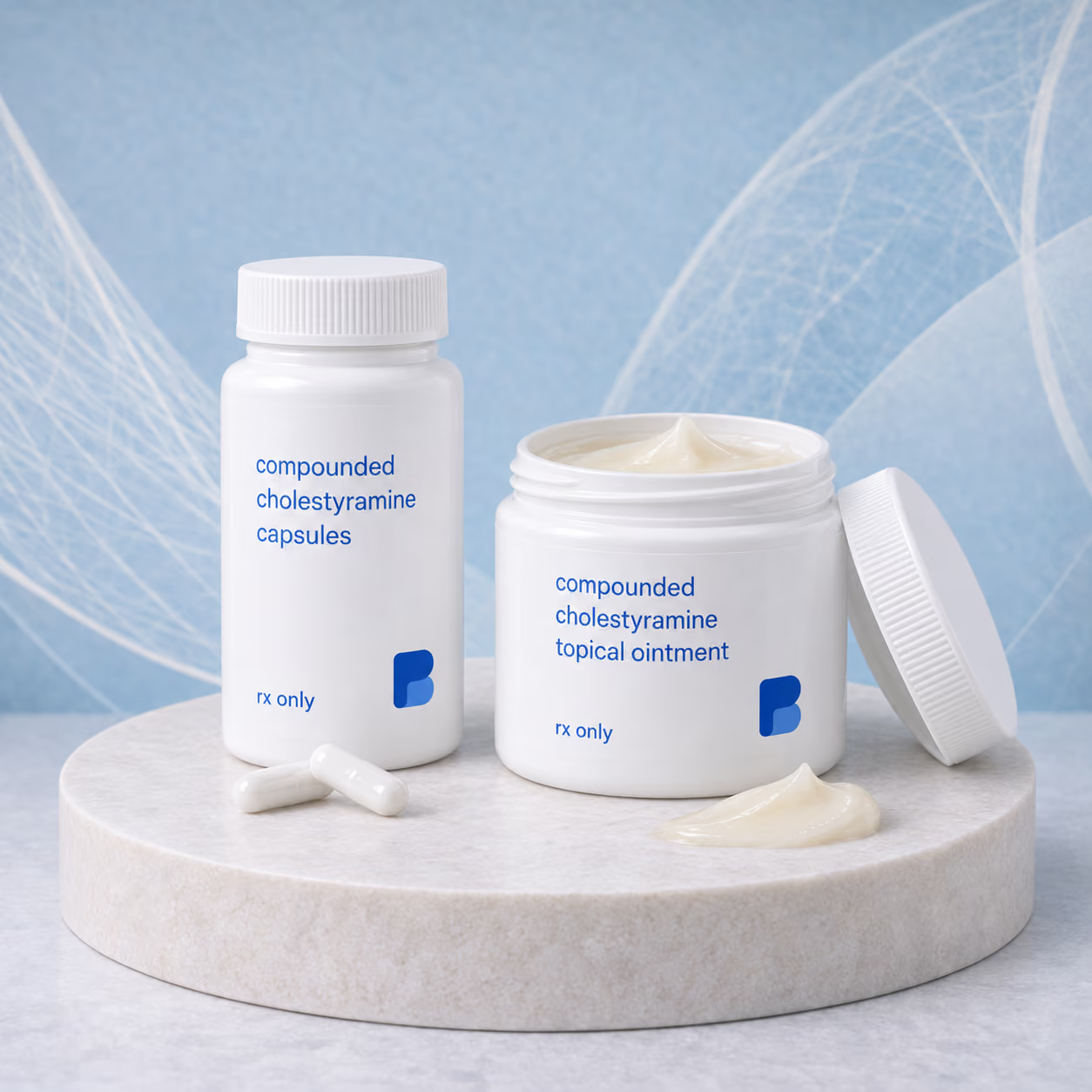
Cholestyramine ointment is a compounded skin preparation that puts cholestyramine resin, a drug that binds bile acids, into an ointment base. Prescribers order it for diaper-area, perianal, or peristomal skin that is irritated by stool rich in bile acids. No manufactured version exists, topical use is off-label, and the published evidence is limited to case reports and small series. Bayview prepares compounded cholestyramine ointment to a prescriber's order.
What is cholestyramine ointment?
Cholestyramine is a bile acid sequestrant: a large resin that does not dissolve in water and is not absorbed into the bloodstream. Taken by mouth, it binds bile acids in the intestine and carries them out in the stool (StatPearls, Cholestyramine Resin). The only FDA-approved product is a powder that is stirred into a drink.
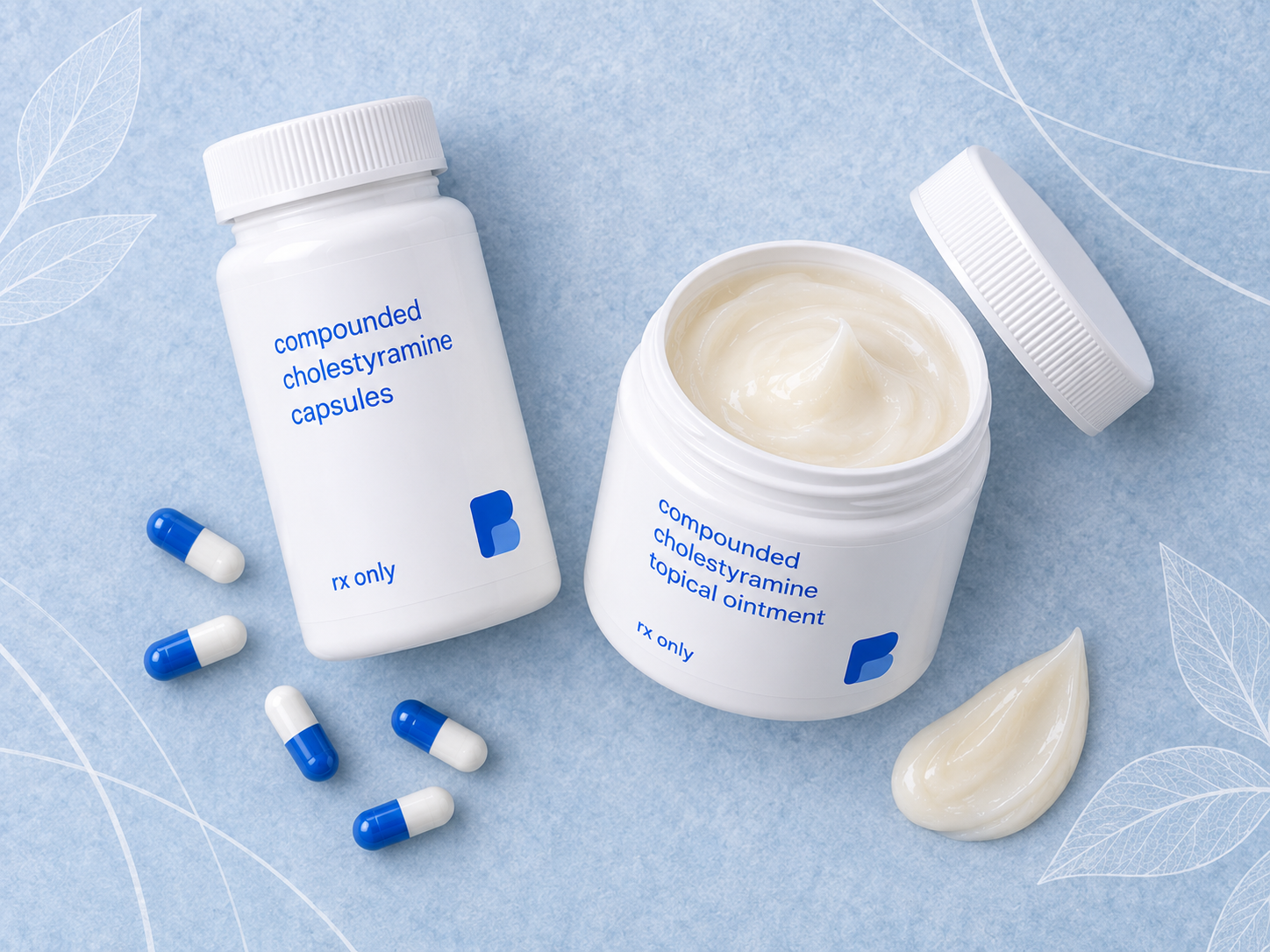
A cholestyramine ointment takes the same resin and mixes it into a base that is spread on the skin instead of swallowed. Bayview compounds it at 5%, 6.5%, and 10%, alone or combined with zinc oxide, or with zinc oxide and nystatin. Because no manufacturer makes a topical cholestyramine product, every one of these preparations is compounded, not FDA-approved, and applied off-label.
Why would a prescriber order cholestyramine cream for diaper rash?
Some skin irritation around the anus, in the diaper area, or around an ostomy is thought to come from stool that carries a heavy load of bile acids. That can happen after bowel surgery, with an ileostomy, or with conditions that speed stool through the gut. The idea behind a cholestyramine ointment is that the resin binds bile acids at the skin surface, the same thing it does inside the intestine.

Prescribers tend to reach for it when the usual barrier creams have already been tried. It is not a first product anyone buys at a store, and a pharmacy cannot sell it without a prescription.
For infants
When the patient is a baby, the ointment is prescribed by the child's own clinician, who decides whether it fits, which strength and base to use, and how often to apply it. This post gives no dosing for infants or anyone else. If you are caring for a child with a diaper rash that is not clearing, the first call is to the child's clinician.
What does the evidence show?
Very little, and it is worth being plain about that. The formulation page lists the published reports, and none of them is a controlled trial:
Case reports and small uncontrolled series can describe what happened to a handful of patients. They cannot say how often a preparation will do anything for the next patient. Your prescriber weighs that when deciding whether it fits your situation.
Cholestyramine and zinc oxide: what are the combinations?
Zinc oxide is the familiar white barrier found in many diaper creams. Some prescribers order it in the same preparation as cholestyramine, and some add nystatin, an antifungal, when yeast is suspected in a skin fold. The forms Bayview prepares, next to the manufactured oral product, are below.
Nystatin on its own is also prepared separately. Our compounded nystatin page covers its forms. A yeast or bacterial infection needs its own treatment, and your prescriber decides whether a combined product or separate products fit.
How is cholestyramine ointment applied?
Follow the directions on the prescription label. Dose and appropriateness are the prescriber's decisions, and the frequency and amount belong on the prescription, not in a blog post. The general points on the formulation page are:
Stop and contact the prescriber if the rash spreads, worsens, blisters, or shows signs of infection such as warmth, pus, or increasing pain.
What about cholestyramine for bile acid diarrhea, and cholestyramine capsules?
Taken by mouth, cholestyramine is FDA-approved to lower LDL cholesterol alongside diet and to relieve itching from a partial blockage of the bile ducts. Prescribers also use it off-label for bile acid diarrhea, for example after ileal disease or resection (StatPearls, Cholestyramine Resin). That oral use is a separate question from the ointment, and it rests on smaller studies and clinical experience rather than an FDA review.
The manufactured powder supplies 4 g of resin per dose and is always mixed with liquid. Bayview can also prepare a 400 mg capsule for a prescriber who wants a swallowed dose form. Ten 400 mg capsules equal the 4 g in one packet of powder, so a capsule order is written as a number of capsules per dose. For other medicines that need a different oral form, our custom oral suspensions page explains how liquid preparations are ordered.
Oral cholestyramine binds other medicines in the gut, so other oral medicines are taken at least 1 hour before or 4 to 6 hours after each dose unless your prescriber or pharmacist gives a different schedule. Long-term oral use can lower vitamins A, D, E, and K.
What side effects should you watch for?
On the skin, the ointments can cause local irritation or redness where they are applied. Report any rash that spreads or worsens. Do not use a preparation if you are allergic to cholestyramine or to any ingredient in it, including zinc oxide or nystatin in a combination.
By mouth, the label lists constipation as the most common problem, along with bloating, gas, stomach pain, heartburn, nausea, and diarrhea (DailyMed, Cholestyramine for Oral Suspension). Unusual bleeding, such as from the gums or rectum, can signal low vitamin K and needs a call to the prescriber.
How should cholestyramine ointment be stored?
Store it as directed on the label, at room temperature away from heat and moisture, in a tightly closed container. Keep it out of the reach of children and pets, which matters more than usual for a product kept at a changing table. Do not use it after the beyond-use date on the label, and ask the pharmacist how to discard what is left.
A compounded ointment is made for one named patient. Do not share it with another child or adult, even one with a similar-looking rash.
What does cholestyramine ointment cost?
Bayview's 2026 fills of cholestyramine have all been the 10% ointment, in 60 g, 120 g, and 240 g. The starting cash price is $169 for 60 g, and larger sizes cost more. Other strengths, combinations, and the capsule are quoted by request.
Compounded preparations are cash-priced and are generally eligible for HSA and FSA cards. Call 401-284-4505 with the preparation and quantity your prescriber ordered and we will quote it before we make it. Our post on whether compounding pharmacies take insurance explains payment options.
What Bayview compounds for this
On a prescriber's order, Bayview prepares cholestyramine as a 5%, 6.5%, or 10% topical ointment; zinc oxide 20% with cholestyramine 5% ointment; a cholestyramine 5% and zinc oxide 5% gel; a cholestyramine, nystatin, and zinc oxide ointment at 10% each; and 400 mg oral capsules. Each is prepared for one patient's prescription using USP 795 non-sterile compounding. Other preparations are listed in the compounded medications catalog.
Talk to your prescriber
If a diaper-area, perianal, or peristomal rash has not settled with the usual barrier products, ask the prescriber following it whether a cholestyramine ointment fits. If they write one, they can send it to Bayview Pharmacy, and we ship to patients in the states where Bayview is licensed, listed on our FAQ page. For how mail-order compounding compares with a local pharmacy, see compounding pharmacy near me.
Frequently asked questions
How much does compounded cholestyramine cost?
Pricing depends on the strength, the form, and the quantity your prescriber orders. Where the manufactured powder fits the order, that is what we dispense, and it may cost less. Compounded preparations are cash-priced and are generally eligible for HSA and FSA cards. Call 401-284-4505 with the preparation and quantity your prescriber ordered and we will quote it before we make it.
Does cholestyramine cause vitamin deficiency?
It can with long-term use. Because cholestyramine binds bile acids, it can reduce absorption of the fat-soluble vitamins A, D, E, and K. Your prescriber may recommend vitamin supplements, taken at a different time of day from cholestyramine, and may check blood tests such as a clotting test if you also take warfarin.
What strengths of cholestyramine ointment does Bayview compound?
Bayview compounds cholestyramine 5%, 6.5%, and 10% topical ointment, zinc oxide 20% with cholestyramine 5% ointment, cholestyramine 5% with zinc oxide 5% gel, and cholestyramine 10% with nystatin 10% and zinc oxide 10% ointment, plus custom strengths your prescriber orders. These are compounded preparations and are not FDA-approved.
What is cholestyramine ointment used for?
Cholestyramine ointment is a compounded, off-label preparation. Prescribers have used it on diaper-area, perianal, and ostomy skin that is irritated by stool rich in bile acids, on the idea that the resin binds those bile acids on the skin. The evidence is limited to case reports and small uncontrolled series, and there are no controlled trials. It is not FDA-approved, and your prescriber decides whether it fits.
What are the side effects of cholestyramine?
Constipation is the most common side effect of oral cholestyramine. Bloating, gas, stomach pain, heartburn, nausea, and diarrhea can also happen. Long-term use can lower vitamins A, D, E, and K, and low vitamin K can cause bleeding, such as from the gums or rectum. Call your prescriber about severe constipation, severe stomach pain, or unusual bleeding.
How far apart should I take cholestyramine and my other medicines?
Cholestyramine can bind other medicines in the gut and reduce how much you absorb. The prescribing information advises taking other oral medicines at least 1 hour before or 4 to 6 hours after cholestyramine. This matters most for warfarin, digitalis, thyroid medicine, and similar medicines. Ask your pharmacist to help you build a daily schedule, and follow any different timing your prescriber gives you.
Why would my prescriber order cholestyramine capsules instead of the powder?
The manufactured product is only a powder that is stirred into a drink. Some prescribers prefer a capsule for a patient who wants a swallowed dose form. Bayview compounds 400 mg capsules for those orders. Each capsule holds far less resin than a 4 g scoop or packet of powder, so ten capsules equal one powder dose, and your prescriber sets how many to take. Compounded capsules are not FDA-approved. When the powder fits the order, Bayview dispenses the powder.
What is cholestyramine used for?
Cholestyramine is a bile acid sequestrant. Taken by mouth, it is FDA-approved as an addition to diet to lower high cholesterol and to relieve itching caused by a partial blockage of the bile ducts. Prescribers also use it off-label for diarrhea caused by bile acids, for example after disease or surgery of the last part of the small intestine. Your prescriber decides whether it is appropriate for you.
Can I use an HSA or FSA card for compounded medications?
Yes. We accept HSA and FSA cards as well as credit cards, and compounded prescriptions are generally an eligible expense because they are dispensed against a valid prescription. Plan rules vary, so keep your receipt in case your administrator asks for documentation.
Can cholestyramine ointment be used for a baby's diaper rash?
Only if the child's own clinician prescribes it. Cholestyramine ointment has been reported in a small number of infant case reports, but it is a compounded, off-label preparation with no controlled trials behind it. The clinician decides whether it fits, which strength and base to use, and how often to apply it. Call the child's clinician about any diaper rash that is not clearing.
What is the evidence for cholestyramine ointment?
It is limited to case reports and small uncontrolled series: 8 patients with irritation around enterostomies (1976), 6 patients with perianal irritation after ileoanal anastomosis (1987), and two single-infant case reports (1996 and 2003). No controlled trials were found. These reports describe a handful of patients and cannot predict what a preparation will do for anyone else. Your prescriber weighs that when deciding.
Why is zinc oxide combined with cholestyramine?
Zinc oxide is a familiar skin barrier used in many diaper creams. Some prescribers order it in the same preparation as cholestyramine so one product carries both ingredients. Bayview compounds zinc oxide 20% with cholestyramine 5% ointment, a 5% and 5% gel, and a combination with nystatin at 10% each. All are compounded, not FDA-approved, and used off-label.
Can cholestyramine ointment be used on skin around an ostomy?
Prescribers have ordered it for peristomal skin irritation, and the earliest published report described 8 patients with irritation around enterostomies. That use is off-label and the evidence is limited to small reports. Your prescriber or ostomy nurse decides whether it fits and how it is applied around your appliance. Report any rash that spreads, blisters, or looks infected.
Is cholestyramine ointment sold over the counter?
No. There is no manufactured cholestyramine ointment, over the counter or by prescription. It is compounded by a pharmacy for one named patient on a prescriber's order. Bayview prepares it at 5%, 6.5%, and 10%, alone or with zinc oxide or with zinc oxide and nystatin. Compounded preparations are not FDA-approved, and topical use of cholestyramine is off-label.
What Bayview compounds for this
Important: Compounded medications are prepared to a prescriber's order for an individual patient. They are not FDA-approved, and the FDA has not evaluated them for safety, effectiveness, or manufacturing quality. This article is educational and is not a substitute for advice from your prescriber or pharmacist.
This preparation contains a controlled substance. Controlled-substance prescriptions carry refill limits, must be e-prescribed, and can only be shipped to states where Bayview holds the required licensure.
Uses discussed here may be off-label, meaning they are not part of any FDA-approved labeling. Off-label use is a decision for you and your prescriber, based on the available evidence.
Veterinary preparations are compounded to a veterinarian's order for a specific animal and are not FDA-approved animal drugs. Never give a compounded human medication to an animal without veterinary direction.
Compounded prescriptions are paid for directly rather than billed through insurance. Most are HSA/FSA-eligible, and many patients submit the receipt to their plan for possible reimbursement. Pricing depends on the strength, dose form and quantity your prescriber orders. Read more about cost and insurance.
Bayview's 2026 cholestyramine fills have all been the 10% ointment. The starting cash price is $169 for 60 g, and the 120 g and 240 g sizes cost more. Compounded preparations are cash-priced and are generally eligible for HSA and FSA cards. Call 401-284-4505 with your prescription details for a quote before it is made.
Bayview Pharmacy is a compounding pharmacy in Warwick, Rhode Island, licensed to fill and ship compounded prescriptions for patients in Rhode Island, Massachusetts, Connecticut, New Jersey, New Hampshire, Florida, Maine and Pennsylvania. Prescriptions for New York patients are filled on a limited basis, and controlled substances are not shipped to New York addresses. See every state we ship to.
Related reading