
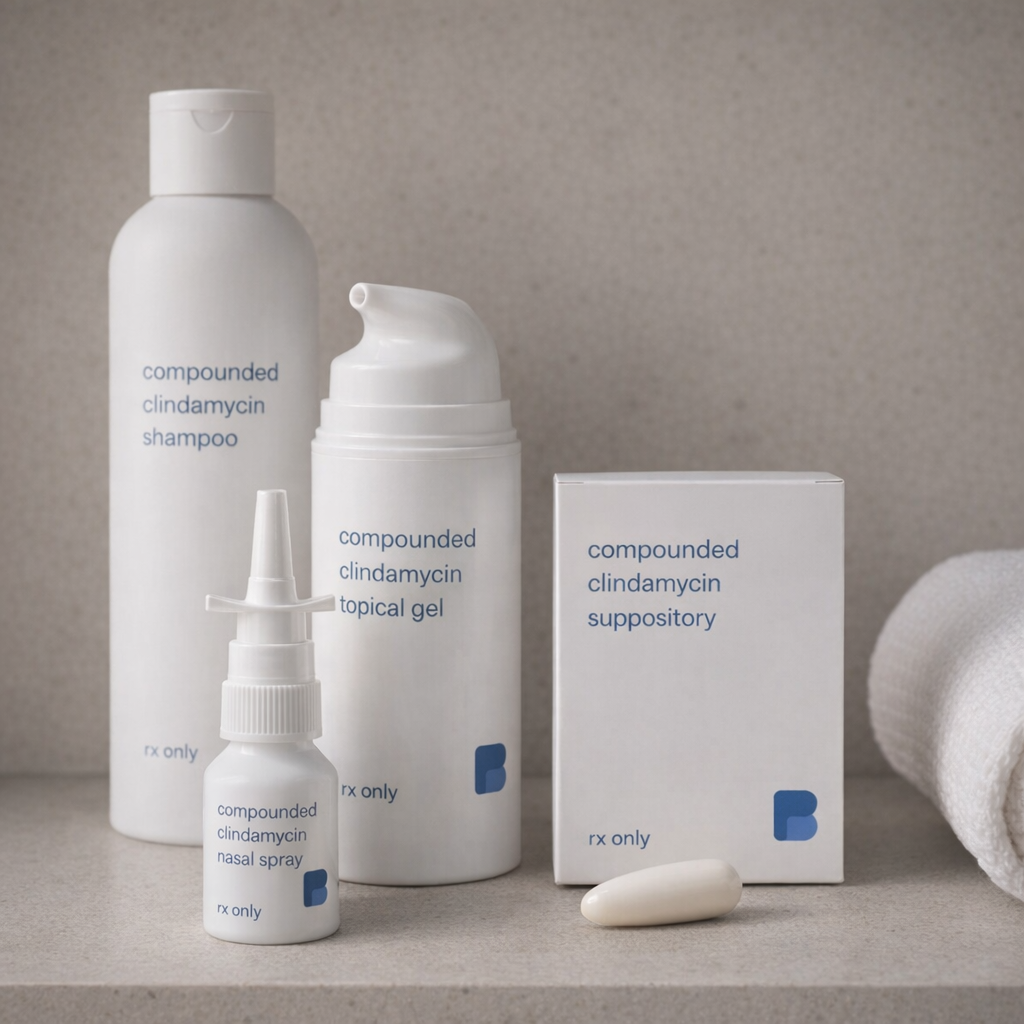
Clindamycin is an antibiotic that blocks bacteria from making the proteins they need to grow. It is used by mouth, on the skin and in the vagina, and manufactured products cover capsules, an oral solution, 1% topicals and vaginal products.
Compounding covers forms that are not manufactured, such as a shampoo, a nasal spray and suppositories, and combinations in one preparation. Bayview prepares clindamycin on a prescriber's order; compounded clindamycin is not FDA-approved.
What is the difference between clindamycin HCl and phosphate?
They are two salt forms of the same antibiotic. Clindamycin hydrochloride is used in capsules taken by mouth. Clindamycin phosphate is used on the skin and in the vagina; a 1.19% clindamycin phosphate gel contains about 1% clindamycin. Your prescriber specifies which one to use.
Two salts of one antibiotic
Clindamycin hydrochloride
Used in capsules taken by mouth.
Clindamycin phosphate
Used on the skin and in the vagina. A 1.19% phosphate gel holds about 1% clindamycin.
Which forms does Bayview compound?

| Route | Formulary preparations |
|---|---|
| Oral | 150 mg capsules (gluten free); HCl 40.72 mg capsules |
| Skin and scalp | Phosphate 1.19% gel; 1% shampoo |
| Vaginal and rectal | Phosphate 2.38% vaginal gel; 150 mg vaginal and rectal suppositories |
| Nose | 1% nasal spray; 0.6 mg/mL nasal irrigation liquid |
Many acne combinations are also prepared; see our acne treatments page. A prescriber may also order clindamycin compounded in a base without alcohol or another ingredient. Forms are listed for education only and are not a statement that any option is better or more effective.
How is each form used?
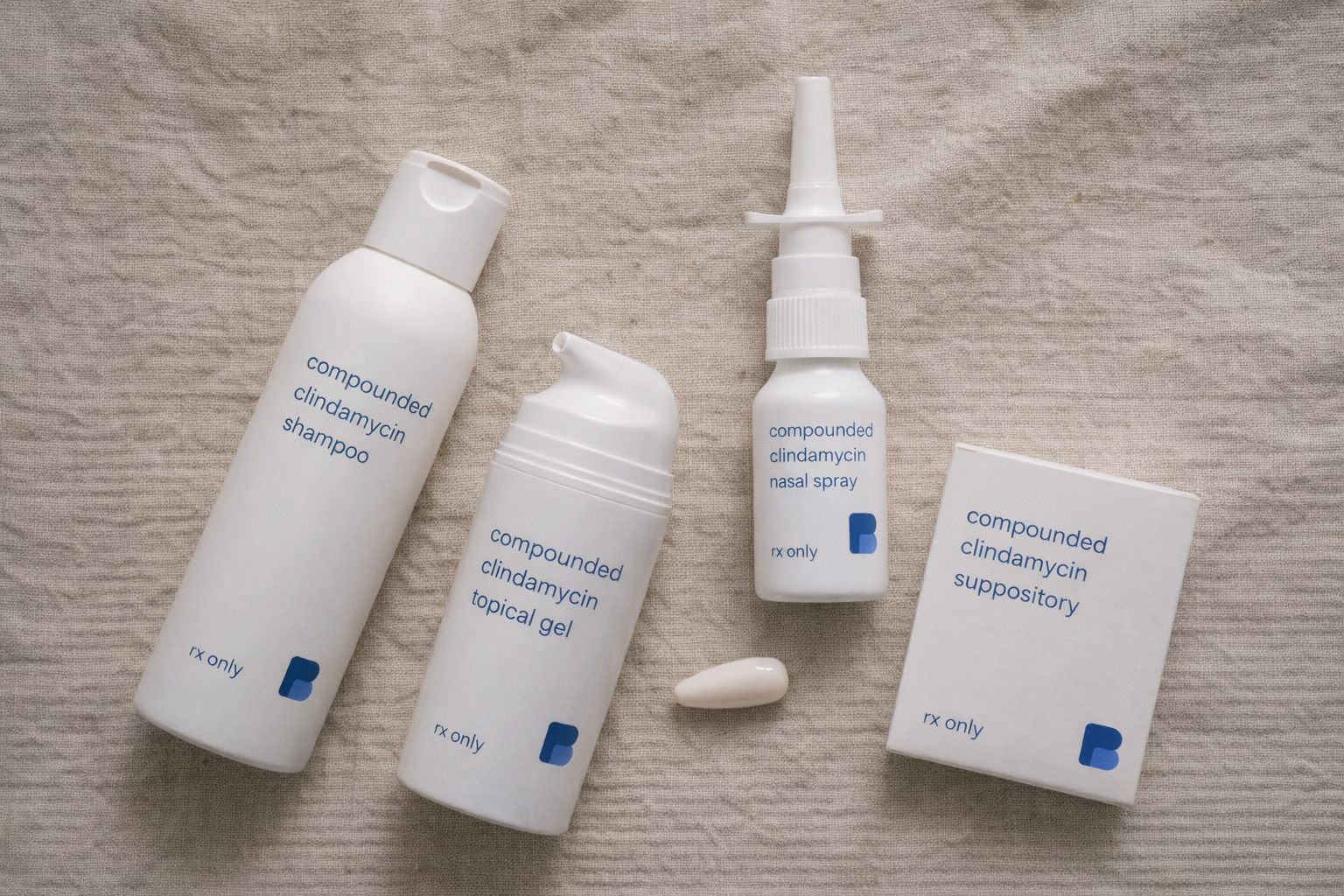
Follow your label exactly and finish the course your prescriber sets. Capsules are taken with a full glass of water. Topicals and shampoo are applied to the skin or scalp, suppositories are inserted, and nasal preparations are used in the nose as directed. Our post on how to use a suppository covers that form.
What is the C. difficile warning?

Oral clindamycin carries an FDA boxed warning for Clostridioides difficile infection, which ranges from mild diarrhea to severe or fatal colitis and can start up to two months after treatment ends. Call your prescriber right away about watery or bloody diarrhea or stomach cramps.
Other side effects depend on the form: nausea, diarrhea or a metallic taste with capsules; dryness, peeling or irritation with topicals; vaginal itching or discharge with vaginal forms. Get care for severe or bloody diarrhea, a rash, blistering or signs of an allergic reaction.
Do not use clindamycin if you are allergic to clindamycin or lincomycin. Tell your prescriber about past colitis or bowel disease, liver or kidney disease, pregnancy or breastfeeding, and every medication you take. Store it as your label directs and do not use it past the beyond-use date.
- Watery or bloody diarrhea or stomach cramps, even up to two months after treatment ends
- A rash or blistering
- Signs of an allergic reaction
Frequently asked questions
What is clindamycin used for?
Clindamycin is an antibiotic. Manufactured forms are FDA-approved for certain serious bacterial infections, acne and bacterial vaginosis. Your prescriber decides whether a compounded form is right for you.
What is the difference between clindamycin HCl and clindamycin phosphate?
They are two salt forms. Clindamycin HCl is used in capsules taken by mouth, and clindamycin phosphate is used on the skin and in the vagina. Your prescriber specifies which one you need.
Which clindamycin forms are compounded?
Bayview compounds clindamycin capsules, rectal and vaginal suppositories, a vaginal gel, a topical gel, a shampoo, a nasal spray and a nasal rinse, plus acne combinations.
Is clindamycin a penicillin?
No. Clindamycin is a lincosamide, a different class of antibiotic. Prescribers sometimes choose it for people who cannot take penicillin, but tell your prescriber about any antibiotic allergy.
What should I watch for while using clindamycin?
Call your prescriber right away about watery or bloody diarrhea or stomach cramps, during treatment or up to two months after. Oral clindamycin carries an FDA boxed warning for this risk.
Are compounded medications FDA-approved?
Compounded medications are not FDA-approved. They're prepared by a licensed pharmacy pursuant to a valid prescription for an individual patient, under USP standards. The FDA does not review compounded medications for safety or effectiveness.
Can you fill a prescription from my own provider?
Yes. Your provider can send your prescription to Bayview Pharmacy by e-prescribe, fax, or phone, or you can transfer an existing prescription from another pharmacy.
Do I need a prescription?
Yes. All of our medications require a valid prescription from a licensed provider. We're a dispensing and compounding pharmacy, so we don't provide consultations or write prescriptions. If you don't have one yet, you'll need to see a provider first.
How does shipping work?
Once your prescription is verified, we prepare your medication and ship it discreetly in plain packaging either via UPS or USPS. A pharmacy technician confirms the details with you before it goes out, and we're available if you have any questions.
How do providers send a prescription to Bayview?
Providers can submit a prescription three ways:
- E-prescribe: Search Bayview Pharmacy, Warwick, RI (NCPDP 4106882) in your EHR. For compounds, use the compound, custom, or free-text option and include the full formulation, strength, quantity, refills, and directions.
- Fax: Send a signed order to 401-284-4506 (alt. 401-210-2757) with patient and prescriber details, medication, quantity, refills, directions, signature, and date.
- Phone: Call 401-284-4505 to submit, clarify, or coordinate refills.
A valid prescription is required, and compounded medications are not FDA-approved.
How do refills and automatic refills work?
Refills are coordinated with your prescriber and your prescription. You can request a refill through our website or by calling us, and we'll handle the rest as long as you have refills remaining on a valid prescription. You can also opt into automatic refills on non-controlled substances, with no need to worry about running out of your medication. We can either ship it to you automatically, or ready for pickup.
What is compounding?
Compounding is the practice of preparing a medication tailored to an individual patient's prescription. Instead of a mass-produced product, a compounding pharmacy makes the medication to the specific strength, form, or combination your provider orders.
Examples on this site include medications compounded as liquids for people who cannot swallow pills, thyroid capsules made to a T3/T4 ratio no manufactured product offers, and all-purpose nipple ointment, which combines three actives that are not sold together commercially.
What Bayview compounds for this
Important: Compounded medications are prepared to a prescriber's order for an individual patient. They are not FDA-approved, and the FDA has not evaluated them for safety, effectiveness, or manufacturing quality. This article is educational and is not a substitute for advice from your prescriber or pharmacist.
This preparation contains a controlled substance. Controlled-substance prescriptions carry refill limits, must be e-prescribed, and can only be shipped to states where Bayview holds the required licensure.
Uses discussed here may be off-label, meaning they are not part of any FDA-approved labeling. Off-label use is a decision for you and your prescriber, based on the available evidence.
Veterinary preparations are compounded to a veterinarian's order for a specific animal and are not FDA-approved animal drugs. Never give a compounded human medication to an animal without veterinary direction.
Compounded prescriptions are paid for directly rather than billed through insurance. Most are HSA/FSA-eligible, and many patients submit the receipt to their plan for possible reimbursement. Pricing depends on the strength, dose form and quantity your prescriber orders. Read more about cost and insurance.
The starting cash price for compounded clindamycin at Bayview is $104 for 15 capsules, and the final price depends on the form, strength and quantity on the prescription. Compounded prescriptions at Bayview are priced as cash prescriptions, and coverage varies by plan.
Bayview Pharmacy is a compounding pharmacy in Warwick, Rhode Island, licensed to fill and ship compounded prescriptions for patients in Rhode Island, Massachusetts, Connecticut, New Jersey, New Hampshire, Florida, Maine, Pennsylvania and Wisconsin. Prescriptions for New York patients are filled on a limited basis, and controlled substances are not shipped to New York addresses. See every state we ship to.
Related reading