The dermatology literature does not describe hydroquinone as a fast agent. Published sources on melasma describe treatment courses measured in weeks to a few months before pigment change is assessed, and the American Academy of Dermatology tells patients that improvement in melasma usually takes three to twelve months. Prescribers commonly write hydroquinone in defined cycles, often around 8 to 12 weeks, with a planned break afterward, and how long you use it is your prescriber's decision, not a rule you set yourself.
That cycling pattern is the reason many patients end up with a compounded preparation rather than a single off-the-shelf product. Hydroquinone brightening blends are compounded prescription gels and creams prepared to a prescriber's exact percentages, which lets the prescriber pick the hydroquinone concentration, add or leave out partner actives such as kojic acid, tranexamic acid, niacinamide, azelaic acid, or tretinoin, and drop a corticosteroid out of the formula for the maintenance interval between cycles. Compounded preparations are not FDA-approved, and a valid prescription is required.
How long does it take for hydroquinone to work?
There is no single number, and anyone quoting you one is overstating what the literature supports. What published sources describe is a timeline shaped like this:
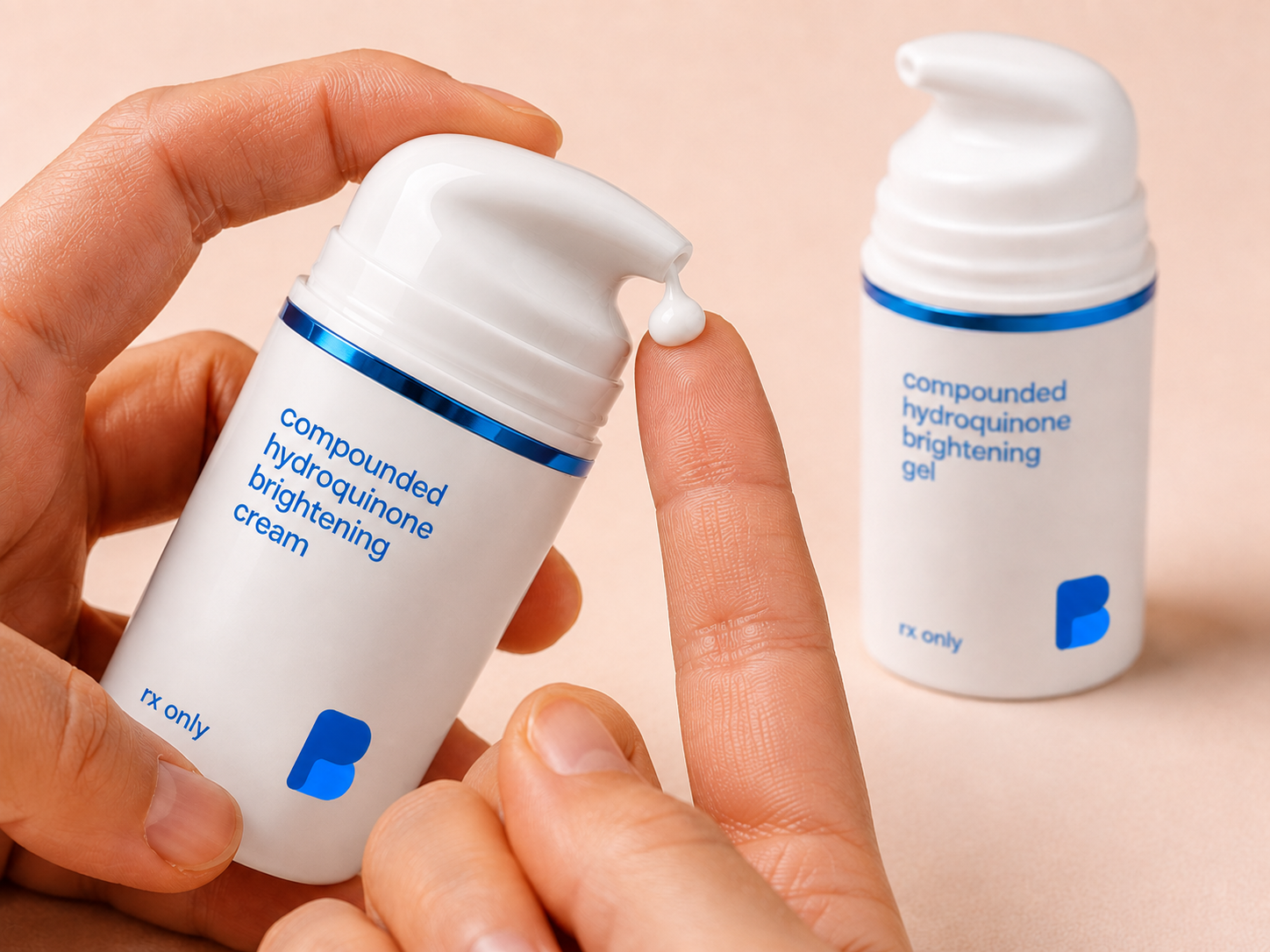
- The first few weeks are usually about tolerance, not pigment. Stinging, dryness, redness, and peeling are the common early effects, and they are more likely in blends containing tretinoin.
- Assessment of pigment change is typically made after a course of several weeks to a few months, which is why prescribers write cycles of roughly 8 to 12 weeks and then reassess.
- For melasma specifically, the AAD describes improvement as usually taking three to twelve months, and melasma as a chronic, relapsing condition rather than something that is finished at the end of one cycle.
Two things stretch that timeline. The first is sun exposure, which drives pigment production directly and is covered below. The second is irritation, which can itself trigger post-inflammatory hyperpigmentation, so a preparation that is inflaming your skin can make an area look darker rather than lighter. That is a reason to contact your prescriber, not to push through.
Does hydroquinone work?
Asked about the drug rather than about any particular compounded preparation: hydroquinone has one of the longer track records in pigment disorders, and StatPearls describes the evidence for hydroquinone in melasma as reasonably strong, with combination therapy generally outperforming single agents and triple-combination creams frequently used as first-line induction therapy. Hydroquinone alone is described as less effective than Kligman-type regimens.
Limits sit alongside that. The literature does not describe hydroquinone as curative for melasma, and pigment commonly returns without daily sun protection and a maintenance plan. None of the above is a statement about a compounded blend. Compounded preparations are not FDA-approved, are not reviewed by FDA for safety or effectiveness, and are not studied as products.
How does hydroquinone work?
Skin color comes from melanin, a pigment made inside cells called melanocytes. The critical step is an enzyme called tyrosinase, which converts the amino acid tyrosine into melanin. Hydroquinone inhibits tyrosinase, so less pigment is produced in the treated area (StatPearls, Hydroquinone). It acts where it is applied, which is why prescribers usually direct it onto the darker patches rather than across the whole face.
Partner ingredients approach the same problem from other angles. Kojic acid and azelaic acid also inhibit tyrosinase. Niacinamide acts on the transfer of finished pigment from melanocytes into surrounding skin cells. Tranexamic acid is used in melasma for its effect on the vascular and inflammatory signaling around pigment production. Tretinoin speeds skin cell turnover and improves how well the other actives penetrate. A low-potency corticosteroid such as hydrocortisone 1% blunts the irritation the other actives cause, which matters because irritation feeds pigment.
Hydroquinone strengths and their FDA status
The strength conversation changed in 2020. Under the CARES Act, FDA eliminated the over-the-counter monograph route for skin-lightening products, and FDA states that manufacturers and distributors of unapproved OTC hydroquinone products were required to remove them from the market effective September 23, 2020. In April 2022 FDA followed with warning letters to companies still selling unapproved OTC hydroquinone products, citing risks including rashes, facial swelling, and ochronosis.

| Strength | Availability | FDA status |
|---|---|---|
| 2% | Formerly OTC fade creams | Not legally marketed |
| 4%, fixed combination | Rx | FDA-approved (Tri-Luma) |
| 4% to 12%, compounded | Rx, compounded to order | Not FDA-approved |
Tri-Luma is fluocinolone acetonide 0.01% with hydroquinone 4% and tretinoin 0.05%, labeled for short-term treatment of moderate to severe facial melasma and not for maintenance, while a compounded blend is made in a gel or cream to the prescriber's own percentages and is not reviewed by FDA for safety or effectiveness. Higher concentration is not simply more of a good thing. The risk of exogenous ochronosis rises with both duration and concentration, so strength selection is a prescriber judgment, not a preference.
How long to use hydroquinone
Prescribers generally write hydroquinone as a course rather than as an open-ended product. Cycles of roughly 8 to 12 weeks followed by a break, or a switch to a steroid-free or hydroquinone-free maintenance preparation, are the pattern described in clinical practice. The FDA-approved combination product carries the same logic in its labeling: it is indicated for short-term treatment and is not indicated for maintenance.
How long can you use hydroquinone?
The limiting factor is exogenous ochronosis, a gradual blue-black or gray-blue darkening of the treated skin that is difficult to treat and may be permanent. It is uncommon, but the risk is higher with long-term or high-concentration use and in people with darker skin tones. Cycling and planned breaks are commonly recommended by dermatologists to limit that risk. If treated skin starts turning darker, gray, or blue-black instead of lighter, stop and contact your prescriber.
Blends containing a corticosteroid carry a second reason for defined cycles. Continuous facial use of a topical steroid can cause skin thinning, visible broken capillaries, and steroid-induced rosacea or acne-like eruptions. Do not extend, stop, or restart a cycle on your own. Your prescriber sets the length, the break, and what you use in between.
How to use hydroquinone and tretinoin together
The pairing is not improvised. The classic three-ingredient combination of hydroquinone plus tretinoin plus a corticosteroid is known as the Kligman formula, and it is the pattern the FDA-approved product Tri-Luma follows. Tretinoin contributes turnover and penetration, hydroquinone inhibits pigment production, and the steroid holds down the irritation the first two cause. That historical combination is the basis for most of the tretinoin-containing blends a prescriber orders today, with the difference that a compounded blend is made to that prescriber's chosen percentages rather than one fixed set.

The table below describes patterns prescribers commonly use. It is not a set of instructions, and it does not describe your prescription. Follow the directions on your label.
| Pattern | Timing | Prescriber rationale |
|---|---|---|
| One combined blend | Thin layer at bedtime | One step, fixed ratio |
| Split by time of day | Hydroquinone AM, tretinoin PM | Actives kept apart |
| Alternate-night tretinoin | Every second or third night | Used when irritation appears |
| Cycle then maintenance | After the hydroquinone cycle | Steroid-free maintenance gel |
Combined blends usually contain hydrocortisone as well, tretinoin breaks down in light so anything containing it goes on at night, and keeping the two actives in separate products lets a prescriber adjust one without remaking the other.
Can I use hydroquinone with tretinoin every day?
That is a prescriber decision, and the answer depends on the strengths involved, whether the blend contains a steroid, how your skin is tolerating the course, and where you are in a cycle. Nightly use of a combined blend during a defined cycle is a documented pattern, and so is spacing tretinoin out because of irritation. What is not a documented pattern is indefinite daily use with no break, which is exactly the scenario the ochronosis and topical-steroid warnings are about. Ask the prescriber who wrote the prescription.
Sun protection is part of the plan, not an extra
Sunlight drives the pigment production these preparations are aimed at. The standard advice in the dermatology literature, including the AAD's patient guidance on melasma, is daily broad-spectrum sunscreen SPF 30 or higher, used year round, along with hats and shade. Tinted sunscreens containing iron oxides are described as also blocking visible light, a driver in melasma. Without consistent photoprotection, pigment commonly returns. Our melasma and dark spots page covers the condition itself in more detail.
What Bayview compounds for this
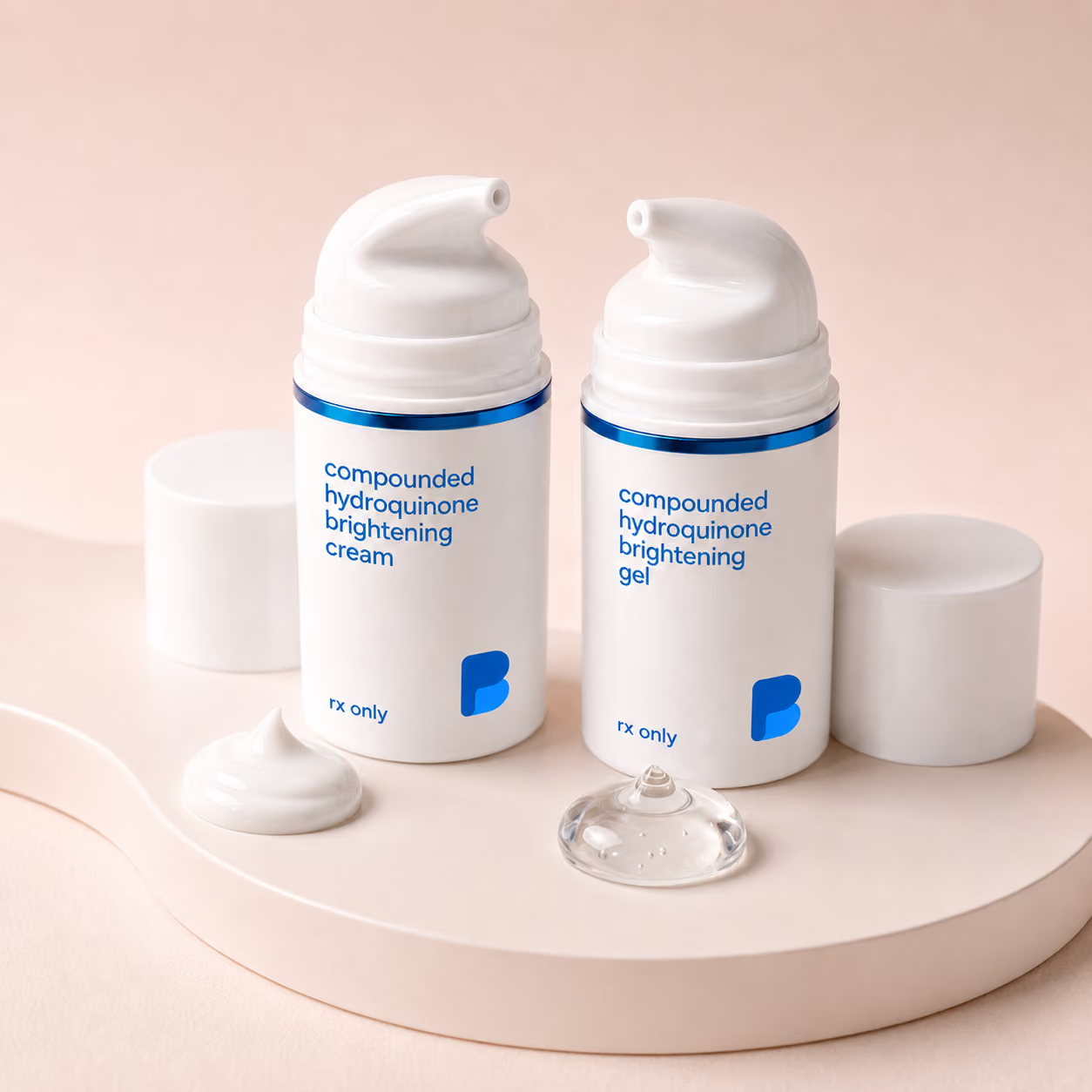
On a prescriber's order, Bayview prepares hydroquinone brightening blends as topical gels and creams in 30 g and 60 g. Blends dispensed include hydroquinone 10% with kojic acid 6%; hydroquinone 8% with kojic acid 6% and tranexamic acid 3%; hydroquinone 4% with azelaic acid 10%, niacinamide 4%, and kojic acid 2%; hydroquinone 10% with hydrocortisone 1% and tretinoin 0.025%; hydroquinone 7% with hydrocortisone 1% and tretinoin 0.05%; and hydroquinone 12% with hydrocortisone 1%, kojic acid 6%, and niacinamide 2%, with or without tretinoin 0.05%. Custom strengths and combinations are prepared as written. These are non-sterile preparations made under USP 795 non-sterile compounding, dispensed in opaque, air-limiting packaging because hydroquinone oxidizes and turns brown in air and light. Other dermatology preparations are listed in our compounded medications catalog.
Talk to your prescriber
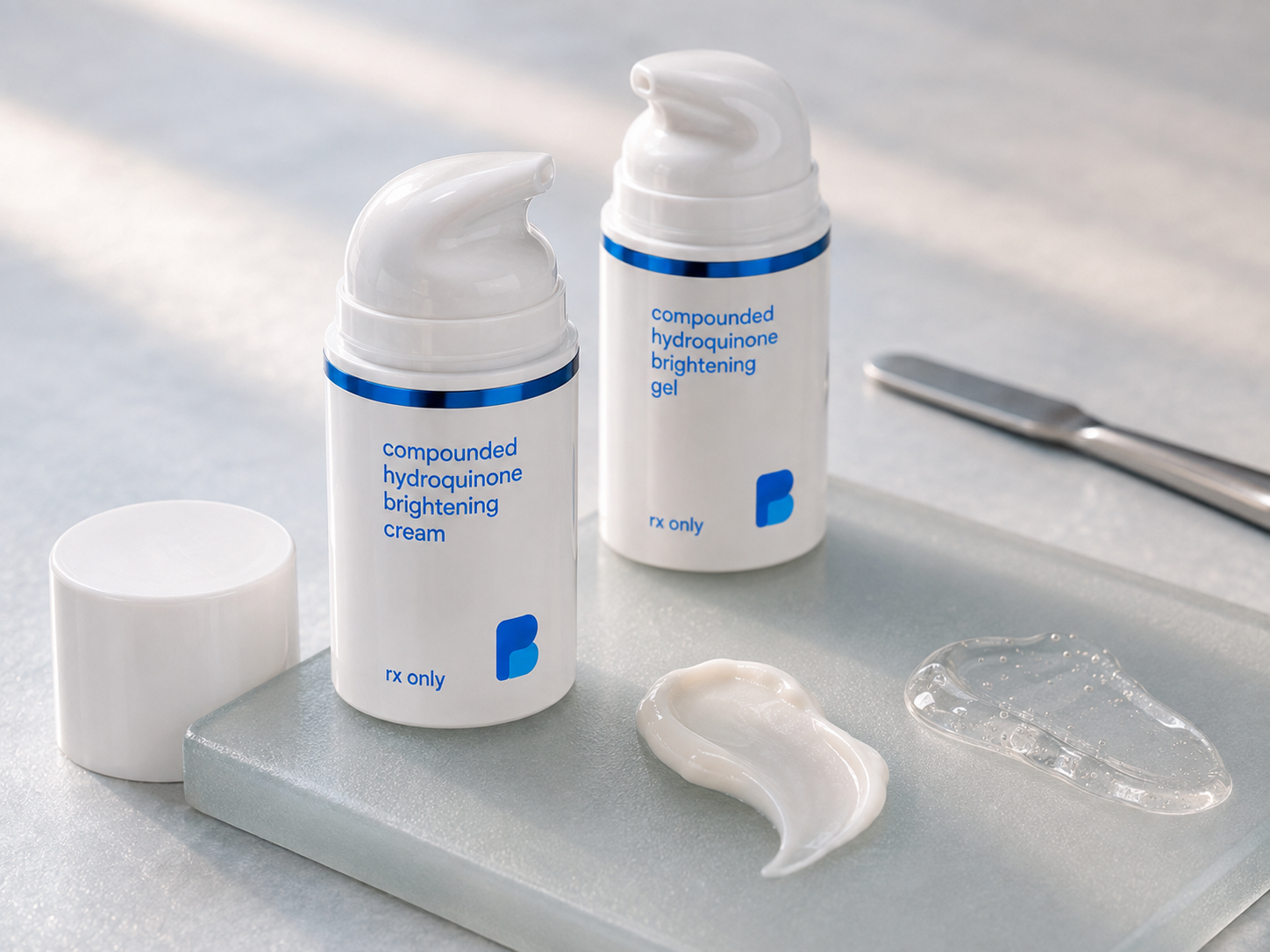
If you want a hydroquinone blend, or want the steroid taken out of one for a maintenance phase, that conversation is with your dermatologist or prescriber. They decide whether hydroquinone is appropriate for you, at what concentration, in what combination, and for how long. Once they send the prescription to Bayview, by e-prescribe or fax, we prepare it and can ship to the states where Bayview is licensed, which are listed in our FAQ. A Bayview pharmacist can answer questions about your prescription.
Compounded hydroquinone brightening blends start at $149 for 60 g, with the final price depending on how many actives are in the blend, their strengths, and the size. These are cash-priced rather than billed through insurance, and are generally eligible for HSA and FSA cards; our post on whether compounding pharmacies take insurance explains why. Call 401-284-4505 with the blend and quantity your prescriber ordered and we will quote it before we make it.
Frequently asked questions
How much does a compounded hydroquinone blend cost?
It depends on how many actives are in the blend, their strengths, and the size — a two-ingredient 30 g gel and a five-ingredient 60 g gel are not priced alike. Compounded preparations are cash-priced and are generally eligible for HSA and FSA cards. Call us at 401-284-4505 with the blend and quantity your prescriber ordered and we will quote it before we make it.
What is in a hydroquinone brightening blend?
Hydroquinone plus whichever other actives your prescriber specifies. The ones Bayview compounds most often are kojic acid, tretinoin, niacinamide, azelaic acid, tranexamic acid, and hydrocortisone. Each works on pigment or irritation by a different route, which is why they are combined into one preparation instead of layered as separate products. Combination blends are designed by the prescriber for an individual patient, are used off-label, and are not FDA-approved.
How long can you use hydroquinone?
Hydroquinone is typically used in defined courses or cycles rather than continuously, and your prescriber sets the schedule. Prolonged uninterrupted use, particularly at higher strengths, is associated with ochronosis — a blue-black darkening of the skin that the FDA notes may be permanent. Blends containing a corticosteroid are cycled for the additional reason that steroids thin the skin with long use. Daily broad-spectrum SPF 30+ is part of the plan throughout; without sun protection, pigment returns. If you have been using a blend for months without a review, contact your prescriber.
What strength of hydroquinone needs a prescription?
All of them. There is no legal over-the-counter strength in the United States any more, so 2% requires a prescription just as 4% or 12% does. Compounded blends are commonly prepared between 4% and 12%, often alongside other actives, and the strength is chosen by your prescriber for your skin and your condition. Higher is not automatically better — stronger blends are more likely to irritate, and irritation itself can worsen pigmentation.
Is hydroquinone banned in the US?
No. Hydroquinone is not banned — it moved to prescription-only. One prescription combination product containing hydroquinone holds FDA approval, for the short-term treatment of dark spots associated with moderate-to-severe melasma, and other strengths and blends are prepared by compounding pharmacies against an individual prescription. What is no longer permitted is selling hydroquinone over the counter without FDA approval. Some other countries have restricted it further, which is where the “banned” idea usually comes from.
Can you buy hydroquinone over the counter?
Not legally in the United States, not since September 23, 2020. The FDA states that all over-the-counter skin lightening products require an approved new drug application before they can be legally marketed, and that manufacturers and distributors of unapproved products had to remove them from the marketplace as of that date. The 2% fade creams that used to sit on drugstore shelves were sold under an older framework and were never formally approved. Anything sold as OTC hydroquinone today is being marketed illegally, which is also why the FDA warns that such products have been found to contain mercury.
Can I use these if I am pregnant or breastfeeding?
Ask your prescriber first, and expect the answer to be no for tretinoin-containing blends. Retinoids are avoided in pregnancy, and these blends are not recommended if you are pregnant, may be pregnant, or are breastfeeding unless your prescriber specifically directs otherwise. Melasma is common in pregnancy, so this comes up often. Raise it before you start rather than after.
What does the steroid in some blends do?
Low-potency hydrocortisone is included to calm the irritation that hydroquinone and tretinoin cause, which helps you stay on the cycle. Irritation itself can darken skin, so that matters.
But continuous facial use of a topical steroid can thin the skin, cause visible broken capillaries, and trigger steroid-induced rosacea or acne-like eruptions. That is why steroid-containing blends are for defined cycles and why the steroid is often left out for maintenance.
Do I really have to wear sunscreen every day?
Yes. This one is not optional. Ultraviolet and visible light drive the pigment these blends are meant to fade, so without daily broad-spectrum SPF 30 or higher the treatment will not work and the pigment returns. Add hats and shade where you can. Keep the sunscreen going during the off-cycle too, because melasma relapses easily.
Why is it used in cycles instead of continuously?
Because the risks build with time. These blends are prescribed for a defined period, commonly around 8 to 12 weeks, followed by a break. That limits ochronosis risk and, for steroid-containing blends, skin thinning. Do not extend or restart a cycle on your own. A hydroquinone-free maintenance option, such as a tretinoin, niacinamide, and hyaluronic acid gel, is often used between cycles.
What is ochronosis, and how do I avoid it?
Exogenous ochronosis is a blue-black or gray-blue darkening of skin treated with hydroquinone, and it can be permanent. Risk rises with prolonged use, higher concentrations, and in people with darker skin tones. Avoid it by using the blend only for the cycle your prescriber sets, applying it only where directed, and stopping and contacting your prescriber at the first sign that treated skin is darkening rather than lightening.
Why do I need a prescription for hydroquinone now?
Because there is no legal over-the-counter hydroquinone in the United States anymore. The CARES Act ended the pathway that allowed OTC hydroquinone products to be marketed, so they came off the shelves. The only FDA-approved hydroquinone product is prescription Tri-Luma (fluocinolone acetonide 0.01% / hydroquinone 4% / tretinoin 0.05%). Anything else, including these blends, is compounded to a prescriber's formula and is not FDA-approved.
How long does it take for hydroquinone to work?
The literature does not give a single number. Published sources describe hydroquinone courses assessed after several weeks to a few months, which is why prescribers commonly write cycles of roughly 8 to 12 weeks and then reassess. For melasma, the American Academy of Dermatology describes improvement as usually taking three to twelve months. Early weeks are often about tolerance rather than pigment change. Timing and duration are your prescriber's decisions.
Why can't I buy 2% hydroquinone at the drugstore anymore?
Under the CARES Act, FDA eliminated the over-the-counter monograph route for skin-lightening products. FDA states that manufacturers and distributors of unapproved OTC hydroquinone products were required to remove them from the market effective September 23, 2020, and in April 2022 FDA issued warning letters to companies still selling them, citing risks including rashes, facial swelling, and ochronosis. Hydroquinone is now prescription-only in the United States.
Can I use hydroquinone with tretinoin every day?
That is a prescriber decision. Nightly use of a combined blend during a defined cycle is a documented pattern, and so is spacing tretinoin to alternate nights because of irritation. What is not a documented pattern is indefinite daily use with no break, which is the scenario the ochronosis and topical-corticosteroid warnings address. Ask the prescriber who wrote your prescription before changing a schedule.
What is the Kligman formula?
It is the classic three-ingredient combination of hydroquinone, tretinoin, and a corticosteroid. Tretinoin contributes cell turnover and penetration, hydroquinone inhibits the tyrosinase step in pigment production, and the corticosteroid blunts the irritation the other two cause. The FDA-approved product Tri-Luma follows that pattern at one fixed set of concentrations. Compounded blends follow the same historical pattern but are made to the percentages the prescriber orders.
Do I really need sunscreen while using hydroquinone?
Sun protection is the standard advice in the dermatology literature for pigment conditions. The AAD's patient guidance on melasma calls for daily broad-spectrum sunscreen SPF 30 or higher, year round, plus hats and shade. Tinted sunscreens containing iron oxides are described as also blocking visible light, which is a driver in melasma. Without consistent photoprotection, pigment commonly returns.
What Bayview compounds for this
Important: Compounded medications are prepared to a prescriber's order for an individual patient. They are not FDA-approved, and the FDA has not evaluated them for safety, effectiveness, or manufacturing quality. This article is educational and is not a substitute for advice from your prescriber or pharmacist.
This preparation contains a controlled substance. Controlled-substance prescriptions carry refill limits, must be e-prescribed, and can only be shipped to states where Bayview holds the required licensure.
Uses discussed here may be off-label, meaning they are not part of any FDA-approved labeling. Off-label use is a decision for you and your prescriber, based on the available evidence.
Veterinary preparations are compounded to a veterinarian's order for a specific animal and are not FDA-approved animal drugs. Never give a compounded human medication to an animal without veterinary direction.
Compounded prescriptions are paid for directly rather than billed through insurance. Most are HSA/FSA-eligible, and many patients submit the receipt to their plan for possible reimbursement. Pricing depends on the strength, dose form and quantity your prescriber orders. Read more about cost and insurance.
Compounded hydroquinone brightening blends start at $149 for 60 g, with the final price depending on how many actives the prescriber includes, their strengths, and the size. Compounded preparations are cash-priced rather than billed through insurance, because each one is prepared to an individual prescription rather than carried as a manufactured product with a coverage listing. They are generally eligible for HSA and FSA cards. Call 401-284-4505 with the blend and quantity your prescriber ordered and we will quote it before we make it.
Bayview Pharmacy is an NABP-accredited compounding pharmacy in Warwick, Rhode Island, licensed to fill and ship compounded prescriptions for patients in Rhode Island, Massachusetts, Connecticut, New Jersey, New Hampshire, Florida, New York and Maine. Controlled substances are not shipped to New York addresses. See where we ship and how to get started.