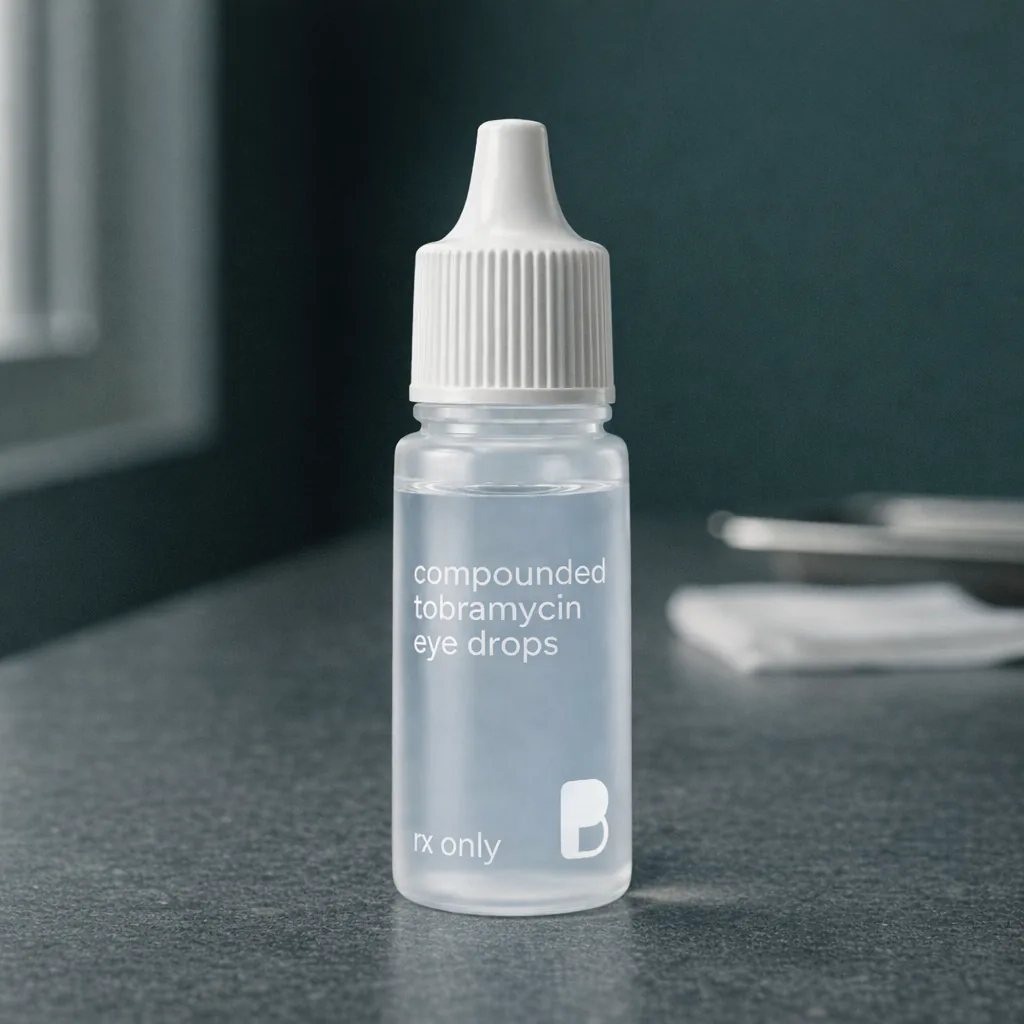
Compounded eye drops are sterile ophthalmic preparations made by a licensed pharmacy to a prescriber's order, for the cases where no manufactured product exists at the concentration or in the form a plan calls for. In eye care that can mean a fortified antibiotic, such as fortified tobramycin eye drops at 15 mg/mL instead of the commercial 0.3% drop, or a molecule with no marketed ophthalmic product at all. Bayview Pharmacy is a 503A compounding pharmacy in Warwick, Rhode Island, and prepares these in our USP 797 sterile lab once a prescription is received.
Appropriateness, concentration, schedule, and length of treatment are the prescriber's decisions. Bayview does not provide consultations and does not determine whether a preparation is appropriate for a given patient.
What are fortified eye drops, and why must the concentration be compounded?
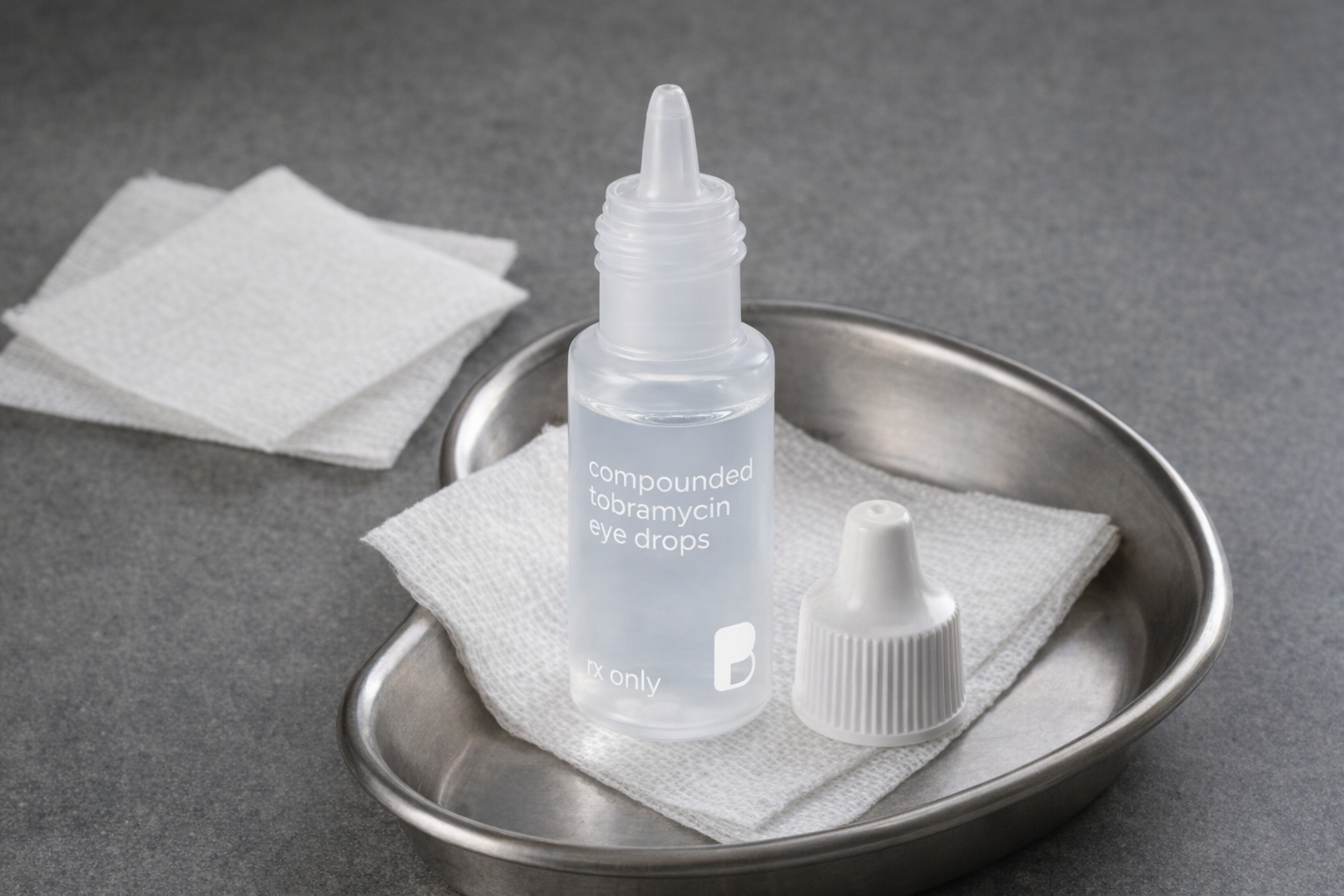
Fortified eye drops take their name from concentration. "Fortified" describes an ophthalmic solution prepared at a higher concentration than the standard commercial drop. Commercial tobramycin and gentamicin ophthalmic solutions are sold only at 0.3% (3 mg/mL). The fortified concentrations ordered for serious corneal infection sit around 15 mg/mL, roughly five times the commercial drop, and no manufacturer markets a fortified product. That is the reason the order has to reach a compounding pharmacy, and it is also why the fortified concentration is prescribed off-label.
Three of the preparations in the table below have no FDA-approved counterpart in the United States at the concentration prescribed. There is no FDA-approved vancomycin eye drop and no FDA-approved acetylcysteine eye drop at any strength, and there is no FDA-approved low-dose atropine product for myopia; only 1% atropine is commercially available. Prescribing in each of those cases is off-label, and the compounded preparation itself is not FDA-approved.
All of them are prepared as sterile ophthalmic preparations in small batches under USP 797 standards. If the regulatory category matters to your practice, our post on 503A versus 503B compounding pharmacies covers how the two differ.
What strengths and preparations are available?
The table lists what Bayview compounds on a prescriber's order. Strengths are given for reference and are not a statement that one concentration is better or stronger than another for a particular case.
| Preparation | Strength | Source | FDA status |
|---|---|---|---|
| Fortified tobramycin solution | 15 mg/mL or 13.6 mg/mL | Compounded | Off-label |
| Fortified gentamicin solution | 15 mg/mL (1.5%) | Compounded | Off-label |
| Fortified vancomycin solution | 25 mg/mL (2.5%) | Compounded | Off-label |
| Acetylcysteine solution | 10% | Compounded | Off-label |
| Atropine solution, low-dose | 0.01%, 0.02%, 0.05% | Compounded | Off-label |
Both fortified tobramycin concentrations sit above the commercial 0.3% drop and in the traditional fortified range of about 14 mg/mL described for bacterial keratitis. Fortified gentamicin at 15 mg/mL is within the traditional fortified range of roughly 9 to 15 mg/mL and is typically prepared from injectable gentamicin. For vancomycin, a fortified concentration study published in IOVS reports greater in-vitro and experimental kill against MRSA at higher concentrations such as 50 mg/mL, while 25 mg/mL is widely used for tolerability; the choice is a matter of clinical judgment and culture results.
Acetylcysteine is prepared at 10% (PCCA formula 7305), preserved with benzalkonium chloride and edetate disodium, hypertonic, and protected from light. Low-dose atropine is prepared at 0.01%, 0.02%, and 0.05%, with custom concentrations available, in 5 mL or 10 mL bottles.
The SIG options recorded on the order forms give a sense of how these are written. For fortified vancomycin: 1 drop into the affected eye every hour while awake, or every 2 hours and then tapered, or 4 times daily, or as prescribed. For acetylcysteine 10%: 1 drop into the affected eye or eyes up to 4 times daily, or as directed. For low-dose atropine: 1 drop into each eye, or as specified, once daily at bedtime. Each of those is an option on a form rather than a dosing recommendation, and the concentration escalation for atropine (0.01% to 0.02% to 0.05%) is prescriber-directed.
How do the fortified antibiotic options differ in spectrum?
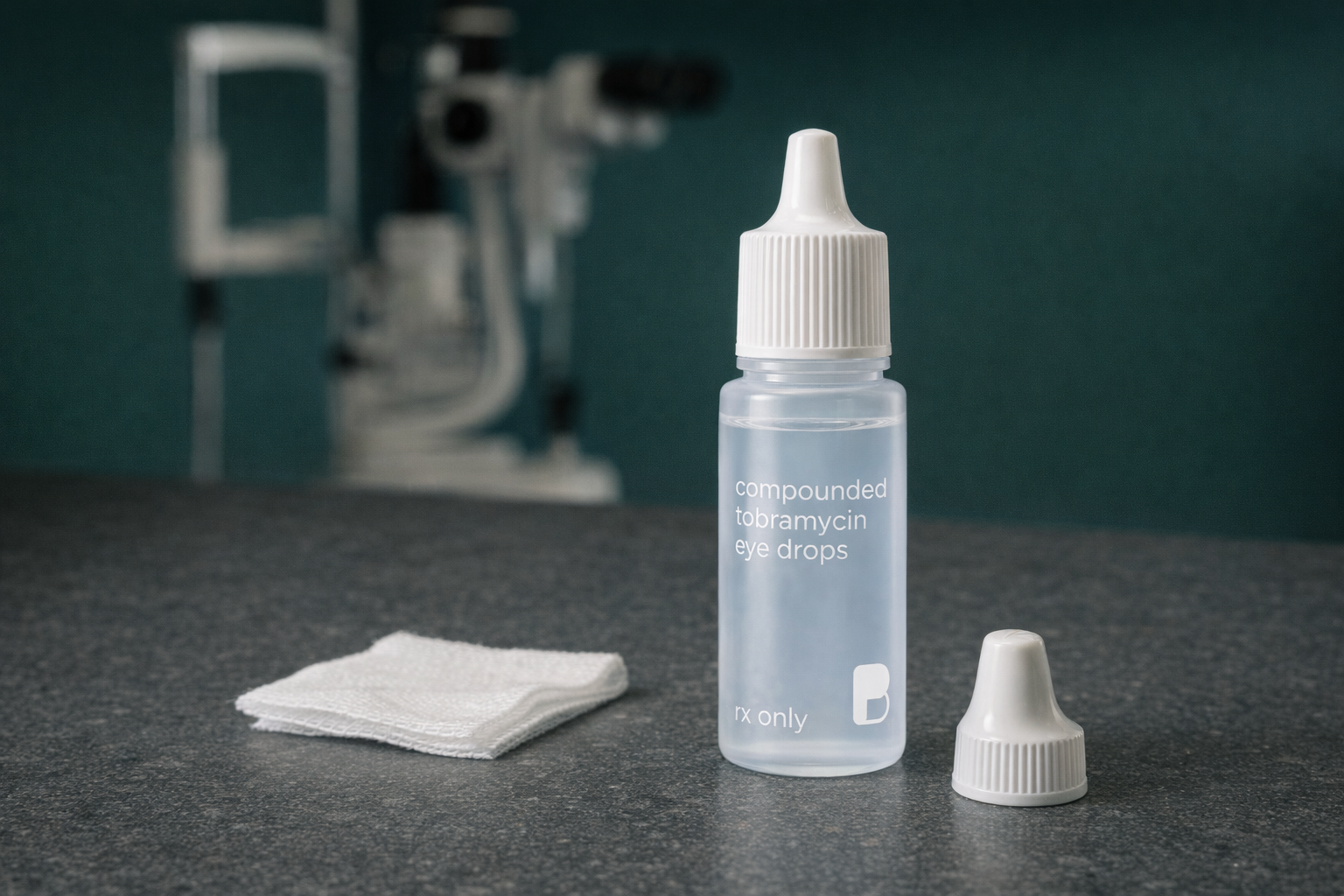
Tobramycin and gentamicin are aminoglycosides. StatPearls describes both as especially active against aerobic gram-negative bacteria, including Pseudomonas aeruginosa, and the gentamicin entry notes concentration-dependent killing, which is part of the published rationale for delivering a high-concentration drop directly to the ocular surface. Fortified gentamicin eye drops and fortified tobramycin eye drops occupy the same general ground, and the choice between them belongs to the prescriber.
Vancomycin is a glycopeptide. StatPearls describes it as especially active against gram-positive bacteria, including MRSA and other staphylococci and streptococci, and its gram-positive coverage includes MRSA and MRSE, streptococci and enterococci, with no gram-negative coverage. EyeWiki's bacterial keratitis article describes empiric dual therapy in which a fortified aminoglycoside is alternated with a gram-positive agent, such as fortified vancomycin eye drops or fortified cefazolin, pending culture and sensitivities.
The regimens reported as common practice are a loading schedule, for example one drop hourly, with gentamicin sometimes every 15 to 30 minutes initially, tapered to clinical response, and an alternating schedule specified when a second fortified antibiotic is part of the plan. Those are reported regimens rather than recommendations, and dosing remains the prescriber's responsibility. The counseling points named for these preparations are ocular surface toxicity with prolonged high-frequency dosing, holding contact lens wear during treatment unless directed otherwise, and re-supply so the course can be completed.
For fortified vancomycin, reassessment against the culture and the clinical course, with management under ophthalmology, is part of that published framing. The limits of the evidence are worth stating plainly: what is cited here is EyeWiki and StatPearls on these molecules and on bacterial keratitis, not controlled trials of the compounded drops themselves, and no outcome is claimed for any compounded preparation.
How do you write a prescription for a compounded ophthalmic solution?
E-prescribe to Bayview Pharmacy, 3844 Post Rd, Warwick, RI 02886. If your EHR does not carry the compound, enter it as a compound or free-text prescription naming each active ingredient and strength. Every preparation described here is noncontrolled. Fax and phone orders are accepted, and order forms exist for the vancomycin ophthalmic and atropine ophthalmic preparations.
| Order route | Destination | Note |
|---|---|---|
| E-prescribe | Bayview Pharmacy, Warwick, RI | Free-text compound if unlisted |
| Fax | 401-284-4506 | Order forms accepted here |
| Phone | 401-284-4505 | Submit, clarify, or coordinate refills |
The order routes above are the same for all of these preparations. What belongs on the order itself is more specific.
- The preparation and concentration written out, for example tobramycin 15 mg/mL (1.5%) fortified sterile ophthalmic solution, or acetylcysteine 10% sterile ophthalmic solution.
- Directions, such as one drop in the affected eye every hour tapering as the cornea responds, or one drop in each eye at bedtime for low-dose atropine.
- An ICD-10 diagnosis code: corneal ulcer H16.0- for a fortified antibiotic, filamentary keratitis H16.12- or dry eye disease for acetylcysteine, myopia H52.13 for low-dose atropine.
- Quantity, which is one bottle, or one multi-dose dropper bottle for acetylcysteine.
- Refills. The fortified antibiotic pages note typically none for acute keratitis, with re-evaluation before continuing; acetylcysteine and atropine are refilled as clinically appropriate.
Example directions reflect common regimens and are not treatment recommendations. Account setup, licensing, and ordering are covered on our provider page. For non-sterile preparations, see our provider guide to compounded pain creams.
What should you know about sterile compounding, beyond-use dates, and refrigeration?
Each of these sterile compounded eye drops is compounded in our USP 797 sterile lab in small batches and dispensed against a prescription written for a named patient. Fortified tobramycin, fortified gentamicin, and fortified vancomycin are stored refrigerated and carry a short beyond-use date, because the drug in solution is stable for a limited time only.
Acetylcysteine 10% behaves differently because it is a preserved multi-dose sterile preparation. Its in-use beyond-use date is 28 days after first opening, or the beyond-use date on the label, whichever comes first, and the solution is protected from light. Low-dose atropine is stored away from heat and light, and some compounded atropine drops are refrigerated, so the dispensing label governs.
Two practical consequences follow for a treatment plan. First, the beyond-use date on the label governs rather than the volume left in the bottle, and a fresh supply may be needed so the course can be completed. Second, counseling needs to cover keeping the dropper tip off the eye and off every surface, and spacing when more than one drop is prescribed. Where the patient is not local, arrange pickup or delivery within the states where Bayview is licensed, which our FAQ sets out.
Which non-antibiotic ophthalmic preparations are available?
Acetylcysteine eye drops at 10% are the mucolytic in this group. Acetylcysteine carries a thiol group that takes part in thiol-disulfide interchange, reducing the cross-linking that gives ocular mucus its structure (StatPearls, N-Acetylcysteine). Eye doctors prescribe it off-label where mucus or filaments build up on the ocular surface, most classically filamentary keratitis, and in mucus-related dry eye disease (EyeWiki, Filamentary Keratitis).
It has also been studied in meibomian gland dysfunction (Akyol-Salman and colleagues, 2010). The evidence base is limited and consists largely of small studies and clinical experience, and there is no FDA-approved acetylcysteine eye drop in the United States. The counseling points are benzalkonium chloride exposure with frequent or long-term dosing, transient stinging, and the sulfur-like odor that is expected with acetylcysteine.
Low-dose atropine eye drops are compounded at 0.01%, 0.02%, and 0.05% because only 1% atropine is commercially available in the United States, approved for cycloplegia, mydriasis, and as an adjunct for amblyopia and uveitis. Our post on atropine ophthalmic drops for the prevention of myopia progression covers the evidence, concentration selection, and monitoring.
What do compounded eye drops cost?
Starting cash prices are $150 for 7.5 mL of fortified tobramycin, $150 for 7.5 mL of fortified gentamicin, $150 for 7.5 mL of fortified vancomycin, $152 for 10 mL of acetylcysteine 10%, and $60 for 5 mL of low-dose atropine. Those are starting prices for the quantity listed, and a different concentration or bottle size changes the figure.
Coverage is the question patients ask next, and our post on whether compounding pharmacies take insurance is the one to hand them.
What does Bayview compound, and how do you send the order?
On a prescriber's order Bayview prepares fortified tobramycin sterile ophthalmic solution at 15 mg/mL (1.5%) and 13.6 mg/mL (1.36%) in 7.5 mL; fortified gentamicin at 15 mg/mL (1.5%) in 7.5 mL; fortified vancomycin at 25 mg/mL (2.5%) in 7.5 mL; acetylcysteine 10% in a multi-dose dropper bottle; and low-dose atropine at 0.01%, 0.02%, 0.05%, or a custom concentration in 5 mL or 10 mL. Each is a sterile ophthalmic preparation dispensed on a prescription for a named patient. Every ophthalmic preparation sits under our compounded eye drops service page, and the rest of what we prepare is listed in the compounded medications catalog.
To order, send an eRx to Bayview Pharmacy at 3844 Post Rd, Warwick, RI 02886, fax the prescription or an order form to 401-284-4506, or call 401-284-4505 to submit a prescription or coordinate refills. Include the concentration, the directions, an ICD-10 code, and the quantity. Account setup and licensing questions are handled on the provider page.
Frequently asked questions
How do providers send a prescription to Bayview?
Providers can submit a prescription three ways:
- E-prescribe: Search Bayview Pharmacy, Warwick, RI (NCPDP 4106882) in your EHR. For compounds, use the compound, custom, or free-text option and include the full formulation, strength, quantity, refills, and directions.
- Fax: Send a signed order to 401-284-4506 (alt. 401-210-2757) with patient and prescriber details, medication, quantity, refills, directions, signature, and date.
- Phone: Call 401-284-4505 to submit, clarify, or coordinate refills.
A valid prescription is required, and compounded medications are not FDA-approved.
Are compounded medications FDA-approved?
Compounded medications are not FDA-approved. They're prepared by a licensed pharmacy pursuant to a valid prescription for an individual patient, under USP standards. The FDA does not review compounded medications for safety or effectiveness.
Why is it compounded instead of bought off the shelf?
The commercial tobramycin eye drop is sold only at 0.3%. There is no commercially available fortified tobramycin, so the higher concentration your specialist needs is prepared by a compounding pharmacy. As a 503A pharmacy, Bayview compounds it sterile under USP <797> standards. Compounded medications are not FDA-approved.
Is it used with another antibiotic?
Often, yes. Because a serious corneal infection may involve gram-negative or gram-positive bacteria, specialists frequently prescribe fortified tobramycin together with a second fortified antibiotic that covers gram-positive bacteria, such as fortified vancomycin or cefazolin, until cultures come back. Your specialist will tell you how to alternate the drops.
How is fortified gentamicin different from fortified tobramycin?
Both are aminoglycoside antibiotics with similar gram-negative coverage, and both are used fortified for serious eye infections. Your eye specialist chooses between them based on the suspected or cultured bacteria and their treatment plan. See our fortified tobramycin page for that option.
What does "fortified" mean?
Fortified means the drop is compounded at a higher, stronger concentration than a standard commercial eye drop, because serious infections need a higher dose of antibiotic at the surface of the eye.
Is there an FDA-approved acetylcysteine eye drop?
No. There is no FDA-approved acetylcysteine eye drop in the United States, so your eye doctor prescribes it off-label and a compounding pharmacy prepares it sterile to that prescription. Compounded preparations are not FDA-approved. Acetylcysteine drops have been used in other countries for decades, which is where much of the supporting clinical experience comes from.
Is there an FDA-approved vancomycin eye drop in the United States?
No. There is no FDA-approved ophthalmic vancomycin product in the United States, so the fortified ophthalmic form is compounded and prescribed off-label. Bayview prepares vancomycin ophthalmic solution at 25 mg/mL (2.5%) as a sterile preparation on a prescription written for a named patient. A fortified vancomycin concentration study published in IOVS reports greater in-vitro and experimental MRSA kill at higher concentrations, while 25 mg/mL is widely used for tolerability.
How are fortified antibiotic eye drops stored?
Fortified tobramycin, gentamicin, and vancomycin ophthalmic solutions are stored refrigerated and carry a short beyond-use date, because the drug in solution is stable for a limited time only. The dispensing label governs. The beyond-use date, rather than the volume left in the bottle, decides when a bottle is finished with, so a fresh supply may be needed before a prescribed course is complete.
How long can a preserved acetylcysteine eye drop be used after opening?
Acetylcysteine 10% is a preserved multi-dose sterile preparation, preserved with benzalkonium chloride and edetate disodium. Its in-use beyond-use date is 28 days after first opening, or the beyond-use date printed on the label, whichever comes first. The solution is hypertonic and protected from light. Counsel on benzalkonium chloride exposure with frequent or long-term dosing, transient stinging, and the expected sulfur-like odor.
What should a compounded ophthalmic prescription include?
Name the preparation and concentration in full, for example tobramycin 15 mg/mL (1.5%) fortified sterile ophthalmic solution. Add the directions, an ICD-10 diagnosis code such as corneal ulcer H16.0- or myopia H52.13, the quantity as one bottle, and refills. If your EHR does not carry the compound, enter it as a free-text compound naming each active ingredient and strength.
Can I fax or phone a compounded eye drop order to Bayview?
Yes. The preparations described here are noncontrolled, and Bayview accepts e-prescribing, fax, and phone orders. E-prescribe to Bayview Pharmacy, 3844 Post Rd, Warwick, RI 02886, fax to 401-284-4506, or call 401-284-4505. Order forms exist for the vancomycin ophthalmic and atropine ophthalmic preparations and can be faxed in. Account setup and licensing are covered on the provider page.
What do compounded eye drops cost at Bayview?
The formulation pages publish starting cash prices: $150 for 7.5 mL of each fortified antibiotic solution, $152 for 10 mL of acetylcysteine 10%, and $60 for 5 mL of low-dose atropine. A different concentration or bottle size changes the figure. For what coverage means from the patient's side, see our post on whether compounding pharmacies take insurance.
What Bayview compounds for this
Important: Compounded medications are prepared to a prescriber's order for an individual patient. They are not FDA-approved, and the FDA has not evaluated them for safety, effectiveness, or manufacturing quality. This article is educational and is not a substitute for advice from your prescriber or pharmacist.
This preparation contains a controlled substance. Controlled-substance prescriptions carry refill limits, must be e-prescribed, and can only be shipped to states where Bayview holds the required licensure.
Uses discussed here may be off-label, meaning they are not part of any FDA-approved labeling. Off-label use is a decision for you and your prescriber, based on the available evidence.
Veterinary preparations are compounded to a veterinarian's order for a specific animal and are not FDA-approved animal drugs. Never give a compounded human medication to an animal without veterinary direction.
Compounded prescriptions are paid for directly rather than billed through insurance. Most are HSA/FSA-eligible, and many patients submit the receipt to their plan for possible reimbursement. Pricing depends on the strength, dose form and quantity your prescriber orders. Read more about cost and insurance.
Starting cash prices are $150 for 7.5 mL of fortified tobramycin, fortified gentamicin, or fortified vancomycin ophthalmic solution, $152 for 10 mL of acetylcysteine 10%, and $60 for 5 mL of low-dose atropine. A different concentration or bottle size changes the figure.
Bayview Pharmacy is a compounding pharmacy in Warwick, Rhode Island, licensed to fill and ship compounded prescriptions for patients in Rhode Island, Massachusetts, Connecticut, New Jersey, New Hampshire, Florida, Maine and Pennsylvania. Prescriptions for New York patients are filled on a limited basis, and controlled substances are not shipped to New York addresses. See every state we ship to.