
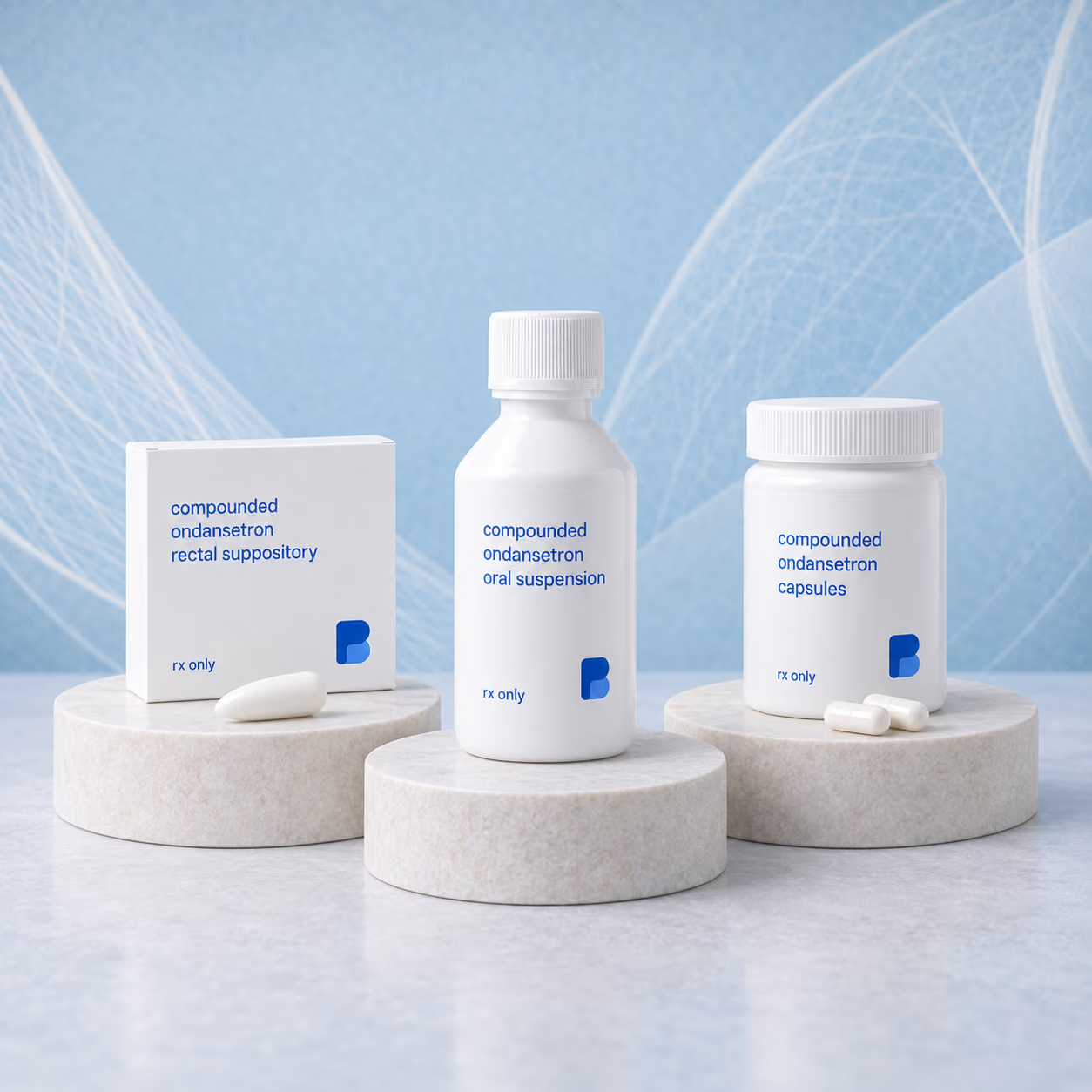
Ondansetron works by blocking serotonin at 5-HT3 receptors, both on nerve endings in the gut and in the part of the brain that triggers vomiting. Manufactured ondansetron, sold under the brand name Zofran and as generics, is FDA-approved to help prevent nausea and vomiting from chemotherapy, radiation treatment, and surgery. It comes as tablets, dissolving tablets, film, an oral solution, and injection, and Bayview prepares compounded ondansetron in forms no manufacturer makes, such as rectal suppositories, when a prescriber orders one.
What does ondansetron do?
Ondansetron is a prescription anti-nausea medicine in a class called selective 5-HT3 receptor antagonists. Serotonin, also called 5-HT, is a chemical messenger, and 5-HT3 is one of the receptors it acts on. Ondansetron sits on those receptors and keeps serotonin from switching them on (StatPearls, Ondansetron).
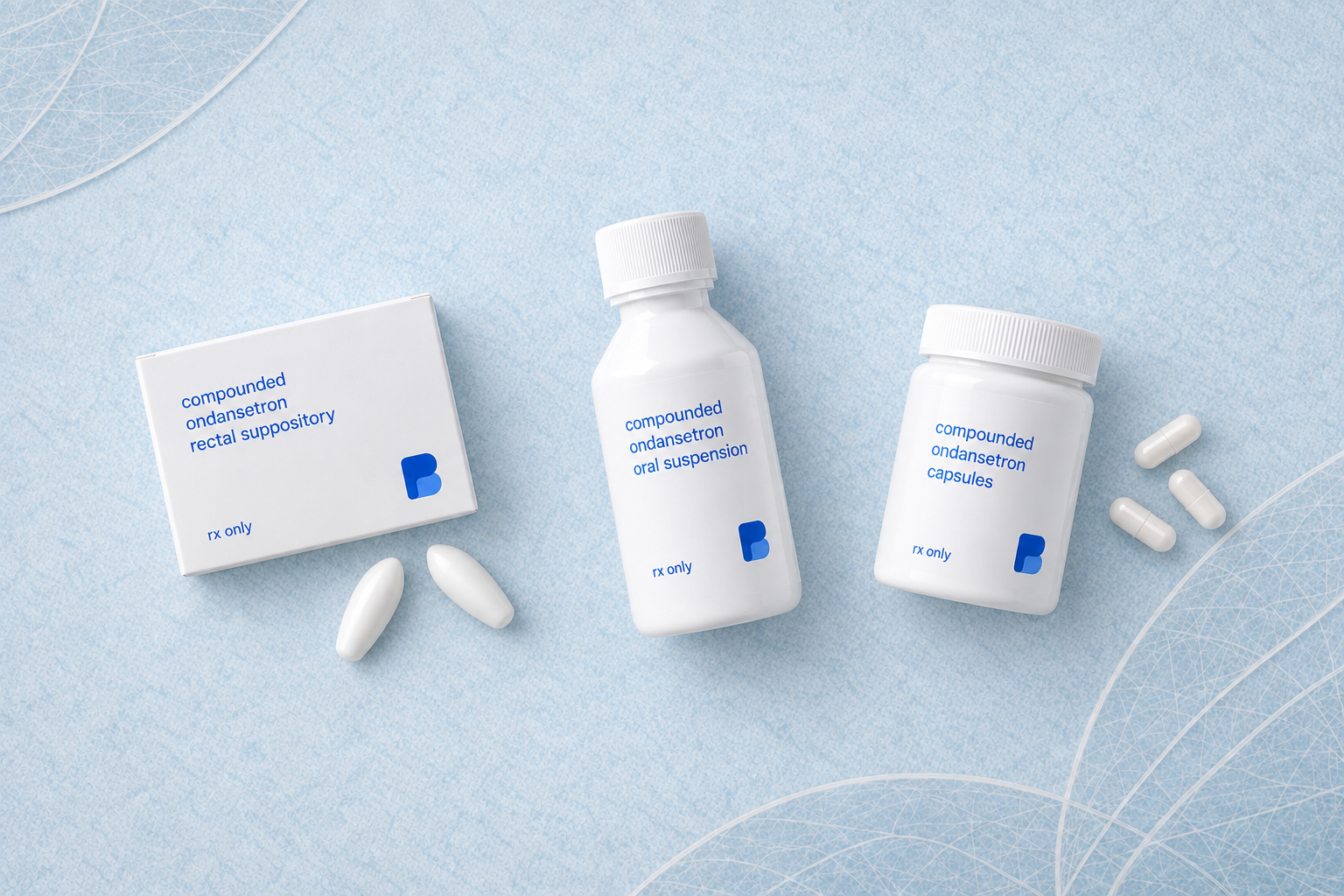
That matters because the vomiting reflex depends on a relay. When something irritates the gut, such as chemotherapy, serotonin is released in the lining of the small intestine and stimulates vagal nerve endings there. Those nerves carry the signal to the brain. Blocking the receptors interrupts the relay at both ends.
How does ondansetron work in the gut and the brain?
StatPearls describes two sites of action, and both use the same receptor:

- In the gut: 5-HT3 receptors on vagal nerve endings respond to irritation from chemotherapy and other triggers. Ondansetron blocks them, so less of the signal leaves the gut.
- In the brain: the chemoreceptor trigger zone is an area that senses drugs and toxins in the blood and signals the vomiting reflex. Ondansetron blocks 5-HT3 receptors there too.
What ondansetron does not do is also useful to know. The prescribing information states that it is not a dopamine-receptor blocker, which sets it apart from older anti-nausea drugs such as prochlorperazine.
What is ondansetron used for?
The FDA-approved uses of manufactured ondansetron are all about prevention. According to the DailyMed prescribing information, it is indicated to prevent nausea and vomiting in three settings:
| Use | Forms labeled | Status |
|---|---|---|
| Chemotherapy nausea and vomiting | Oral, IV | FDA-approved |
| Radiation nausea and vomiting | Oral | FDA-approved |
| Nausea and vomiting after surgery | Oral, IV | FDA-approved |
| Motion sickness | None | Not effective per StatPearls |
Prescribers also use ondansetron off-label, meaning for purposes outside the FDA-approved labeling. Any off-label use is a decision for your prescriber, who knows your history and the other medicines you take.
What is ondansetron 4 mg used for?
The 4 mg and 8 mg tablets carry the same labeled uses. The strength is part of the prescription, not a different indication. The 8 mg tablet is the strength most adults are prescribed for moderately emetogenic chemotherapy, meaning chemotherapy with a moderate chance of causing vomiting, and the label also uses 4 mg doses, including for children aged 4 to 11 on that kind of chemotherapy (DailyMed, ondansetron tablets label). Your prescriber chooses the strength and schedule, and this post does not suggest a dose.
Is ondansetron used for motion sickness?
No. StatPearls reports that ondansetron is not effective for motion sickness, and it is not an approved use. Prescribers who want a motion sickness preparation usually look at another drug, such as scopolamine, which Bayview compounds as a transdermal gel, capsules, and nasal spray on a prescriber's order.
How fast does ondansetron work, and how long does it last?
The label builds its timing around the trigger. For moderately emetogenic chemotherapy, the first 8 mg oral dose is given 30 minutes before treatment and a second 8 mg dose 8 hours later, then 8 mg twice a day for 1 to 2 days. For nausea after surgery, the oral dose is given 1 hour before anesthesia starts (DailyMed). In other words, ondansetron is meant to be on board before the nausea begins.

Ondansetron is cleared by the liver through several enzymes. Its half-life, the time for the level in the blood to fall by half, is about 3 to 4 hours in adults and longer in older adults (StatPearls, Ondansetron). That is why labeled schedules repeat doses through the day instead of relying on one. In severe liver impairment, the label caps the total at 8 mg per day.
The orally disintegrating tablet dissolves on the tongue in seconds (MedlinePlus, Ondansetron).
What are the side effects and warnings?
Common side effects of ondansetron include headache, constipation, diarrhea, and tiredness (DailyMed, ondansetron tablets label). The prescribing information also carries warnings that apply to every form:
- Heart rhythm: ondansetron can prolong the QT interval, which can lead to a dangerous irregular heartbeat called Torsade de Pointes. Tell your prescriber about any heart rhythm problem, long QT syndrome, heart failure, slow heartbeat, or low potassium or magnesium.
- Serotonin syndrome: the risk rises when ondansetron is combined with antidepressants, triptans, or other serotonergic medicines. Seek care right away for agitation, fast heartbeat, fever, sweating, or muscle stiffness or twitching.
- Masking a bowel problem: ondansetron may hide the signs of a blocked or slowed bowel, or a swollen stomach, after surgery or chemotherapy.
- Apomorphine: do not use ondansetron with it. The combination has caused very low blood pressure and loss of consciousness.
In 2012 the FDA removed the 32 mg single intravenous dose because of QT risk (FDA Drug Safety Communication, 2012). Get medical help right away for chest pain, a fast or irregular heartbeat, fainting, rash or swelling, trouble breathing, confusion, fever with stiff muscles, or seizures. Tell your prescriber if you are pregnant, planning a pregnancy, or breastfeeding.
What forms does ondansetron come in?
Most prescriptions are filled with a manufactured product. These are the FDA-approved forms:

| Form | Route | Status |
|---|---|---|
| Tablet 4 mg, 8 mg | Oral | FDA-approved |
| Orally disintegrating tablet | Oral | FDA-approved |
| Oral film | Oral | FDA-approved |
| Oral solution 4 mg/5 mL | Oral | FDA-approved |
| Injection | IV | FDA-approved |
When one of these fits the order, that is what a pharmacy dispenses, Bayview included. The dissolving tablets contain aspartame, which matters for people with phenylketonuria (MedlinePlus).
Compounding covers forms the manufactured line does not include. None of these is FDA-approved:
| Form | Route | Status | Evidence |
|---|---|---|---|
| Suppository 4, 5, 8 mg | Rectal | Off-label | One small PK study |
| Ondansetron/prochlorperazine suppository | Rectal | Off-label | No trials |
| Gluten-free suspension 4 mg/5 mL | Oral | Compounded, not FDA-approved | Manufactured solution exists |
| Slow-release capsule 4, 8 mg | Oral | Compounded, not FDA-approved | No FDA-reviewed release data |
| Cream or gel | Skin | Off-label | Absorption unproven |
Is there a Zofran suppository?
No. There is no FDA-approved ondansetron suppository in the United States, brand or generic. A compounded ondansetron suppository is a separate preparation made by a pharmacy for one named patient. It is not a version of Zofran, it is not equivalent to it, and giving ondansetron rectally is off-label.
The usual reason a prescriber orders one is practical: a person who is actively vomiting may bring a tablet back up. A small pharmacokinetic study in 12 healthy volunteers found ondansetron was absorbed from a rectal suppository, but more slowly and with lower bioavailability than the oral tablet (VanDenBerg et al., 2000). That was one single-dose study, and it does not establish how any compounded suppository will perform. Rectal forms also come up in comfort care; our hospice and palliative care page describes preparations for patients who can no longer take medicine by mouth.
The combined suppository adds prochlorperazine 25 mg, which has a boxed warning for older adults with dementia-related psychosis, is not for children under 2 years or under 20 lbs, and can cause involuntary movements.
Suspension, slow-release capsules, and creams
A compounded suspension is for a prescriber who needs a specific vehicle, such as one made without gluten-containing ingredients. Our custom oral suspensions page explains how liquid preparations are made. There is no FDA-approved extended-release ondansetron, so the release profile of a compounded slow-release capsule has not been established by FDA review, and the prescriber sets the dosing interval.
There is also no FDA-approved topical ondansetron. Bayview did not find a published human study showing it is absorbed through the skin, and in a study of five healthy cats, ondansetron applied to the ear in a transdermal base produced no clinically relevant blood levels (Zajic et al., 2017). A prescriber who orders a cream or gel should know that absorption is unproven.
What does compounded ondansetron cost?
Compounded ondansetron capsules start at $90 for 30 capsules. Other forms and quantities are priced to the order. Where manufactured ondansetron tablets or oral solution fit the prescription, that is what we dispense, and it may cost less. Compounded preparations are cash-priced and are generally eligible for HSA and FSA cards. Call 401-284-4505 with the preparation and quantity for a quote before it is made. Our post on whether compounding pharmacies take insurance explains payment.
What Bayview compounds for this
On a prescriber's order, Bayview prepares ondansetron as 4 mg, 5 mg, and 8 mg rectal suppositories; a 4 mg ondansetron and 25 mg prochlorperazine suppository; a 0.8 mg/mL (4 mg/5 mL) gluten-free oral suspension; 4 mg and 8 mg slow-release capsules; and topical creams and gels. Each is made for one patient's prescription using USP 795 non-sterile compounding. Dose and appropriateness are always your prescriber's decisions. For people whose chemotherapy or radiation leaves the mouth sore, prescribers also order magic mouthwash rinses, and our post on sublingual medications covers another route for people who have trouble swallowing. Everything else is in the compounded medications catalog.
Talk to your prescriber
If you have questions about how ondansetron fits your treatment, or if a tablet is hard to keep down, ask your prescriber which form is right for you. If they write a compounded preparation, they can send it to Bayview Pharmacy, and we ship to patients in the states where Bayview is licensed, listed on our FAQ page.
Frequently asked questions
How much does compounded ondansetron cost?
Pricing depends on the form, the strength, and the quantity. If brand-name or generic ondansetron tablets or oral solution fit your prescription, that is what we dispense, and it may cost less. Call Bayview at 401-284-4505 with the preparation and quantity your prescriber ordered for a quote. Compounded preparations are not FDA-approved.
Who should not take ondansetron?
People who are allergic to ondansetron or who take apomorphine should not use it. Tell your prescriber if you have a heart rhythm problem, long QT syndrome, low potassium or magnesium, or liver disease, or if you are pregnant or breastfeeding. People with severe liver impairment should not take more than 8 mg a day.
What are the side effects of ondansetron?
Common side effects include headache, constipation, diarrhea, and tiredness. Serious risks include an irregular heart rhythm from QT prolongation and serotonin syndrome when it is combined with antidepressants, triptans, or other serotonergic drugs. Get medical help right away for chest pain, a fast or irregular heartbeat, fainting, trouble breathing, confusion, or fever with stiff muscles.
Does ondansetron cream or gel work through the skin?
Evidence that ondansetron is absorbed through the skin is limited. We did not find a published study measuring blood levels in people after topical ondansetron, and a study in cats using 4 mg in a transdermal base found no clinically relevant blood levels. There is no FDA-approved topical ondansetron. If your prescriber orders a topical form, ask them how they will judge whether it is helping.
Is there an extended-release form of ondansetron?
No FDA-approved extended-release ondansetron exists. Bayview compounds slow-release capsules when a prescriber orders them, but the release profile of a compounded slow-release capsule has not been established by FDA review. Your prescriber decides how often to take it.
Why would my prescriber order an ondansetron suppository?
A suppository may be ordered when a patient is vomiting and cannot keep a tablet or liquid down. There is no FDA-approved ondansetron suppository in the United States. One small study in healthy volunteers found that ondansetron is absorbed from a rectal suppository, but more slowly and to a lesser extent than from an oral tablet, so your prescriber sets the dose with that in mind.
What is compounded ondansetron?
Compounded ondansetron is ondansetron prepared by a pharmacist in a form the manufactured products do not come in, such as a rectal suppository, a gluten-free oral suspension, a slow-release capsule, or a topical cream or gel. Each one is made for an individual patient's prescription. Compounded preparations are not FDA-approved.
What is ondansetron 8 mg used for?
Ondansetron 8 mg tablets are FDA-approved to help prevent nausea and vomiting caused by chemotherapy, radiation treatment, and surgery. For moderately emetogenic chemotherapy, the labeled adult regimen is 8 mg 30 minutes before treatment, another 8 mg 8 hours later, then 8 mg twice a day for 1 to 2 days. Prescribers also use it off-label for other causes of nausea. Take it exactly as your prescriber directs.
Can I use an HSA or FSA card for compounded medications?
Yes. We accept HSA and FSA cards as well as credit cards, and compounded prescriptions are generally an eligible expense because they are dispensed against a valid prescription. Plan rules vary, so keep your receipt in case your administrator asks for documentation.
Is there a Zofran suppository?
No. There is no FDA-approved ondansetron suppository in the United States, and neither brand-name Zofran nor generic ondansetron is made as one. A compounded ondansetron suppository is a separate preparation made by a pharmacy for one named patient on a prescriber's order. It is not equivalent to Zofran, it is not FDA-approved, and rectal use is off-label. Bayview prepares 4 mg, 5 mg, and 8 mg strengths.
How does ondansetron work in the body?
Ondansetron blocks 5-HT3 serotonin receptors in two places: on vagal nerve endings in the gut, which respond to irritation from chemotherapy and other triggers, and in the chemoreceptor trigger zone of the brain, which signals the vomiting reflex (StatPearls, Ondansetron). With those receptors blocked, serotonin cannot switch them on. The prescribing information notes that it is not a dopamine-receptor blocker, unlike older anti-nausea drugs such as prochlorperazine.
What is ondansetron FDA-approved for?
Manufactured ondansetron is indicated to prevent nausea and vomiting in three settings: chemotherapy, radiation treatment, and surgery (DailyMed, ondansetron tablets label). The 4 mg and 8 mg tablets carry the same labeled uses, and the strength is set by the prescriber. Other uses are off-label, meaning outside the FDA-approved labeling, and are the prescriber's decision. StatPearls reports it is not effective for motion sickness.
Is ondansetron used for motion sickness?
StatPearls reports that ondansetron is not effective for motion sickness, and motion sickness is not among its FDA-approved uses. Prescribers who want a motion sickness preparation usually choose a different drug, such as scopolamine, which Bayview compounds as a transdermal gel, capsules, and nasal spray on a prescriber's order. Ask your prescriber which option fits you.
How long does ondansetron last?
Ondansetron has a half-life of about 3 to 4 hours in adults, and longer in older adults (StatPearls, Ondansetron). Labeled schedules give it before the trigger, for example 30 minutes before chemotherapy, then repeat doses through the day, such as 8 mg eight hours later and then twice a day for 1 to 2 days (DailyMed). Your prescriber sets your schedule; do not double a dose to make up for a missed one.
Can ondansetron affect your heart rhythm?
Yes. The prescribing information warns that ondansetron can prolong the QT interval, which can lead to a dangerous irregular heartbeat called Torsade de Pointes. Tell your prescriber about any heart rhythm problem, long QT syndrome, heart failure, slow heartbeat, low potassium or magnesium, or other medicines that affect heart rhythm. Get help right away for chest pain, a fast or irregular heartbeat, or fainting.
What Bayview compounds for this
Important: Compounded medications are prepared to a prescriber's order for an individual patient. They are not FDA-approved, and the FDA has not evaluated them for safety, effectiveness, or manufacturing quality. This article is educational and is not a substitute for advice from your prescriber or pharmacist.
This preparation contains a controlled substance. Controlled-substance prescriptions carry refill limits, must be e-prescribed, and can only be shipped to states where Bayview holds the required licensure.
Uses discussed here may be off-label, meaning they are not part of any FDA-approved labeling. Off-label use is a decision for you and your prescriber, based on the available evidence.
Veterinary preparations are compounded to a veterinarian's order for a specific animal and are not FDA-approved animal drugs. Never give a compounded human medication to an animal without veterinary direction.
Compounded prescriptions are paid for directly rather than billed through insurance. Most are HSA/FSA-eligible, and many patients submit the receipt to their plan for possible reimbursement. Pricing depends on the strength, dose form and quantity your prescriber orders. Read more about cost and insurance.
Compounded ondansetron capsules start at $90 for 30 capsules; other forms and quantities are priced to the order, and we quote them before they are made (401-284-4505). Compounded preparations are cash-priced and are generally eligible for HSA and FSA cards.
Bayview Pharmacy is a compounding pharmacy in Warwick, Rhode Island, licensed to fill and ship compounded prescriptions for patients in Rhode Island, Massachusetts, Connecticut, New Jersey, New Hampshire, Florida, Maine and Pennsylvania. Prescriptions for New York patients are filled on a limited basis, and controlled substances are not shipped to New York addresses. See every state we ship to.
Related reading