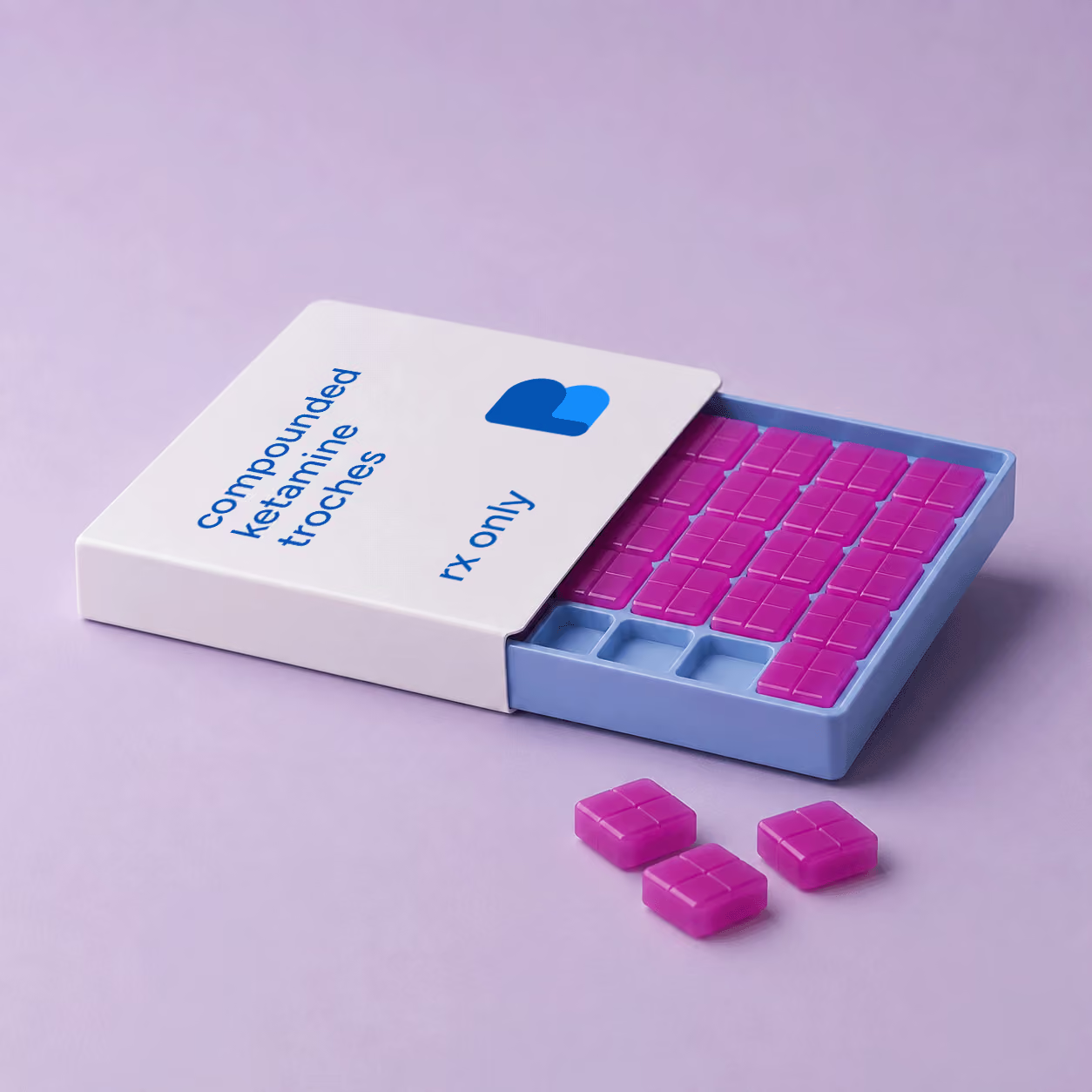
A troche is a small, firm lozenge that dissolves slowly in the mouth instead of being swallowed whole. It is held between the cheek and gum, or under the tongue, so the medication can be absorbed across the oral mucosa before the remaining amount is swallowed. Troches are compounded to a prescriber's order, which is how Bayview prepares its Ketamine Troche, a buccal troche made to the strength a prescriber writes.
This page covers what a troche is made of, how buccal and sublingual placement differ, how the form is used, how it is stored, and what it costs. One thing to settle up front: strength, placement, frequency, and whether a troche is appropriate at all are decisions for the prescriber, not for the pharmacy and not for the internet.
What is a troche made of?
A compounded troche combines the active ingredient with a base that holds its shape at room temperature and dissolves in the mouth. The pharmacist weighs the active ingredient, mixes it into that base, and molds the batch so each unit carries the strength written on the prescription. Troches are prepared under USP 795 non-sterile compounding.
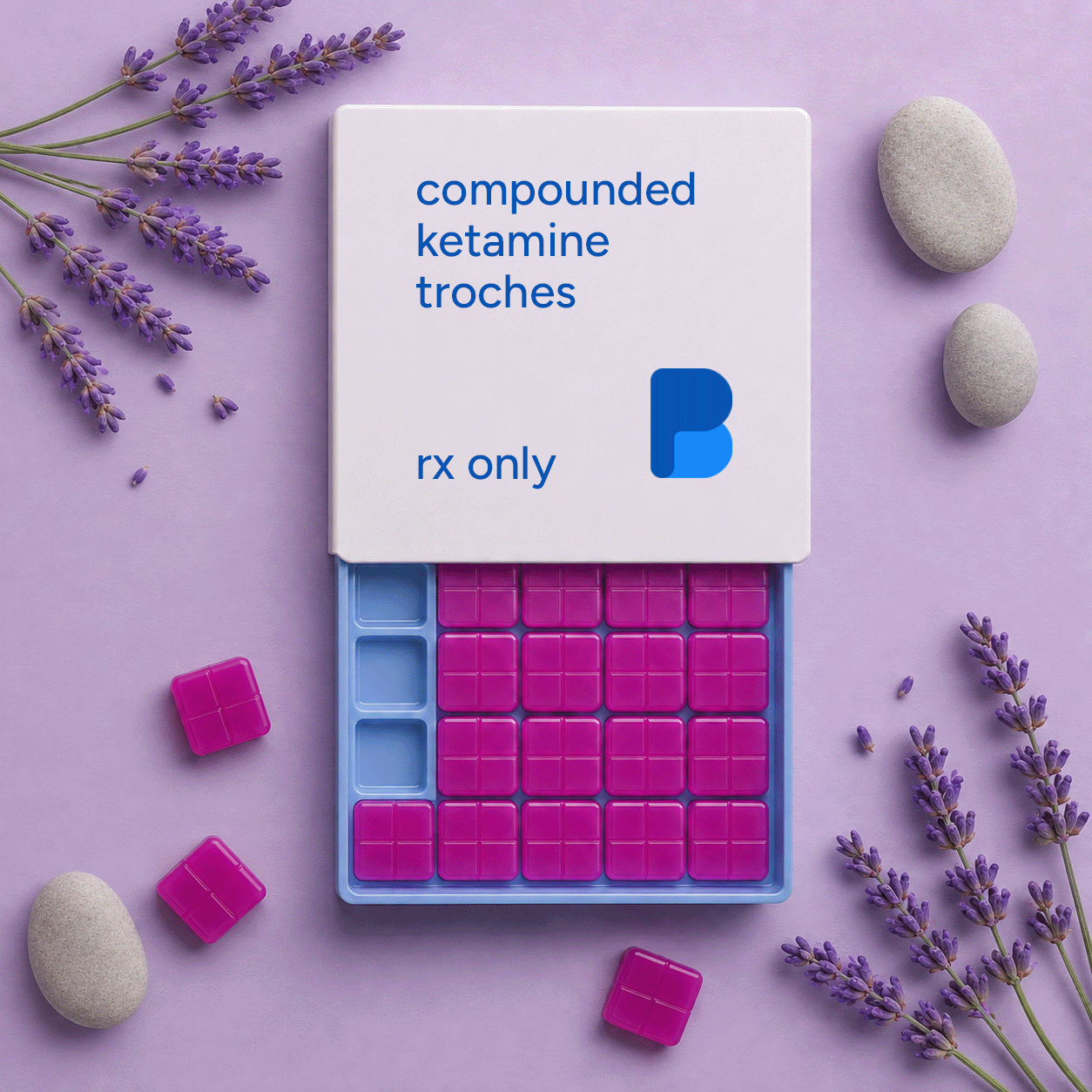
Flavor is part of the preparation rather than an afterthought, because a troche sits in the mouth the whole time it dissolves. Bayview can flavor troches strawberry, watermelon, or lemon, or leave them flavorless. A prescriber can also direct a patient to use a whole unit or a scored portion of one.
What is a troche used for?
A troche is a delivery form, not a drug class. Prescribers reach for it when they want a medication to dissolve in the mouth rather than travel down as a swallowed tablet, when the strength or flavor they want is not available as a manufactured product, or when a patient has trouble swallowing tablets at all.

Ketamine troches are one example. Ketamine in this form is prescribed off-label, under a prescriber's supervision, for treatment-resistant depression and related mood conditions. No compounded ketamine product is FDA-approved, and the FDA has cautioned about the risks of compounded ketamine for psychiatric use, particularly at-home use without monitoring. Compounded preparations are not reviewed or approved by the FDA.
Where the evidence sits matters here. Injectable ketamine is FDA-approved as an anesthetic, and an intranasal form of its S-enantiomer, esketamine (Spravato), is FDA-approved for treatment-resistant depression and administered in a certified healthcare setting under a REMS program. The strongest evidence for ketamine in depression comes from clinician-administered intravenous ketamine and from FDA-approved intranasal esketamine. Evidence on compounded buccal, sublingual, and oral ketamine is growing but remains more limited, as summarized in a 2022 review by Swainson and colleagues in Frontiers in Psychiatry.
Troche vs lozenge: what is the difference?
In everyday speech the two words overlap. A lozenge is any solid piece meant to dissolve in the mouth, including cough drops sold over the counter. "Troche" is the word pharmacies use for a compounded, prescription lozenge molded to a specific strength for a named patient.
FormHow usedStatusCompounded trocheHeld in mouth, dissolves slowlyCompounded, not FDA-approvedCough drop lozengeSucked until dissolvedOTCOral dissolve tabletDissolves under the tongueCompounded or manufacturedConventional tabletSwallowed whole with waterManufactured
The over-the-counter row is there for contrast only. A compounded troche is dispensed on a prescription written for one patient, and the strength, flavor, and quantity all come from that prescription.
Buccal vs sublingual: where does a troche go?
Buccal placement means the unit sits between the cheek and gum. Sublingual placement means it sits under the tongue. Either way the troche stays in contact with the lining of the mouth while it dissolves. Bayview lists the ketamine troche route as buccal, and its directions note that the troche may be placed between the cheek and gum or under the tongue, depending on the prescription.

PlacementPositionDirectionBuccalBetween cheek and gumRoute listed for ketamine trochesSublingualUnder the tongueIf the prescriber directsSwallowedDown to the stomachNot unless specifically directed
Do not chew a troche or swallow it whole unless the prescriber has specifically told you to. Sublingual dosing across other preparations is covered in our post on compounding sublingual medications.
How to take a troche
The prescription label is the instruction that counts. In general terms, taking a troche looks like this.
For ketamine specifically, Bayview lists dissociation (a sense of detachment from your body or surroundings), dizziness, drowsiness, nausea, altered perception, increased saliva, changes in taste, and a temporary increase in blood pressure among common short-term effects. Long-term or heavy ketamine use has been associated with bladder and urinary symptoms (StatPearls). Anything on that list is a conversation to have with the prescriber, along with their instructions about supervision and setting.
How long does a troche take to dissolve?
Bayview does not publish a set number of minutes, and no one should guess at one. Dissolution depends on the base, the strength of the unit, where it is placed, and the person. The direction that matters is the one on the label, which will tell you to let the troche dissolve slowly in place.

Chewing it or swallowing it early changes how much of the dose is absorbed across the oral mucosa versus how much goes down and is swallowed. That is the reason the directions say not to do it unless the prescriber has said otherwise.
How are troches stored?
Keep troches in their original packaging and protect them from excessive heat and moisture unless the prescription label gives different instructions. Heat and humidity are the two things to plan around, so a cool, dry cabinet is a better spot than a car glovebox or a bathroom shelf.
The label carries a beyond-use date. Dispose of unused or expired medication as directed by the pharmacist. Because ketamine is a controlled substance, keep it secured and out of reach of children and everyone else in the household, and never share it with another person.
What else does Bayview compound in a dissolving form?
Troches are not tied to one drug. Apomorphine Sublingual Troches are compounded as 2 mg and 3 mg sublingual troches, plus a 3 mg/mL sublingual solution, to a prescriber's order. Oxytocin Nasal Spray and Troche is a compounded intranasal spray and a sublingual or oral troche, available by prescription only and not FDA-approved in these forms. Sildenafil Oral Dissolve Tablets are compounded sildenafil in a tablet that dissolves under the tongue, for patients who have difficulty swallowing conventional tablets. Bayview also prepares ketamine as a rapidly dissolving sublingual tablet and as a nasal spray, and the rest of the list is in the searchable catalog.
PreparationFormPlacementKetamine TrocheBuccal trocheBetween cheek and gumApomorphineSublingual troche, solutionUnder the tongueOxytocinNasal spray, trocheNose, or under tongueSildenafil ODTOral dissolve tabletUnder the tongue
Each of those preparations has its own starting cash price on its formulation page, and strength, quantity, and flavor change what a specific prescription comes to, so call for a quote on the exact order your prescriber wrote.
Is a compounded troche covered by insurance?
Ketamine troches start at $250 for 90 troches, paid as cash at the pharmacy. Compounded preparations are made for one patient on one prescription, so they are not billed through insurance the way a manufactured product with a national drug code is. Patients pay Bayview directly and can ask their own plan about out-of-network reimbursement or paying from a flexible spending account. Our post on whether compounding pharmacies take insurance walks through the details.
What strengths and forms does Bayview prepare?
On a prescriber's order, Bayview compounds ketamine troches in commonly prepared strengths of 50, 100, 200, and 300 mg, and any strength from 10 mg to 300 mg can be made to order. Units can be flavored strawberry, watermelon, or lemon, or left flavorless, and they can be scored if the prescriber wants a portion dosed rather than a whole unit. Quantity is dispensed to the prescription, subject to the federal limit of 100 dosage units.
How to order
Start with your prescriber. Ask whether a troche is the right form for you, and let them decide the strength, the placement, and how often to use it. Ketamine is a Schedule III controlled substance and is dispensed only on a prescription written for a named patient, sent to us as an electronic controlled-substance prescription.
Controlled substances are not shipped to New York addresses, and controlled-substance prescriptions are filled only in the states where Bayview is licensed to dispense them, which is listed on our FAQ page. Once the prescription reaches us, our pharmacists compound it and ship it to you. Call the pharmacy with questions about placement, flavor, storage, or refills, and take questions about dose, frequency, and monitoring back to your prescriber.
Frequently asked questions
How does my provider prescribe them?
Because ketamine is a controlled substance, prescribers must send an electronic controlled-substance prescription (EPCS). Bayview fills for patients in RI, MA, CT, NJ, NH, FL, and ME. Your provider can find our controlled-substance prescribing guidance and contact our pharmacists with questions.
Can it be misused, and how should I store it?
Yes, ketamine is a Schedule III controlled substance with potential for misuse and abuse. Store troches securely, out of reach of children, teens, and anyone they aren't prescribed for, and don't share them. Take only your prescribed amount and dispose of unused medication properly.
What side effects should I expect?
Common short-term effects include dissociation (feeling detached), dizziness, drowsiness, nausea, and a temporary rise in blood pressure. Long-term or heavy use has been linked to bladder and urinary problems. Tell your prescriber about heart or blood-pressure conditions and all medications you take. Seek urgent care for chest pain, severe confusion, trouble breathing, or symptoms that alarm you.
Is it FDA-approved? Is it safe?
Compounded ketamine is not FDA-approved for any psychiatric condition, and the FDA has cautioned about risks of compounded ketamine, particularly at-home use without monitoring. Known risks include sedation, dissociation, raised blood pressure, slowed breathing, bladder and urinary symptoms with long-term use, and potential for misuse. Used exactly as prescribed within a supervised plan, your prescriber weighs these risks against the potential benefit.
How is a troche different from the rapid dissolve tablet?
Both absorb through the lining of the mouth rather than the stomach. A rapid dissolve tablet melts quickly under the tongue; a troche is a firmer lozenge held between the cheek and gum that dissolves more slowly. Your prescriber chooses the form, strength, and schedule that fit your plan and preference.
How do I take a troche?
Use it exactly as prescribed. A common direction is to dissolve one troche between the cheek and gum once daily. Try not to swallow saliva for a few minutes so the medication can absorb, stay seated, and don't drive or operate machinery until the effects have fully worn off. Follow your prescriber's guidance on setting and any monitoring.
What are ketamine troches used for?
They're compounded and prescribed off-label, under a prescriber's supervision, most often for treatment-resistant depression, depression that hasn't responded to other medications, and sometimes related mood conditions. Your prescriber decides whether they're appropriate for you and how they fit into your treatment plan.
What is the difference between a rapid dissolve tablet and a troche?
A rapid dissolve tablet goes under the tongue (sublingual); a troche dissolves between the cheek and gum (buccal). Both are taken without water. Your provider selects the form and strength that are appropriate for you, and the difference is placement and preference rather than a statement that one works better.
Do you swallow a troche or let it dissolve?
You let it dissolve. Place the troche where the prescription label directs, between the cheek and gum or under the tongue, and leave it there while it dissolves slowly. Do not chew it or swallow it whole unless the prescriber has specifically directed that. Chewing or swallowing early changes how much of the dose is absorbed across the lining of the mouth.
What is the difference between buccal and sublingual?
Buccal placement means the unit sits between the cheek and gum. Sublingual placement means it sits under the tongue. Both keep the troche against the lining of the mouth while it dissolves. Bayview lists the route for its ketamine troche as buccal, and the directions note that placement may be buccal or sublingual depending on what the prescriber wrote.
How long does a troche take to dissolve?
There is no single number, and Bayview does not publish one. How long a troche takes depends on the base, the strength of the unit, where it is placed in the mouth, and the person taking it. The prescription label is the instruction that counts, and it will tell you to let the troche dissolve slowly in place rather than chewing it.
How much do ketamine troches cost?
Ketamine troches at Bayview start at $250 for 90 troches as a cash price. Strength, quantity, and flavor all change what a specific prescription comes to, so call the pharmacy for a quote on the exact order your prescriber wrote. Compounded preparations are made for one patient on one prescription and are not billed through insurance.
How should I store troches?
Keep troches in their original packaging and protect them from excessive heat and moisture unless the prescription label says otherwise. A cool, dry cabinet is a better spot than a car glovebox or a bathroom shelf. The label carries a beyond-use date, and unused or expired medication should be disposed of as the pharmacist directs. Store controlled substances secured and never share them.
Are compounded troches FDA-approved?
No. Compounded preparations are not reviewed or approved by the FDA. They are prepared by a licensed pharmacy on a prescription written for a named patient. In the case of ketamine, no compounded product is FDA-approved, and the FDA has cautioned about the risks of compounded ketamine for psychiatric use, particularly at-home use without monitoring.
Can I buy a troche without a prescription?
No. A troche compounded by a pharmacy is a prescription preparation, made to the strength and quantity a prescriber orders for a named patient. Over-the-counter lozenges such as cough drops are a different category of product. Ketamine troches carry an additional requirement: ketamine is a Schedule III controlled substance and needs an electronic controlled-substance prescription.
What Bayview compounds for this
Important: Compounded medications are prepared to a prescriber's order for an individual patient. They are not FDA-approved, and the FDA has not evaluated them for safety, effectiveness, or manufacturing quality. This article is educational and is not a substitute for advice from your prescriber or pharmacist.
This preparation contains a controlled substance. Controlled-substance prescriptions carry refill limits, must be e-prescribed, and can only be shipped to states where Bayview holds the required licensure.
Uses discussed here may be off-label, meaning they are not part of any FDA-approved labeling. Off-label use is a decision for you and your prescriber, based on the available evidence.
Veterinary preparations are compounded to a veterinarian's order for a specific animal and are not FDA-approved animal drugs. Never give a compounded human medication to an animal without veterinary direction.
Compounded prescriptions are paid for directly rather than billed through insurance. Most are HSA/FSA-eligible, and many patients submit the receipt to their plan for possible reimbursement. Pricing depends on the strength, dose form and quantity your prescriber orders. Read more about cost and insurance.
Ketamine troches at Bayview start at $250 for 90 troches, paid as cash at the pharmacy, and strength, quantity, and flavor change what a specific prescription comes to. Compounded preparations are made for one patient on one prescription, so they are not billed through insurance the way a manufactured product with a national drug code is. Patients can ask their own plan about out-of-network reimbursement or paying from a flexible spending account.
Bayview Pharmacy is an NABP-accredited compounding pharmacy in Warwick, Rhode Island, licensed to fill and ship compounded prescriptions for patients in Rhode Island, Massachusetts, Connecticut, New Jersey, New Hampshire, Florida, New York and Maine. Controlled substances are not shipped to New York addresses. See where we ship and how to get started.