The application sites described in the literature for topical testosterone in women are the inner thigh, the lower abdomen, the upper arm or shoulder, and the buttocks, with sites rotated rather than used in the same spot every day. Your prescriber decides which site to use, how much to apply, and how often, and that instruction is on your label. This article explains what the published sources say about sites and technique, what the 2019 Global Consensus Position Statement on testosterone therapy for women concluded, and what strengths and forms of compounded testosterone for women exist.
One thing to settle first, because it shapes everything below: there is no FDA-approved testosterone product for women in the United States. Compounded testosterone for women is not FDA-approved, and its use in women is off-label. Testosterone is also a Schedule III controlled substance, dispensed only on a prescription written for a named patient.
Where to apply testosterone cream for females
Topical testosterone is absorbed through the skin, so the site matters for two reasons: how much drug crosses the skin, and who else might come into contact with it. The sites that appear in the published literature and in prescribing directions are all areas of relatively thin, dry, intact skin that are easy to cover with clothing.
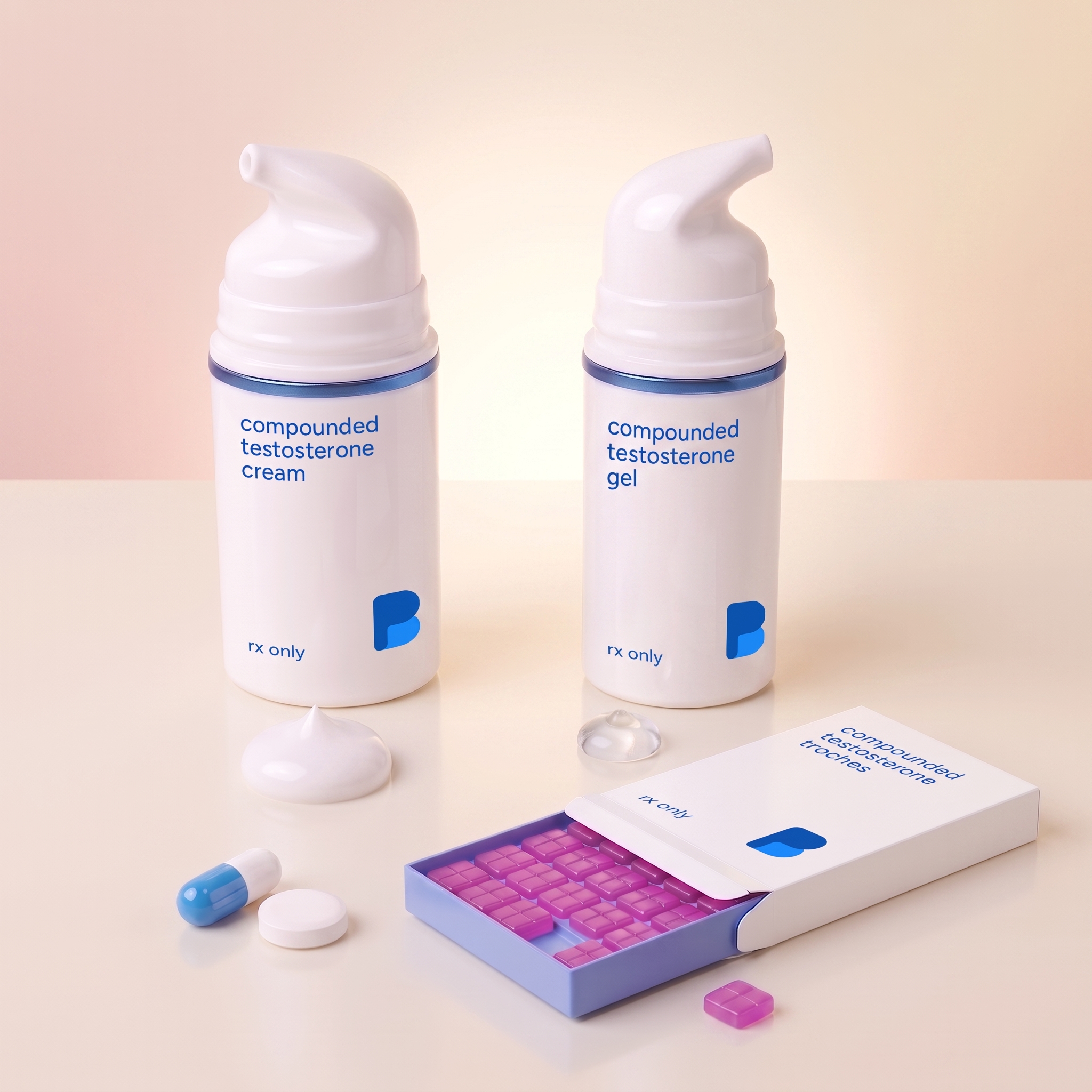
The consistent instructions across sources are to rotate sites rather than applying to the same patch of skin daily, to avoid genital application unless a prescriber has specifically directed it, to wash your hands after applying, and to keep the treated area covered or washed before skin-to-skin contact with anyone else. Never apply to broken, irritated, or freshly shaved skin.
Where to apply testosterone cream: women's site comparison
| Site | Skin type | Transfer risk |
|---|---|---|
| Inner thigh | Thin, commonly specified | Low, usually covered |
| Lower abdomen | Thin, large rotation area | Low, usually covered |
| Upper arm or shoulder | Site used in studies | Higher in short sleeves |
| Buttocks | Large rotation area | Low, almost always covered |
| Genital or vulvar | Very thin, highly vascular | Prescriber direction only |
| Broken or irritated | Absorption unpredictable | Avoid entirely |
Let the cream dry and cover the site with clothing, wash the area before close contact, and skip a site that a waistband, a shower, or exercise will disturb. The two things to take from that table: the site changes how much drug gets in, which is why you should not switch sites on your own, and every topical site carries some risk of transferring testosterone to another person by skin contact.

How to apply testosterone cream for women
The mechanics are simple, and following them consistently is what keeps your dose consistent.
- Apply to clean, dry, intact skin at the site your prescriber specified.
- Measure the dose with the metered pump or applicator the pharmacy dispensed. Do not estimate by eye or squeeze from the tube.
- Rub it in until it is absorbed, then let the area dry fully before dressing.
- Wash your hands thoroughly right after applying.
- Cover the site with clothing, and wash the site before skin-to-skin contact with a partner, a child, or anyone else in the household.
- Rotate through the sites your prescriber approved rather than using one spot every day.
- Apply at the same time each day, as directed on your label.
The transfer point is not a formality. Skin-to-skin contact can move testosterone from a treated person to someone else, and unintended exposure in children or in other women can cause signs of virilization. This mirrors the boxed warning carried by FDA-approved topical testosterone products. If a child or household member develops unexpected hair growth, acne, or other changes, contact your provider.
Compounded testosterone cream dosage: how much do you use?
How much you apply is your prescriber's decision, not something to work out from an article. Dose and appropriateness are clinical judgments made by the person who wrote your prescription, and the amount is on your label.

What can be reported is the framing the literature uses. The 2019 Global Consensus Position Statement on testosterone therapy for women describes the goal of therapy as achieving testosterone concentrations in the physiologic premenopausal range, and it advises against dosing that produces supraphysiologic (higher than normal for a premenopausal woman) concentrations. Female androgen dosing is an order of magnitude below male replacement dosing. Prescribers commonly order baseline and follow-up testosterone levels to check that the dose is landing where they intended.
The compounded strengths listed on the testosterone for women formulation page are given as ranges, because the pharmacy prepares whatever strength within that range the prescription specifies. A range on a page is not a dose recommendation. Do not adjust your own dose, add applications, or change sites without talking to your prescriber.
What does the 2019 Global Consensus Position Statement say?
This is the document most often cited on testosterone in women, and reporting it accurately means reporting the parts that cut both ways.
The statement was issued in 2019 by a group of international menopause and endocrine societies. Its position is that the only evidence-based indication for testosterone therapy in women is hypoactive sexual desire disorder in postmenopausal women. It does not endorse testosterone for other purposes in women, including energy, mood, cognition, bone, or general wellbeing, on the basis that the evidence does not support those uses.
On formulations, the statement recommends against the use of compounded testosterone where an approved female product is available, and it also states a preference for approved products generally, noting concerns about the blood concentrations that compounded and male-dosed products can produce. Because no product approved for women is marketed in the United States, American prescribers who decide to prescribe testosterone for a woman are working off-label either way: with a compounded preparation, or by using a fraction of a male product. That is the honest picture, and it is one to discuss with your prescriber rather than resolve on the internet.
Compounded testosterone cream for females: what forms and strengths exist
Bayview compounds testosterone for women in topical and oral forms on a prescriber's order. All of them are compounded preparations and none of them are FDA-approved.

| Form | Strength | Route | Status |
|---|---|---|---|
| Topical cream | 0.5 to 2 mg / 0.1 mL | Skin | Off-label, not FDA-approved |
| Topical gel (Atrevis) | 1 to 5 mg / gram | Skin | Off-label, not FDA-approved |
| Troche | 0.25 to 0.5 mg | Dissolved in mouth | Off-label, not FDA-approved |
| Rapid-dissolve tablet | 0.25 mg | Dissolved in mouth | Off-label, not FDA-approved |
The Atrevis gel is a water-free base, the topical forms go on the site your prescriber specifies, and the strengths shown are female dosing ranges rather than dose recommendations. Differences between forms are described here for education only, and are not a statement that any form or strength is better, stronger, or more effective than another. The oral forms (troche and rapid-dissolve tablet) do not involve an application site and carry no skin transfer risk, which is one of the practical differences a prescriber may weigh. More on that route is in our post on compounded sublingual medications.
What Bayview compounds for this
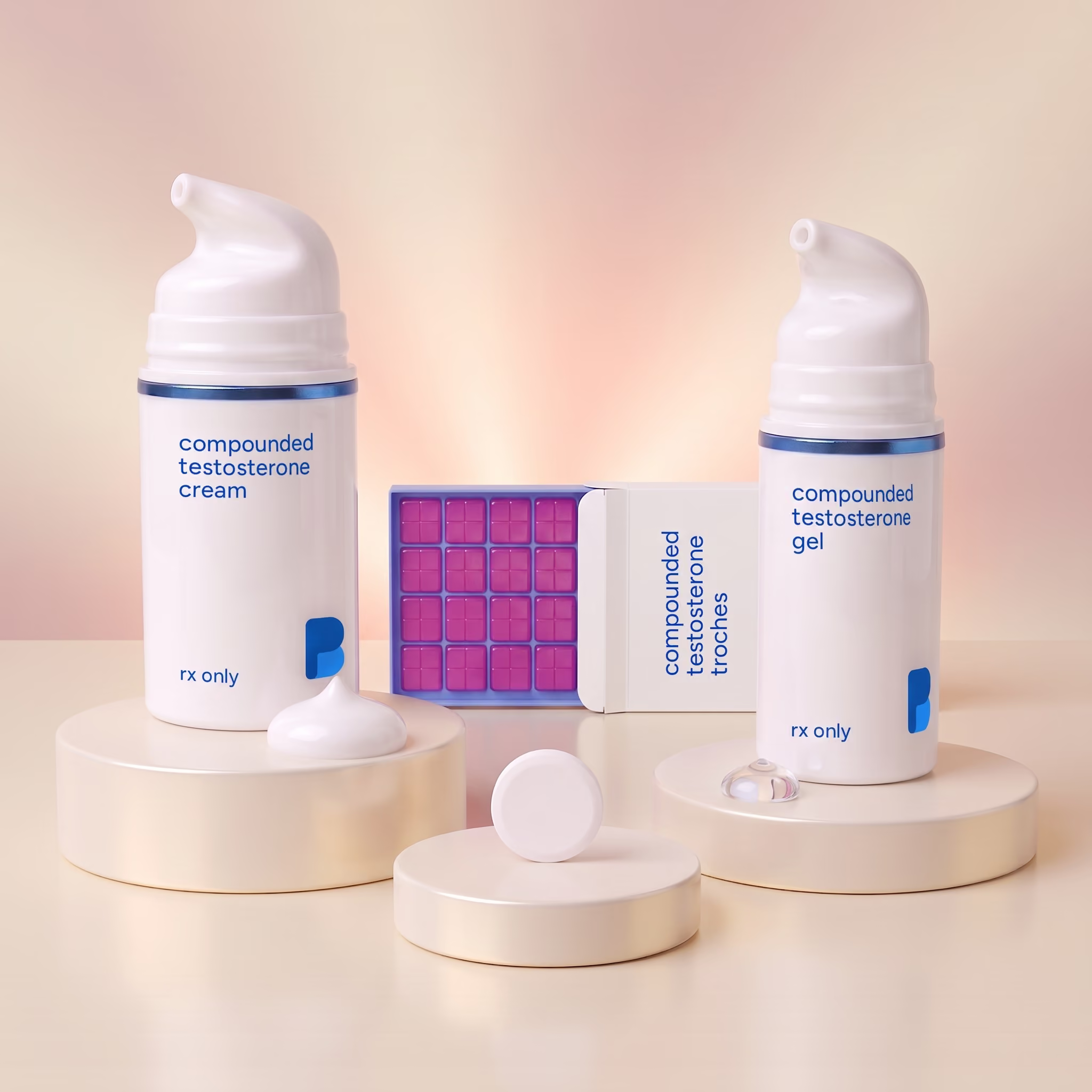
On a prescriber's order, Bayview prepares testosterone for women as a topical cream at 0.5 mg to 2 mg per 0.1 mL, an anhydrous topical gel at 1 mg to 5 mg per gram, a troche at 0.25 mg to 0.5 mg, and a rapid-dissolve tablet at 0.25 mg, dispensed with a metered pump for the topical forms. These are prepared in small batches under USP 795 non-sterile compounding standards, to the strength and form written on the prescription. Related women's hormone preparations include DHEA for women and Bi-Est; men's dosing is prepared separately as testosterone for men. The full range is in our compounded medications catalog.
What does it cost?
Compounded testosterone for women starts at $90 for a 45 g pump at Bayview. Compounded preparations are generally paid in cash rather than billed through a pharmacy benefit, because they do not carry the national drug codes insurers adjudicate against. We can quote your specific strength and quantity before anything is prepared. The background on billing is in our post on whether compounding pharmacies take insurance.
Talk to your prescriber
Whether testosterone is appropriate for you, which form, which strength, which site, and how often are all decisions for your prescriber. Bayview does not provide consultations and does not decide whether a medication is right for you. If your prescriber agrees a compounded preparation is appropriate, they can send it to us electronically, and we can fill and ship to the states where Bayview is licensed. Details are on our FAQ page, and if you are looking for a compounding pharmacy locally, our post on finding a compounding pharmacy near you covers what to ask.
Frequently asked questions
How is testosterone for women dosed differently than for men?
Women's doses are a fraction of male replacement doses, chosen to keep testosterone within a woman's normal physiologic range. That is one reason it is compounded, so the strength and form can be tailored to a much lower dose than manufactured products for men provide.
Can women take testosterone?
Testosterone is present in women at much lower levels than in men, and a provider may include it in hormone therapy for some women at correspondingly low doses. Whether it is appropriate is a decision your provider makes.
Is testosterone a controlled substance?
Yes. Testosterone is a Schedule III controlled substance under federal law (some states classify it more strictly). That means a provider must e-prescribe it (EPCS) and hold a valid DEA registration, and there are limits on refills and quantities.
Where do you put testosterone cream on a woman?
The sites reported in the literature and in prescribing directions are the inner thigh, the lower abdomen, the upper arm or shoulder, and the buttocks, with the site rotated rather than used in the same spot daily. Your prescriber chooses the site and writes it on your label. Genital application is not used unless your prescriber specifically directs it. Do not apply to broken, shaved, or irritated skin.
How much testosterone cream should a woman use?
That is your prescriber's decision and it is written on your label. The 2019 Global Consensus Position Statement describes the aim of therapy as concentrations in the physiologic premenopausal range, and advises against dosing that produces higher than normal levels. Compounded strengths are listed as ranges because the pharmacy prepares whatever the prescription specifies. Measure with the metered pump provided and do not adjust on your own.
Can testosterone cream transfer to my partner or children?
Yes. Skin-to-skin contact can transfer testosterone from a treated person to someone else, and unintended exposure in children or other women can cause signs of virilization. This mirrors the boxed warning on FDA-approved topical testosterone products. Wash your hands after applying, let the site dry, keep it covered with clothing, and wash the area before close contact. Contact your provider about any new symptom in an exposed household member.
Is compounded testosterone cream for women FDA-approved?
No. There is no FDA-approved testosterone product for women in the United States, and compounded preparations are not FDA-approved. Use of testosterone in women is off-label. The 2019 Global Consensus Position Statement supports testosterone in women only for hypoactive sexual desire disorder in postmenopausal women, and recommends against compounded products where an approved female product is available. Discuss the tradeoffs with your prescriber.
What forms does compounded testosterone for women come in?
Bayview prepares it as a topical cream at 0.5 mg to 2 mg per 0.1 mL, an anhydrous topical gel at 1 mg to 5 mg per gram, a troche at 0.25 mg to 0.5 mg, and a rapid-dissolve tablet at 0.25 mg, all on a prescriber's order. Topical forms are dispensed with a metered pump. The oral forms have no application site and no skin transfer risk. None of these are FDA-approved.
How much does compounded testosterone cream for women cost?
It starts at $90 for a 45 g pump at Bayview. Compounded preparations are generally paid in cash rather than billed through a pharmacy benefit, because they do not carry the national drug codes insurers adjudicate against. Price varies with the strength, form, and quantity your prescriber orders, so call with the prescription in hand and we can quote it before anything is prepared.
Do I need a special prescription for testosterone?
Testosterone is a Schedule III controlled substance under federal law, and some states schedule it more strictly. It is dispensed only on a prescription written for a named patient, and your provider must send it by electronic prescribing for controlled substances with a valid DEA registration. It cannot be phoned in or faxed, refill and quantity limits apply, and controlled substances are not shipped to New York addresses.
What Bayview compounds for this
Important: Compounded medications are prepared to a prescriber's order for an individual patient. They are not FDA-approved, and the FDA has not evaluated them for safety, effectiveness, or manufacturing quality. This article is educational and is not a substitute for advice from your prescriber or pharmacist.
This preparation contains a controlled substance. Controlled-substance prescriptions carry refill limits, must be e-prescribed, and can only be shipped to states where Bayview holds the required licensure.
Uses discussed here may be off-label, meaning they are not part of any FDA-approved labeling. Off-label use is a decision for you and your prescriber, based on the available evidence.
Veterinary preparations are compounded to a veterinarian's order for a specific animal and are not FDA-approved animal drugs. Never give a compounded human medication to an animal without veterinary direction.
Compounded prescriptions are paid for directly rather than billed through insurance. Most are HSA/FSA-eligible, and many patients submit the receipt to their plan for possible reimbursement. Pricing depends on the strength, dose form and quantity your prescriber orders. Read more about cost and insurance.
Compounded testosterone for women starts at $90 for a 45 g pump at Bayview, and the final price depends on the strength, form, and quantity your prescriber orders. Compounded preparations are generally paid in cash rather than billed through a pharmacy benefit, because they are prepared to an individual prescription and do not carry the national drug codes pharmacy benefit managers adjudicate against. Call us with the prescription in hand and we can quote the price before anything is prepared.
Bayview Pharmacy is an NABP-accredited compounding pharmacy in Warwick, Rhode Island, licensed to fill and ship compounded prescriptions for patients in Rhode Island, Massachusetts, Connecticut, New Jersey, New Hampshire, Florida, New York and Maine. Controlled substances are not shipped to New York addresses. See where we ship and how to get started.