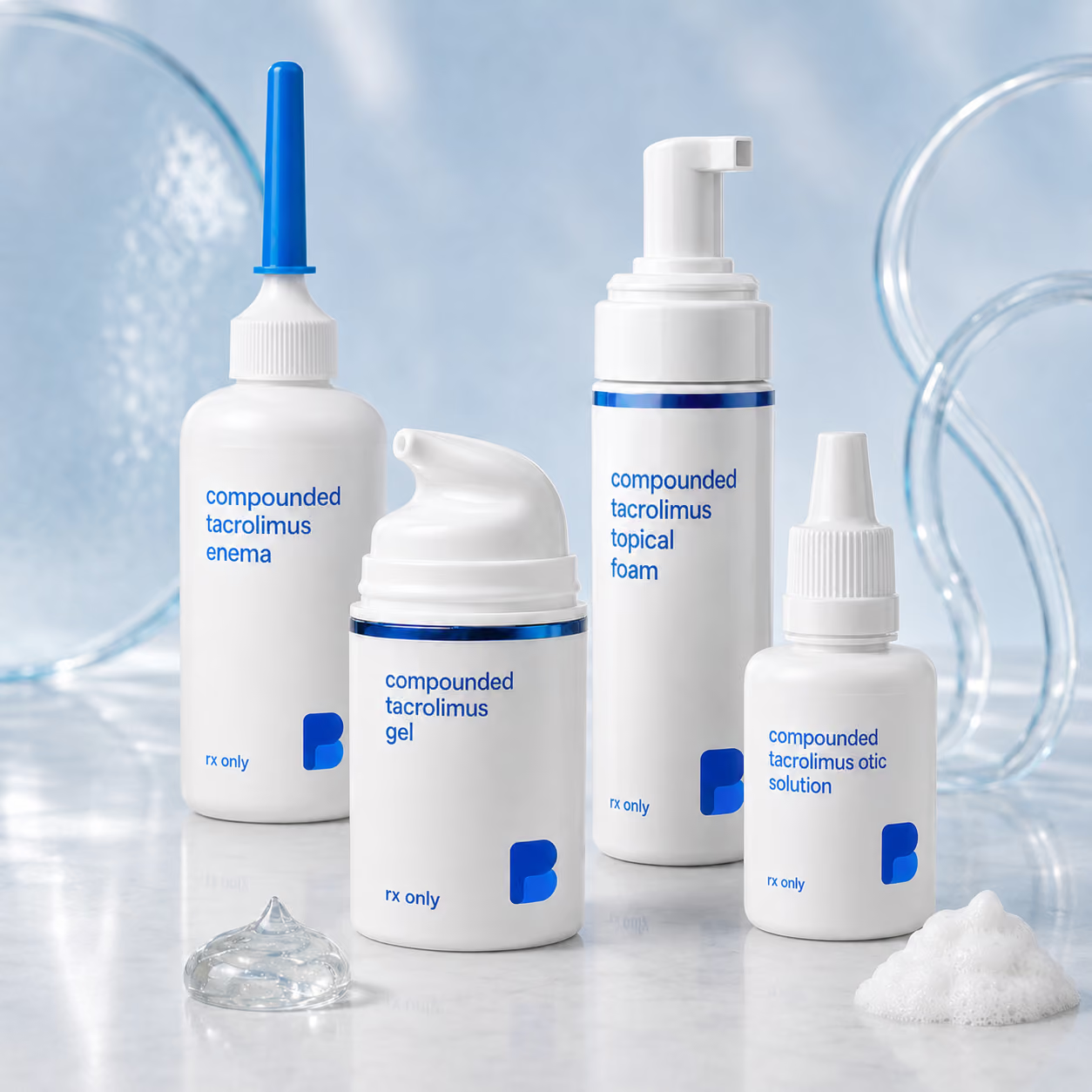
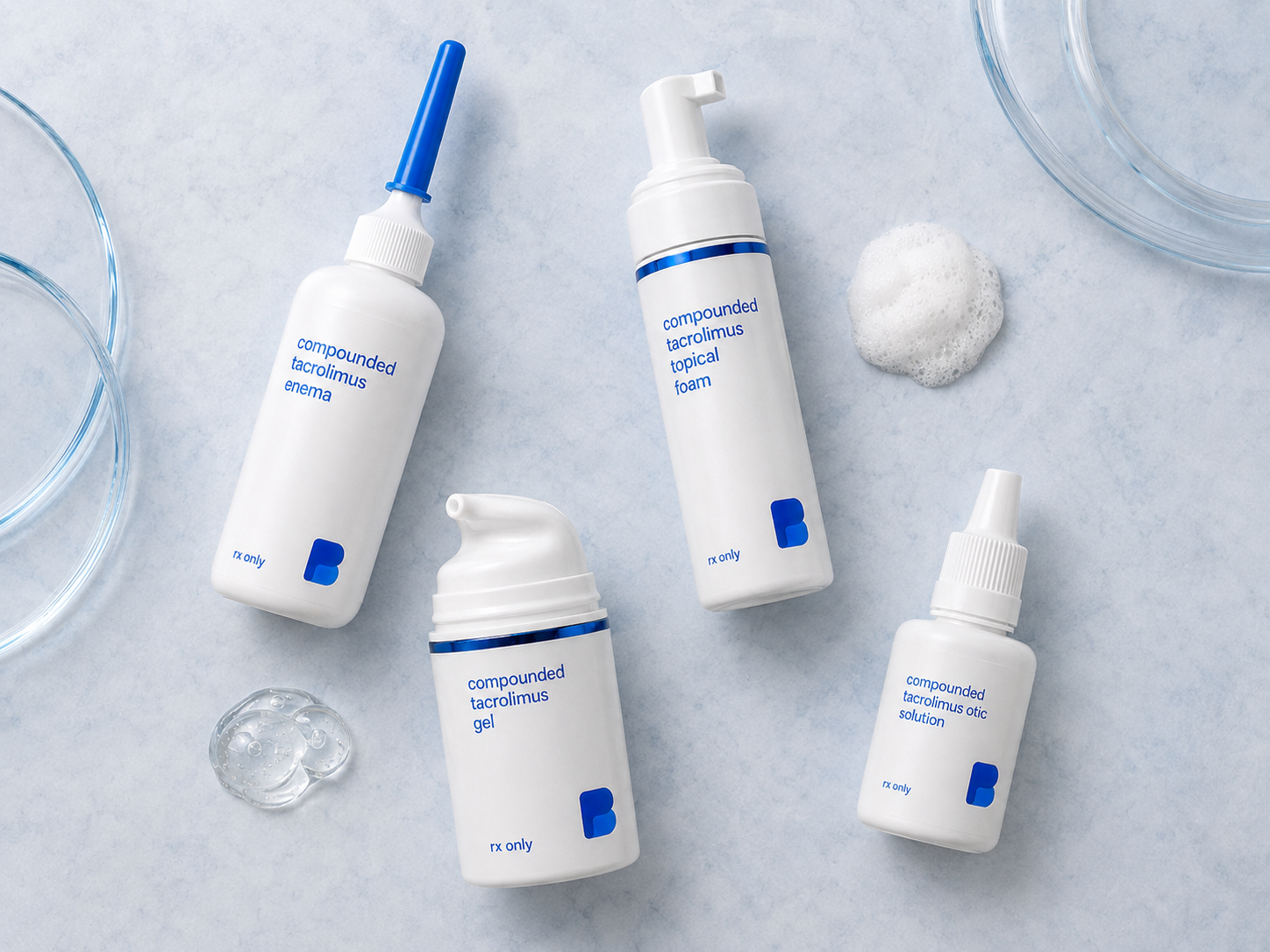
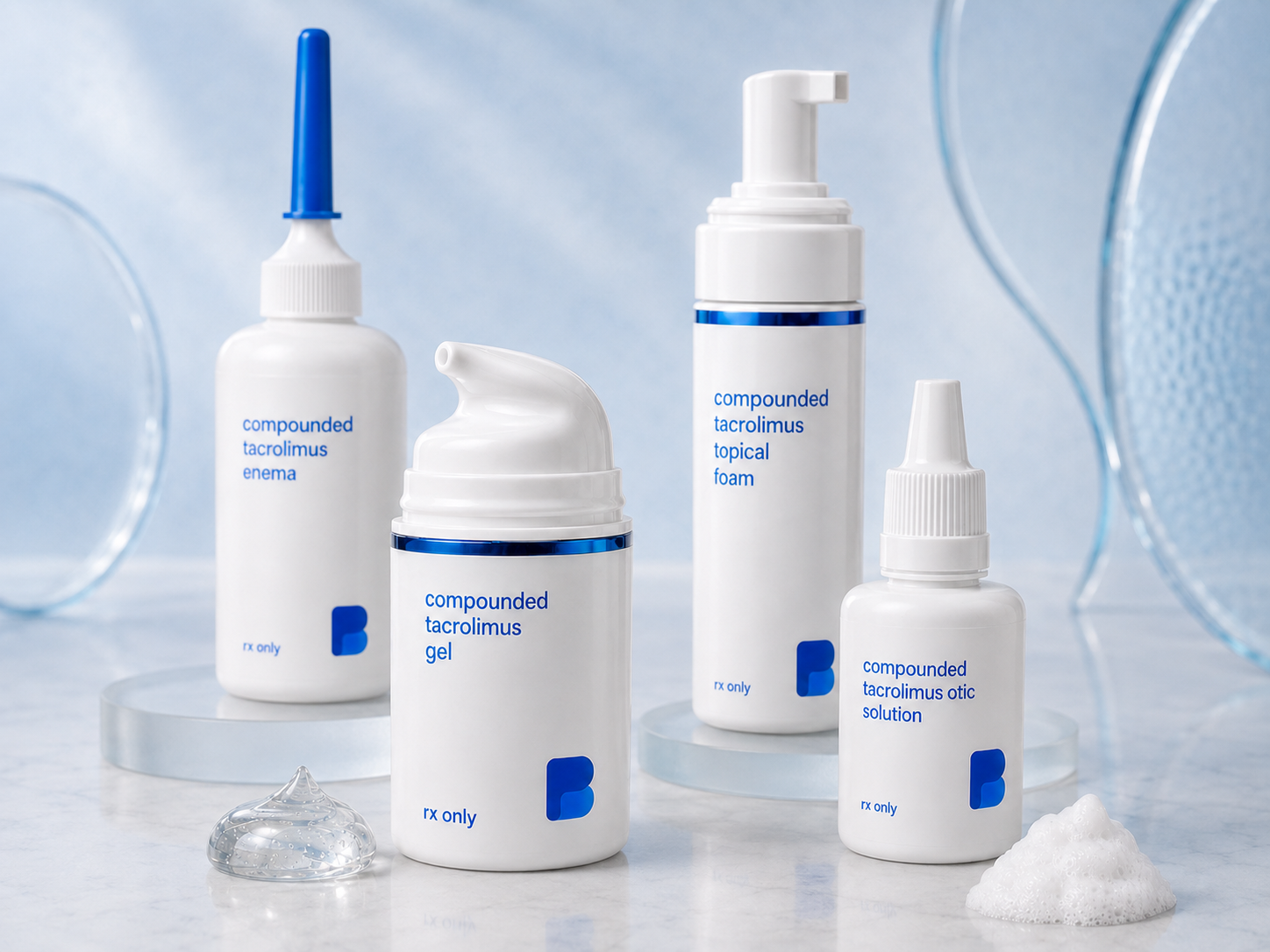
Tacrolimus ointment costs what it costs for structural reasons, not because pharmacies mark it up: it came to market as a brand (Protopic), it went years with very little generic competition, and it is a topical that insurers tend to place on a specialty or non-preferred tier behind a prior authorization. Compounding does not solve that problem, and it is not a workaround for it. What a compounding pharmacy does is different: compounded tacrolimus preparations are made on a prescriber's order in forms and strengths no manufacturer makes, such as ear drops, rectal enemas, gels, foams, and scalp solutions, and they are priced as cash preparations rather than as a cheaper version of the ointment.
Why is tacrolimus ointment so expensive?
Four things stack up. None of them are about the pharmacy that hands you the tube.
It started as a brand, and the brand set the reference price
Tacrolimus ointment was approved as Protopic, a first-in-class topical calcineurin inhibitor. Products that arrive as the only member of a new class are priced against the value of being new, not against the cost of the ingredients, and that opening price becomes the anchor everything after it is measured against.
Generic competition arrived late and stayed thin
Generic tacrolimus ointment now exists, but it took years to appear, and topical generics in general have not multiplied the way oral tablet generics do. Topicals are harder to manufacture and harder to prove equivalent, which means fewer manufacturers enter, and price drops less than people expect.
The active ingredient itself is not cheap
Tacrolimus is an expensive active pharmaceutical ingredient. That is true for the manufacturer and it is true for us. In compounded tacrolimus preparations, the drug substance drives most of the cost rather than the base, the container, or the volume.
Insurance tiering and prior authorization
Even when a plan covers tacrolimus ointment, it is often placed on a higher tier with step therapy attached: try a topical corticosteroid such as triamcinolone or fluocinonide first, document that it did not work or is not appropriate, then request the calcineurin inhibitor. Every one of those steps is a place the prescription can stall, and a denied or unprocessed prior authorization turns a covered drug into a full retail purchase at the counter. If you want the longer version of how coverage works for compounded and non-covered prescriptions, we wrote about that in do compounding pharmacies take insurance.
What is tacrolimus ointment used for?
The only FDA-approved topical use is moderate to severe atopic dermatitis (eczema), and the label describes it as second-line, short-term and non-continuous therapy for people who did not respond well to other topical prescription treatments or for whom those treatments are not advisable. The ointment comes in two strengths: 0.03%, approved for ages 2 through 15, and 0.1%, approved for age 16 and older. Neither is approved for children under 2.

Tacrolimus is also manufactured as oral capsules, oral granules, and an injection, all used to prevent organ transplant rejection. Those are separate products with separate labeling, and they are not interchangeable with anything applied to skin.
Prescribers also use topical tacrolimus off-label for conditions such as vitiligo, oral lichen planus, and inflammation of the ear canal or scalp. Off-label means the FDA has not reviewed the drug for that use. It does not mean it is prohibited, and it does not mean the evidence is strong. For most of these uses the published record is small studies and case series.
Is tacrolimus a steroid?
No. Tacrolimus is a calcineurin inhibitor, a different class of drug entirely.
Corticosteroids like triamcinolone, fluocinonide, and hydrocortisone are hormone-like molecules that act broadly on inflammation and also act on the structural tissue of the skin. That second effect is the reason long courses can lead to skin thinning, stretch marks, and visible small blood vessels.
Tacrolimus works by a narrower mechanism. Inflammation in conditions like eczema is driven largely by immune cells called T cells, and a T cell needs an internal signal relayed by an enzyme called calcineurin in order to switch on. Tacrolimus blocks calcineurin, so that signal does not get through, and the local chemical messengers that produce redness, swelling, and itch are turned down. It has no corticosteroid effect on collagen, which is why prescribers describe it as steroid-sparing and why it turns up on the face, eyelids, skin folds, and the ear canal, where repeated steroid use is a problem.
Is tacrolimus ointment a steroid?
The same answer applies to the ointment specifically. Tacrolimus ointment 0.03% and 0.1% contains no corticosteroid. If a prescription is described to you as a "steroid cream" and the ingredient is tacrolimus, the description is wrong. Note that some prescriber-designed compounded combinations do pair tacrolimus with a corticosteroid (a scalp foam combining minoxidil, tacrolimus, and clobetasol, for example), so read the label of the specific preparation you were given rather than assuming.
The boxed warning you should know about
Topical calcineurin inhibitors carry an FDA boxed warning. The approved tacrolimus ointment label states that although a causal relationship has not been established, rare cases of malignancy, including skin cancer and lymphoma, have been reported in patients treated with topical calcineurin inhibitors. The label directs avoiding continuous long-term use, applying only to affected areas, and not using it in children under 2. The FDA added the warning in 2006, citing that long-term safety had not been established.
Since then, larger studies have not confirmed a causal link, and the American Academy of Dermatology describes these medicines as having a good safety record when used as directed while noting that the risk of developing cancer remains unknown. The honest summary is that the warning is still on the label, the evidence has not proven the risk is real, and the evidence has not proven it is not. That is a conversation to have with your prescriber before starting, not after.
Does tacrolimus ointment lighten skin?
Hypopigmentation is not a listed effect of topical tacrolimus in the approved labeling, and the drug is not a skin-lightening agent. The confusion usually comes from the opposite direction: topical tacrolimus has been studied off-label in vitiligo, a condition of pigment loss, particularly on the face and neck, where prescribers want a steroid-sparing option for delicate skin. The published reports there describe repigmentation as slow, partial, and inconsistent, and the evidence base is not large or definitive.

Treated skin can be more sensitive to sunlight, and the AAD advises staying out of the sun while a topical calcineurin inhibitor is part of the plan, avoiding tanning beds, and not using phototherapy at the same time. Sun exposure changes how treated and untreated skin look next to each other, which is another reason people report an apparent color change.
Does tacrolimus cause hair loss?
Hair loss is not a listed effect of topical tacrolimus in the approved labeling. Again the literature runs the other way: topical tacrolimus has been studied off-label in alopecia areata and in scalp inflammation, mostly in case reports and small series, which is the weakest evidence of any route it is used for. Combination scalp preparations, such as a foam pairing minoxidil, tacrolimus, and clobetasol, are prescriber-designed formulas rather than studied products.
Oral tacrolimus, used systemically after transplant, is a different situation with its own reported effects, and it should not be read across to something applied to skin. If scalp shedding is the concern and the underlying problem is a fungal or seborrheic scalp condition, that is a separate question, and prescribers sometimes reach for an antifungal such as ciclopirox instead.
What compounding changes, and what it does not
Compounded tacrolimus is not a copy of the ointment and it is not a substitute for it. Where an FDA-approved product already exists in the form and strength a patient needs (the 0.03% and 0.1% ointments, the oral capsules, the injection), that approved product is available through any pharmacy, and duplicating it is not what a 503A pharmacy is for. What a compounding pharmacy makes is the rest of the list: the routes no manufacturer supplies.

| Form | Route | Status |
|---|---|---|
| Ointment 0.03%, 0.1% | Skin | FDA-approved (atopic dermatitis) |
| Otic solution 0.1%, 0.2% | Ear canal | Compounded, not FDA-approved, off-label |
| Rectal enema 4 mg/60 mL | Rectal | Compounded, not FDA-approved, off-label |
| Anhydrous gel 0.1% | Skin or mouth | Compounded, not FDA-approved, off-label |
| Cream 0.1% with ketotifen | Skin | Compounded, not FDA-approved, off-label |
| Shampoo 0.1% | Scalp | Compounded, not FDA-approved, off-label |
| Foam with minoxidil, clobetasol | Scalp | Compounded, not FDA-approved, off-label |
The approved ointment is labeled second-line, short-term and non-continuous, with 0.03% for ages 2 to 15 and 0.1% for age 16 and older, and the bases and combination strengths (WO6 gel, ketotifen 0.05%, VersaBase shampoo, minoxidil 5% with clobetasol 0.05%) are listed in the section below.
Compounded preparations are not FDA-approved and are not reviewed by the FDA for safety or effectiveness. The evidence behind these routes varies: the rectal route has one small randomized trial plus case series, the otic and oral lichen planus routes rest on small studies and open-label work, and the scalp route is mostly case reports.
What Bayview compounds for this
On a prescriber's order, Bayview prepares tacrolimus as a 0.1% or 0.2% otic solution (15 or 30 mL), a 4 mg per 60 mL rectal enema, a 0.1% anhydrous gel in a WO6 base (30 g), a 0.1% cream with ketotifen 0.05% (60 g), a 0.1% shampoo in VersaBase (60 or 100 mL), and a minoxidil, tacrolimus, and clobetasol 5%/0.3%/0.05% scalp foam (30 mL). Custom strengths, bases, and combinations are prepared to order under USP 795 non-sterile compounding. The full list of what we make is in our compounded medications catalog, and the detail for this one lives on the compounded tacrolimus formulation page.
What it costs, and how to order
Compounded tacrolimus at Bayview starts at $122 for a 15 mL otic solution. Price varies with the form, strength, base, and quantity, and because tacrolimus is an expensive active ingredient, the drug itself drives most of the total. These are cash-priced preparations that are generally eligible for HSA and FSA cards, and we quote the price before we compound anything: call 401-284-4505 with the preparation and quantity your prescriber ordered.
If one of these routes is something you want to ask about, ask your prescriber, not us. Bayview Pharmacy does not provide consultations and does not determine whether a medication is appropriate for you. Your prescriber selects the preparation, strength, and schedule, and if they decide a compounded form is appropriate, they can send the prescription to Bayview Pharmacy, 3844 Post Rd, Warwick, RI 02886 (NCPDP 4106882) or fax 401-284-4506, and we can fill and ship it within the states where Bayview is licensed. Details are on our FAQ page.
Frequently asked questions
How much does compounded tacrolimus cost?
Compounded tacrolimus starts at $122 for a 15 mL otic solution, and the price varies with the form, strength, base, and quantity. Tacrolimus is an expensive active ingredient, so the drug itself drives most of the cost rather than the base or the container size. Compounded preparations are cash-priced and are generally eligible for HSA and FSA cards. Call us at 401-284-4505 with the preparation and quantity your prescriber ordered and we will quote it before we make it.
Can tacrolimus be used on the face or eyelids?
Being steroid-sparing is the reason prescribers consider it there. Tacrolimus does not thin the skin the way long-term topical corticosteroids can, so it is often chosen for delicate areas such as the face, eyelids, skin folds, and the ear canal. Use it only on the areas your prescriber specifies, protect treated skin from the sun, and do not cover the area with bandages or wraps unless you are told to, since covering increases absorption.
How long does tacrolimus take to work?
Tacrolimus works gradually rather than immediately, and burning or stinging in the first few days is common and usually fades as the skin settles. The approved ointment label directs treating for a defined stretch rather than continuously, and prescribers generally set a course length and a point to reassess. Ask your prescriber what result they are expecting and by when they will decide whether it is working — a fair question for any treatment, and particularly for the compounded routes, where the supporting evidence is limited.
Is tacrolimus an immunosuppressant?
Yes. Tacrolimus is a calcineurin inhibitor, a type of immunosuppressant. Taken by mouth or given by injection it suppresses the immune system throughout the body, which is why it is used after organ transplants. Applied to one area, it acts mostly at that spot, and very little normally reaches the bloodstream through intact skin — though absorption rises when skin is broken or inflamed, and it is more of a consideration with the rectal route. Because local immunity is damped down where it is applied, skin infections such as cold sores, shingles, and warts can occur or spread more easily.
Does Bayview compound tacrolimus ointment?
No. Tacrolimus ointment 0.03% and 0.1% is a commercially manufactured, FDA-approved product available through any pharmacy, so there is no reason to compound a version of it. Bayview compounds the forms no manufacturer makes: otic solutions, rectal enemas, anhydrous gels, creams, foams, and shampoos, plus prescriber-designed combinations such as tacrolimus with ketotifen. Those preparations are used off-label and are not FDA-approved.
What is the difference between tacrolimus 0.03% and 0.1%?
Those are the two strengths of the commercially manufactured ointment. The FDA-approved label covers 0.03% for ages 2 through 15 and 0.1% for age 16 and older, and neither strength for children under 2. A higher percentage is not automatically the better choice, since more tacrolimus in contact with inflamed or broken skin also means more of it is absorbed. Compounded tacrolimus is most often prepared at 0.1%, with 0.2% used in otic solutions. Your prescriber selects the strength.
What forms does tacrolimus come in?
Commercially, tacrolimus is manufactured as a topical ointment in 0.03% and 0.1%, as oral capsules and granules, and as an injection. Everything else — ear drops, rectal enemas, anhydrous gels, creams, foams, and shampoos — is compounded to a prescriber's order and used off-label, because no manufacturer makes tacrolimus in those forms. Compounded preparations are not FDA-approved.
How should I store my preparation?
Follow the storage instructions on your label, since they depend on the base and the form, an otic solution, an enema, a gel, a cream, a foam, and a shampoo are not all kept the same way. Keep it out of the reach of children, use it by the beyond-use date on the label, and do not share it. Call us if anything on the label is unclear.
Do I need to protect treated skin from the sun?
Yes. Protect treated areas from sunlight, avoid tanning beds, and do not use phototherapy while you are using tacrolimus. Cover up or use sunscreen on exposed areas as your prescriber advises. Also avoid applying it to infected skin, and do not bandage or wrap a treated area unless your prescriber tells you to, since covering it increases how much is absorbed.
Why are the ear, rectal, and scalp forms compounded?
No manufacturer makes a tacrolimus ear drop, rectal enema, gel, foam, or shampoo, so each one is compounded to the prescriber's order and used off-label. These routes are supported mainly by small studies and case series rather than large trials, so the evidence behind them is limited. Compounded preparations are not FDA-approved, and your prescriber decides whether one is appropriate for you.
Will it burn when I apply it?
Often, yes. Burning, stinging, warmth, or itching where you apply it is common, especially in the first days of treatment, and it usually eases as your skin settles. Tell your prescriber if it is severe or does not improve, and report new blisters, sores, or a spreading rash, tacrolimus lowers local immunity, so skin infections such as cold sores, shingles, and warts can occur or spread.
What is the boxed warning about?
The FDA-approved tacrolimus ointment label carries a boxed warning that rare cases of malignancy, including skin cancer and lymphoma, have been reported in people treated with topical calcineurin inhibitors, although a causal relationship has not been established. FDA added it in 2006 because long-term safety had not been established.
Larger studies since then have not confirmed a causal link, but the warning is still on the label today. The label directs avoiding continuous long-term use and applying only to affected areas. This is worth discussing directly with your prescriber.
How is this different from a steroid?
Tacrolimus is a calcineurin inhibitor, not a corticosteroid. It quiets the immune activity driving inflammation in the area where it is applied, and it does not thin the skin the way long-term topical steroids can. That is why prescribers reach for it on delicate places such as the face, eyelids, skin folds, and the ear canal, and for longer stretches of treatment.
Is tacrolimus a steroid?
No. Tacrolimus is a calcineurin inhibitor. It blocks an enzyme that T cells need in order to switch on, which turns down local inflammatory signaling. Corticosteroids such as triamcinolone and fluocinonide work by a different mechanism and also act on the structural tissue of the skin, which is why long courses can thin it. Tacrolimus has no corticosteroid effect on collagen.
What is tacrolimus ointment used for?
The only FDA-approved topical use is moderate to severe atopic dermatitis (eczema), described on the label as second-line, short-term and non-continuous therapy. The ointment comes in 0.03% (ages 2 through 15) and 0.1% (age 16 and older), and neither strength is approved under age 2. Prescribers also use topical tacrolimus off-label for conditions such as vitiligo and oral lichen planus.
Does tacrolimus ointment lighten skin?
Hypopigmentation is not a listed effect in the approved labeling, and tacrolimus is not a skin-lightening agent. The association usually comes from the opposite direction: topical tacrolimus has been studied off-label in vitiligo, a condition of pigment loss, where reported repigmentation is slow, partial, and inconsistent. Treated skin can also be more sun-sensitive, which changes how areas look next to each other.
Does tacrolimus cause hair loss?
Hair loss is not a listed effect of topical tacrolimus in the approved labeling. Topical tacrolimus has instead been studied off-label in alopecia areata and scalp inflammation, mostly in case reports and small series, which is the thinnest evidence of any route it is used for. Oral tacrolimus used after transplant is a separate product with its own reported effects.
Why is tacrolimus ointment so expensive?
It launched as a brand in a new drug class, and that opening price set the reference point. Generic tacrolimus ointment arrived late, and topical generics tend to attract fewer manufacturers than oral tablets, so prices fall less. Tacrolimus is also an expensive active ingredient. Plans commonly place it on a higher tier behind step therapy and prior authorization, which can leave patients paying retail.
Is compounded tacrolimus the same as Protopic?
No. Compounded tacrolimus is not a copy of, substitute for, or equivalent to any FDA-approved product. Where the approved ointment already exists in the form and strength needed, it is available through any pharmacy. A compounding pharmacy prepares the forms no manufacturer makes: otic solutions, rectal enemas, anhydrous gels, creams, foams, and shampoos. These are compounded, off-label, and not FDA-approved.
What is the boxed warning on tacrolimus ointment?
The approved label states that although a causal relationship has not been established, rare cases of malignancy including skin cancer and lymphoma have been reported in patients treated with topical calcineurin inhibitors. The FDA added it in 2006. The label directs avoiding continuous long-term use, applying only to affected areas, and not using it under age 2. Discuss it with your prescriber.
How much does compounded tacrolimus cost at Bayview?
Compounded tacrolimus starts at $122 for a 15 mL otic solution. The price varies with the form, strength, base, and quantity, and because tacrolimus is an expensive active ingredient, the drug substance drives most of the total. These are cash-priced preparations, generally eligible for HSA and FSA cards. Call 401-284-4505 with the preparation and quantity ordered and we will quote it before compounding.
What Bayview compounds for this
Important: Compounded medications are prepared to a prescriber's order for an individual patient. They are not FDA-approved, and the FDA has not evaluated them for safety, effectiveness, or manufacturing quality. This article is educational and is not a substitute for advice from your prescriber or pharmacist.
This preparation contains a controlled substance. Controlled-substance prescriptions carry refill limits, must be e-prescribed, and can only be shipped to states where Bayview holds the required licensure.
Uses discussed here may be off-label, meaning they are not part of any FDA-approved labeling. Off-label use is a decision for you and your prescriber, based on the available evidence.
Veterinary preparations are compounded to a veterinarian's order for a specific animal and are not FDA-approved animal drugs. Never give a compounded human medication to an animal without veterinary direction.
Compounded prescriptions are paid for directly rather than billed through insurance. Most are HSA/FSA-eligible, and many patients submit the receipt to their plan for possible reimbursement. Pricing depends on the strength, dose form and quantity your prescriber orders. Read more about cost and insurance.
Compounded tacrolimus at Bayview starts at $122 for a 15 mL otic solution, with the final price depending on the form, strength, base, and quantity; tacrolimus is an expensive active ingredient, so the drug substance drives most of the cost rather than the base or container. Compounded preparations are not FDA-approved and are not billed through insurance, because insurers cover FDA-approved products by NDC and a compounded preparation does not have one. They are cash-priced and generally eligible for HSA and FSA cards, and we quote the price before we compound anything.
Bayview Pharmacy is an NABP-accredited compounding pharmacy in Warwick, Rhode Island, licensed to fill and ship compounded prescriptions for patients in Rhode Island, Massachusetts, Connecticut, New Jersey, New Hampshire, Florida, New York and Maine. Controlled substances are not shipped to New York addresses. See where we ship and how to get started.