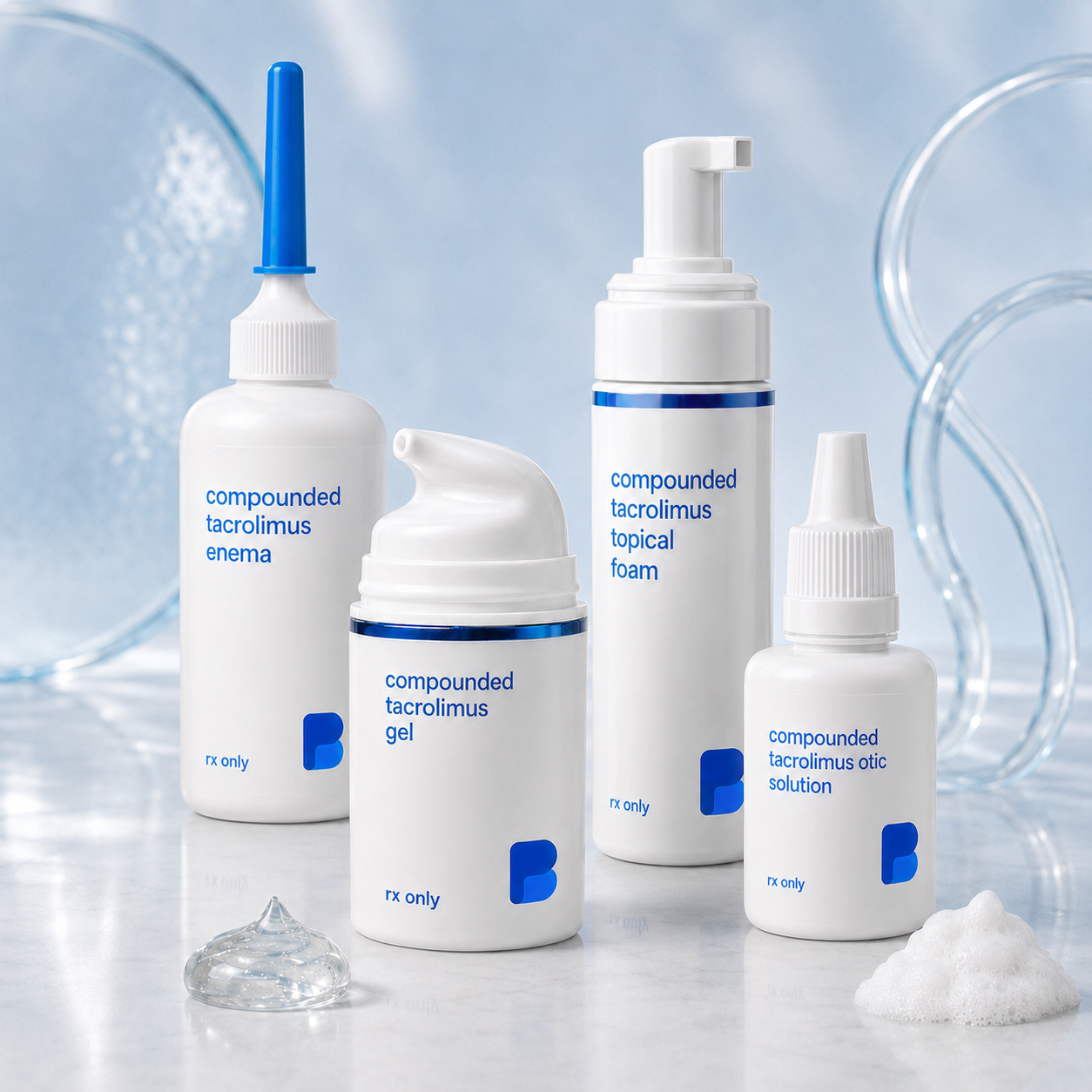
Compounded tacrolimus is a prescription calcineurin inhibitor prepared in dosage forms no manufacturer makes: otic solutions, rectal enemas, anhydrous gels, creams, foams, and shampoos. Only the 0.03% and 0.1% topical ointment, the oral capsules and granules, and the injection are FDA-approved. The compounded forms are off-label, they are not FDA-approved, and they exist only because a compounding pharmacy prepares them. Bayview compounds Tacrolimus Ointment & Compounded Forms to the strength, base, and quantity written on the order.
This guide is written for prescribers. It covers what is approved and what is not, how the boxed warning for topical calcineurin inhibitors currently reads, what the published literature does and does not support route by route, the strengths and sizes Bayview prepares, and how to write the prescription. Tacrolimus is not a controlled substance. Preparation, strength, course length, and whether tacrolimus is appropriate for a given patient are your decisions, not the pharmacy's.
Is tacrolimus a steroid?
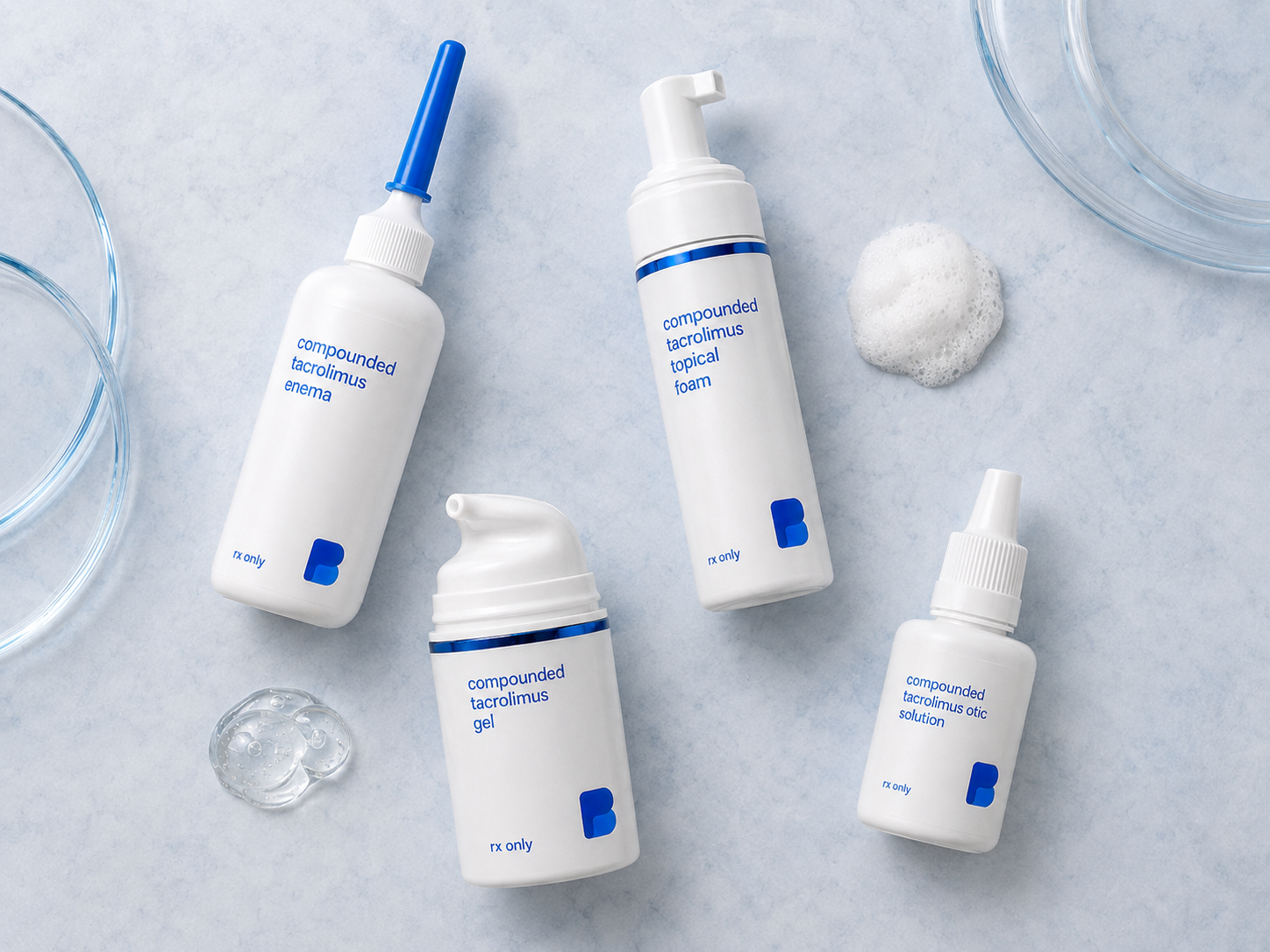
No. Tacrolimus is a calcineurin inhibitor. It binds FKBP-12, inhibits calcineurin phosphatase, and blocks NFAT-mediated transcription of interleukin-2 and other pro-inflammatory cytokines, which suppresses T-cell activation locally. There is no corticosteroid effect on collagen, so atrophy, striae, and telangiectasia are not part of its profile. That is the stated basis for use on the face, eyelids, flexures, and the external auditory canal, and the reason the class is described as steroid-sparing.
If you are weighing tacrolimus against a topical corticosteroid, our topical steroid potency chart lays out the classes side by side. Bayview also compounds Fluocinonide Cream, Ointment & Oral Paste and Triamcinolone Acetonide Cream, Ointment & Oral Rinse when a corticosteroid is the intended agent, and clobetasol for lichen sclerosus covers an anogenital example where potency and duration carry most of the decision.
Percutaneous absorption is low through intact skin but rises with barrier disruption, erythroderma, occlusion, and mucosal or rectal administration. That gradient drives the monitoring question later on this page.
Which tacrolimus forms are FDA-approved, and which are compounded?
| Form and strength | Route | FDA status | Source |
|---|---|---|---|
| Ointment 0.03% and 0.1% | Skin | FDA-approved | Manufactured |
| Capsules and granules | Oral | FDA-approved | Manufactured |
| Injection | Intravenous | FDA-approved | Manufactured |
| Otic solution 0.1% or 0.2% | Ear canal | Off-label | Compounded |
| Rectal enema 4 mg/60 mL | Rectal | Off-label | Compounded |
| Anhydrous gel 0.1%, WO6 base | Skin or mouth | Off-label | Compounded |
| Cream 0.1% plus ketotifen 0.05% | Skin | Off-label | Compounded |
| Shampoo 0.1%, VersaBase | Scalp | Off-label | Compounded |
| Minoxidil/tacrolimus/clobetasol foam | Scalp | Off-label | Compounded |
| Custom strengths and combinations | As prescribed | Off-label | Compounded |
The Off-label token in that table means there is no FDA-approved tacrolimus product in that dosage form at all, so the preparation is compounded and the use is off-label on both counts. The approved ointment is indicated for moderate-to-severe atopic dermatitis as second-line, short-term and non-continuous therapy in non-immunocompromised patients, with 0.03% labeled for ages 2 to 15 and 0.1% for 16 and older. Neither strength is labeled for children under 2.

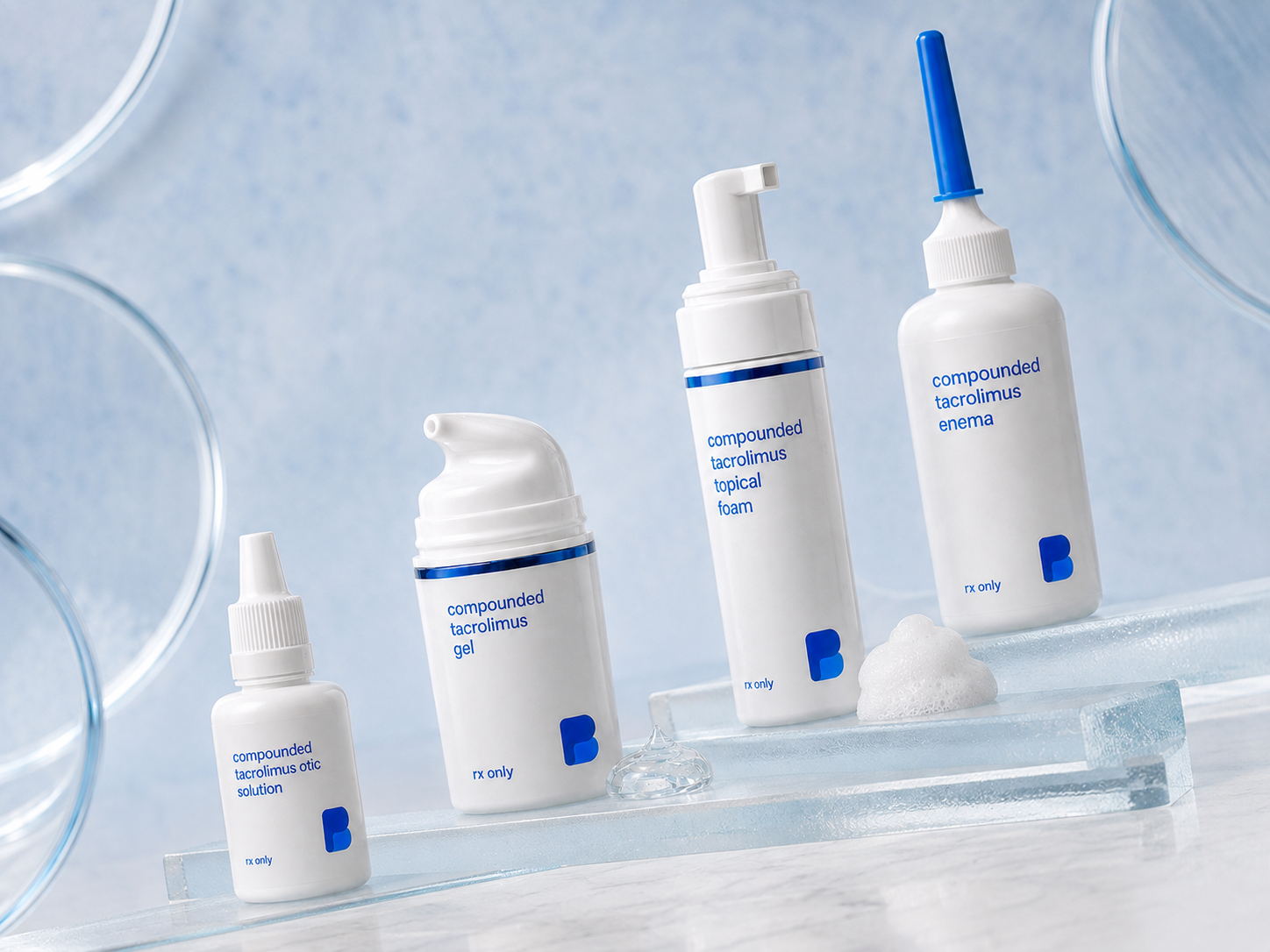
Where an approved product already exists in the form and strength your patient needs, that product is available through any pharmacy and is not something a 503A pharmacy duplicates. The compounded list is the remainder: the ear, rectal, oral mucosal, and scalp routes, plus prescriber-designed combinations. If the distinction between pharmacy types matters for your practice, see 503A vs 503B compounding pharmacy and what is a compounding pharmacy. These are non-sterile preparations, made under USP 795 non-sterile compounding standards.
What does the boxed warning say right now?
This is the most sensitive item on the page, so it is reproduced as it stands on the FDA-approved tacrolimus ointment label as of the current October 2025 revision:
Although a causal relationship has not been established, rare cases of malignancy (e.g., skin and lymphoma) have been reported in patients treated with topical calcineurin inhibitors, including tacrolimus ointment.
The label directs avoiding continuous long-term use, limiting application to affected areas, and restricting pediatric use as described above. FDA added the warning in 2006, citing unestablished long-term safety. Subsequent pharmacoepidemiologic data have not established causation, and the American Academy of Dermatology characterizes topical calcineurin inhibitors as having a good safety record when used as directed while stating that the cancer risk remains unknown.
The warning has not been removed. The honest summary is the one on the formulation page: the warning is still on the label, the evidence has not proven the risk is real, and the evidence has not proven it is not. Patients on a compounded off-label route should be counseled on it the same way a patient on the approved ointment would be.
What strengths are available?
The commercial ointment comes in 0.03% and 0.1%. Compounded tacrolimus is most often prepared at 0.1%, with 0.2% used in otic solutions where a prescriber wants a higher concentration in the ear canal. The rectal enema is dosed as 4 mg in 60 mL rather than as a percentage. A higher percentage is not automatically a better choice, because more tacrolimus in contact with inflamed or broken skin also means more of it absorbed.

| Preparation | Typical size | Application site |
|---|---|---|
| Tacrolimus 0.1% otic solution | 15 mL | Affected ear canal |
| Tacrolimus 0.2% otic solution | 15 or 30 mL | Affected ear canal |
| Tacrolimus 4 mg/60 mL rectal enema | Multi-dose supply | Rectum, usually at bedtime |
| Tacrolimus 0.1% anhydrous gel (WO6) | 30 g | Skin or mouth, as directed |
| Tacrolimus 0.1% with ketotifen 0.05% cream | 60 g | Skin, thin layer |
| Tacrolimus 0.1% shampoo (VersaBase) | 60 or 100 mL | Scalp |
| Minoxidil/tacrolimus/clobetasol 5%/0.3%/0.05% foam | 30 mL | Scalp |
Two points on that table. The 0.2% otic solution is listed at 15 or 30 mL, so specify the volume you want rather than leaving it to be inferred. And the scalp foam carries tacrolimus at 0.3%, above the 0.1% to 0.2% range used in the single-ingredient preparations, alongside minoxidil 5% and clobetasol 0.05%; combination foams of this kind are prescriber-designed formulas rather than studied products. Custom strengths, bases, and combinations are prepared on request. The wider list of preparations sits in the compounded medications catalog.
What does the published evidence show by route?
| Off-label use | Evidence base | Status |
|---|---|---|
| Chronic or eczematous otitis externa | Small prospective studies, case series | Off-label |
| Refractory ulcerative proctitis, distal colitis | One small randomized trial, retrospective series | Off-label |
| Oral lichen planus | Open-label and comparative studies | Off-label |
| Vitiligo of face and neck | Reports on face and neck | Off-label |
| Alopecia areata, scalp inflammation | Case reports, small series | Off-label |
The evidence quality is not even across that list, and the formulation page is explicit about it. Apart from the rectal route, which has one small randomized trial, these routes are supported mainly by small studies and case series.
Tacrolimus otic solution
For chronic or eczematous otitis externa the literature is limited to small prospective studies and case series, with no randomized controlled trial. The appeal described on the page is situational: the canal is thin-skinned and easily damaged by repeated steroid drops, so a steroid-sparing option is attractive where canal skin atrophy has already followed topical corticosteroid courses. There is no FDA-approved otic tacrolimus of any strength.
Tacrolimus rectal enema
This is the strongest of the off-label routes and still small. A double-blind placebo-controlled trial in resistant ulcerative proctitis reported clinical response and mucosal healing in 73% of patients versus 10% on placebo and was terminated early at n=20. A retrospective series of 23 patients reported 52.3% clinical remission, with a mean serum tacrolimus of about 5.5 ng/mL and one reversible creatinine rise accompanied by tremor, headache, and fatigue (Cohen and Weisshof, Gastroenterology & Hepatology, 2020). A 2024 review concluded the data are supportive of the use of topical tacrolimus in selected patients while pointing out that most reports were retrospective, open-label, short, and heterogeneous (Khayatan, Lemberg and Day, Journal of Clinical Medicine, 2024).
Tacrolimus for oral lichen planus and vitiligo
Oral lichen planus is supported by open-label trials and comparative studies rather than large definitive ones; the preparation is usually a gel or rinse applied to the lesions. For vitiligo, the page reports that topical tacrolimus is a common steroid-sparing choice on the face and neck, and that the response described in the literature is slow and partial rather than reliable.
Tacrolimus shampoo and combination scalp foam
Scalp inflammation and alopecia areata are the weakest of the group, largely case reports and small series. Combination foams such as minoxidil with tacrolimus and clobetasol are prescriber-designed formulas and are unstudied as products. The formulation page suggests patients ask what result the prescriber is hoping for and by when, which is a reasonable thing to have settled before the first fill.
What monitoring and counseling should accompany a course?
Consider whole-blood tacrolimus levels and renal function for rectal courses, extensive body-surface application, or barrier-compromised skin. Tacrolimus given rectally can reach the bloodstream; the 2024 review notes that topical tacrolimus usually results in low (under 3.2 ng/mL) or undetectable systemic levels but recommends monitoring levels regardless of the route used, and the retrospective series above is the reminder that levels are not always negligible.

On counseling, the approved ointment label reports application-site burning or stinging in roughly 46 to 58% of patients and itching in about 41 to 46%, typically worst in the first days and on the rawest skin. Patients who know to expect it are the ones who get through the first week. Also cover alcohol-related facial flushing, photoprotection, and the risk of local viral or bacterial skin infection, since local immunity is damped down and cold sores, shingles, and warts can occur or spread more easily. The AAD advises staying out of the sun while a topical calcineurin inhibitor is part of the plan, avoiding tanning beds, and not using phototherapy concurrently.
Tacrolimus should not be applied to actively infected skin or to a suspected malignant lesion, and it is contraindicated in hypersensitivity to tacrolimus or to any ingredient in the preparation. Review it carefully in patients with a weakened immune system, an active infection at the treatment site, a barrier condition such as Netherton syndrome or widespread erythroderma where absorption may be much higher, a history of skin cancer or lymphoma, or kidney or liver impairment. The approved label directs avoiding continuous long-term use, which is why a defined course length belongs on the prescription.
How do I write a tacrolimus prescription?
E-prescribe to Bayview Pharmacy, 3844 Post Rd, Warwick, RI 02886, NCPDP 4106882. If your EHR does not list the compound, enter it as a compound or free-text prescription naming each active ingredient, strength, base, and total quantity. Tacrolimus is a noncontrolled medication, so fax orders to 401-284-4506 and phone orders are also accepted.
Five things keep a compound order from needing a callback:
- The preparation, strength, and base, for example tacrolimus 0.1% otic solution, tacrolimus 4 mg/60 mL rectal enema in preserved water, or tacrolimus 0.1% shampoo in VersaBase.
- Directions with a defined course length, for example instill 3 drops into the affected ear twice daily for 14 days, or administer 60 mL per rectum at bedtime for 8 weeks.
- An ICD-10 diagnosis code: ulcerative proctitis K51.20, chronic otitis externa H60.5-, atopic dermatitis L20.9, oral lichen planus L43.9, vitiligo L80, alopecia areata L63.9.
- Total quantity, including container volume where two sizes exist.
- Refills as clinically appropriate.
Those example directions reflect common regimens and are not treatment recommendations. Dosing remains your responsibility, and Bayview does not provide consultations or determine whether a medication is appropriate for a patient.
What does compounded tacrolimus cost, and is it billed to insurance?
Compounded tacrolimus starts at $122 for a 15 mL otic solution. Price varies with the form, the strength, the base, and the quantity. Tacrolimus is an expensive active ingredient, so the drug itself drives most of the cost rather than the base or the container size. Our post on why tacrolimus ointment is so expensive covers the cost question for the commercial product.
Compounded preparations are cash-priced and are generally eligible for HSA and FSA cards. They are not billed through insurance, for the reasons set out in do compounding pharmacies take insurance. Patients or staff can call 401-284-4505 with the preparation and quantity you ordered for a quote before anything is made.
How do I send the order to Bayview?
What Bayview compounds for this, on a prescriber's order: tacrolimus 0.1% and 0.2% otic solutions in 15 or 30 mL, a tacrolimus 4 mg/60 mL rectal enema, a tacrolimus 0.1% anhydrous gel in a WO6 base in 30 g, a tacrolimus 0.1% with ketotifen 0.05% cream in 60 g, a tacrolimus 0.1% shampoo in VersaBase in 60 or 100 mL, and a minoxidil 5% with tacrolimus 0.3% and clobetasol 0.05% foam in 30 mL. Custom strengths, bases, and combinations are prepared to order. Full details on each preparation are on the compounded tacrolimus formulation page.
Send an eRx or fax the order with the preparation, base, directions, course length, diagnosis code, and quantity. We fill and ship to patients in the states where Bayview is licensed; the current list and account setup details are on our FAQ. If you are unsure which base or container size fits the site you are treating, call the pharmacy before you send the prescription and a pharmacist will walk through the options with you.
Frequently asked questions
Is compounded tacrolimus ointment the same as the 0.03% and 0.1% tubes?
No. Tacrolimus ointment 0.03% and 0.1% is an FDA-approved manufactured product, and when a prescriber orders one of those, that is what a pharmacy dispenses. Compounding covers what the tubes do not: other strengths, and forms such as ear drops, enemas, gels, foams and shampoos. Compounded preparations are not FDA-approved and are made only on a prescriber's order.
How much does compounded tacrolimus cost at Bayview?
Compounded tacrolimus starts at $122 for a 15 mL otic solution. The price varies with the form, strength, base, and quantity, and because tacrolimus is an expensive active ingredient, the drug substance drives most of the total. These are cash-priced preparations, generally eligible for HSA and FSA cards. Call 401-284-4505 with the preparation and quantity ordered and we will quote it before compounding.
What is the boxed warning on tacrolimus ointment?
The approved label states that although a causal relationship has not been established, rare cases of malignancy including skin cancer and lymphoma have been reported in patients treated with topical calcineurin inhibitors. The FDA added it in 2006. The label directs avoiding continuous long-term use, applying only to affected areas, and not using it under age 2. Discuss it with your prescriber.
Is compounded tacrolimus the same as Protopic?
No. Compounded tacrolimus is not a copy of, substitute for, or equivalent to any FDA-approved product. Where the approved ointment already exists in the form and strength needed, it is available through any pharmacy. A compounding pharmacy prepares the forms no manufacturer makes: otic solutions, rectal enemas, anhydrous gels, creams, foams, and shampoos. These are compounded, off-label, and not FDA-approved.
Why is tacrolimus ointment so expensive?
It launched as a brand in a new drug class, and that opening price set the reference point. Generic tacrolimus ointment arrived late, and topical generics tend to attract fewer manufacturers than oral tablets, so prices fall less. Tacrolimus is also an expensive active ingredient. Plans commonly place it on a higher tier behind step therapy and prior authorization, which can leave patients paying retail.
Does tacrolimus cause hair loss?
Hair loss is not a listed effect of topical tacrolimus in the approved labeling. Topical tacrolimus has instead been studied off-label in alopecia areata and scalp inflammation, mostly in case reports and small series, which is the thinnest evidence of any route it is used for. Oral tacrolimus used after transplant is a separate product with its own reported effects.
Does tacrolimus ointment lighten skin?
Hypopigmentation is not a listed effect in the approved labeling, and tacrolimus is not a skin-lightening agent. The association usually comes from the opposite direction: topical tacrolimus has been studied off-label in vitiligo, a condition of pigment loss, where reported repigmentation is slow, partial, and inconsistent. Treated skin can also be more sun-sensitive, which changes how areas look next to each other.
What is tacrolimus ointment used for?
The only FDA-approved topical use is moderate to severe atopic dermatitis (eczema), described on the label as second-line, short-term and non-continuous therapy. The ointment comes in 0.03% (ages 2 through 15) and 0.1% (age 16 and older), and neither strength is approved under age 2. Prescribers also use topical tacrolimus off-label for conditions such as vitiligo and oral lichen planus.
Is tacrolimus a steroid?
No. Tacrolimus is a calcineurin inhibitor. It blocks an enzyme that T cells need in order to switch on, which turns down local inflammatory signaling. Corticosteroids such as triamcinolone and fluocinonide work by a different mechanism and also act on the structural tissue of the skin, which is why long courses can thin it. Tacrolimus has no corticosteroid effect on collagen.
How much does compounded tacrolimus cost?
Compounded tacrolimus starts at $122 for a 15 mL otic solution, and the price varies with the form, strength, base, and quantity. Tacrolimus is an expensive active ingredient, so the drug itself drives most of the cost rather than the base or the container size. Compounded preparations are cash-priced and are generally eligible for HSA and FSA cards. Call us at 401-284-4505 with the preparation and quantity your prescriber ordered and we will quote it before we make it.
Can tacrolimus be used on the face or eyelids?
Being steroid-sparing is the reason prescribers consider it there. Tacrolimus does not thin the skin the way long-term topical corticosteroids can, so it is often chosen for delicate areas such as the face, eyelids, skin folds, and the ear canal. Use it only on the areas your prescriber specifies, protect treated skin from the sun, and do not cover the area with bandages or wraps unless you are told to, since covering increases absorption.
How long does tacrolimus take to work?
Tacrolimus works gradually rather than immediately, and burning or stinging in the first few days is common and usually fades as the skin settles. The approved ointment label directs treating for a defined stretch rather than continuously, and prescribers generally set a course length and a point to reassess. Ask your prescriber what result they are expecting and by when they will decide whether it is working — a fair question for any treatment, and particularly for the compounded routes, where the supporting evidence is limited.
Is tacrolimus an immunosuppressant?
Yes. Tacrolimus is a calcineurin inhibitor, a type of immunosuppressant. Taken by mouth or given by injection it suppresses the immune system throughout the body, which is why it is used after organ transplants. Applied to one area, it acts mostly at that spot, and very little normally reaches the bloodstream through intact skin — though absorption rises when skin is broken or inflamed, and it is more of a consideration with the rectal route. Because local immunity is damped down where it is applied, skin infections such as cold sores, shingles, and warts can occur or spread more easily.
Does Bayview compound tacrolimus ointment?
No. Tacrolimus ointment 0.03% and 0.1% is a commercially manufactured, FDA-approved product available through any pharmacy, so there is no reason to compound a version of it. Bayview compounds the forms no manufacturer makes: otic solutions, rectal enemas, anhydrous gels, creams, foams, and shampoos, plus prescriber-designed combinations such as tacrolimus with ketotifen. Those preparations are used off-label and are not FDA-approved.
What is the difference between tacrolimus 0.03% and 0.1%?
Those are the two strengths of the commercially manufactured ointment. The FDA-approved label covers 0.03% for ages 2 through 15 and 0.1% for age 16 and older, and neither strength for children under 2. A higher percentage is not automatically the better choice, since more tacrolimus in contact with inflamed or broken skin also means more of it is absorbed. Compounded tacrolimus is most often prepared at 0.1%, with 0.2% used in otic solutions. Your prescriber selects the strength.
Is there an FDA-approved tacrolimus ear drop?
No. There is no FDA-approved otic, rectal, gel, foam, or shampoo tacrolimus. The approved products are the 0.03% and 0.1% topical ointment for moderate-to-severe atopic dermatitis as second-line, short-term and non-continuous therapy, plus oral capsules and granules and an injection for transplant. Ear drops exist only because a compounding pharmacy prepares them, and the route is off-label. Published support is limited to small prospective studies and case series.
What strengths of compounded tacrolimus does Bayview prepare?
Compounded tacrolimus is most often prepared at 0.1%, with 0.2% used in otic solutions where a prescriber wants a higher concentration in the ear canal. The rectal enema is written as 4 mg in 60 mL rather than a percentage. The scalp foam combines minoxidil 5%, tacrolimus 0.3%, and clobetasol 0.05%. Custom strengths, bases, and combinations are prepared on a prescriber's order. The prescriber selects the strength.
Does the boxed warning apply to compounded tacrolimus?
The boxed warning sits on the FDA-approved topical calcineurin inhibitor label and reads, in part, that although a causal relationship has not been established, rare cases of malignancy have been reported in patients treated with topical calcineurin inhibitors. It directs avoiding continuous long-term use, limiting application to affected areas, and not using it under age 2. The warning has not been removed, and patients on compounded routes should be counseled on it.
How do I write a compounded tacrolimus prescription?
E-prescribe to Bayview Pharmacy, 3844 Post Rd, Warwick, RI 02886, NCPDP 4106882, or fax 401-284-4506. If your EHR has no entry for the compound, send it as a compound or free-text prescription naming each active ingredient, strength, base, and total quantity. Add directions with a defined course length, an ICD-10 code, the container size where two sizes exist, and refills as clinically appropriate.
Is compounded tacrolimus billed through insurance?
No. Compounded tacrolimus is cash-priced, starting at $122 for a 15 mL otic solution, and the price varies with the form, strength, base, and quantity. Tacrolimus is an expensive active ingredient, so the drug drives most of the cost rather than the base or container. Compounded preparations are generally eligible for HSA and FSA cards. Call 401-284-4505 with the preparation and quantity for a quote before anything is made.
Is tacrolimus a controlled substance?
No. Tacrolimus is a noncontrolled prescription medication, so Bayview accepts eRx, fax, and phone orders for compounded tacrolimus preparations. A valid prescription written for a named patient is still required for every preparation, and the prescriber determines the preparation, strength, and course. Bayview does not provide consultations and does not decide whether a medication is appropriate for a patient.
What Bayview compounds for this
Important: Compounded medications are prepared to a prescriber's order for an individual patient. They are not FDA-approved, and the FDA has not evaluated them for safety, effectiveness, or manufacturing quality. This article is educational and is not a substitute for advice from your prescriber or pharmacist.
This preparation contains a controlled substance. Controlled-substance prescriptions carry refill limits, must be e-prescribed, and can only be shipped to states where Bayview holds the required licensure.
Uses discussed here may be off-label, meaning they are not part of any FDA-approved labeling. Off-label use is a decision for you and your prescriber, based on the available evidence.
Veterinary preparations are compounded to a veterinarian's order for a specific animal and are not FDA-approved animal drugs. Never give a compounded human medication to an animal without veterinary direction.
Compounded prescriptions are paid for directly rather than billed through insurance. Most are HSA/FSA-eligible, and many patients submit the receipt to their plan for possible reimbursement. Pricing depends on the strength, dose form and quantity your prescriber orders. Read more about cost and insurance.
Compounded tacrolimus starts at $122 for a 15 mL otic solution, and the price moves with the form, the strength, the base, and the quantity, since tacrolimus is an expensive active ingredient and the drug itself drives most of the cost. Compounded preparations are cash-priced rather than billed through insurance. They are generally eligible for HSA and FSA cards, and the pharmacy quotes a preparation at 401-284-4505 before making it.
Bayview Pharmacy is a compounding pharmacy in Warwick, Rhode Island, licensed to fill and ship compounded prescriptions for patients in Rhode Island, Massachusetts, Connecticut, New Jersey, New Hampshire, Florida, Maine and Pennsylvania. Prescriptions for New York patients are filled on a limited basis, and controlled substances are not shipped to New York addresses. See every state we ship to.
Related reading