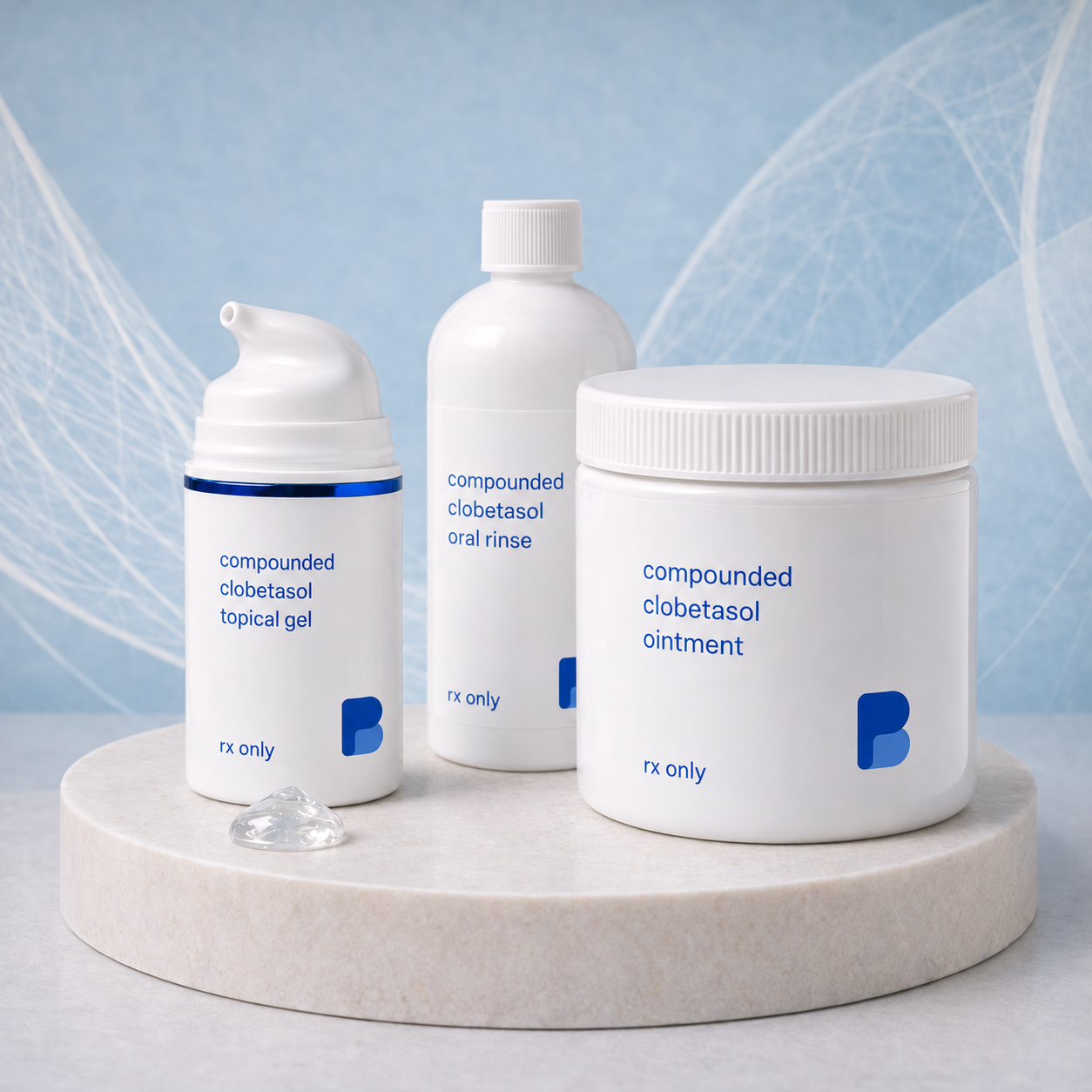
Clobetasol propionate is a class I, superpotent topical corticosteroid, and for genital lichen sclerosus a course of a high-potency steroid such as clobetasol is described in the medical literature as the standard treatment (StatPearls, Lichen Sclerosus). The manufactured product comes only at 0.05%, and its labeling is written for skin outside the genital area, so vulvar, vaginal, and oral use is prescriber-directed and off-label. Bayview prepares compounded clobetasol propionate as ointment, vulvar gel, vaginal suppositories, dental gel, and oral rinse when a prescriber orders a strength or form the manufactured line does not include.
Is clobetasol a steroid?
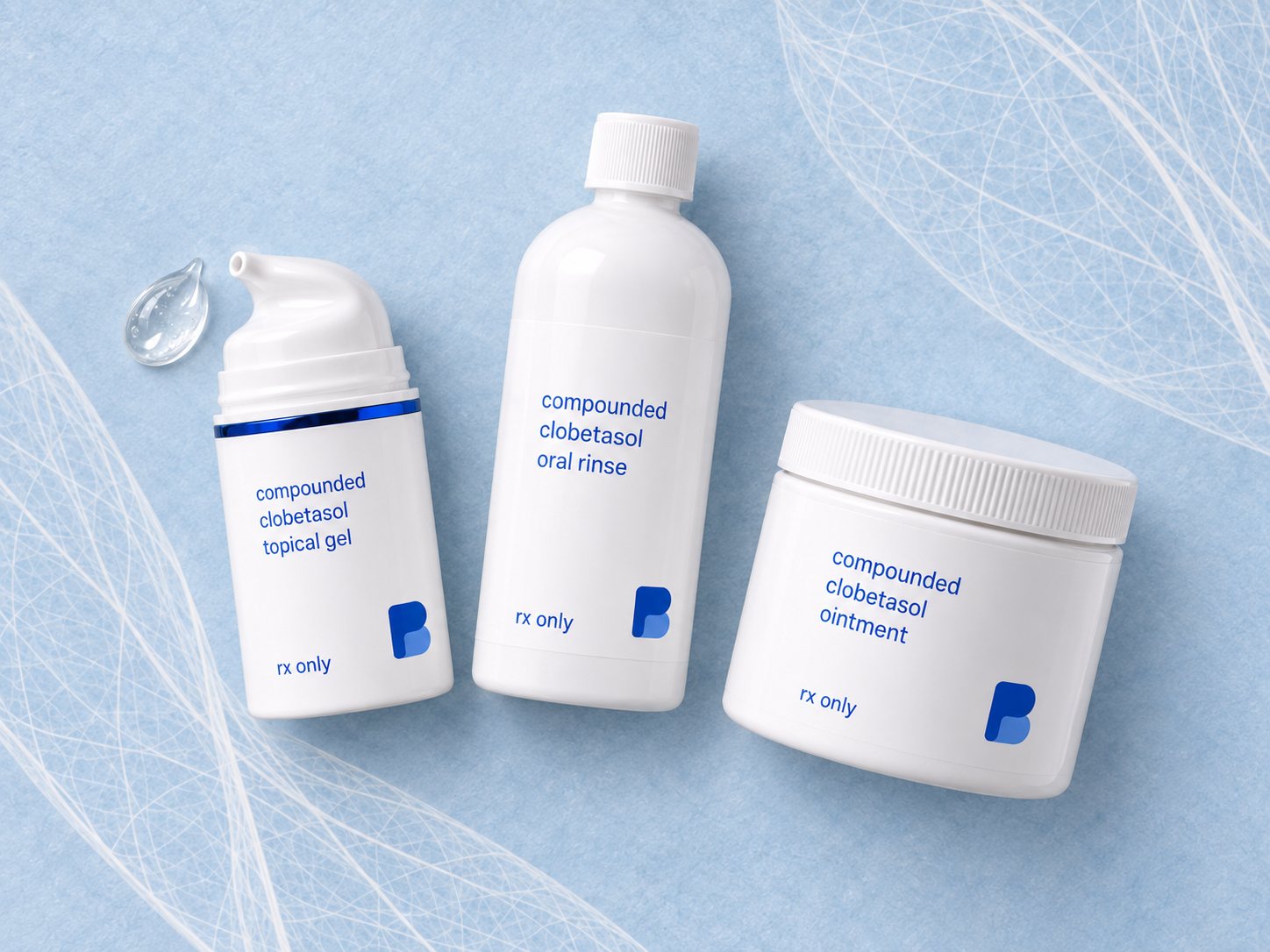
Yes. Clobetasol propionate is a synthetic corticosteroid applied to the skin, not an anabolic steroid. Topical steroids are ranked in seven potency classes, and clobetasol propionate 0.05% sits in class I, the superpotent group (StatPearls, Topical Corticosteroids). MedlinePlus describes it as reducing the inflammation, redness, scaling, and itch of conditions such as psoriasis and eczema.
Corticosteroids act in the skin by narrowing small blood vessels, turning down the chemical signals that drive inflammation, and slowing cell turnover. Because clobetasol is so potent, enough of it can be absorbed through the skin to suppress the body's own steroid production (the HPA axis). The manufacturer's labeling reports that suppression at doses as low as 2 g per day, which is why the label sets firm limits on amount and course length.
For comparison, fluocinonide 0.05% is a class II (high potency) steroid and triamcinolone 0.1% is mid potency. Bayview compounds both: see compounded fluocinonide and compounded triamcinolone. A stronger class is not automatically a better choice. The prescriber picks the agent, strength, base, and course length.
Why is clobetasol used for lichen sclerosus?
Lichen sclerosus is a chronic inflammatory skin condition that most often affects the vulvar and perianal skin, though it can appear elsewhere and in men. StatPearls describes a three-month course of a high-potency topical steroid such as clobetasol propionate as the standard treatment for genital lichen sclerosus, with long-term follow-up afterward because anogenital lichen sclerosus carries a risk of squamous cell carcinoma.
That is a statement about the drug in the published literature, not a promise about any one preparation. Compounded clobetasol is not FDA-approved, and how it is used, how often, and for how long are decisions for the prescriber who is following the condition over time.
What are the label limits on clobetasol propionate ointment?
The manufactured 0.05% cream and ointment carry three limits that matter for anyone using clobetasol near the genitals:
- Treatment is limited to 2 consecutive weeks.
- Use is limited to no more than 50 g per week.
- It is kept off the face, groin, and underarms, and the label reads "for dermatologic use only; not for ophthalmic, oral or intravaginal use."
Vulvar skin sits inside the area that label steers away from. So when a gynecologist or dermatologist prescribes clobetasol for vulvar lichen sclerosus, the directions for that site come from the prescriber, not from the manufacturer's label. For the compounded forms made for vulvar and vaginal use, that use is off-label.
The compounded 0.1% and 0.2% ointments are a separate case. No manufacturer makes them, they are not formally assigned a potency class, and they have no labeled dose limit at all. That puts the weekly amount and course length entirely on the prescription, and prescribers ordering those strengths are asked to write both explicitly.
Ointment, vulvar gel, or suppository: how do the forms differ?
The base changes how the medicine feels and how strongly it acts. Ointments are the most occlusive base and suit thick, dry skin. Gels spread more easily and leave less residue. A suppository places the dose inside the vagina rather than on the outer skin. The table below lists the clobetasol forms Bayview prepares for the genital area and mouth, and their status.
| Form | Strength | Status |
|---|---|---|
| Cream or ointment (manufactured) | 0.05% | FDA-approved (skin) |
| Ointment | 0.1%, 0.2% | Compounded, not FDA-approved |
| Topical or vulvar gel | 0.05% | Compounded; vaginal use off-label |
| Vaginal suppository | 0.5 mg | Compounded; off-label |
| Dental gel | 0.05% | Compounded; off-label |
| Oral rinse | 0.05% | Compounded; off-label |
When a manufactured 0.05% product fits the prescription, that is what Bayview dispenses. Compounding covers the strengths and forms the manufactured line does not include, such as a vulvar gel or a vaginal suppository for lichen sclerosus or lichen planus inside the vagina.
Clobetasol for oral lichen planus: dental gel and mouthwash
Lichen planus can affect the lining of the mouth. StatPearls describes topical corticosteroids in an adhesive gel or a rinse as first-line treatment for symptomatic oral lichen planus. No manufactured clobetasol product is labeled for the mouth, so clobetasol for oral lichen planus is always compounded and always off-label.
Dental gel
The dental gel is applied to dried patches inside the mouth. Directions on the formulation page say to dry the area first and to avoid eating or drinking for at least 30 minutes afterward.
Clobetasol mouthwash (oral rinse)
A clobetasol oral rinse reaches widespread or hard-to-reach patches. It is swished and spit out, not swallowed. The most common problem with steroids used in the mouth is thrush (oral yeast), so tell your prescriber if white patches appear. For general mouth soreness, prescribers sometimes order a different preparation altogether: our magic mouthwash page explains those rinses.
How is clobetasol applied?
Your prescriber's directions govern every detail, including the site, how often, how much, and for how long. Dose and appropriateness are the prescriber's decisions, and this post does not suggest a dose. The general handling points from the manufacturer's labeling and MedlinePlus are:
- Use a thin layer on the affected area only, and rub it in gently.
- Do not cover the area with plastic wrap, a tight dressing, or tight clothing unless told to. Covering raises the amount absorbed.
- Keep it away from the eyes, and wash your hands afterward.
- Vaginal preparations are used only as the prescriber directs.
- If there is no improvement within 2 weeks, contact your prescriber rather than continuing on your own.
What side effects should you watch for?
The most frequent effect on the label is burning or stinging where clobetasol is applied. Itching, skin thinning, cracking, acne-like bumps, lightening of skin color, and stretch marks have also been reported, and skin thinning is the most common adverse effect of topical corticosteroids as a group (StatPearls, Topical Corticosteroids).
Absorbed steroid can affect the adrenal glands, raise blood sugar, or cause Cushing's syndrome, especially with large areas, covering, or long use. Contact your prescriber about unusual tiredness, weight gain, a rounded face, muscle weakness, increased thirst or urination, blurred vision, or a rash that spreads or looks infected. Tell your prescriber if you are pregnant or breastfeeding, have diabetes, or use other steroid medicines. Children absorb proportionally more, and use under age 12 is not recommended for the manufactured cream and ointment.
Some prescribers move to a steroid-sparing option for thin skin or longer maintenance. Bayview also prepares compounded tacrolimus on a prescriber's order.
What does compounded clobetasol cost?
Price depends on the strength, the base, and the size. Bayview's starting cash price for compounded clobetasol in 2026 is $92 for 30 g of the 0.05% dental paste, and larger ointment sizes cost more. Where a manufactured 0.05% product fits the prescription, that is what we dispense, and it may cost less.
Compounded preparations are cash-priced and are generally eligible for HSA and FSA cards. Call 401-284-4505 with the preparation and quantity your prescriber ordered and we will quote it before we make it. Our post on whether compounding pharmacies take insurance covers payment in more detail.
What Bayview compounds for this
On a prescriber's order, Bayview prepares clobetasol propionate as 0.1% and 0.2% ointment in 15 g and 30 g, 0.05% topical or vulvar gel in 15 g and 30 g, 0.5 mg vaginal suppositories, 0.05% dental gel, 0.05% oral rinse, and 0.05% foam, plus combinations for the scalp, skin, nails, and mouth. Each is made using USP 795 non-sterile compounding for one patient's prescription. The rest of our preparations are in the compounded medications catalog, and our guide to what a compounding pharmacy is explains how custom preparations are made.
Talk to your prescriber
If you have lichen sclerosus or oral lichen planus and your prescriber thinks a clobetasol strength or form outside the manufactured 0.05% line fits your care, ask them to send the prescription to Bayview Pharmacy. We fill it as written and ship to patients in the states where Bayview is licensed, listed on our FAQ page. Questions about a preparation or a quote go to 401-284-4505.
Frequently asked questions
How strong is clobetasol compared with other steroid creams?
Topical steroids are grouped into seven potency classes, with class I the strongest and class VII the mildest. Clobetasol propionate 0.05% is in class I. For comparison, fluocinonide 0.05% is class II, triamcinolone acetonide 0.1% is class IV, and over-the-counter hydrocortisone 1% is class VII. A stronger class is not automatically a better choice, and the agents are not interchangeable; your prescriber selects the steroid and strength.
Can I use clobetasol on my face, groin, or on a child?
Not unless your prescriber specifically directs it. The label for the manufactured cream and ointment says not to use it on the face, groin, or underarms, and not to use it for rosacea or perioral dermatitis. Use in children under 12 is not recommended, because children absorb more steroid through their skin and can have slowed growth. Prescribers usually choose a milder steroid or a steroid-sparing option such as compounded tacrolimus for those areas.
What are the side effects of clobetasol?
The most common is burning or stinging where it is applied. Itching, cracking, thinning skin, acne-like bumps, lighter skin color, and stretch marks can also happen, especially with longer use. Because clobetasol is so strong, enough can be absorbed to affect your body's own steroid production, which can show up as unusual tiredness, weight gain, a rounded face, or muscle weakness. Inside the mouth, the usual problem is thrush. Contact your prescriber if any of these happen.
How do I apply clobetasol?
Apply a thin layer to the affected skin, usually twice a day, and rub it in gently. Wash your hands afterward unless you are treating your hands. Do not bandage, wrap, or cover the area unless your prescriber tells you to, and keep it away from your eyes. For the dental gel, dry the area first; for the rinse, swish as directed and spit it out. Do not eat or drink for 30 minutes after either one.
How long can I use clobetasol?
For the manufactured 0.05% cream and ointment, labeling limits treatment to 2 weeks in a row and no more than 50 g per week, and use stops once the condition is under control. If your skin has not improved within 2 weeks, contact your prescriber. Some conditions, such as lichen sclerosus, are treated on a longer schedule set by the prescriber. Follow your own directions and do not extend the course or move it to a new area without asking.
What is clobetasol prescribed for?
The manufactured product is used for skin conditions that respond to corticosteroids, most often psoriasis, including scalp psoriasis, and eczema. Prescribers also use clobetasol for lichen sclerosus and, in a mouth gel or rinse, for oral lichen planus; those uses in the mouth and vagina are off-label. Your prescriber decides whether it is appropriate for you and at what strength.
Why would my prescriber order compounded clobetasol instead of the regular 0.05% cream or ointment?
Manufactured clobetasol only comes at 0.05%. A prescriber may want an ointment at 0.1% or 0.2%, a dental gel or rinse for inside the mouth, a vaginal gel or suppository, or clobetasol combined with another ingredient such as zinc pyrithione or ketoconazole for the scalp. Use in the mouth or vagina is off-label. When a manufactured product fits the order, Bayview dispenses the manufactured product.
What is clobetasol propionate?
Clobetasol propionate is a prescription corticosteroid applied to the skin to reduce inflammation, redness, scaling, and itch in conditions such as psoriasis and eczema. It is one of the strongest topical steroids, in the superpotent class I group. Manufactured clobetasol is FDA-approved at 0.05% as a cream, ointment, gel, solution, foam, lotion, shampoo, and spray. Bayview compounds other strengths and forms to your prescriber's order; compounded preparations are not FDA-approved.
What is in magic mouthwash?
The version most people mean combines three ingredients in equal parts (1:1:1): diphenhydramine, an antacid such as aluminum and magnesium hydroxide, and viscous lidocaine.
But magic mouthwash is a nickname, not a defined medicine. There is no standard recipe and no FDA-approved product, and formulas vary between hospitals, clinics, and individual prescribers. Some add a steroid, an antifungal, or an antibiotic. What is in your bottle is whatever your prescriber ordered, so read your label.
Can I use an HSA or FSA card for compounded medications?
Yes. We accept HSA and FSA cards as well as credit cards, and compounded prescriptions are generally an eligible expense because they are dispensed against a valid prescription. Plan rules vary, so keep your receipt in case your administrator asks for documentation.
Why is clobetasol used for lichen sclerosus?
StatPearls describes a three-month course of a high-potency topical steroid such as clobetasol propionate as the standard treatment for genital lichen sclerosus, with long-term follow-up because anogenital disease carries a risk of squamous cell carcinoma. That describes the drug in the literature. Compounded clobetasol is not FDA-approved, and your prescriber decides the form, frequency, and course length for your situation.
Can clobetasol be used on vulvar skin?
The manufactured 0.05% cream and ointment are labeled for skin use and kept off the groin, so vulvar use is directed by the prescriber rather than the label. Compounded vulvar gel and vaginal suppositories are off-label. Use clobetasol on vulvar skin only as your prescriber directs, and ask them how much to apply, how often, and for how long.
What is a clobetasol vaginal suppository?
It is a compounded suppository containing 0.5 mg of clobetasol propionate, placed inside the vagina. Prescribers order it for lichen sclerosus or lichen planus affecting the vagina. No manufactured clobetasol suppository exists, so it is compounded, not FDA-approved, and its use is off-label. Your prescriber sets how often it is used and for how long.
Can clobetasol be used in the mouth for oral lichen planus?
StatPearls describes topical corticosteroids in an adhesive gel or a rinse as first-line treatment for symptomatic oral lichen planus. Clobetasol for the mouth is compounded as a 0.05% dental gel or oral rinse, and oral use is off-label. Directions on the formulation page say not to eat or drink for at least 30 minutes afterward. Tell your prescriber if white patches of thrush appear.
What is clobetasol mouthwash, and do you swallow it?
Clobetasol mouthwash is a compounded 0.05% clobetasol propionate oral rinse for widespread patches inside the mouth. It is swished and spit out, not swallowed, as your prescriber directs. No manufactured clobetasol product is labeled for the mouth, so this rinse is not FDA-approved and its use is off-label. Thrush is a common problem with steroids used in the mouth.
Is there a dose limit for clobetasol 0.1% or 0.2% ointment?
No labeled limit exists, because no manufacturer makes these strengths. The 2-week, 50 g per week limit on the label applies to the manufactured 0.05% cream and ointment. For compounded 0.1% and 0.2% ointment, the prescriber writes the weekly amount and course length on the prescription. Use it only on the area, in the amount, and for the time your prescriber directs.
What Bayview compounds for this
Important: Compounded medications are prepared to a prescriber's order for an individual patient. They are not FDA-approved, and the FDA has not evaluated them for safety, effectiveness, or manufacturing quality. This article is educational and is not a substitute for advice from your prescriber or pharmacist.
This preparation contains a controlled substance. Controlled-substance prescriptions carry refill limits, must be e-prescribed, and can only be shipped to states where Bayview holds the required licensure.
Uses discussed here may be off-label, meaning they are not part of any FDA-approved labeling. Off-label use is a decision for you and your prescriber, based on the available evidence.
Veterinary preparations are compounded to a veterinarian's order for a specific animal and are not FDA-approved animal drugs. Never give a compounded human medication to an animal without veterinary direction.
Compounded prescriptions are paid for directly rather than billed through insurance. Most are HSA/FSA-eligible, and many patients submit the receipt to their plan for possible reimbursement. Pricing depends on the strength, dose form and quantity your prescriber orders. Read more about cost and insurance.
Compounded clobetasol is priced by strength, base, and size. Bayview's starting cash price in 2026 is $92 for 30 g of clobetasol 0.05% dental paste; larger ointment sizes cost more. Compounded preparations are cash-priced and are generally eligible for HSA and FSA cards. Call 401-284-4505 with your prescription details for a quote before it is made.
Bayview Pharmacy is a compounding pharmacy in Warwick, Rhode Island, licensed to fill and ship compounded prescriptions for patients in Rhode Island, Massachusetts, Connecticut, New Jersey, New Hampshire, Florida, Maine and Pennsylvania. Prescriptions for New York patients are filled on a limited basis, and controlled substances are not shipped to New York addresses. See every state we ship to.
Related reading