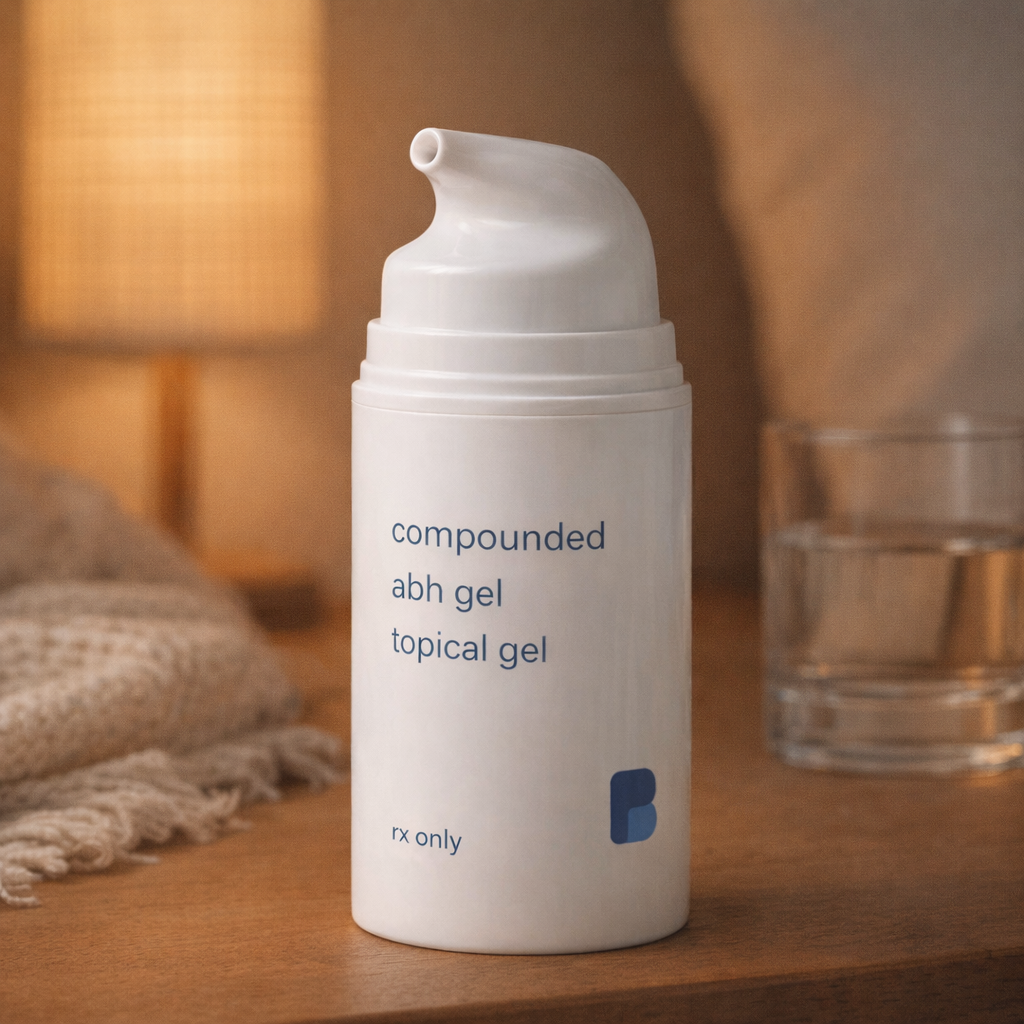
ABH gel is a compounded gel that combines three medicines: lorazepam, a benzodiazepine; diphenhydramine, an antihistamine; and haloperidol, an antipsychotic. The name comes from the brand names of those three ingredients. Hospice and palliative care prescribers order it to be rubbed into the skin, usually for a patient who can no longer swallow tablets.
Families and hospice staff often ask what ABH gel actually does. The honest answer starts with a study that measured it, and that study is the reason Bayview prepares ABH gel on a prescriber's order while making no claim that it is absorbed or that it works.
What is ABH gel?

Each of the three medicines in ABH gel is FDA-approved in forms that are swallowed or injected. No manufactured product combines them in a gel, so a prescriber who wants ABH gel needs a compounding pharmacy to make it. ABH gel itself is not FDA-approved for any use.
Bayview's formulary includes a topical gel with lorazepam 1 mg, diphenhydramine 12.5 mg and haloperidol 2 mg per mL, two transdermal versions with different amounts of each ingredient, and a version that adds metoclopramide. The prescriber chooses the preparation and the dose. The list describes what is compounded, not what should be used.
What did the absorption study find?
In 2012, Smith and colleagues applied ABH gel to the skin of ten healthy volunteers and measured blood levels over four hours. No lorazepam and no haloperidol were found in any sample from any volunteer. Diphenhydramine showed up in five of the ten volunteers, at low and inconsistent levels. The authors concluded that none of the three medicines is absorbed in amounts large enough to be effective.
That is one small study in healthy adults, not in hospice patients, and it does not settle every question. It is still the best direct measurement available, and it is why this post, and the ABH gel page, make no claim about what the gel does in the body.
0 of 10volunteers
No lorazepam and no haloperidol were found in the blood of any of the ten healthy volunteers. Diphenhydramine showed up in five, at low and inconsistent levels.Smith and colleagues, 2012
Why do hospice teams still ask for it?
When a patient can no longer swallow, the care team needs another way to give medicines, and a gel rubbed on the wrist is easy to use at home. Whether ABH gel is part of the plan, and what it is used for, belongs to the prescriber and the hospice team.
Other forms exist for getting these medicines into the body without tablets. Bayview's hospice and palliative care page lists the oral concentrates and the oral or sublingual prefilled syringes we prepare, including an ABH-type syringe and the manufactured lorazepam oral concentrate.
How is ABH gel applied?

Follow the directions on the label; they come from the prescriber. The gel is usually drawn into a syringe (no needle) to measure it and then rubbed into the skin, often on the inner wrist. Apply only the amount prescribed, to the area the prescriber named.
The person applying it should wash their hands afterward, so the gel is not carried to their own skin, eyes or mouth.
- Follow the directions on the label. They come from the prescriber.
- Measure the gel with the needle-free syringe.
- Rub only the prescribed amount into the area the prescriber named, often the inner wrist.
- Wash your hands afterward so the gel does not reach your own skin, eyes or mouth.
What safety points should caregivers know?
The warnings for these medicines were written for the swallowed forms. The study above found very little of the gel in the blood, but ten healthy volunteers cannot rule the risks out, especially in someone who is frail or whose skin is broken.
- Lorazepam can cause serious breathing problems, drowsiness or coma when combined with some other medicines, including some cough and pain medicines, and it may be habit forming.
- Older adults with dementia who take antipsychotics such as haloperidol may have an increased chance of death. Haloperidol is not FDA-approved for behavior problems in older adults with dementia.
- Diphenhydramine commonly causes drowsiness.
Call 911, or the hospice team if the patient is on hospice, for slow or difficult breathing, a person who cannot be woken, fever with stiff muscles and confusion, a fast or irregular heartbeat, seizures, or swelling of the face, eyes or mouth.
Tell the prescriber about Parkinson's disease, glaucoma, breathing problems such as sleep apnea or COPD, a history of prolonged QT or an irregular heartbeat, seizures, and every medicine the patient takes, especially opioids and other medicines that cause drowsiness.
- Slow or difficult breathing
- A person who cannot be woken
- Fever with stiff muscles and confusion
- A fast or irregular heartbeat
- Seizures
- Swelling of the face, eyes or mouth
How is it stored and ordered?
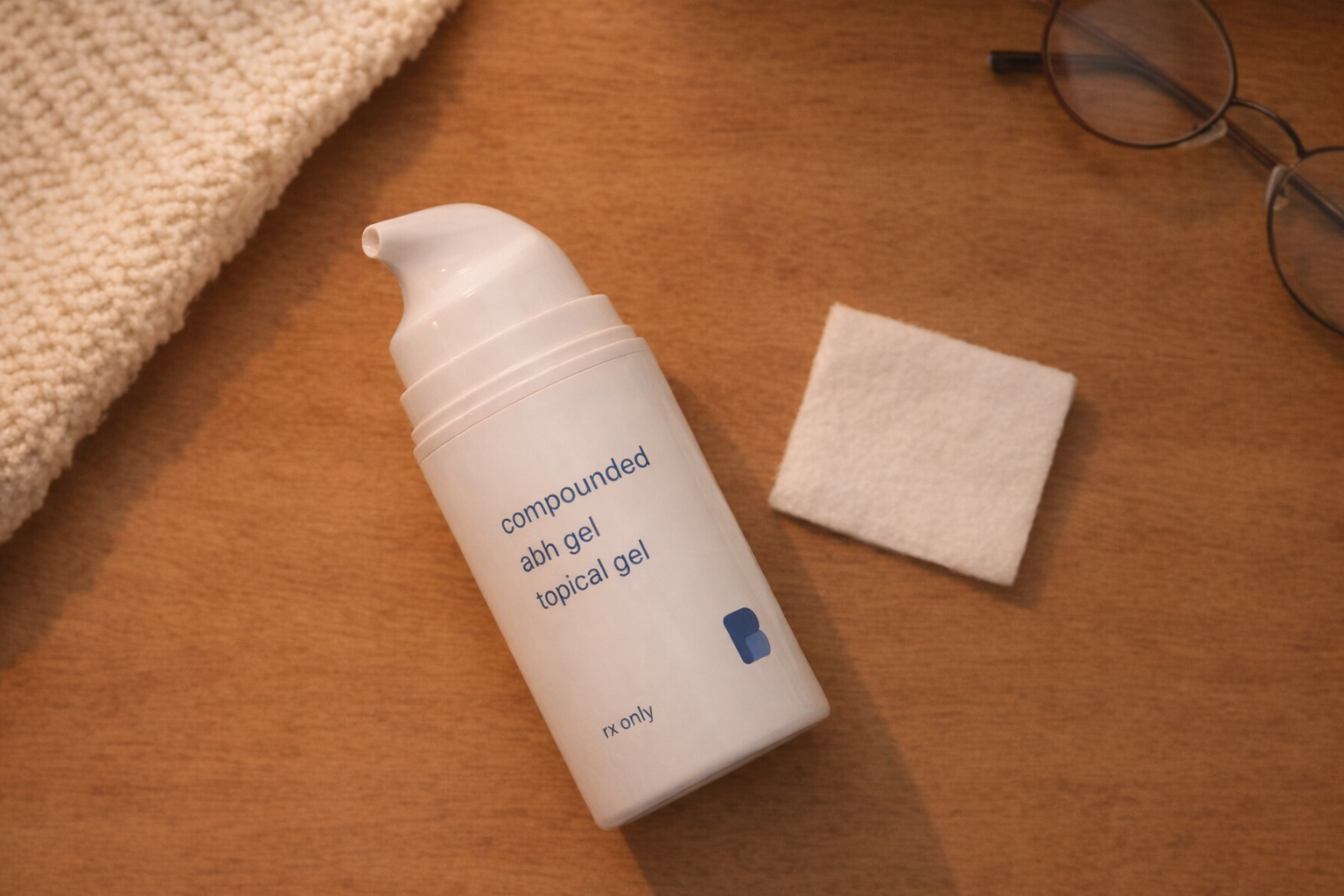
Store ABH gel as the label directs and use it before the beyond-use date printed on it; our post on beyond-use dates explains what that date means. Lorazepam is a Schedule IV controlled substance, so keep the gel where children, pets and visitors cannot reach it, do not share it, and ask the pharmacist or hospice team how to dispose of what is left over.
Because of the lorazepam, Bayview accepts ABH gel orders by e-prescribe only, not by fax or phone, and prepares it for an individual patient rather than as agency or facility stock. Prescribers can find the formulary preparations on the ABH gel page and the ordering steps on how to e-prescribe.
Frequently asked questions
What does ABH stand for?
ABH is named for the brand names of its three ingredients: Ativan (lorazepam), Benadryl (diphenhydramine) and Haldol (haloperidol). Each is FDA-approved in forms that are swallowed or injected. ABH gel itself is compounded and is not FDA-approved.
Is ABH gel absorbed through the skin?
A study by Smith and colleagues (2012) applied ABH gel to ten healthy volunteers and found no lorazepam or haloperidol in any blood sample, and low, inconsistent diphenhydramine in five of them. Bayview prepares ABH gel on a prescriber's order and makes no claim that it is absorbed or that it works for any condition.
Can an ABH gel prescription be faxed or phoned in?
No. ABH gel contains lorazepam, a Schedule IV controlled substance, so Bayview fills it only from an electronic prescription for controlled substances (EPCS) sent to Bayview Pharmacy, NCPDP 4106882. The order form can be used as a reference when entering the compound in your EHR.
How is ABH gel applied?
Follow the directions on the label; they come from the prescriber. The gel is usually measured in a syringe and rubbed into the skin, often on the inner wrist. The person applying it should wash their hands afterward so the gel is not carried to their own skin, eyes or mouth.
What other options are there when a patient cannot swallow?
Bayview also prepares oral concentrates and prefilled oral or sublingual syringes for patients who can no longer swallow tablets. See our hospice and palliative care page. The prescriber and care team choose what fits the patient.
Are compounded medications FDA-approved?
Compounded medications are not FDA-approved. They're prepared by a licensed pharmacy pursuant to a valid prescription for an individual patient, under USP standards. The FDA does not review compounded medications for safety or effectiveness.
Can you fill a prescription from my own provider?
Yes. Your provider can send your prescription to Bayview Pharmacy by e-prescribe, fax, or phone, or you can transfer an existing prescription from another pharmacy.
Do I need a prescription?
Yes. All of our medications require a valid prescription from a licensed provider. We're a dispensing and compounding pharmacy, so we don't provide consultations or write prescriptions. If you don't have one yet, you'll need to see a provider first.
How do providers send a prescription to Bayview?
Providers can submit a prescription three ways:
- E-prescribe: Search Bayview Pharmacy, Warwick, RI (NCPDP 4106882) in your EHR. For compounds, use the compound, custom, or free-text option and include the full formulation, strength, quantity, refills, and directions.
- Fax: Send a signed order to 401-284-4506 (alt. 401-210-2757) with patient and prescriber details, medication, quantity, refills, directions, signature, and date.
- Phone: Call 401-284-4505 to submit, clarify, or coordinate refills.
A valid prescription is required, and compounded medications are not FDA-approved.
How do refills and automatic refills work?
Refills are coordinated with your prescriber and your prescription. You can request a refill through our website or by calling us, and we'll handle the rest as long as you have refills remaining on a valid prescription. You can also opt into automatic refills on non-controlled substances, with no need to worry about running out of your medication. We can either ship it to you automatically, or ready for pickup.
How does shipping work?
Once your prescription is verified, we prepare your medication and ship it discreetly in plain packaging either via UPS or USPS. A pharmacy technician confirms the details with you before it goes out, and we're available if you have any questions.
What is compounding?
Compounding is the practice of preparing a medication tailored to an individual patient's prescription. Instead of a mass-produced product, a compounding pharmacy makes the medication to the specific strength, form, or combination your provider orders.
Examples on this site include medications compounded as liquids for people who cannot swallow pills, thyroid capsules made to a T3/T4 ratio no manufactured product offers, and all-purpose nipple ointment, which combines three actives that are not sold together commercially.
What Bayview compounds for this
Important: Compounded medications are prepared to a prescriber's order for an individual patient. They are not FDA-approved, and the FDA has not evaluated them for safety, effectiveness, or manufacturing quality. This article is educational and is not a substitute for advice from your prescriber or pharmacist.
This preparation contains a controlled substance. Controlled-substance prescriptions carry refill limits, must be e-prescribed, and can only be shipped to states where Bayview holds the required licensure.
Uses discussed here may be off-label, meaning they are not part of any FDA-approved labeling. Off-label use is a decision for you and your prescriber, based on the available evidence.
Veterinary preparations are compounded to a veterinarian's order for a specific animal and are not FDA-approved animal drugs. Never give a compounded human medication to an animal without veterinary direction.
Compounded prescriptions are paid for directly rather than billed through insurance. Most are HSA/FSA-eligible, and many patients submit the receipt to their plan for possible reimbursement. Pricing depends on the strength, dose form and quantity your prescriber orders. Read more about cost and insurance.
The starting cash price for ABH gel at Bayview is $110 for 25 mL, and the final price depends on the strength and quantity on the prescription. Compounded prescriptions at Bayview are priced as cash prescriptions, and coverage varies by plan and by hospice benefit.
Bayview Pharmacy is a compounding pharmacy in Warwick, Rhode Island, licensed to fill and ship compounded prescriptions for patients in Rhode Island, Massachusetts, Connecticut, New Jersey, New Hampshire, Florida, Maine, Pennsylvania and Wisconsin. Prescriptions for New York patients are filled on a limited basis, and controlled substances are not shipped to New York addresses. See every state we ship to.
Related reading