
Hydrocortisone is a synthetic form of cortisol, the steroid hormone the adrenal glands make. On the skin it eases redness, swelling and itching, and it sits in the least potent class of topical steroids. Most people know it as the 1% cream sold at the drugstore.
Because 1% and 2.5% products are already sold, a compounded hydrocortisone preparation is for a strength, base or combination a prescriber specifies that the manufactured products do not offer. Compounded hydrocortisone is not FDA-approved.
How is it different from over-the-counter hydrocortisone?

Over-the-counter creams are manufactured at 1% in fixed bases, and prescription cream and ointment at 2.5%. A compounded preparation is made for one patient in the strength, base and combination written on the prescription, which is why it needs a prescriber's order. It is not a stronger version of a store product unless your prescriber writes it that way.
Where hydrocortisone sits next to other steroids is laid out in our topical steroid potency chart, and our post on triamcinolone vs hydrocortisone compares it with a mid-strength option.
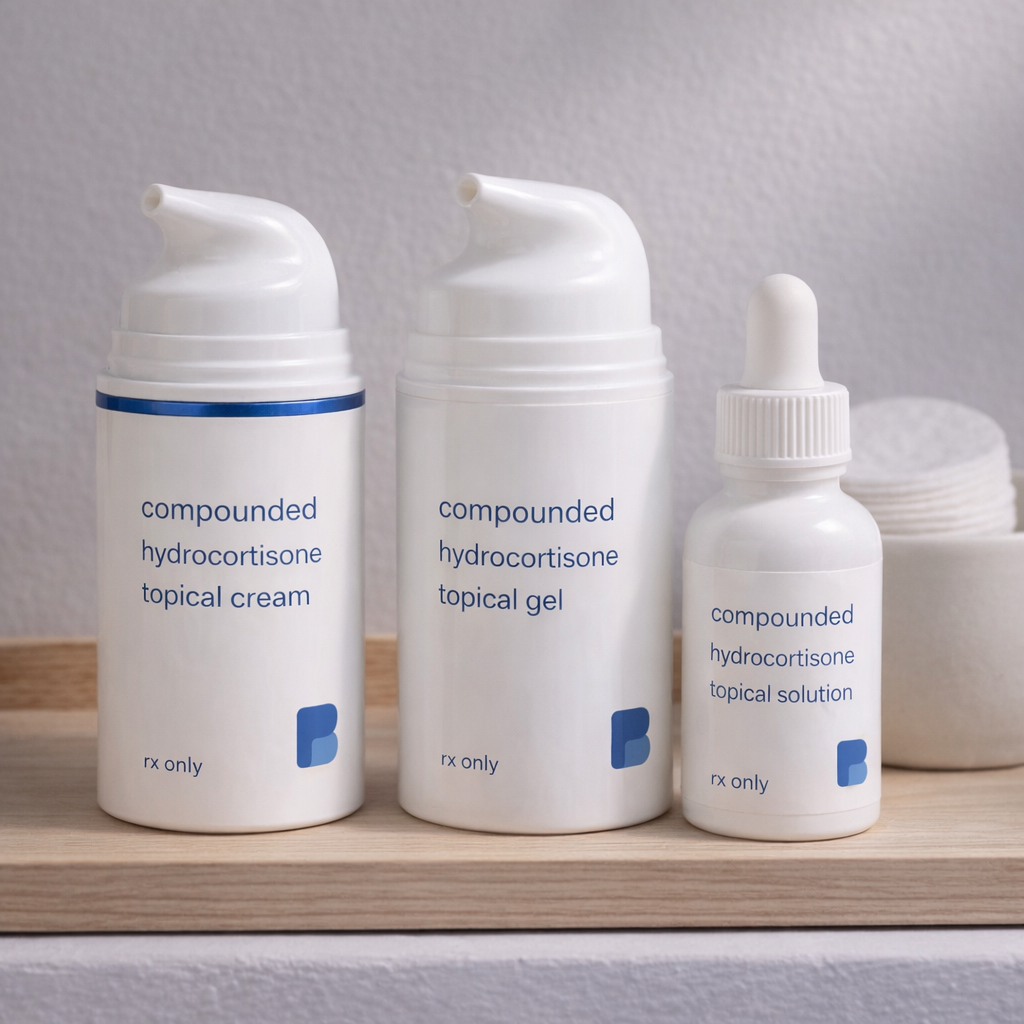
Which forms does Bayview compound?
| Form | Formulary strengths |
|---|---|
| Cream | 2% and 3%; hydrocortisone acetate 0.2% |
| Gel | 3% and 5% |
| Topical solution | 2.5%, for skin or scalp |
| Topical spray | 5% |
Two-ingredient preparations with lidocaine, pramoxine, iodoquinol, clotrimazole, miconazole, neomycin, nystatin or acyclovir can also be prepared, and a prescriber may want a base without a preservative or fragrance. Forms are listed for education only and are not a statement that any option is better or more effective.
How do you apply it?

Apply a thin layer to the affected area as your prescriber directs, usually one to several times a day, and rub it in gently. Do not cover the area with bandages or plastic unless told to, and do not use it on the face, groin or under the arms for longer than your prescriber directs. Keep it out of the eyes.
What should you watch for?
Side effects can include burning, itching, dryness or irritation where it is applied. With long use, large areas or covered skin, enough can be absorbed to affect the body's own cortisol production, especially in children. Get medical care for a rash that spreads, signs of a skin infection or signs of an allergic reaction.
Do not use hydrocortisone if you are allergic to it or any ingredient, or on a skin infection your prescriber has not treated. Tell your prescriber if you are pregnant or breastfeeding and about any other steroid products you use. Store it as your label directs and use it before the beyond-use date. Related preparations include lidocaine and nystatin.
Frequently asked questions
What is hydrocortisone cream used for?
Hydrocortisone is a mild steroid used on the skin to ease redness, swelling and itching. Your prescriber decides whether a compounded cream is right for you and what to use it on.
What strengths of hydrocortisone cream can be compounded?
Bayview compounds hydrocortisone creams at 2% and 3%, a 0.2% hydrocortisone acetate cream, gels at 3% and 5%, a 2.5% solution and a 5% spray. Other strengths and combinations can be made to order.
Is hydrocortisone a steroid?
Yes. It is a corticosteroid, a form of the hormone cortisol, and the mildest class of topical steroid. It is not an anabolic steroid.
Where should hydrocortisone cream not be used?
Keep it out of the eyes, and do not use it on a skin infection your prescriber has not treated. Use it on the face, groin or under the arms only as long as your prescriber directs.
Can hydrocortisone be combined with lidocaine or an antifungal?
Yes, when a prescriber orders it. Bayview compounds hydrocortisone with lidocaine, pramoxine, clotrimazole, miconazole, nystatin and other actives in one preparation.
Are compounded medications FDA-approved?
Compounded medications are not FDA-approved. They're prepared by a licensed pharmacy pursuant to a valid prescription for an individual patient, under USP standards. The FDA does not review compounded medications for safety or effectiveness.
Can you fill a prescription from my own provider?
Yes. Your provider can send your prescription to Bayview Pharmacy by e-prescribe, fax, or phone, or you can transfer an existing prescription from another pharmacy.
Do I need a prescription?
Yes. All of our medications require a valid prescription from a licensed provider. We're a dispensing and compounding pharmacy, so we don't provide consultations or write prescriptions. If you don't have one yet, you'll need to see a provider first.
How does shipping work?
Once your prescription is verified, we prepare your medication and ship it discreetly in plain packaging either via UPS or USPS. A pharmacy technician confirms the details with you before it goes out, and we're available if you have any questions.
How do providers send a prescription to Bayview?
Providers can submit a prescription three ways:
- E-prescribe: Search Bayview Pharmacy, Warwick, RI (NCPDP 4106882) in your EHR. For compounds, use the compound, custom, or free-text option and include the full formulation, strength, quantity, refills, and directions.
- Fax: Send a signed order to 401-284-4506 (alt. 401-210-2757) with patient and prescriber details, medication, quantity, refills, directions, signature, and date.
- Phone: Call 401-284-4505 to submit, clarify, or coordinate refills.
A valid prescription is required, and compounded medications are not FDA-approved.
How do refills and automatic refills work?
Refills are coordinated with your prescriber and your prescription. You can request a refill through our website or by calling us, and we'll handle the rest as long as you have refills remaining on a valid prescription. You can also opt into automatic refills on non-controlled substances, with no need to worry about running out of your medication. We can either ship it to you automatically, or ready for pickup.
What is compounding?
Compounding is the practice of preparing a medication tailored to an individual patient's prescription. Instead of a mass-produced product, a compounding pharmacy makes the medication to the specific strength, form, or combination your provider orders.
Examples on this site include medications compounded as liquids for people who cannot swallow pills, thyroid capsules made to a T3/T4 ratio no manufactured product offers, and all-purpose nipple ointment, which combines three actives that are not sold together commercially.
What Bayview compounds for this
Important: Compounded medications are prepared to a prescriber's order for an individual patient. They are not FDA-approved, and the FDA has not evaluated them for safety, effectiveness, or manufacturing quality. This article is educational and is not a substitute for advice from your prescriber or pharmacist.
This preparation contains a controlled substance. Controlled-substance prescriptions carry refill limits, must be e-prescribed, and can only be shipped to states where Bayview holds the required licensure.
Uses discussed here may be off-label, meaning they are not part of any FDA-approved labeling. Off-label use is a decision for you and your prescriber, based on the available evidence.
Veterinary preparations are compounded to a veterinarian's order for a specific animal and are not FDA-approved animal drugs. Never give a compounded human medication to an animal without veterinary direction.
Compounded prescriptions are paid for directly rather than billed through insurance. Most are HSA/FSA-eligible, and many patients submit the receipt to their plan for possible reimbursement. Pricing depends on the strength, dose form and quantity your prescriber orders. Read more about cost and insurance.
The starting cash price for compounded hydrocortisone at Bayview is $92 for 30 g, and the final price depends on the strength, base and quantity on the prescription. Compounded prescriptions at Bayview are priced as cash prescriptions, and coverage varies by plan.
Bayview Pharmacy is a compounding pharmacy in Warwick, Rhode Island, licensed to fill and ship compounded prescriptions for patients in Rhode Island, Massachusetts, Connecticut, New Jersey, New Hampshire, Florida, Maine, Pennsylvania and Wisconsin. Prescriptions for New York patients are filled on a limited basis, and controlled substances are not shipped to New York addresses. See every state we ship to.
Related reading