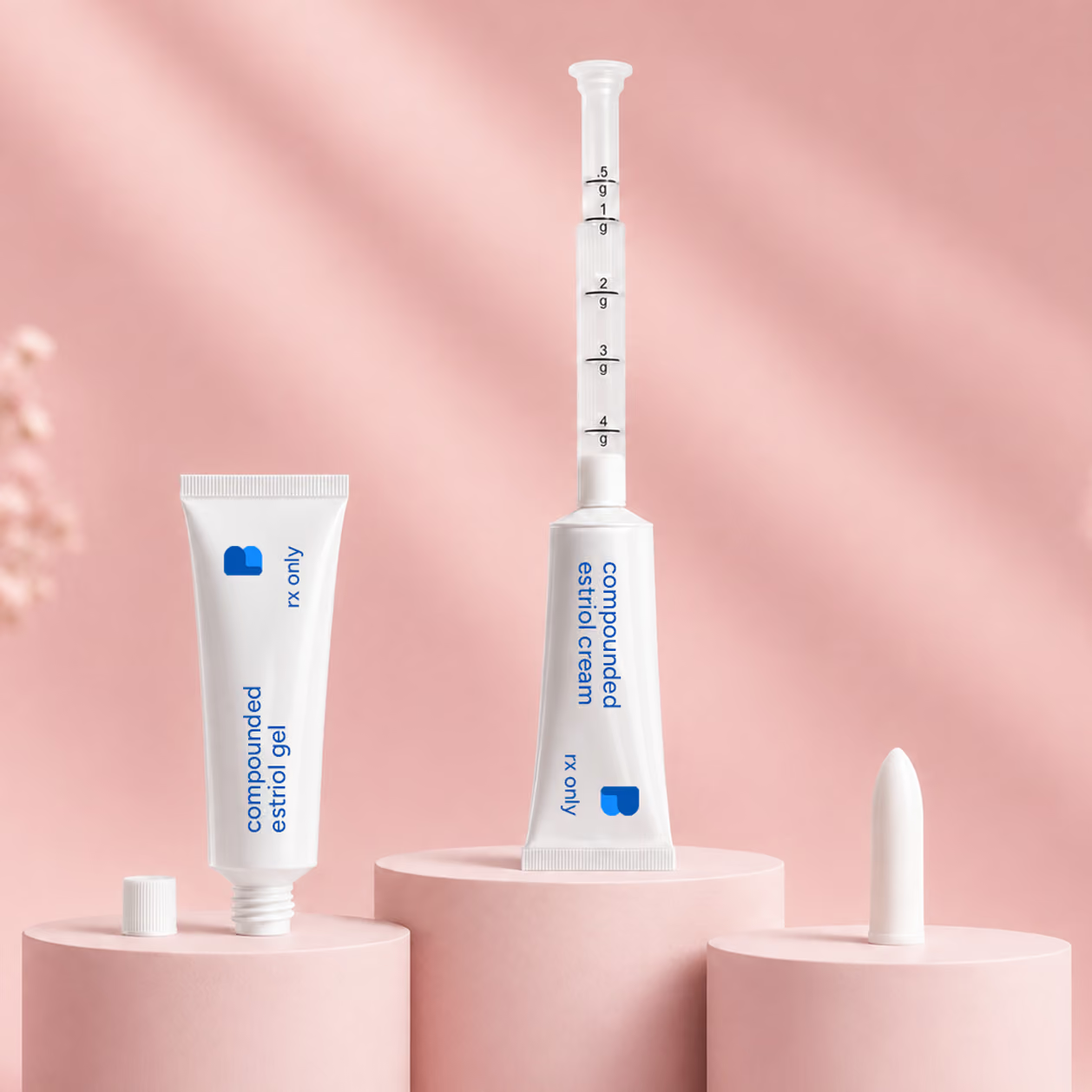
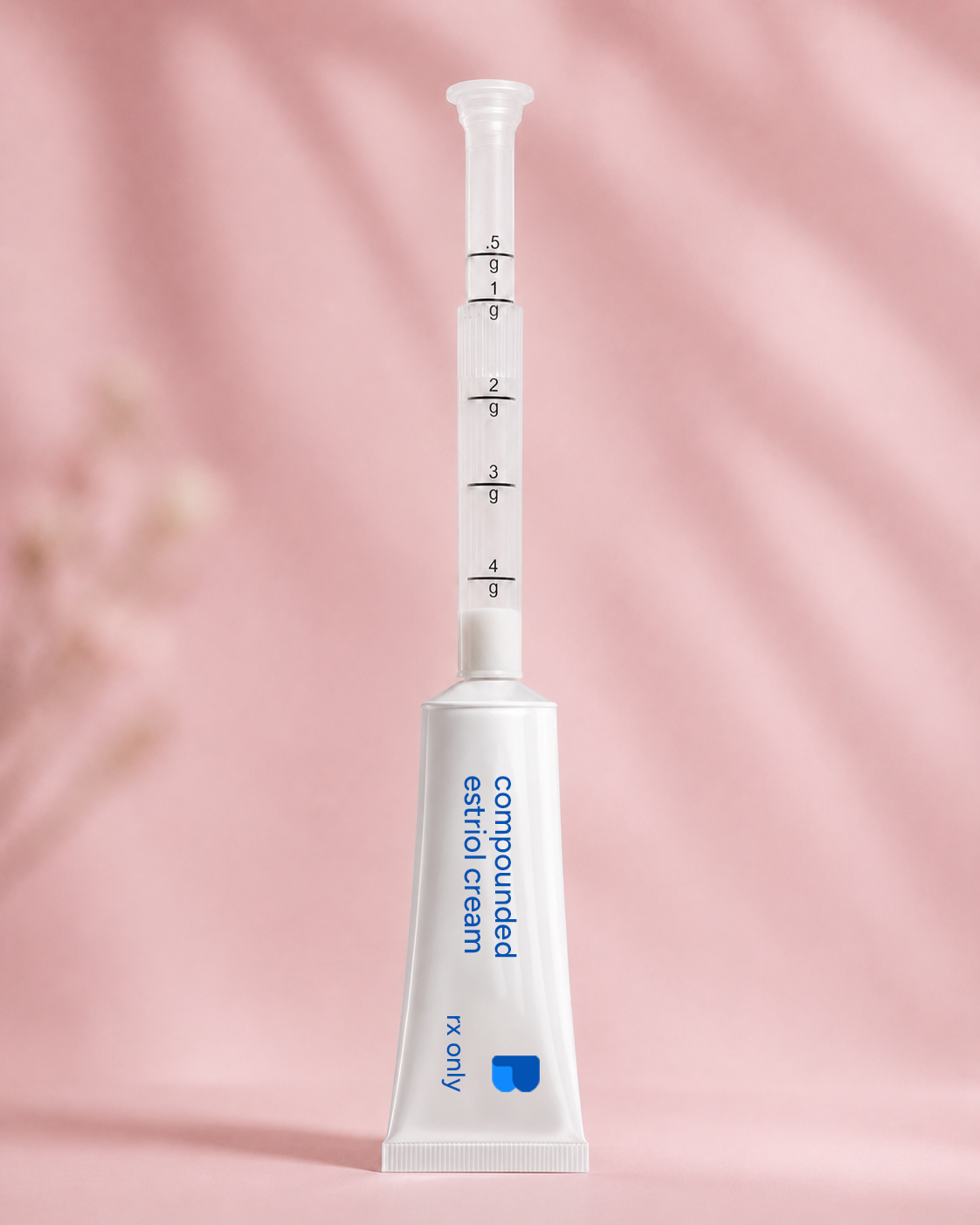
Estriol and estradiol are two of the three estrogens the body makes: estradiol is the most potent, and estriol is the weakest. FDA-approved estradiol products are sold in the United States, but there is no FDA-approved estriol product, so estriol is available only as a compounded preparation such as Estriol Vaginal Cream. Bi-Est is a compounded preparation that combines the two in a ratio your prescriber chooses.
This guide explains what each name means, how vaginal and skin (topical) estrogen creams differ, and where compounding fits. It is written so the conversation with your prescriber makes sense. It is not a guide to choosing one.
What is the difference between estriol and estradiol?
The body makes three estrogens: estrone (E1), estradiol (E2), and estriol (E3). They are related hormones, but they are not interchangeable. They differ in how strongly they bind and act on estrogen receptors, in when the body relies on each, and in what is available as an FDA-approved medicine.
| Estrogen | Relative potency | US status |
|---|---|---|
| Estriol (E3) | Weakest of the three | Compounded, not FDA-approved |
| Estradiol (E2) | Most potent | FDA-approved products exist |
| Estrone (E1) | Intermediate | Not used alone here |
| Bi-Est | Estriol plus estradiol | Compounded, not FDA-approved |
Estradiol is the main estrogen during the reproductive years, and estrone is the predominant estrogen after menopause. Estrone appears in the table only to complete the picture; it is not used on its own in the preparations discussed here.
Is estriol weaker than estradiol?
Yes. StatPearls, the NCBI Bookshelf reference on estrogen, describes estriol as the weakest of the three estrogens, one that binds estrogen receptors less strongly than estradiol does.

Potency describes how strongly an estrogen binds and acts. It does not describe how well a medicine will suit a particular person, and a weaker estrogen is not automatically the safer or better choice. That point matters, because "weaker" is often read as "gentler." The published guidance does not support that reading (see the FDA section below).
What is Bi-Est?
Bi-Est means "two estrogens." It is a compounded, prescription-only preparation that combines estriol and estradiol in one product. A combined estriol and estradiol product is not available as a standard FDA-approved manufactured medicine, so it is prepared by compounding.
Bi-Est is described by a ratio, most commonly 80/20 or 50/50. The ratio is the proportion of estriol to estradiol, so 80/20 means 80% estriol and 20% estradiol. Your prescriber sets the ratio, the strength, and the form. Bayview prepares Bi-Est as a topical cream, an anhydrous topical gel, or a troche (a lozenge that dissolves in the mouth).
Because Bi-Est contains estradiol, it is not an estriol-only preparation. A related compounded preparation, Tri-Est, adds estrone as a third estrogen.
Is estriol FDA-approved?
No. There is no FDA-approved estriol product in the United States, so estriol is available only through 503A compounding. That makes estriol "compounded, not FDA-approved" rather than an off-label use of an approved drug.

ACOG's clinical consensus on compounded hormone therapy reports that the FDA has stated it lacks evidence of the safety and effectiveness of estriol-containing drugs, and lacks evidence that they are "safer" forms of estrogen. Compounded preparations, including estriol and Bi-Est, are not reviewed by the FDA for safety or effectiveness.
Estradiol is different. FDA-approved estradiol products exist in many forms, including low-dose vaginal creams, vaginal inserts and tablets, a vaginal ring, and skin gels, sprays, and patches. Where an FDA-approved product fits your prescriber's order, that is what a pharmacy dispenses. For background on how compounding pharmacies are regulated, see what a compounding pharmacy is and 503A vs 503B compounding pharmacies.
Vaginal vs topical estrogen cream: what is the difference?
The same word, "cream," covers two very different uses. The route decides where the estrogen goes.
| Preparation | Route | Reaches | Status |
|---|---|---|---|
| Vaginal estriol | Vaginal | Local tissue | Compounded, not FDA-approved |
| Vaginal estradiol, compounded | Vaginal | Local tissue | Compounded, not FDA-approved |
| Vaginal estradiol, manufactured | Vaginal | Local tissue | FDA-approved |
| Estradiol skin cream, compounded | Skin | Bloodstream | Compounded, not FDA-approved |
| Estradiol gel, spray, patch | Skin | Bloodstream | FDA-approved |
| Bi-Est cream or gel | Skin | Bloodstream | Compounded, not FDA-approved |
| Bi-Est troche | Mouth | Bloodstream | Compounded, not FDA-approved |
Look at the "Reaches" column: vaginal preparations are meant to stay local, while skin creams and troches are systemic hormone therapy. Bi-Est is listed among Bayview's systemic hormone preparations.
The route also changes what goes with the estrogen. For systemic estrogen, estrogen used without a progestogen raises the risk of endometrial (uterine) cancer in people who still have a uterus, so prescribers generally add a progestogen such as progesterone. For low-dose vaginal estrogen, major society guidance generally does not call for a systemic progestogen, and your prescriber individualizes that decision.
Estradiol on the skin can also transfer to other people and to pets through skin contact, which is why the skin-cream labels ask you to wash your hands and let the area dry before close contact.
When is compounded estradiol used instead of an FDA-approved product?
Because FDA-approved estradiol is widely available, professional guidance is specific about compounded versions. A 2020 report from the National Academies (NASEM) on compounded "bioidentical" hormone therapy recommends restricting it to two circumstances: an allergy to an ingredient in an FDA-approved product, or a need for a dosage form that is not commercially available. ACOG's 2023 clinical consensus advises that compounded formulations should not be routinely prescribed when FDA-approved options exist, and that patients be told these products lack FDA approval.

In practice, a prescriber may order compounded vaginal estradiol for a base without propylene glycol or parabens, a strength that is not marketed, or a prefilled-syringe form. A compounded estradiol topical cream is generally reserved for a documented ingredient allergy, or a dose or dosage form not sold commercially. Of the hormone preparations, a compounded systemic estradiol cream is the hardest to justify.
Estriol sits in a different place. Since there is no FDA-approved estriol product, compounding is the only way a prescriber who wants estriol can obtain it.
What changed with the boxed warning on vaginal estrogen?
In 2025 the FDA announced the removal of the boxed warning from low-dose vaginal estrogen products (FDA; The Menopause Society). ACOG and The Menopause Society support low-dose vaginal estrogen use with shared decision-making between patient and prescriber.
That labeling change applies to FDA-approved products. Compounded preparations carry no FDA-approved labeling of their own, so the change does not describe any compounded cream. It also does not describe systemic estrogen: for systemic estrogen-alone products, the boxed warning about endometrial cancer was not removed. None of this means estrogen therapy is free of risk, and your prescriber reviews your own history.
Are estriol and estradiol interchangeable?
No. A pharmacy fills the estrogen, strength, and form written on the prescription. Estriol cannot be swapped for estradiol, and an 80/20 Bi-Est cannot be swapped for a 50/50 one, without a new order from your prescriber.
Which estrogen, which route, and what dose are your prescriber's decisions, not the pharmacy's. Bayview does not provide consultations and does not decide whether a medication is right for you. A Bayview pharmacist is available for questions about a prescription you already have.
How much does compounded estriol cream cost?
Compounded preparations are cash-priced, and the price varies with the form, strength, and quantity your prescriber orders. Starting prices for the preparations in this guide:
| Preparation | Route | Starting price |
|---|---|---|
| Estriol Vaginal Cream | Vaginal | $70 / 20 g |
| Vaginal estradiol, compounded | Vaginal | $50 / 20 mL |
| Estradiol topical cream | Skin | $70 / 30 g |
| Bi-Est | Skin or mouth | $125 / 90 g |
Compounded preparations are generally eligible for HSA and FSA cards. Where an FDA-approved vaginal estrogen product fits your prescriber's order, that is what we dispense, and it may be covered by your insurance. More detail is in do compounding pharmacies take insurance. For a quote, call 401-284-4505 with the preparation and quantity your prescriber ordered.
What does Bayview compound for this?
On a prescriber's order, Bayview prepares vaginal estriol as a cream (0.25 mg to 1 mg per gram), a suppository (0.03 mg to 1 mg), or a gel (0.25 mg to 1 mg per gram). Bi-Est is prepared in 50/50 and 80/20 ratios as a topical cream (0.25 mg to 2.5 mg per gram), an anhydrous gel (0.25 mg to 5 mg per gram for 50/50, 1 mg per gram for 80/20), or a troche (1 mg for 50/50, 1.25 mg for 80/20). Compounded vaginal estradiol is prepared as a 0.01% or 0.02% cream in prefilled syringes or a tube, or as 0.1 mg suppositories. Estradiol topical cream is prepared from 0.5 mg up to 4 mg per gram.
Each is made in small batches under USP 795 non-sterile compounding standards. These strengths are listed for reference, not as a recommendation, and the full hormone line is in our compounded medications catalog.
Talk to your prescriber
If you have questions about estriol, estradiol, or Bi-Est, bring them to your prescriber, who decides whether any estrogen is appropriate for you and writes the order. Once you have a prescription, Bayview can fill it and ship it to the states where Bayview is licensed (see our FAQ), or you can read about finding a compounding pharmacy near you.
Frequently asked questions
How much does compounded vaginal estriol cost?
Compounded vaginal estriol starts at $70 for 20 g, and the price varies with the form, strength, and size. Compounded preparations are cash-priced and are generally eligible for HSA and FSA cards. Where an FDA-approved vaginal estrogen product fits your prescriber's order, that is what we dispense, and it may be covered by your insurance. Call us at 401-284-4505 with the preparation and quantity your prescriber ordered and we will quote it before we make it.
Does vaginal estriol get absorbed into the bloodstream?
Only in small amounts. Low-dose vaginal estrogen acts mostly on the tissue it is applied to, and major professional societies distinguish it from systemic, whole-body estrogen therapy on exactly that basis. In 2025 the FDA announced the removal of the boxed warning from low-dose vaginal estrogen products, reflecting that minimal systemic exposure. That does not mean it is right for everyone — share your full medical history with your prescriber, particularly any history of estrogen-sensitive cancer, and report any postmenopausal bleeding.
What is Bi-Est?
Bi-Est is a compounded preparation combining two estrogens, estriol and estradiol, in a ratio the prescriber specifies. It is ordered when a prescriber wants both in a single preparation rather than estriol alone. Like estriol on its own, Bi-Est is compounded and is not FDA-approved, and a valid prescription is required. Your prescriber decides whether it is appropriate and sets the ratio, form, and dose.
Is estriol FDA-approved?
No. There is no FDA-approved estriol product in the United States, which is why vaginal estriol is available only through a compounding pharmacy and only against a valid prescription. Compounded preparations are not reviewed by the FDA for safety or effectiveness. FDA-approved low-dose vaginal estrogen products do exist using estradiol, and where one of those fits your prescriber's order, that is what a pharmacy dispenses.
Is estriol the same as estradiol?
No. They are two different estrogens the body makes. Estradiol (E2) is the most potent and is the main estrogen before menopause; estriol (E3) is the weakest of the three natural estrogens. That difference in potency is usually why a prescriber picks one over the other for local vaginal use. They are not interchangeable, and estradiol has FDA-approved low-dose vaginal products while estriol does not — estriol is available only as a compounded preparation. Which one suits you is your prescriber's decision.
What side effects can it cause?
The most common effects are local, such as vaginal irritation, itching, mild burning, or discharge. Report any unusual vaginal bleeding or any reaction that concerns you to your provider.
Which form should I use: cream, suppository, ovule, or gel?
Your provider chooses the form and dose that fit you. All are placed in the vagina to act locally and differ mainly in how they are inserted; one is not stronger or better than another.
Do I need to take progesterone with it?
Low-dose vaginal estrogen generally does not require a separate progesterone for uterine protection, but your provider makes that decision based on your history. Report any unusual vaginal bleeding.
Is vaginal estriol the same as taking estrogen for my whole body?
No. Low-dose vaginal estriol acts mainly on the local tissue and is absorbed into the rest of the body only in small amounts. Major societies distinguish low-dose vaginal estrogen from systemic estrogen therapy, and in 2025 the FDA removed the boxed warning from low-dose vaginal estrogen. Your provider decides what is right for you.
What is vaginal estriol used for?
Providers may use low-dose vaginal estriol as part of care for the genitourinary syndrome of menopause, vaginal dryness, irritation, and discomfort with intercourse, when they determine it is appropriate. A valid prescription is required.
Is estriol weaker than estradiol?
Yes. StatPearls describes estriol as the weakest of the body's three estrogens, binding estrogen receptors less strongly than estradiol, which is the most potent. Potency describes how strongly an estrogen binds and acts, not how well it will suit a particular person. A weaker estrogen is not automatically the safer or better choice, and your prescriber decides which estrogen, form, and strength are appropriate for you.
Is estriol safer than estradiol?
That has not been shown. ACOG's clinical consensus on compounded hormone therapy reports that the FDA has stated it lacks evidence that estriol-containing drugs are "safer" forms of estrogen. Estriol is a weaker estrogen, but a weaker estrogen is not automatically the safer or better choice. Your prescriber weighs your history and decides which estrogen, if any, is appropriate.
What does 80/20 mean for Bi-Est?
The ratio is the proportion of estriol to estradiol in the preparation. An 80/20 Bi-Est is 80% estriol and 20% estradiol, and a 50/50 Bi-Est contains equal parts of each. Your prescriber chooses the ratio, strength, and form, and Bayview prepares Bi-Est as a topical cream, an anhydrous gel, or a troche on a prescriber's order.
Can a pharmacist switch estradiol to estriol?
No. Estriol and estradiol are not interchangeable, and a pharmacy fills the estrogen, strength, and form written on the prescription. Changing from one estrogen to another, or from one Bi-Est ratio to another, needs a new order from your prescriber. Where an FDA-approved estradiol product fits the order, that is what a pharmacy dispenses.
Does insurance cover compounded estriol cream?
Compounded preparations such as estriol vaginal cream are cash-priced and are generally eligible for HSA and FSA cards. Bayview's compounded vaginal estriol starts at $70 for 20 g, and the price varies with form, strength, and size. Where an FDA-approved vaginal estrogen product fits your prescriber's order, that is what Bayview dispenses, and it may be covered by your insurance.
What Bayview compounds for this
Important: Compounded medications are prepared to a prescriber's order for an individual patient. They are not FDA-approved, and the FDA has not evaluated them for safety, effectiveness, or manufacturing quality. This article is educational and is not a substitute for advice from your prescriber or pharmacist.
This preparation contains a controlled substance. Controlled-substance prescriptions carry refill limits, must be e-prescribed, and can only be shipped to states where Bayview holds the required licensure.
Uses discussed here may be off-label, meaning they are not part of any FDA-approved labeling. Off-label use is a decision for you and your prescriber, based on the available evidence.
Veterinary preparations are compounded to a veterinarian's order for a specific animal and are not FDA-approved animal drugs. Never give a compounded human medication to an animal without veterinary direction.
Compounded prescriptions are paid for directly rather than billed through insurance. Most are HSA/FSA-eligible, and many patients submit the receipt to their plan for possible reimbursement. Pricing depends on the strength, dose form and quantity your prescriber orders. Read more about cost and insurance.
Compounded Estriol Vaginal Cream starts at $70 for 20 g, and the price varies with the form, strength, and size your prescriber orders. Compounded preparations are cash-priced rather than billed through insurance, and are generally eligible for HSA and FSA cards. Where an FDA-approved vaginal estrogen product fits the order, that is what Bayview dispenses, and it may be covered. Call 401-284-4505 for a quote before we make it.
Bayview Pharmacy is a compounding pharmacy in Warwick, Rhode Island, licensed to fill and ship compounded prescriptions for patients in Rhode Island, Massachusetts, Connecticut, New Jersey, New Hampshire, Florida, Maine and Pennsylvania. Prescriptions for New York patients are filled on a limited basis, and controlled substances are not shipped to New York addresses. See every state we ship to.
Related reading