

Ibuprofen is a nonsteroidal anti-inflammatory drug, or NSAID. According to MedlinePlus, it works by stopping the body from making a substance that causes pain, fever and inflammation, and the ibuprofen products it lists are all taken by mouth: tablets, chewable tablets, capsules and liquids.
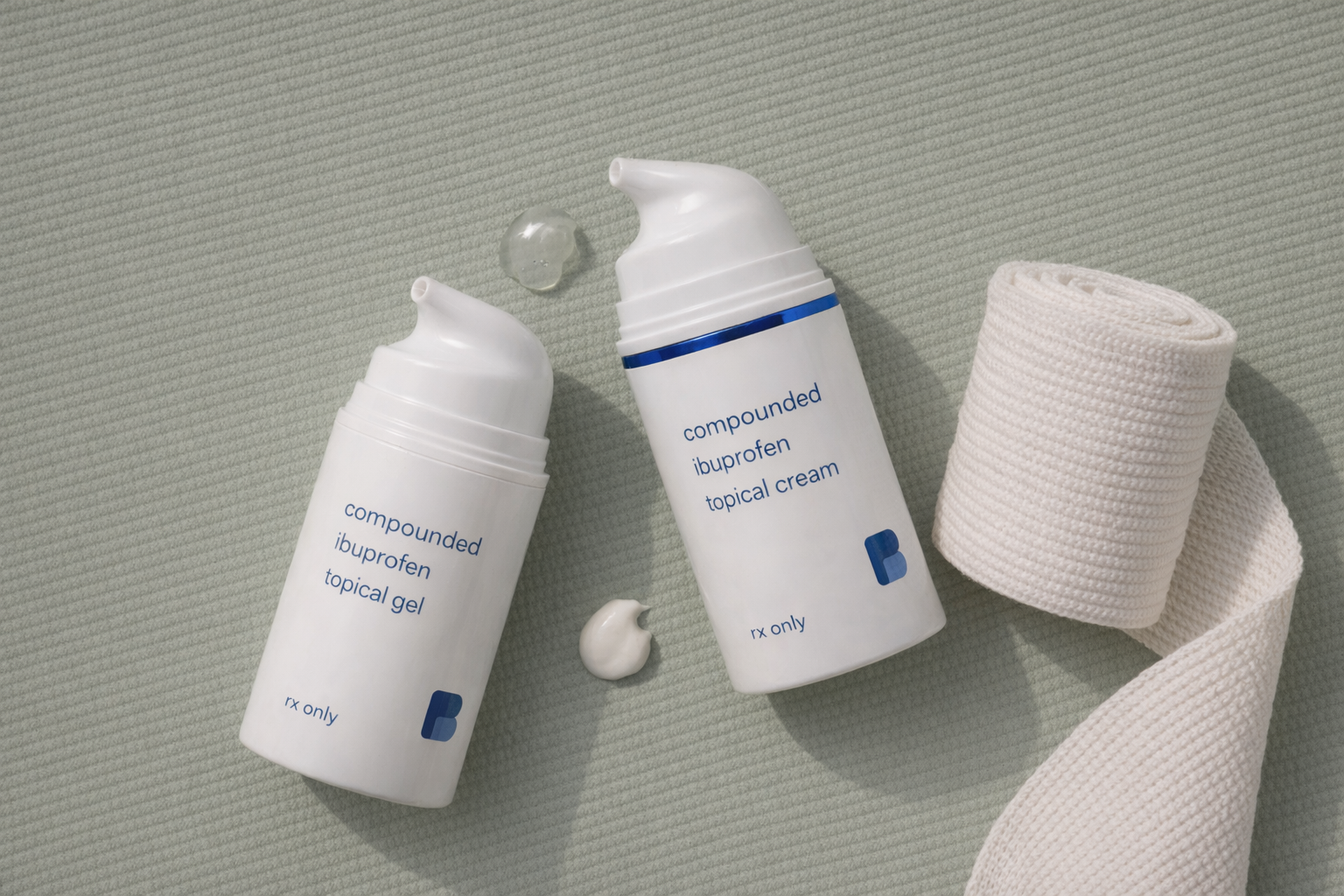
Ibuprofen gel is ibuprofen compounded into a gel or cream that is applied to the skin. Bayview prepares ibuprofen gel and cream in several strengths, alone or with other ingredients, when a prescriber orders it for an individual patient.
What is topical ibuprofen?

Prescription ibuprofen taken by mouth is used to relieve soreness, swelling and stiffness from osteoarthritis and rheumatoid arthritis, and for mild to moderate pain such as menstrual pain. Those are the uses of the FDA-approved oral products.
Compounded ibuprofen gels and creams are not FDA-approved, and the FDA has not evaluated them for safety, effectiveness or how much ibuprofen reaches the bloodstream. They have not been studied in clinical trials, and Bayview makes no claim that they work for any condition. Your prescriber decides whether topical ibuprofen fits your situation. Our post on topical vs oral explains in general terms what changes when a medicine goes on the skin.
What strengths and combinations are available?
| Form | Formulary strengths |
|---|---|
| Topical gel | Ibuprofen 2%, 5%, 10% or 20% |
| Transdermal gel or cream | Ibuprofen 10% gel; 200 mg/mL cream |
| With menthol | Ibuprofen 5% / menthol 3% |
| With lidocaine | Ibuprofen 10% / lidocaine HCl 5% cream |
| With ketoprofen or cyclobenzaprine | Ketoprofen 10% / ibuprofen 2.5%; cyclobenzaprine 1% / ibuprofen 20% |
Forms and strengths are listed for education only and are not a statement that any option is better, stronger or more effective. Combinations that add tramadol or ketamine are controlled substances and are covered on our custom pain cream page. For how prescribers build a multi-ingredient cream, see compounded pain cream formulations. Other topical NSAIDs Bayview prepares include diclofenac gel and ketoprofen gel.
How do you apply ibuprofen gel?

Follow the directions on your label; they come from your prescriber. Apply only the amount prescribed, to clean, intact skin over the area your prescriber named, not to wounds, broken skin or a rash. Keep it out of your eyes, nose and mouth, and wash your hands after each application unless your hands are the treated area.
Do not cover the treated area with a tight or airtight bandage or apply heat unless your prescriber tells you to. If your prescription also contains menthol, lidocaine, ketoprofen or cyclobenzaprine, follow the extra directions on your label.
- Apply only the amount prescribed, to clean, intact skin over the area named.
- Keep it off wounds, broken skin and rashes, and out of your eyes, nose and mouth.
- Wash your hands afterward unless your hands are the treated area.
- Do not cover it tightly or add heat unless your prescriber says to.
Do the NSAID warnings still apply to a gel?
MedlinePlus warns that NSAIDs such as ibuprofen may raise the risk of heart attack or stroke, and may cause ulcers, bleeding or holes in the stomach or intestine. Those warnings were written for ibuprofen taken by mouth. How much ibuprofen reaches the blood from a compounded gel has not been evaluated by the FDA, so the risks are not ruled out.
- Do not use another NSAID at the same time, including over-the-counter ibuprofen or naproxen, unless your prescriber tells you to.
- Do not use ibuprofen around or after 20 weeks of pregnancy unless your prescriber directs it.
- Do not use it if you are allergic to ibuprofen, aspirin or another NSAID, or are about to have or have just had heart bypass surgery, unless a doctor directs it.
Redness, itching, dryness or a rash where it is applied can happen; stop and call your provider for a rash, blisters or swelling, stomach pain, or black, tarry or bloody stools. Call 911 for chest pain, shortness of breath, weakness on one side of the body, slurred speech, or swelling of the face or throat. Tell your prescriber about asthma, heart failure, lupus, liver or kidney disease, and every medicine you take, especially blood thinners, aspirin, steroids and SSRI or SNRI antidepressants.
- Chest pain or shortness of breath
- Weakness on one side of the body or slurred speech
- Swelling of the face or throat
Store it with the cap or pump closed, away from heat and moisture, and use it before the beyond-use date on the label. If your prescriber decides topical ibuprofen is right for you, they can send the prescription to Bayview by e-prescribe, fax or phone.
Frequently asked questions
Is ibuprofen gel FDA-approved?
No. Ibuprofen taken by mouth is FDA-approved, but Bayview's ibuprofen gels and creams are compounded preparations. The FDA has not evaluated them for safety, effectiveness, or how much ibuprofen reaches the bloodstream.
Can I take ibuprofen by mouth while using ibuprofen gel?
Not unless your prescriber tells you to. Do not use another NSAID, such as ibuprofen or naproxen taken by mouth, at the same time as the gel without your prescriber's direction.
What strengths and combinations does Bayview make?
Ibuprofen topical gels from 2% to 20%, a 10% transdermal gel and a 200 mg/mL transdermal cream, plus combinations with menthol and camphor, lidocaine, ketoprofen or cyclobenzaprine. Your prescriber chooses the preparation. Combinations that add tramadol or ketamine are controlled substances and must be e-prescribed.
Can I cover the area or use a heating pad after applying it?
Do not cover the treated area with a tight or airtight bandage or apply heat unless your prescriber tells you to. Apply it only to clean, intact skin, and wash your hands afterward unless your hands are the treated area.
Can I use ibuprofen gel during pregnancy?
Tell your prescriber if you are pregnant, planning a pregnancy, or breastfeeding. MedlinePlus advises against taking ibuprofen around or after 20 weeks of pregnancy unless a doctor says to, and how much reaches the blood from a compounded gel has not been evaluated.
Are compounded medications FDA-approved?
Compounded medications are not FDA-approved. They're prepared by a licensed pharmacy pursuant to a valid prescription for an individual patient, under USP standards. The FDA does not review compounded medications for safety or effectiveness.
Can you fill a prescription from my own provider?
Yes. Your provider can send your prescription to Bayview Pharmacy by e-prescribe, fax, or phone, or you can transfer an existing prescription from another pharmacy.
Do I need a prescription?
Yes. All of our medications require a valid prescription from a licensed provider. We're a dispensing and compounding pharmacy, so we don't provide consultations or write prescriptions. If you don't have one yet, you'll need to see a provider first.
How do providers send a prescription to Bayview?
Providers can submit a prescription three ways:
- E-prescribe: Search Bayview Pharmacy, Warwick, RI (NCPDP 4106882) in your EHR. For compounds, use the compound, custom, or free-text option and include the full formulation, strength, quantity, refills, and directions.
- Fax: Send a signed order to 401-284-4506 (alt. 401-210-2757) with patient and prescriber details, medication, quantity, refills, directions, signature, and date.
- Phone: Call 401-284-4505 to submit, clarify, or coordinate refills.
A valid prescription is required, and compounded medications are not FDA-approved.
How do refills and automatic refills work?
Refills are coordinated with your prescriber and your prescription. You can request a refill through our website or by calling us, and we'll handle the rest as long as you have refills remaining on a valid prescription. You can also opt into automatic refills on non-controlled substances, with no need to worry about running out of your medication. We can either ship it to you automatically, or ready for pickup.
How does shipping work?
Once your prescription is verified, we prepare your medication and ship it discreetly in plain packaging either via UPS or USPS. A pharmacy technician confirms the details with you before it goes out, and we're available if you have any questions.
What is compounding?
Compounding is the practice of preparing a medication tailored to an individual patient's prescription. Instead of a mass-produced product, a compounding pharmacy makes the medication to the specific strength, form, or combination your provider orders.
Examples on this site include medications compounded as liquids for people who cannot swallow pills, thyroid capsules made to a T3/T4 ratio no manufactured product offers, and all-purpose nipple ointment, which combines three actives that are not sold together commercially.
What Bayview compounds for this
Important: Compounded medications are prepared to a prescriber's order for an individual patient. They are not FDA-approved, and the FDA has not evaluated them for safety, effectiveness, or manufacturing quality. This article is educational and is not a substitute for advice from your prescriber or pharmacist.
This preparation contains a controlled substance. Controlled-substance prescriptions carry refill limits, must be e-prescribed, and can only be shipped to states where Bayview holds the required licensure.
Uses discussed here may be off-label, meaning they are not part of any FDA-approved labeling. Off-label use is a decision for you and your prescriber, based on the available evidence.
Veterinary preparations are compounded to a veterinarian's order for a specific animal and are not FDA-approved animal drugs. Never give a compounded human medication to an animal without veterinary direction.
Compounded prescriptions are paid for directly rather than billed through insurance. Most are HSA/FSA-eligible, and many patients submit the receipt to their plan for possible reimbursement. Pricing depends on the strength, dose form and quantity your prescriber orders. Read more about cost and insurance.
The starting cash price for compounded ibuprofen gel at Bayview is $128 for 60 g, and the final price depends on the strength, base, added ingredients and quantity on the prescription. Compounded prescriptions at Bayview are priced as cash prescriptions, and coverage varies by plan.
Bayview Pharmacy is a compounding pharmacy in Warwick, Rhode Island, licensed to fill and ship compounded prescriptions for patients in Rhode Island, Massachusetts, Connecticut, New Jersey, New Hampshire, Florida, Maine, Pennsylvania and Wisconsin. Prescriptions for New York patients are filled on a limited basis, and controlled substances are not shipped to New York addresses. See every state we ship to.
Related reading