
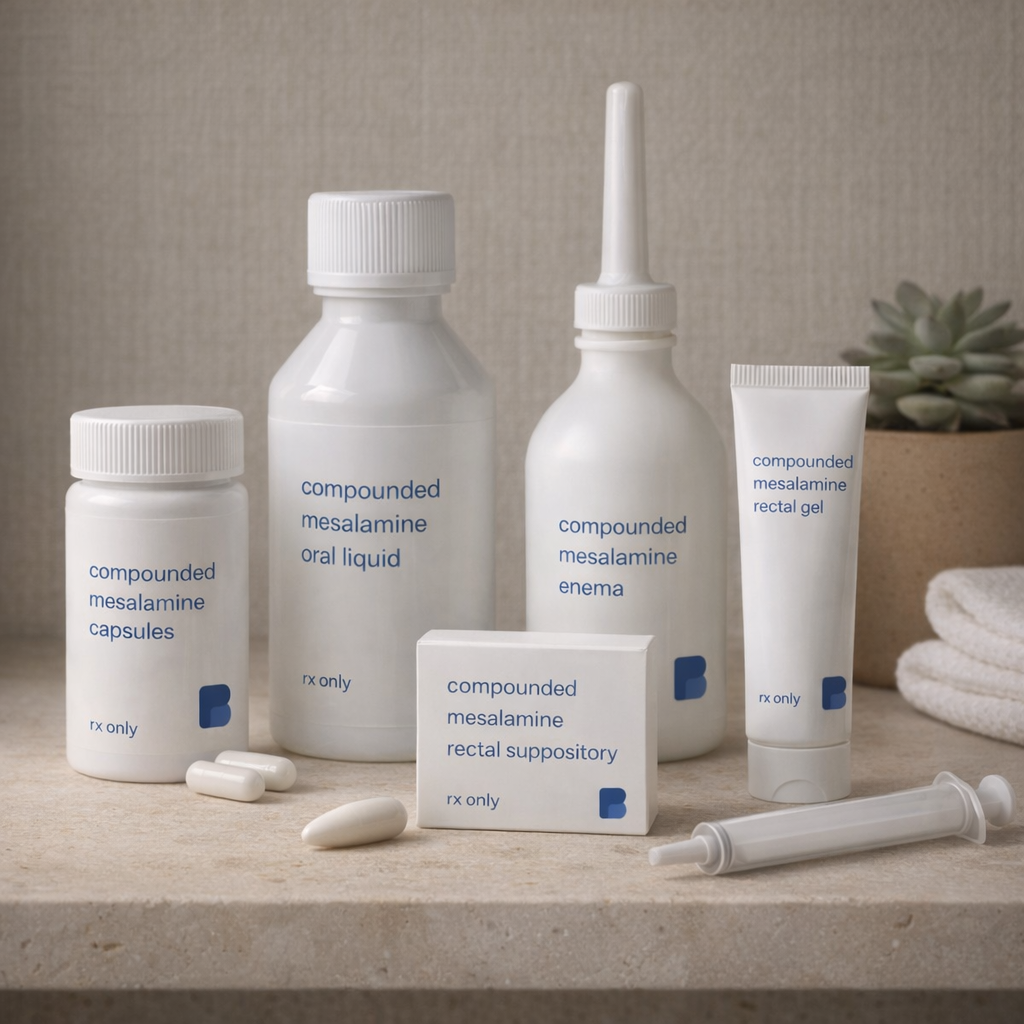
Mesalamine, also called 5-ASA or mesalazine, is a prescription anti-inflammatory medicine that acts mainly on the lining of the bowel where it is placed. It comes in more forms than most medicines, and the difference between them matters: some are made to release in the intestine, some release gradually, and rectal forms deliver it directly to the lower bowel.
This post sorts out what is manufactured and what Bayview compounds as mesalamine, and how the rectal forms are used. Your prescriber decides which form and dose fit you.
What forms are manufactured?

Manufactured oral mesalamine comes as delayed-release tablets, delayed-release capsules and extended-release capsules. Delayed-release forms release the medicine in the intestine, and extended-release capsules release it throughout the digestive system. Manufactured rectal mesalamine is a 1000 mg suppository and a 4 g in 60 mL rectal suspension enema. There is no manufactured oral liquid and no manufactured rectal gel.
Which forms does Bayview compound?
| Route | Formulary preparations |
|---|---|
| Oral | 200, 250 and 400 mg capsules; 200 and 250 mg slow release capsules; 50 mg/mL oral liquid |
| Rectal | 250, 500 and 1000 mg suppositories; 1.2 g/60 mL enema; 50 mg/mL rectal gel |
One point is easy to miss: the compounded capsules and oral liquid are not delayed-release products, and the slow release capsules are not the same as a manufactured extended-release capsule. That changes where in the gut the medicine is released, which is part of why the choice belongs to your prescriber. Forms and strengths are listed for education only and are not a statement that any option is better or more effective.
How are suppositories and enemas used?
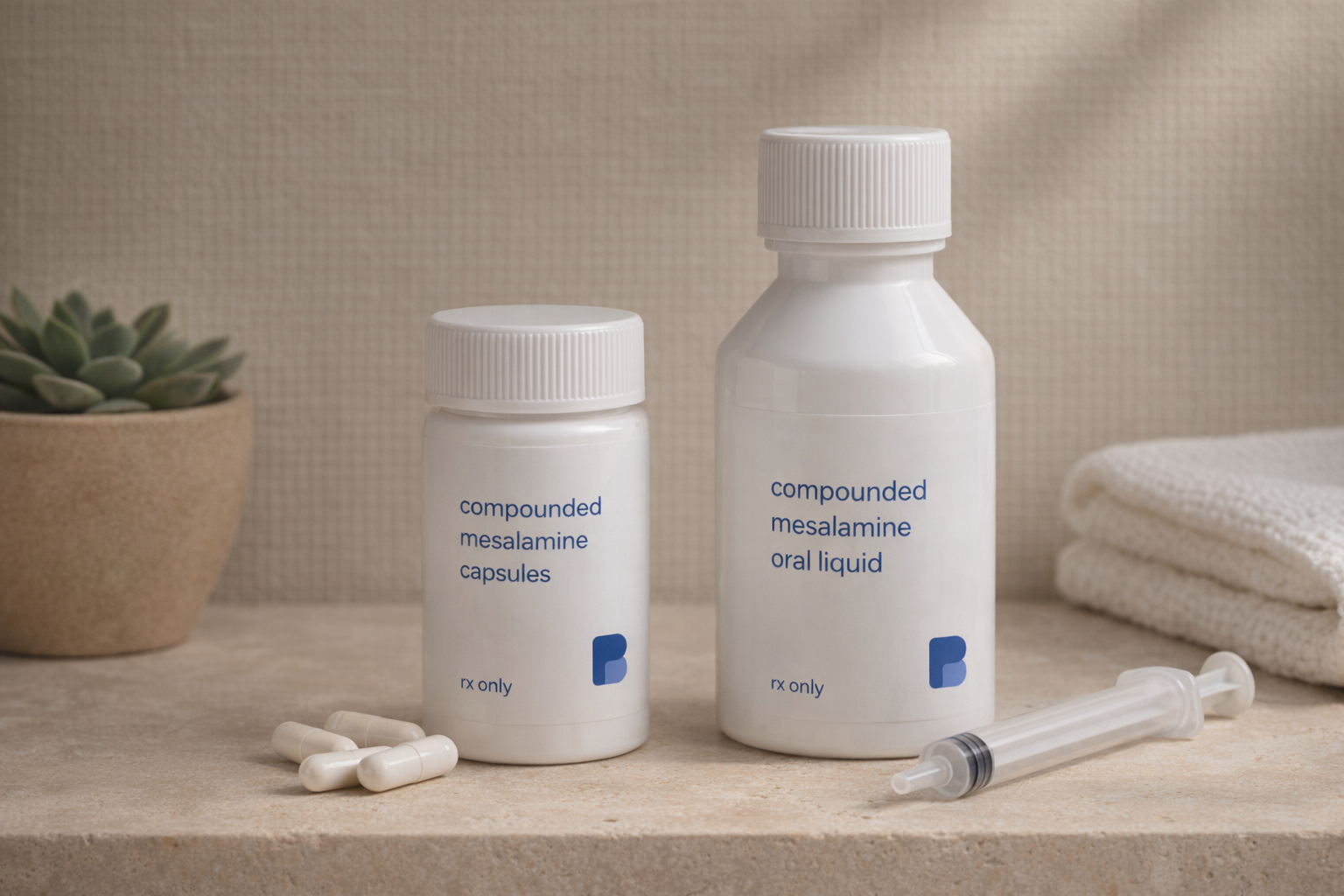
Follow the directions on your label. MedlinePlus advises emptying the bowels before a rectal dose. Insert a suppository pointed end first; our post on how to use a suppository walks through the steps. Shake an enema well, lie on your left side, and insert the tip as directed.
Swallow capsules whole unless your prescriber or label says otherwise, and measure the oral liquid with an oral syringe, not a kitchen spoon. Mesalamine can stain clothing, fabrics, flooring and other surfaces, so take care during use. Drink plenty of fluids while you use it.
- Empty your bowels before the dose.
- Suppository: insert pointed end first.
- Enema: shake well, lie on your left side and insert the tip as directed.
- Take care with fabrics and surfaces. Mesalamine can stain.
What side effects and cautions matter?

Common side effects include joint or back pain, gas, dizziness and hair loss. Oral forms can cause nausea, vomiting or heartburn, and rectal forms can cause rectal pain. Mesalamine can affect the kidneys, so your prescriber may check kidney function, and it can make your skin more sensitive to the sun.
Rarely, a reaction to mesalamine can look like a flare of bowel inflammation. Get medical care for cramping, bloody diarrhea or fever that is worse than before, chest pain or shortness of breath, a blistering or peeling rash, yellow skin or eyes, reduced urination, or swelling of the face or throat.
Do not use mesalamine if you are allergic to it, to salicylates such as aspirin, or to aminosalicylates, or if you had the chickenpox vaccine in the past six weeks. Tell your prescriber about kidney or liver disease, kidney stones, heart inflammation, asthma, sulfite sensitivity, pregnancy, breastfeeding and every medication you take.
How long does it keep?
Bayview dates each preparation by the USP 795 standard. Capsules and suppositories, which contain no water, can be dated up to 180 days. The oral liquid, enema and rectal gel contain water, so they can be dated up to 35 days with a preservative, or 14 days in the refrigerator without one. Your label shows the exact date; our post on beyond-use dates explains why. Related rectal preparations include the SCFA enema and diltiazem rectal ointment.
Beyond-use dates under USP 795
- Capsules and suppositories: up to 180 days, since they contain no water
- Oral liquid, enema and rectal gel, preserved: up to 35 days
- Oral liquid, enema and rectal gel, unpreserved: 14 days in the refrigerator
Frequently asked questions
What forms of mesalamine does Bayview compound?
By mouth: 200 mg, 250 mg and 400 mg capsules, 200 mg and 250 mg slow release capsules, and a 50 mg/mL oral liquid. Rectally: 250 mg, 500 mg and 1000 mg suppositories, a 1.2 g/60 mL rectal suspension enema and a 50 mg/mL rectal gel. Each is prepared on a prescriber's order and is not FDA-approved.
How is a compounded mesalamine enema different from the manufactured one?
The manufactured mesalamine enema contains 4 g in 60 mL and is FDA-approved. Bayview's compounded enema contains 1.2 g in 60 mL, for prescribers who want a smaller amount. It is not FDA-approved, and it is not a statement that either one is better. Your prescriber decides which is appropriate.
Is mesalamine a steroid?
No. Mesalamine (also called 5-ASA or mesalazine) is an aminosalicylate, a different class of medicine from corticosteroids.
Who should not use mesalamine?
Do not use mesalamine if you are allergic to mesalamine, to salicylates such as aspirin, to aminosalicylates or to any ingredient in the preparation. MedlinePlus advises that it should not be taken by people who have had the chickenpox (varicella) vaccine in the past six weeks. Tell your prescriber about kidney or liver disease, kidney stones, a history of myocarditis or pericarditis, eczema, asthma or sulfite sensitivity, pregnancy or breastfeeding, and every medication you take.
Can mesalamine stain clothing?
Yes. Mesalamine suppositories and enemas can stain clothing, fabrics, flooring and other surfaces. Use them over a towel and take care during use.
Are compounded medications FDA-approved?
Compounded medications are not FDA-approved. They're prepared by a licensed pharmacy pursuant to a valid prescription for an individual patient, under USP standards. The FDA does not review compounded medications for safety or effectiveness.
Can you fill a prescription from my own provider?
Yes. Your provider can send your prescription to Bayview Pharmacy by e-prescribe, fax, or phone, or you can transfer an existing prescription from another pharmacy.
Do I need a prescription?
Yes. All of our medications require a valid prescription from a licensed provider. We're a dispensing and compounding pharmacy, so we don't provide consultations or write prescriptions. If you don't have one yet, you'll need to see a provider first.
How does shipping work?
Once your prescription is verified, we prepare your medication and ship it discreetly in plain packaging either via UPS or USPS. A pharmacy technician confirms the details with you before it goes out, and we're available if you have any questions.
How do providers send a prescription to Bayview?
Providers can submit a prescription three ways:
- E-prescribe: Search Bayview Pharmacy, Warwick, RI (NCPDP 4106882) in your EHR. For compounds, use the compound, custom, or free-text option and include the full formulation, strength, quantity, refills, and directions.
- Fax: Send a signed order to 401-284-4506 (alt. 401-210-2757) with patient and prescriber details, medication, quantity, refills, directions, signature, and date.
- Phone: Call 401-284-4505 to submit, clarify, or coordinate refills.
A valid prescription is required, and compounded medications are not FDA-approved.
How do refills and automatic refills work?
Refills are coordinated with your prescriber and your prescription. You can request a refill through our website or by calling us, and we'll handle the rest as long as you have refills remaining on a valid prescription. You can also opt into automatic refills on non-controlled substances, with no need to worry about running out of your medication. We can either ship it to you automatically, or ready for pickup.
What is compounding?
Compounding is the practice of preparing a medication tailored to an individual patient's prescription. Instead of a mass-produced product, a compounding pharmacy makes the medication to the specific strength, form, or combination your provider orders.
Examples on this site include medications compounded as liquids for people who cannot swallow pills, thyroid capsules made to a T3/T4 ratio no manufactured product offers, and all-purpose nipple ointment, which combines three actives that are not sold together commercially.
What Bayview compounds for this
Important: Compounded medications are prepared to a prescriber's order for an individual patient. They are not FDA-approved, and the FDA has not evaluated them for safety, effectiveness, or manufacturing quality. This article is educational and is not a substitute for advice from your prescriber or pharmacist.
This preparation contains a controlled substance. Controlled-substance prescriptions carry refill limits, must be e-prescribed, and can only be shipped to states where Bayview holds the required licensure.
Uses discussed here may be off-label, meaning they are not part of any FDA-approved labeling. Off-label use is a decision for you and your prescriber, based on the available evidence.
Veterinary preparations are compounded to a veterinarian's order for a specific animal and are not FDA-approved animal drugs. Never give a compounded human medication to an animal without veterinary direction.
Compounded prescriptions are paid for directly rather than billed through insurance. Most are HSA/FSA-eligible, and many patients submit the receipt to their plan for possible reimbursement. Pricing depends on the strength, dose form and quantity your prescriber orders. Read more about cost and insurance.
The starting cash price for compounded mesalamine at Bayview is $92 for 21 suppositories, and the final price depends on the form, strength and quantity on the prescription. Compounded prescriptions at Bayview are priced as cash prescriptions, and coverage varies by plan.
Bayview Pharmacy is a compounding pharmacy in Warwick, Rhode Island, licensed to fill and ship compounded prescriptions for patients in Rhode Island, Massachusetts, Connecticut, New Jersey, New Hampshire, Florida, Maine, Pennsylvania and Wisconsin. Prescriptions for New York patients are filled on a limited basis, and controlled substances are not shipped to New York addresses. See every state we ship to.
Related reading