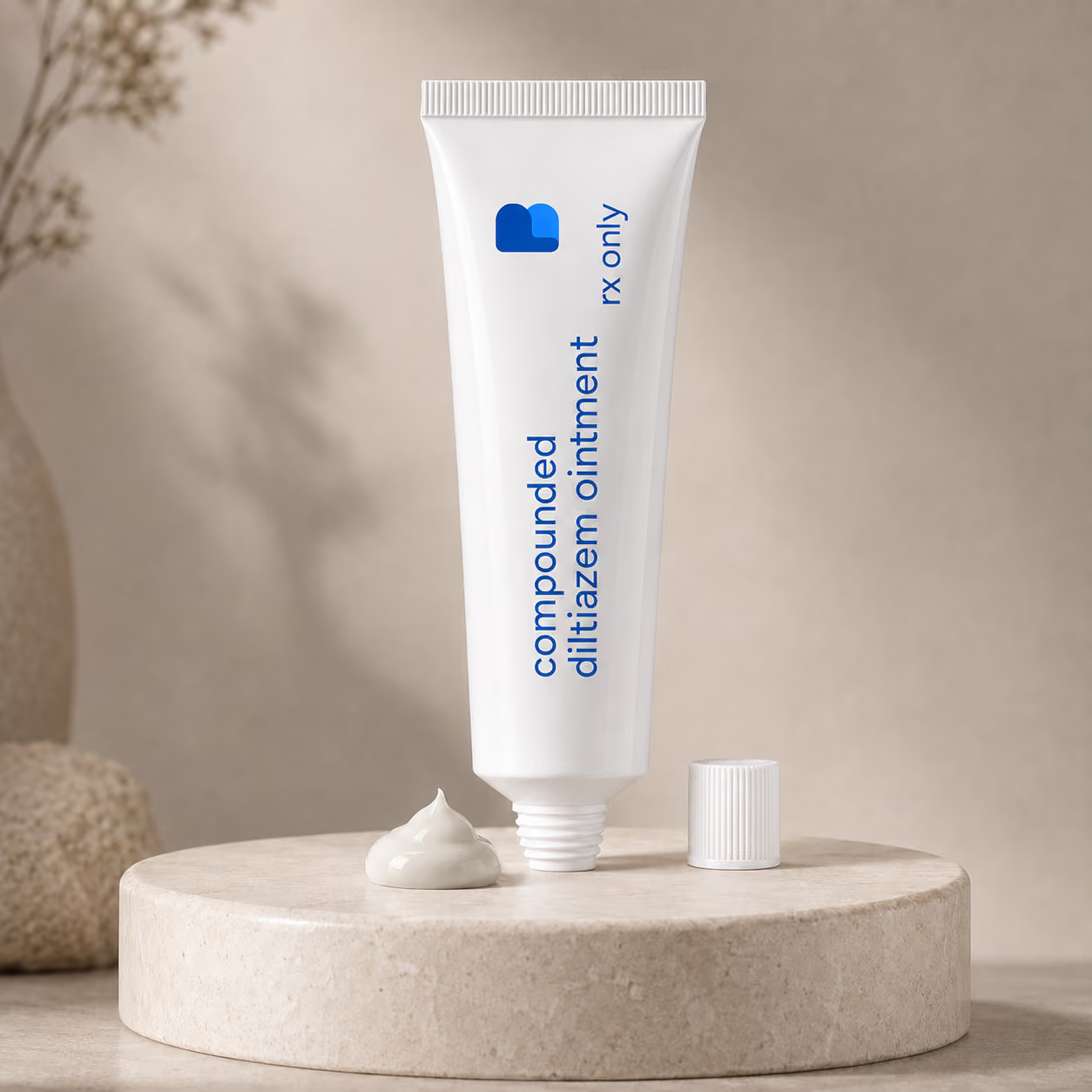
Diltiazem for an anal fissure is a compounded preparation applied to the anal area. Bayview Pharmacy prepares it as a 2% diltiazem rectal ointment or a 2% gel, not as a cream, because those are the bases prescribers write for this area. There is no FDA-approved topical or rectal diltiazem product in the United States, so every perianal diltiazem preparation is compounded on a prescriber's order and is not FDA-approved. Applying diltiazem to the anal area is an off-label use of the drug: oral diltiazem is FDA-approved for high blood pressure and chest pain, not for this.
What is diltiazem, and why would a prescriber write it for a fissure?
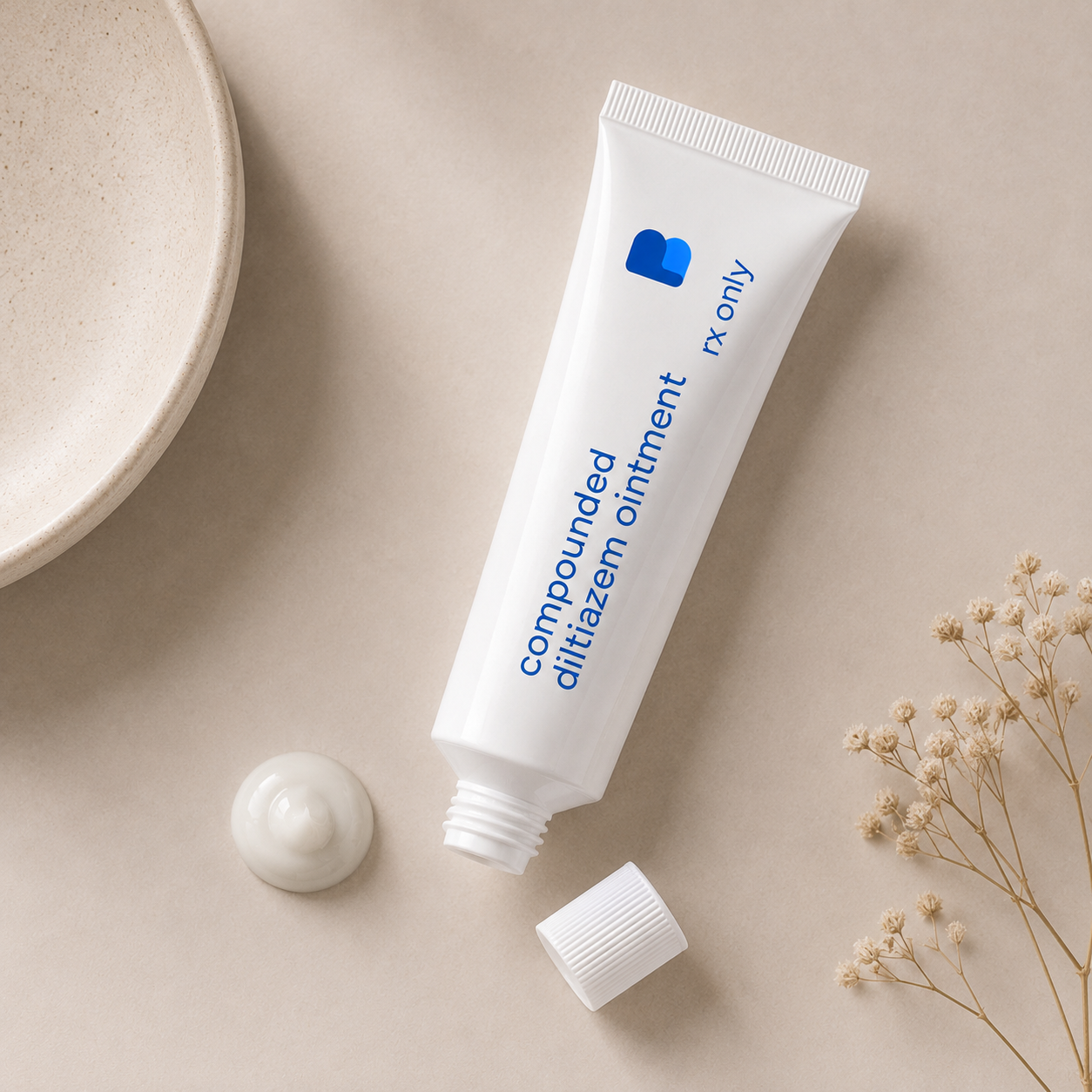
Diltiazem is a calcium channel blocker. Taken by mouth, it is an FDA-approved medication for high blood pressure and angina. Applied to the anal area, it acts locally on the internal anal sphincter, the ring of muscle around the anus, and only small amounts are absorbed into the rest of the body.
An anal fissure is a small tear in the lining of the anal canal that can cause sharp pain and bleeding with bowel movements. The mechanism described in StatPearls and in the 2023 clinical practice guideline from the American Society of Colon and Rectal Surgeons is that the sphincter tightens and goes into spasm, and that constant tension squeezes the small blood vessels supplying the torn tissue. Topical calcium channel blockers are used to lower that resting muscle tone.
Whether any of this fits your situation is a decision for your prescriber. A pharmacy does not evaluate patients and does not decide what is appropriate for you.
Is diltiazem for a fissure a cream, an ointment, or a gel?
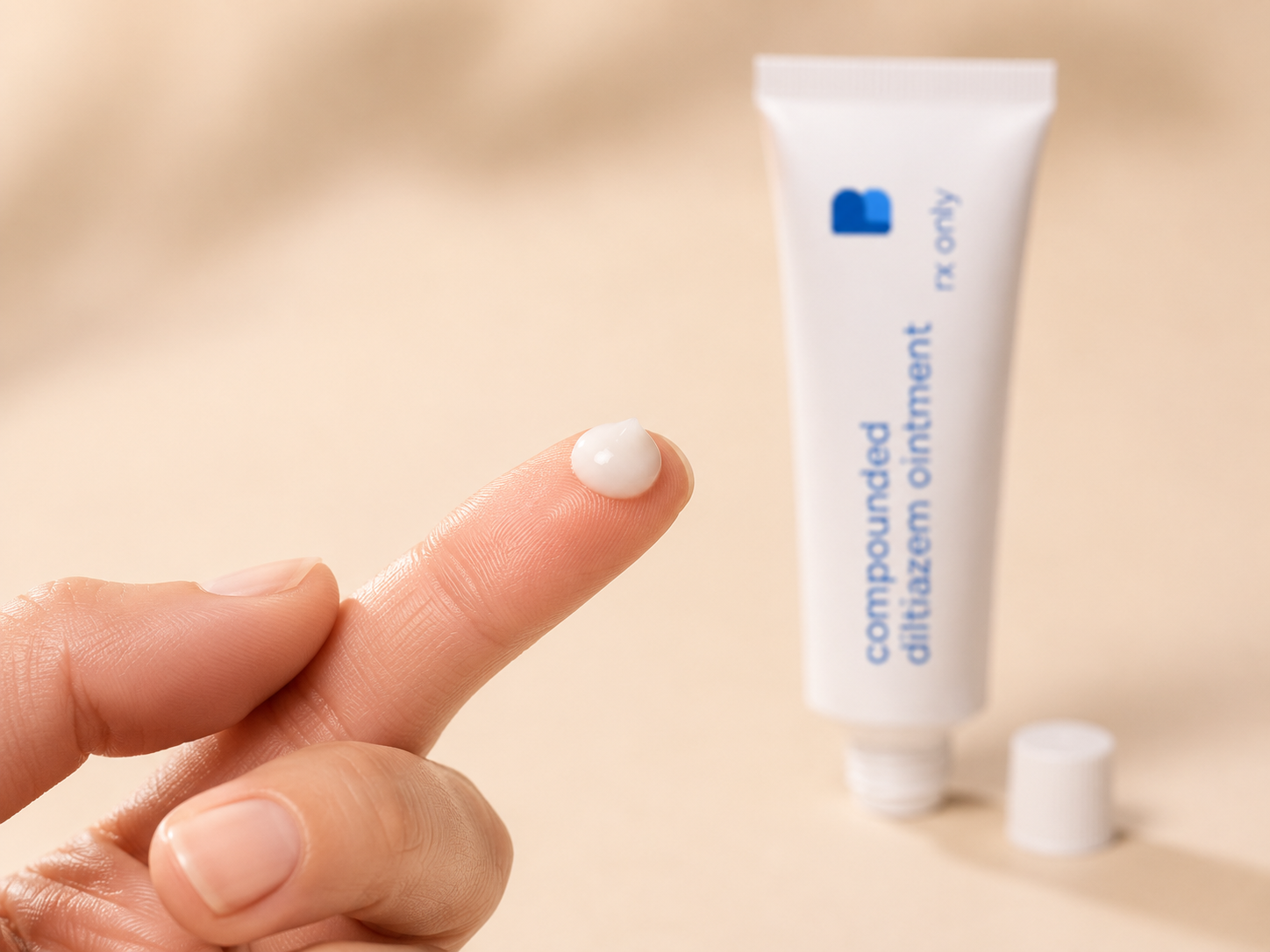
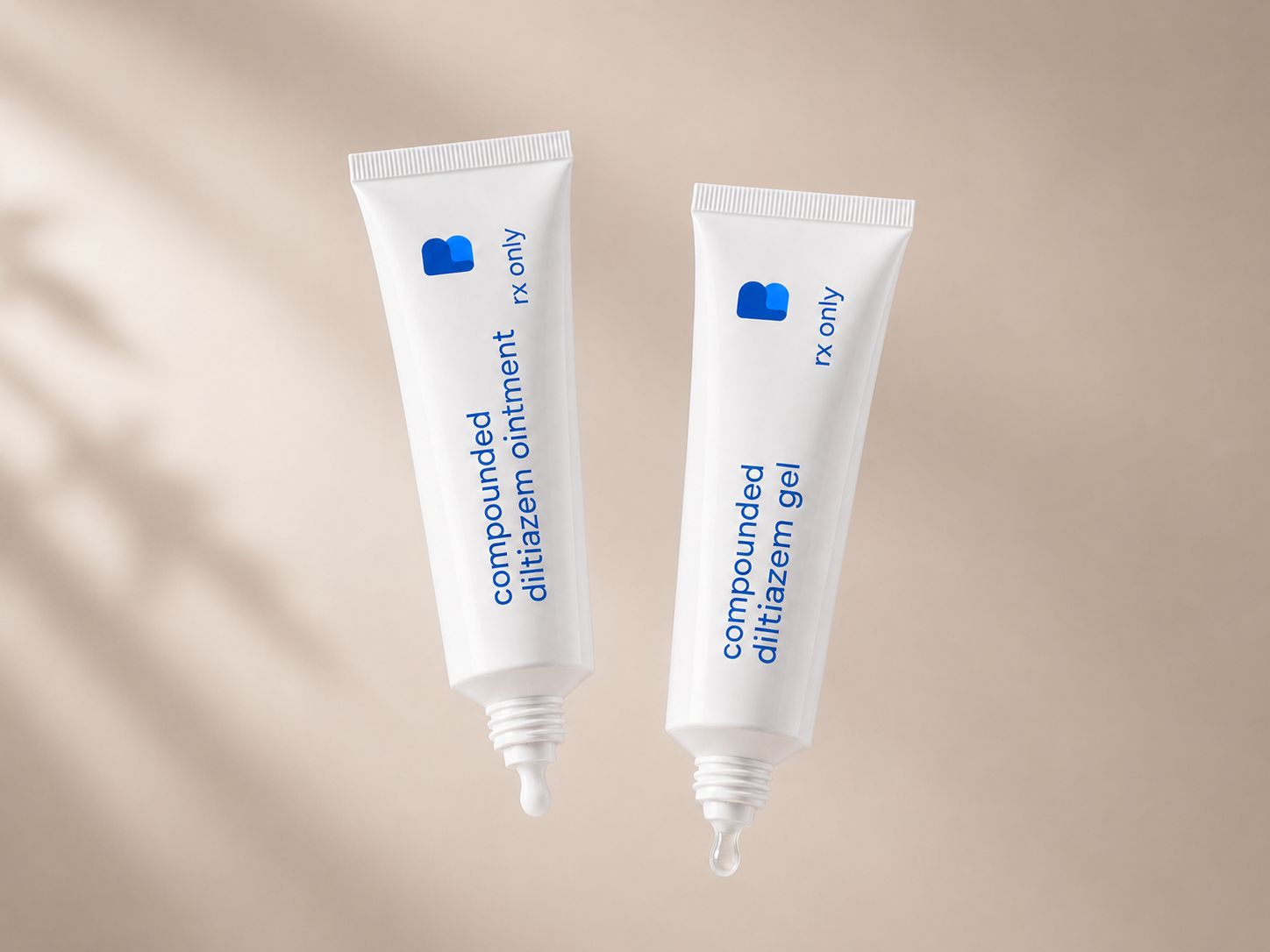
People search for "diltiazem cream", and prescriptions are sometimes written that way, but the two bases Bayview compounds are an ointment and a gel. Both carry diltiazem at 2%, which is 20 mg per gram, and both go on the same area. They differ in how they feel and how they wash off.

| Form | Base | Handling |
|---|---|---|
| Rectal ointment | Oil-based, petrolatum style | Stays in place, coats skin |
| Rectal gel | Water-washable | Spreads easily, less greasy |
The difference between the two bases is feel and handling. Neither is presented here as better, stronger or more effective than the other, and the prescriber picks which one to write.
What is diltigel?
"Diltigel" is the name patients and prescribers commonly use for the 2% diltiazem gel. On a Bayview prescription it refers to the water-washable gel base rather than the oil-based ointment.
It is worth being precise about what that name does and does not mean here. What Bayview prepares is a compounded preparation, made for one named patient against a prescription, in the base and quantity that prescription specifies. It is not FDA-approved. Bayview does not present it as the same as, equivalent to, or a substitute for any commercially named product, and no such comparison should be read into the word. If your prescriber wrote a product name you do not recognize, ask them what they intend, and ask the pharmacy what will actually be prepared.
Why is this compounded instead of dispensed off the shelf?
Because no manufacturer makes it. With no FDA-approved topical or rectal diltiazem product in the United States, compounding is the only route to a perianal diltiazem preparation. Compounding also lets a pharmacy prepare the base the prescriber wants, and prescriber-designed combinations that are not manufactured at all.

That is the ordinary work of a 503A pharmacy: preparing a medication from individual ingredients against a prescription written for one named patient. If the model is new to you, our explainer on what a compounding pharmacy is and what it prepares covers the basics, and the difference between 503A and 503B pharmacies covers which category Bayview sits in.
One caution worth passing on: a published analysis in the International Journal of Pharmaceutical Compounding found that the measured strength of compounded topical 2% diltiazem varied between pharmacies. That is a reason to ask any pharmacy about its quality practices. Bayview compounds this preparation under USP 795 non-sterile compounding standards.
What strengths and forms does Bayview compound?
| Preparation | Strength | Quantities |
|---|---|---|
| Diltiazem rectal ointment | 2% (20 mg per gram) | 30 g, 45 g, 60 g |
| Diltiazem rectal gel | 2% (20 mg per gram) | 30 g, 45 g, 60 g |
| Diltiazem with lidocaine | 2% / 3% | 30 g |
| Diltiazem, lidocaine, hydrocortisone | 2% / 5% / 2.5% | 60 g |
The two combination preparations add a local anesthetic, and in one case a topical corticosteroid as well. They are designed by the prescriber for an individual patient, they are off-label, no FDA-approved product exists in either form, and they are not studied as products. Lidocaine shows up across compounded topicals generally, and our post on how compounded BLT anesthetic topicals are put together explains how those combinations are built. Custom strengths and bases are compounded to a prescriber's order.
How is diltiazem ointment or gel applied?
Your label is the instruction. The amount, the schedule and the length of the course are set by your prescriber, and a pharmacy cannot change any of them.

For context only, the directions commonly reported for this preparation, and listed on Bayview's diltiazem formulation page, are a small pea-sized amount applied to the anal area two to three times a day, with some prescribers adding an application after a bowel movement. Courses reported in the literature run six to eight weeks, and the usual counseling point is to finish the course as written even if pain settles earlier. None of that is a dose for you.
The handling is plain enough. Apply with a fingertip, a glove or a finger cot as directed, wash your hands beforehand and afterward, and use it only on the area your prescriber named. Do not change the amount or stop early on your own. Store it at room temperature, away from heat, light and moisture, with the cap closed, out of reach of children, and do not share it.
How does diltiazem compare with nifedipine and nitroglycerin?
Three topical drugs come up repeatedly in fissure care. Diltiazem and nifedipine are calcium channel blockers. Nitroglycerin is a nitrate and acts through a different pathway. The 2023 ASCRS guideline reports that topical calcium channel blockers heal chronic fissures about as well as topical nitroglycerin, with a lower incidence of headache, and lists them as a first-line non-surgical option. That is a statement the guideline makes about the drugs. It is not a claim about any preparation Bayview compounds, and it does not settle which one your prescriber should choose.
| Preparation | Drug class | FDA status | Starting cash price |
|---|---|---|---|
| Diltiazem 2% | Calcium channel blocker | No approved topical product | $92 for 30 g |
| Nifedipine 0.3% | Calcium channel blocker | No approved topical product | $89 for 30 g |
| Nitroglycerin 0.125%, 0.2% | Nitrate | Approved 0.4% product exists | $97 for 30 g |
Bayview compounds nifedipine 0.3% rectal ointment and nitroglycerin rectal ointment in 0.125% and 0.2%, including a nitroglycerin and lidocaine combination. Read that last table row carefully: a manufactured 0.4% rectal nitroglycerin ointment is FDA-approved, while the lower compounded strengths listed above are a different thing and carry no FDA approval. Nitroglycerin also has one hard rule attached to it, which is that it must not be used with a PDE5 inhibitor such as sildenafil, tadalafil or vardenafil, because the combination can cause a dangerous drop in blood pressure. Prescribers screen for that before writing it.
Anorectal preparations come in other forms too. Our post on compounded rectal rockets and how rectal preparations are assembled covers the suppository side of the same territory.
What side effects have been reported?
The effects reported most often with perianal diltiazem are local: itching, burning or irritation where it is applied. Mild headache is reported. Contact dermatitis, an itchy rash from the drug or the base, has been described in the NICE evidence summary and is reported to settle once the medication is stopped. The ASCRS guideline reports fewer headaches with topical calcium channel blockers than with topical nitroglycerin.
Because some drug is absorbed, tell your prescriber about every heart and blood pressure medication you take, including oral diltiazem or another calcium channel blocker. Seek emergency care for fainting, a very slow or irregular heartbeat, severe dizziness, or signs of an allergic reaction such as a spreading rash, swelling or trouble breathing.
One point deserves repeating. Rectal bleeding always needs to be evaluated. Bleeding with bowel movements is common with fissures and is also a sign of other conditions, so make sure a clinician has established the cause, and report any new, heavy or persistent bleeding promptly.
Who should not use it?
This preparation is not appropriate for everyone. It is not used by people allergic to diltiazem or to any ingredient in the base. It is used with caution in people taking oral diltiazem or other blood pressure or heart rhythm medications, and in people with certain heart conditions such as a very slow heartbeat or low blood pressure, because even small absorbed amounts add to the same drug class. If you are pregnant, planning a pregnancy or breastfeeding, raise it with your prescriber before you start. Bayview does not evaluate patients or determine appropriateness; your prescriber does.
What does compounded diltiazem cost, and does insurance cover it?
Compounded diltiazem starts at $92 for 30 g. The price moves with the base, the quantity (30, 45 or 60 g), and whether the prescription is a plain 2% preparation or a prescriber-designed combination. Compounded preparations are cash-priced and are generally eligible for HSA and FSA cards.
They are usually not billed through a pharmacy benefit plan, because a plan prices a claim against a national drug code that identifies a specific manufactured product, and a preparation made for one patient does not have one. Our post on whether compounding pharmacies take insurance works through that in more detail. Call 401-284-4505 with the preparation and quantity your prescriber ordered and Bayview will quote it before preparing it.
What Bayview compounds for this
On a prescriber's order, Bayview prepares diltiazem 2% as a rectal ointment or a water-washable gel in 30 g, 45 g and 60 g quantities, plus prescriber-designed combinations of diltiazem 2% with lidocaine 3% in 30 g, and diltiazem 2% with lidocaine 5% and hydrocortisone 2.5% in 60 g. The related anorectal preparations are nifedipine 0.3% ointment and nitroglycerin ointment at 0.125% and 0.2%, with or without lidocaine. Each is prepared only against a prescription written for a named patient. The rest of the catalog is searchable in Bayview's compounded medications catalog.
How to talk to your prescriber about it
If you have a fissure that has not settled with the usual first steps, fiber, fluids and sitz baths, the conversation to have is with the clinician treating it. Ask whether a topical sphincter relaxant fits your history and the rest of your medication list, and if they decide to write for one, ask which base they want. A prescription naming diltiazem 2%, the base (ointment or gel), the directions, the quantity and a diagnosis code gives a pharmacy everything it needs.
Prescribers can e-prescribe, fax or phone the order in, since diltiazem is not a controlled substance. If you are deciding where to fill it, our post on choosing a compounding pharmacy and when mail order makes sense covers what to ask, and how compounding and retail pharmacies differ explains why your usual counter is unlikely to stock this. If you want to understand what goes into a compounded topical before you fill one, start with what goes into a compounded cream.
Frequently asked questions
How much does compounded diltiazem cost?
Compounded diltiazem starts at $92 for 30 g. The price varies with the base, the quantity (30, 45, or 60 g), and whether the prescription is a plain 2% preparation or a combination with lidocaine. Compounded preparations are cash-priced and are generally eligible for HSA and FSA cards. Call us at 401-284-4505 with the preparation and quantity your prescriber ordered and we will quote it before we make it.
Does diltiazem ointment cause headaches?
Some people get a mild headache, but it is reported less often than with topical nitroglycerin — one of the reasons the ASCRS guideline notes calcium channel blockers as better tolerated. The more common effects are local: itching, burning, or irritation where it is applied. Occasionally an itchy rash (contact dermatitis) develops in response to the medication or its base, and it usually resolves once the medication is stopped. Tell your provider about any reaction that concerns you.
How does diltiazem compare with nitroglycerin or nifedipine for an anal fissure?
All three are applied to the anal area, and all three are compounded, since none is available as an FDA-approved topical product in the United States. The 2023 clinical practice guideline from the American Society of Colon and Rectal Surgeons reports that topical calcium channel blockers such as diltiazem and nifedipine heal chronic fissures about as well as topical nitroglycerin while causing fewer side effects such as headache, and that either class may be used first-line. Which one suits a particular person is your prescriber's decision.
How long does diltiazem take to work on a fissure?
Pain often eases within the first week or two, but healing takes longer. Chronic fissures are usually treated for six to eight weeks, and prescribers generally direct patients to finish the full course even after the pain improves, since stopping early is a common reason a fissure returns. Supportive care such as fiber, fluids, and sitz baths is usually part of the plan. If your symptoms are not improving after several weeks of use, contact your provider.
Is there an over-the-counter diltiazem cream?
No. Diltiazem is prescription-only in every form. Oral diltiazem tablets and capsules are FDA-approved for blood pressure and chest pain, but there is no FDA-approved topical or rectal diltiazem product in the United States and nothing equivalent is sold over the counter. The 2% ointment and gel used for anal fissures exist only as compounded preparations, and a valid prescription is required.
What is diltigel?
“Diltigel” is shorthand that patients and prescribers use for compounded diltiazem gel — the water-washable version of diltiazem 2% prepared for the anal area. It contains the same medication and the same strength as the diltiazem 2% rectal ointment, in a base that spreads more easily and washes off rather than staying greasy. It is not a brand-name product. There is no FDA-approved topical or rectal diltiazem in the United States, so both the gel and the ointment are compounded to a prescriber's order and require a prescription.
How is it stored?
At room temperature, away from heat, light, and moisture, with the cap tightly closed. Keep it out of the reach of children, do not share it, and do not use it past the beyond-use date on the label.
How long does it take to work?
Many people notice less pain within the first week or two, but the fissure itself usually needs six to eight weeks of consistent use to heal. Finish the full course your provider prescribes, and follow up if pain is not improving after several weeks.
How do I apply it?
Follow your prescriber's directions exactly. A common direction is a small, pea-sized amount applied to the anal area twice daily, sometimes also after bowel movements. Apply it with a fingertip, glove, or finger cot, and wash your hands before and after. Treatment often continues for six to eight weeks so the fissure has time to heal, even if the pain improves sooner.
What is the difference between the ointment and the gel?
Both contain the same 2% strength of diltiazem. The ointment is oil-based, stays in place, and can protect the skin. The gel is water-washable, spreads easily, and feels less greasy. The gel also has a longer beyond-use-date. Your provider selects the base, and switching is an option if one irritates your skin.
Why is it compounded instead of bought off the shelf?
Diltiazem tablets are FDA-approved for blood pressure and chest pain, but no topical or rectal diltiazem product is manufactured in the United States. Compounding is the only way to obtain it. A licensed pharmacy prepares it to the strength and base your provider orders. Compounded medications are not FDA-approved.
What is it used for?
Most often for chronic anal fissures, tears that have not healed after several weeks of home care such as fiber, fluids, and warm sitz baths. Guidelines from the American Society of Colon and Rectal Surgeons list topical calcium channel blockers like diltiazem as a first-line, non-surgical treatment. Some providers also consider it for other conditions involving anal muscle spasm. Only your provider can decide whether it is appropriate for you.
What is diltiazem rectal ointment?
It is a compounded, prescription medication applied to the anal area. Diltiazem is a calcium channel blocker, and used this way it relaxes the ring of muscle around the anus. Providers most often prescribe it for anal fissures, small tears in the skin of the anal canal that cause sharp pain and bleeding with bowel movements. Bayview compounds it at 2% strength as an ointment and as a gel.
Is diltiazem for a fissure an ointment, a gel, or a cream?
Bayview compounds two bases: a rectal ointment and a rectal gel. Prescriptions and searches often say cream, but that is not what is prepared. The ointment is oil-based and stays in place. The gel is water-washable, spreads easily and feels less greasy. Both hold diltiazem at 2%. The base is the prescriber's choice, and neither base is presented as better or stronger than the other.
How is compounded diltiazem ointment applied?
Follow the label your prescriber wrote. The amount, the schedule and the length of the course are theirs to set, and a pharmacy cannot change them. The directions commonly reported for this preparation are a small pea-sized amount applied to the anal area two to three times daily, sometimes with an application after a bowel movement, over a course of six to eight weeks. Apply with a fingertip, glove or finger cot, and wash your hands beforehand and afterward.
What side effects have been reported with topical diltiazem?
The effects reported most often are local: itching, burning or irritation where it is applied. Mild headache is reported. Contact dermatitis, an itchy rash from the drug or the base, has been described in the NICE evidence summary and is reported to settle when the medication is stopped. The 2023 ASCRS guideline reports fewer headaches with topical calcium channel blockers than with topical nitroglycerin. Tell your prescriber about every heart and blood pressure medication you take.
Does insurance cover compounded diltiazem?
Usually not. A pharmacy benefit plan prices a claim against a national drug code that identifies a specific manufactured product, and a preparation made for one patient does not have one. Compounded diltiazem starts at $92 for 30 g at Bayview, and the price moves with the base, the quantity and whether the prescription is a plain 2% preparation or a combination. Compounded preparations are cash-priced and are generally eligible for HSA and FSA cards.
Can diltiazem be compounded with lidocaine?
Yes, on a prescriber's order. Bayview compounds diltiazem 2% with lidocaine 3% in 30 g, and diltiazem 2% with lidocaine 5% and hydrocortisone 2.5% in 60 g. Lidocaine is a local anesthetic and hydrocortisone is a topical corticosteroid. These combinations are designed by the prescriber for an individual patient, they are off-label, no FDA-approved product exists in either form, and they are not studied as products.
What Bayview compounds for this
Important: Compounded medications are prepared to a prescriber's order for an individual patient. They are not FDA-approved, and the FDA has not evaluated them for safety, effectiveness, or manufacturing quality. This article is educational and is not a substitute for advice from your prescriber or pharmacist.
This preparation contains a controlled substance. Controlled-substance prescriptions carry refill limits, must be e-prescribed, and can only be shipped to states where Bayview holds the required licensure.
Uses discussed here may be off-label, meaning they are not part of any FDA-approved labeling. Off-label use is a decision for you and your prescriber, based on the available evidence.
Veterinary preparations are compounded to a veterinarian's order for a specific animal and are not FDA-approved animal drugs. Never give a compounded human medication to an animal without veterinary direction.
Compounded prescriptions are paid for directly rather than billed through insurance. Most are HSA/FSA-eligible, and many patients submit the receipt to their plan for possible reimbursement. Pricing depends on the strength, dose form and quantity your prescriber orders. Read more about cost and insurance.
Compounded diltiazem starts at $92 for 30 g. Price moves with the base, the quantity (30, 45 or 60 g), and whether the prescription is a plain 2% preparation or a prescriber-designed combination with lidocaine. Compounded preparations are cash-priced and are generally eligible for HSA and FSA cards. They are usually not billed through a pharmacy benefit plan, because a plan prices a claim against a national drug code that identifies a specific manufactured product, and a preparation made for one patient does not have one. Call 401-284-4505 with the preparation and quantity your prescriber ordered and Bayview will quote it before preparing it.
Bayview Pharmacy is an NABP-accredited compounding pharmacy in Warwick, Rhode Island, licensed to fill and ship compounded prescriptions for patients in Rhode Island, Massachusetts, Connecticut, New Jersey, New Hampshire, Florida, New York and Maine. Controlled substances are not shipped to New York addresses. See where we ship and how to get started.