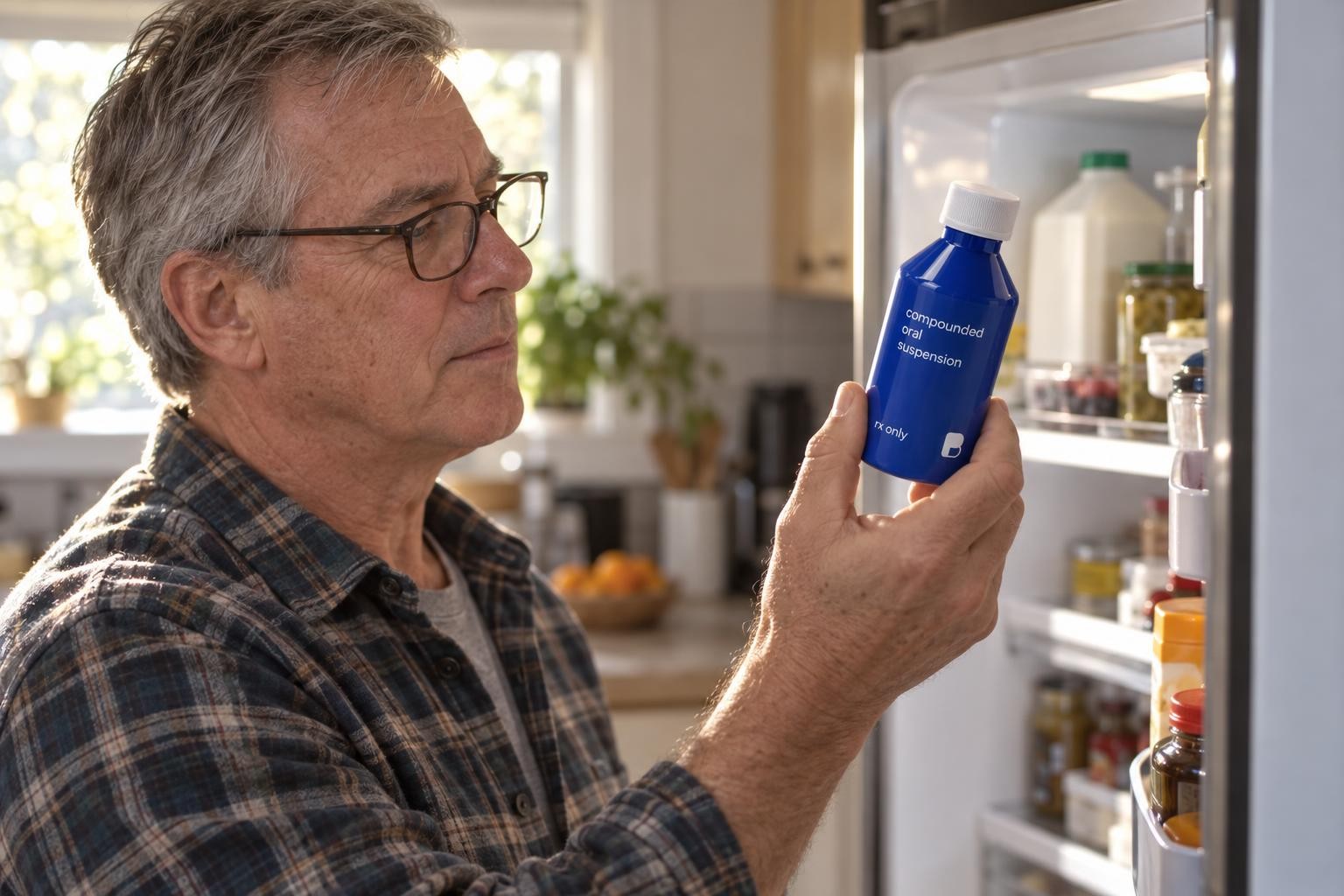
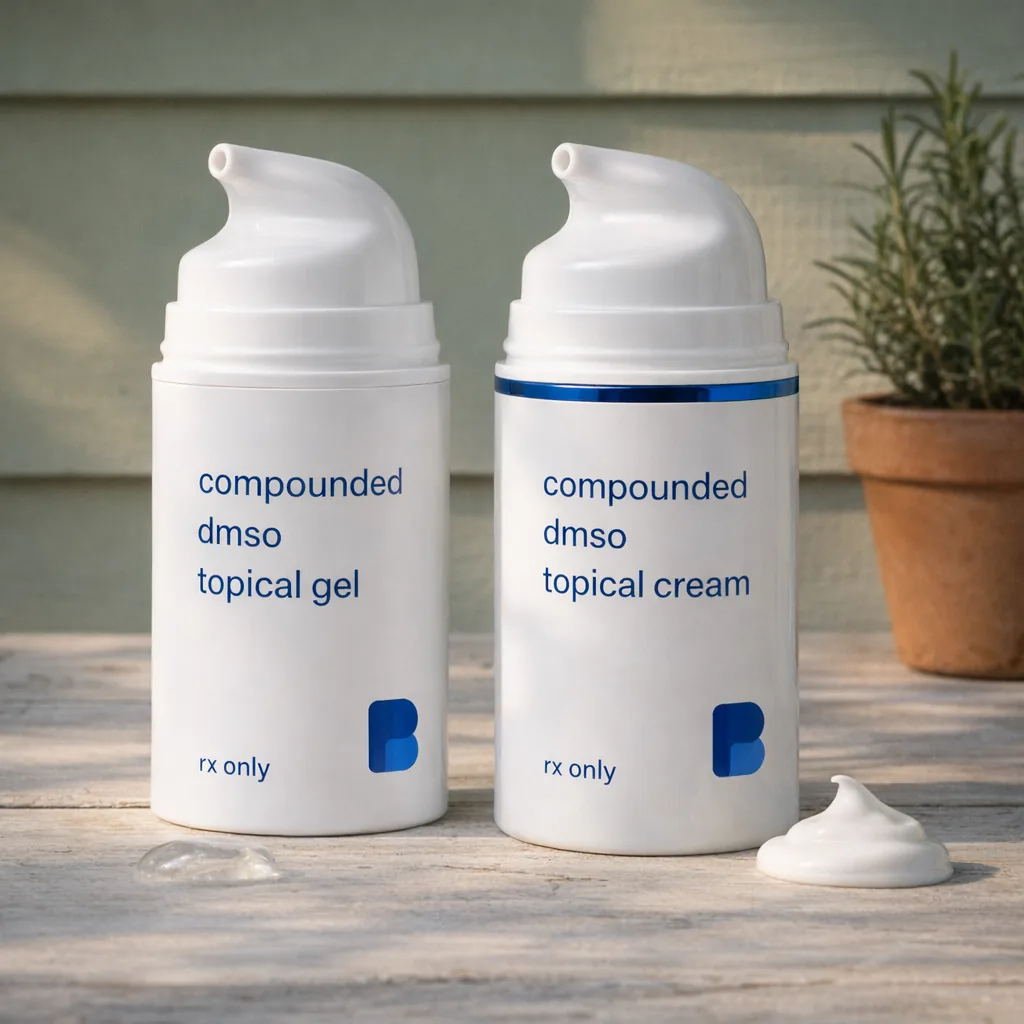
Using topical DMSO comes down to two things: it goes on clean, dry, intact skin with nothing else on that skin, and most people notice a garlic-like taste within minutes, with a matching odor on the breath and skin that can last up to three days. Bayview compounds dimethyl sulfoxide as a 10% topical gel and a 50% topical cream, prepared to a prescriber's order. Both are 503A compounded preparations, neither is FDA-approved, and this use on the skin is off-label.
What is DMSO, and what is it used for?
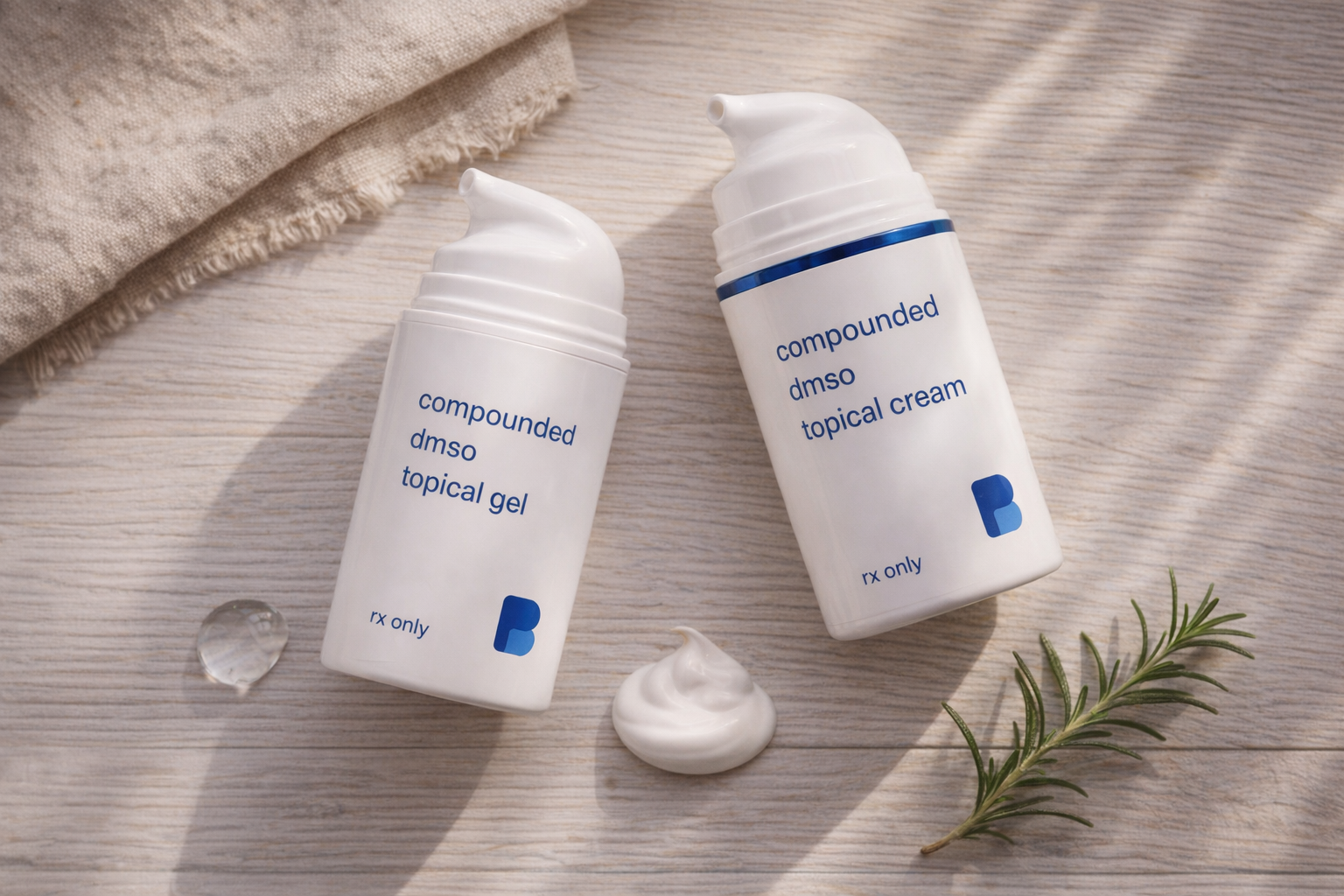
Dimethyl sulfoxide, usually shortened to DMSO, is a clear, colorless liquid solvent that was first produced as a by-product of paper making. It dissolves an unusually wide range of substances, mixes with water, and passes through skin within minutes, carrying dissolved material with it. It has been studied as a medicine since the 1960s.
Prescribers order compounded topical DMSO for localized musculoskeletal pain and inflammation: an osteoarthritic knee or hand, a sprain or strain, tendinitis, bursitis. It is also added to a custom cream as a vehicle, so that another ingredient reaches deeper tissue. Whether topical DMSO fits your situation is your prescriber's decision, and so are the strength, the form, and how often it is applied.
In the published literature, DMSO is described as a small, polar solvent that moves through the outer layer of skin and increases the passage of other molecules with it, which is why it is used as a penetration enhancer (Capriotti and Capriotti, a 2012 dermatology review). On its own, that same review reports it has been described as scavenging hydroxyl free radicals, reducing local inflammation, and slowing conduction in small pain fibers, which is the stated basis for studying it in painful and inflamed joints and soft tissue. That is a research rationale, not a finding about what the cream or gel does.
How do you apply it, and what does the prescription usually say?
The handling sequence is the part of this preparation worth learning properly, for one reason: whatever is on the skin can travel inward with the DMSO.
- Wash the area and dry it before anything goes on it.
- Put nothing else on that skin: no other cream, lotion, sunscreen, or insect repellent.
- Apply a thin layer and let it dry, without covering it unless told to.
- Wash your hands afterward.
- Keep it away from your eyes, broken skin, and large areas of the body.
- Never share it, and use it exactly as prescribed.
Prescriptions for topical DMSO are commonly written for a thin layer two to three times daily on clean, dry, intact skin, with no occlusion and no other topical at the site. That is a description of what prescribers commonly write, not a direction for you to follow: the label on your pump and your prescriber govern how much and how often, and that is their decision rather than yours or ours.
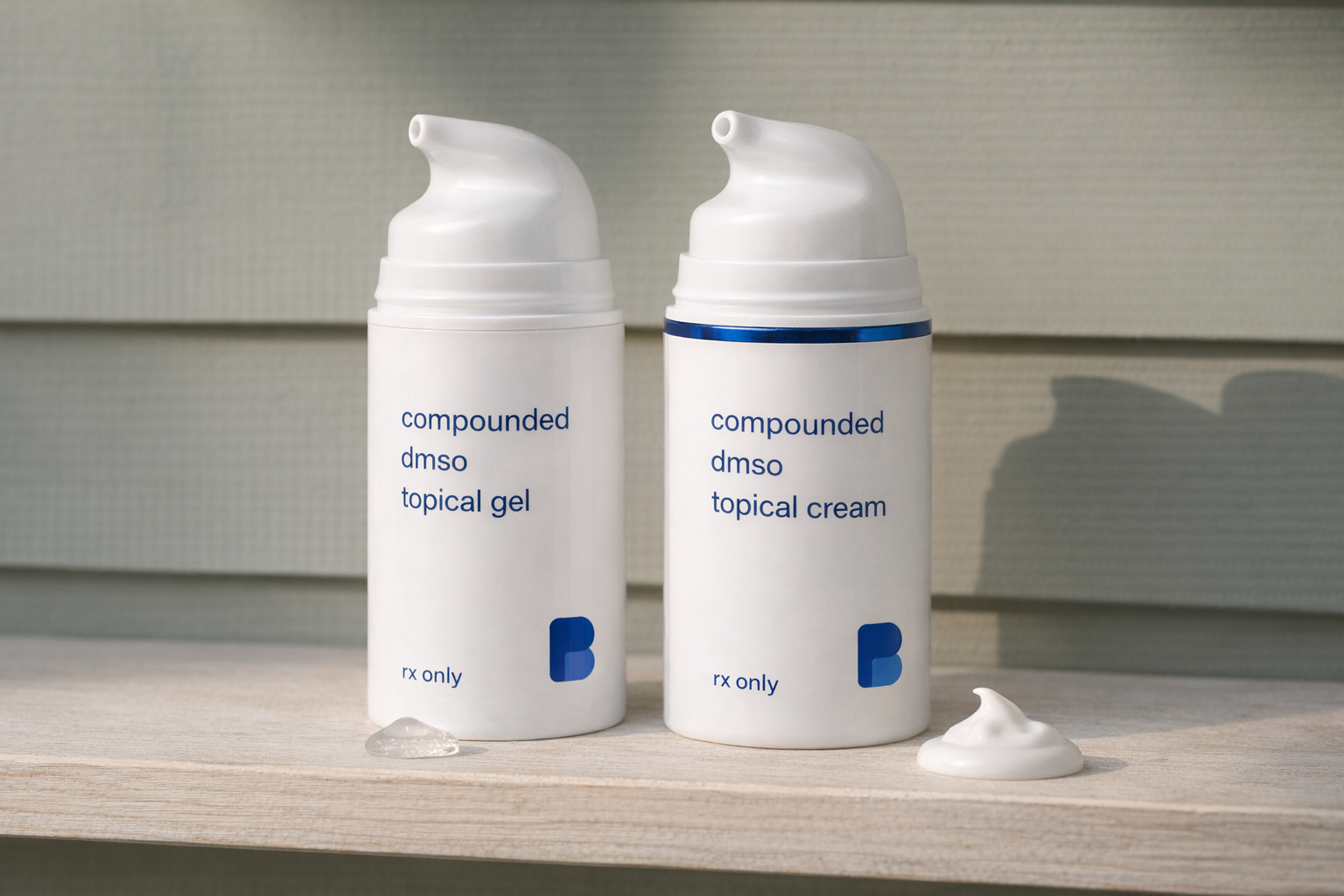
Both the gel and the cream are dispensed in a metered pump, so each press delivers about the same amount.
How should you store it?
Store it as directed on the label, at room temperature, away from heat and light, with the pump closed and out of the reach of children and pets. Do not use it after the beyond-use date, and dispose of unused medication as directed.
Why does DMSO smell like garlic?
Because of what your body does with it. DMSO is broken down into dimethyl sulfone and dimethyl sulfide, and the sulfide is what produces the garlic-like breath odor (DailyMed, Rimso-50 prescribing information). Expect a garlic-like taste within minutes of applying it, along with an odor on your breath and on your skin.
That odor can last up to three days, or 72 hours, and it fades once treatment stops. Brushing your teeth does not remove it, because it is not coming from your mouth. It is worth knowing before the first application rather than after it.
Is DMSO safe on skin, and what side effects are reported?
A compounded preparation cannot be called safe or effective, and DMSO has a specific set of reported problems. The most common are the garlic-like taste and odor, and reactions at the application site: dryness, redness, itching, warmth, burning.
The reported skin data comes from the trials of Pennsaid, an approved diclofenac solution in which DMSO makes up 45.5% of the product by weight. Dry skin at the application site was reported by about a third of patients, and contact dermatitis, sometimes with blisters, occurred with long-term use (FDA, Pennsaid prescribing information, 2016). Stronger preparations, and covering the area with a dressing, make irritation more likely.
DMSO can also release histamine. Hives, swelling of the face or throat, wheezing, or faintness after application need medical care, and so do blistering, peeling, or a spreading rash at the site, or any change in vision.
DMSO potentiates other medicines and carries whatever is on the skin inward, so tell your prescriber about every medicine and product you use. Talk to your prescriber first if you take a blood thinner or another medicine whose effect could be increased, if you have a history of eye problems, or if you are pregnant or breastfeeding: the approved labeling says DMSO should be used in pregnancy only if the potential benefit justifies the risk, and safety in children has not been established. Anyone allergic to DMSO should not use it, and broken, infected, or freshly shaved skin should be avoided, as should use under a dressing unless the prescriber directed otherwise.
What about your eyes and vision?
Changes in the lens of the eye were seen in monkeys, dogs, and rabbits given high doses of DMSO, and the labeling for the approved bladder solution recommends eye examinations, including a slit-lamp exam, before and periodically during treatment (DailyMed, Rimso-50). The Pennsaid labeling notes the same animal lens findings. That is animal data at high doses, plus a labeling recommendation attached to a different product given by a different route. For a cream or gel on your skin, the practical version is short: keep it away from your eyes, and tell your prescriber about any change in vision.
Should you use the 10% gel or the 50% cream?
That choice is your prescriber's, and the two differ in more than the number on the label.
| Feature | DMSO 10% gel | DMSO 50% cream |
|---|---|---|
| Strength | 10% | 50% |
| Feel | Lighter, dries quickly | Cream base |
| Prescribing pattern | Often a starting point | Ordered most often |
| Skin reactions | Reported | More likely at higher strength |
| Sizes | 30 g, 60 g | 30 g, 60 g |
| Dispensed in | Metered pump | Metered pump |
| Status | Compounded, off-label | Compounded, off-label |
Higher strengths are more likely to redden, dry, or irritate the skin, which is one reason a prescriber may start with the gel. A custom strength and base can also be ordered, alone or with other ingredients. Strengths are listed for education only and are not a statement of effectiveness.
How does compounded topical DMSO compare with the approved DMSO products?
| Preparation | DMSO strength | Route | Status |
|---|---|---|---|
| Compounded DMSO gel | 10% | Skin, topical | Compounded, off-label |
| Compounded DMSO cream | 50% | Skin, topical | Compounded, off-label |
| Rimso-50 | 50% aqueous solution | Bladder instillation | FDA-approved |
| Pennsaid | 45.5% as vehicle | Skin, topical | FDA-approved |
Rimso-50 is instilled into the bladder by a clinician for the symptoms of interstitial cystitis, and it is the only FDA-approved DMSO product. Pennsaid is an approved diclofenac solution for knee osteoarthritis in which DMSO is the carrier rather than the active ingredient. Those are different routes and different products, so neither one makes the compounded gel or cream an approved preparation, and the compounded preparations are not a version of either.
What does the research actually show?
The evidence for DMSO by itself is thin. A 2008 systematic review of the randomized trials in knee osteoarthritis (Brien et al.) looked at four DMSO trials. Two of the four reported less pain than the comparator, but the review judged all four to be of poor methodology, noted that the odor may have broken blinding, found the dose and duration uncertain, and concluded that no definitive conclusion could be drawn. That leaves the question open rather than answered.
No DMSO cream, gel, or solution is manufactured for direct use on the skin. The preparations that exist for the skin are compounded ones, prepared one prescription at a time.
Can you buy DMSO cream without a prescription?
Not as a medicine. No DMSO cream or gel is manufactured for use on the skin and no DMSO product is FDA-approved for that use, so there is nothing approved to buy. The compounded 10% gel and 50% cream require a valid prescription written for you by name.
DMSO is sold online as an industrial solvent and as a veterinary product, and those should not be substituted for what a pharmacy dispensed. The reason is the property this whole post turns on: impurities in the liquid travel through the skin as readily as the DMSO does. Use only the pharmaceutical-grade preparation your pharmacy dispensed for you.
Where does DMSO fit with other topical preparations?
DMSO is also used as the penetration-enhancing base for custom preparations, including diclofenac gel, ketoprofen gel, lidocaine cream, and antifungal nail suspensions. Those are separate preparations with their own prescriptions, not this one. If you are reading up on what goes into a compound cream, the base is the part DMSO changes.
A compounded pain cream is ordered on its own prescription, and the provider guide to compounded pain creams sets out what prescribers weigh when they write one. Many of the same questions come up in any topical vs oral medication comparison. The full list of preparations is in the catalog of compounded medications.
What does Bayview compound for this?
On a prescriber's order, Bayview prepares dimethyl sulfoxide 10% as a topical gel and 50% as a topical cream, both in metered pumps, in 30 g and 60 g sizes, plus custom strengths and bases as ordered, alone or with other ingredients. Each prescription is made in small batches, under USP standards, for one named patient. Bayview is a 503A compounding pharmacy and does not supply clinic or office stock, which is the work of a 503B outsourcing facility. Pricing starts at $90 for 30 g.
How do you talk to your prescriber about it?
Bring the two parts of this post that matter most to a visit: the garlic odor, and the fact that nothing else goes on that patch of skin. Ask whether topical DMSO belongs in your plan at all, and ask what the evidence would and would not support in your case.
If your prescriber decides to write for it, the prescription should name the strength and form, the site and frequency, the quantity (30 g or 60 g), and refills, and can be sent to Bayview Pharmacy in Warwick, Rhode Island by e-prescribe. We can fill it and ship to the states where Bayview is licensed. Cost is a separate conversation, and do compounding pharmacies take insurance covers how that usually works.
Frequently asked questions
What is compounded DMSO cream?
A cream or gel made with dimethyl sulfoxide, a solvent that passes through skin and carries other substances with it, prepared by Bayview at 10% (gel) or 50% (cream) to a prescriber's order. No DMSO cream or gel is manufactured; the only FDA-approved DMSO product is a bladder solution for interstitial cystitis. Compounded topical DMSO is not FDA-approved, its use is off-label, and a prescription is required.
What do prescribers use it for?
Most often for pain and inflammation in one place: an arthritic knee or hand, a sprain, tendinitis, or bursitis. Some prescribers also use it as a base that helps another ingredient in a custom cream reach deeper tissue. The trials of DMSO alone in knee osteoarthritis are old and of limited quality, so it is a case-by-case decision for your prescriber, not a proven treatment.
Why does it make my breath smell like garlic?
Your body breaks DMSO down into dimethyl sulfide, which is breathed out through the lungs. The garlic or oyster-like taste starts within minutes of applying it, and the odor on your breath and skin can last up to three days. It is expected, it is not an allergy, and it stops when treatment stops. Brushing your teeth does not remove it, because it comes from inside.
How do I apply it?
Wash and dry the area, then apply a thin layer with the pump as often as your prescriber directed, usually two or three times a day, and let it dry. Do not put anything else on that skin, including other creams, sunscreen, or insect repellent, because DMSO carries them into the body. Do not cover the area unless told to, keep it away from your eyes and broken skin, and wash your hands afterward.
What are the side effects?
Besides the garlic-like taste and odor, the common effects are on the skin where it is applied: dryness, redness, itching, warmth, or burning. Blisters or a rash can develop, especially with the 50% cream or under a bandage. Lens changes were seen in animals given high doses, so tell your prescriber about any change in vision. Get medical care for hives, swelling, wheezing, or faintness.
Can I use it with other medicines or products?
Ask first. DMSO increases the absorption of anything applied to the same skin and can strengthen the effect of some medicines taken by mouth, including blood thinners, so tell your prescriber about everything you use. Never mix it with, or apply it over, a non-pharmaceutical DMSO product bought online; the impurities in industrial or veterinary DMSO pass through the skin as easily as the DMSO does.
Do I need a prescription?
Yes. All of our medications require a valid prescription from a licensed provider. We're a dispensing and compounding pharmacy, so we don't provide consultations or write prescriptions. If you don't have one yet, you'll need to see a provider first.
Can you fill a prescription from my own provider?
Yes. Your provider can send your prescription to Bayview Pharmacy by e-prescribe, fax, or phone, or you can transfer an existing prescription from another pharmacy.
Are compounded medications FDA-approved?
Compounded medications are not FDA-approved. They're prepared by a licensed pharmacy pursuant to a valid prescription for an individual patient, under USP standards. The FDA does not review compounded medications for safety or effectiveness.
What is compounding?
Compounding is the practice of preparing a medication tailored to an individual patient's prescription. Instead of a mass-produced product, a compounding pharmacy makes the medication to the specific strength, form, or combination your provider orders.
Examples on this site include medications compounded as liquids for people who cannot swallow pills, thyroid capsules made to a T3/T4 ratio no manufactured product offers, and all-purpose nipple ointment, which combines three actives that are not sold together commercially.
How do I choose between the 10% gel and the 50% cream?
You do not: the prescriber selects the strength and the form. The 10% gel is lighter and dries quickly, and it is often where a prescriber starts. The 50% cream is the strength ordered most often. Higher strengths are more likely to redden, dry, or irritate the skin. Both come in 30 g and 60 g metered pumps, and both are compounded preparations used off-label on the skin.
Why is no DMSO cream manufactured for use on skin?
No manufacturer holds an FDA approval for a DMSO cream, gel, or solution applied to the skin. The only approved DMSO product is Rimso-50, a 50% solution a clinician instills into the bladder for the symptoms of interstitial cystitis, and DMSO is also the carrier in Pennsaid, an approved diclofenac solution. Anything used on the skin is therefore a compounded preparation, made for one named patient on a valid prescription.
What did the research in knee osteoarthritis actually find?
A 2008 systematic review of the randomized trials (Brien et al.) identified four DMSO trials. Two of the four reported less pain than the comparator, but the review judged all four to be of poor methodology, noted that the odor may have broken blinding, found the dose and duration uncertain, and concluded that no definitive conclusion could be drawn. The evidence for DMSO on its own is thin.
Do I need eye examinations while using DMSO?
Ask your prescriber. Changes in the lens of the eye were seen in monkeys, dogs, and rabbits given high doses of DMSO, and the labeling for the approved bladder solution recommends eye examinations, including a slit-lamp exam, before and periodically during treatment. That is animal data plus a recommendation attached to a different product and route. With the cream or gel, keep it away from your eyes and report any change in vision.
What about industrial or veterinary DMSO sold online?
It should not be substituted for what the pharmacy dispensed. DMSO passes through skin within minutes and carries dissolved material with it, so impurities in a solvent sold for industrial or veterinary use travel through the skin as readily as the DMSO does. Use only the pharmaceutical-grade preparation dispensed on your own prescription, and do not share it with anyone else.
What Bayview compounds for this
Important: Compounded medications are prepared to a prescriber's order for an individual patient. They are not FDA-approved, and the FDA has not evaluated them for safety, effectiveness, or manufacturing quality. This article is educational and is not a substitute for advice from your prescriber or pharmacist.
This preparation contains a controlled substance. Controlled-substance prescriptions carry refill limits, must be e-prescribed, and can only be shipped to states where Bayview holds the required licensure.
Uses discussed here may be off-label, meaning they are not part of any FDA-approved labeling. Off-label use is a decision for you and your prescriber, based on the available evidence.
Veterinary preparations are compounded to a veterinarian's order for a specific animal and are not FDA-approved animal drugs. Never give a compounded human medication to an animal without veterinary direction.
Compounded prescriptions are paid for directly rather than billed through insurance. Most are HSA/FSA-eligible, and many patients submit the receipt to their plan for possible reimbursement. Pricing depends on the strength, dose form and quantity your prescriber orders. Read more about cost and insurance.
Compounded dimethyl sulfoxide starts at $90 for 30 g, and compounded preparations at Bayview are priced as cash prescriptions. Do compounding pharmacies take insurance covers what that means for a compounded prescription.
Bayview Pharmacy is a compounding pharmacy in Warwick, Rhode Island, licensed to fill and ship compounded prescriptions for patients in Rhode Island, Massachusetts, Connecticut, New Jersey, New Hampshire, Florida, Maine and Pennsylvania. Prescriptions for New York patients are filled on a limited basis, and controlled substances are not shipped to New York addresses. See every state we ship to.
Related reading